Post Incorporation Compliance for Private Limited Company | Checklist
This guide explains the key post‑incorporation compliance steps every private limited company in India must complete and why they matter. After incorporation, a company has short, mandatory timelines for board meetings, establishing a registered office, appointing its first auditor, issuing share certificates, keeping books and statutory registers, and, for companies with share capital, obtaining a certificate of commencement of business. Missing or delaying these actions can interrupt corporate governance, create legal exposure for directors, and attract penalties for the company. You will learn what each compliance requires, the legal section or timeline that governs it, and practical implications for directors and company secretaries responsible for meeting these obligations. The guide focuses on the specific post‑incorporation duties set out in the Companies Act and related rules: the first board meeting and required disclosures by directors, the timeline for setting up a registered office, appointment and term of the first auditor, requirements for statutory registers and books of account, issuance of share certificates, and the requirement to obtain a commencement of business certificate where applicable. Read on to understand the sequence and substance of these tasks so you can plan filings and board agendas, keep statutory records in order, and ensure the company starts operations on a compliant footing.
First board meeting and director disclosures
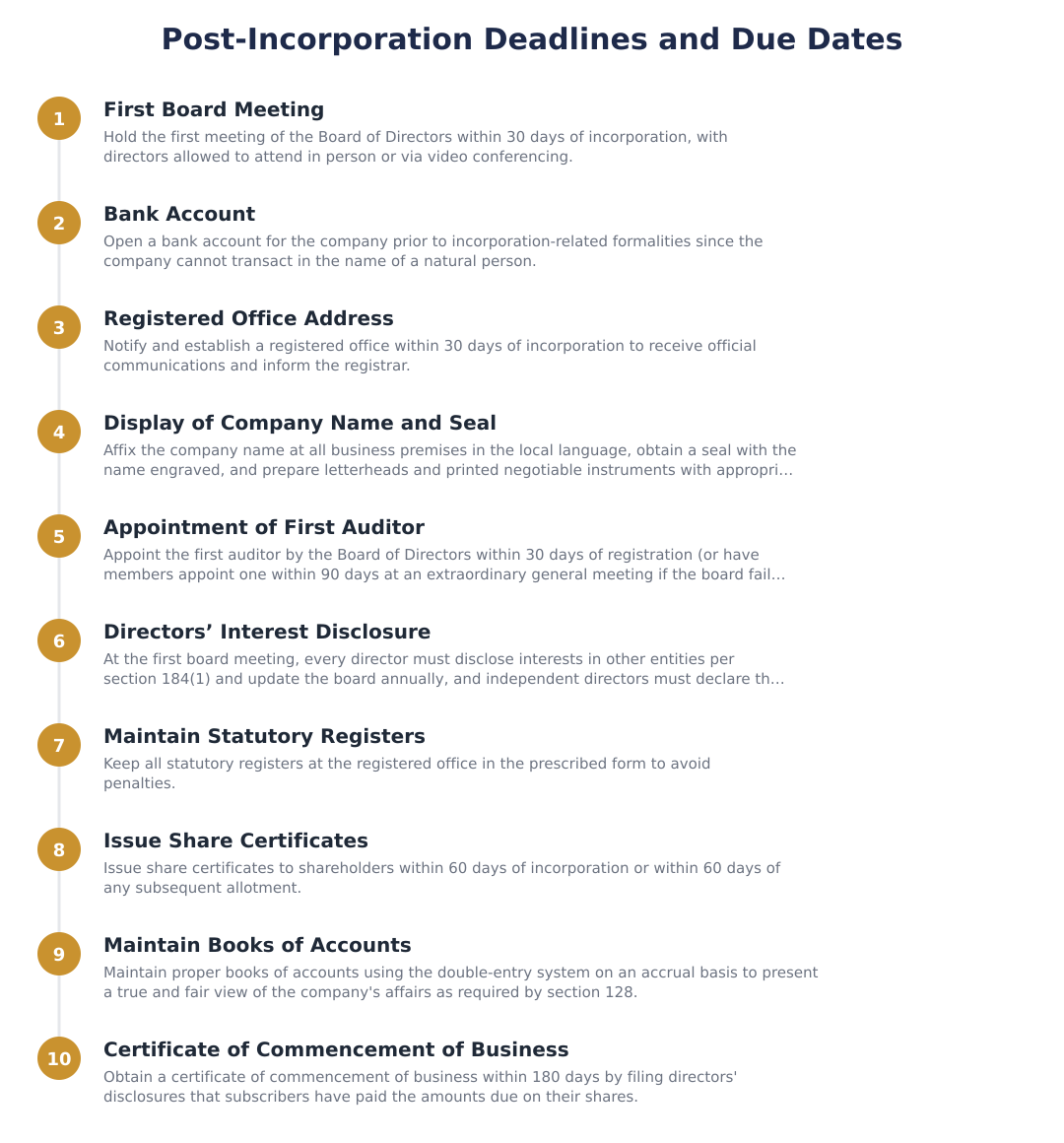
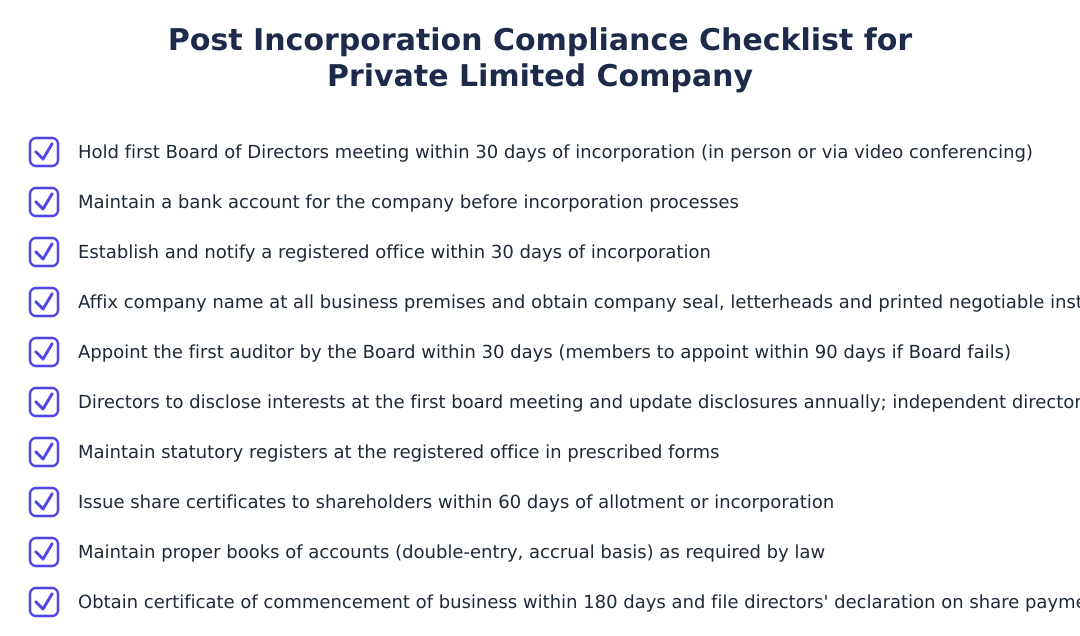
The Companies Act requires the company to hold its first meeting of the Board of Directors within 30 days of incorporation. Directors may attend this meeting in person or through video conferencing, allowing the board to meet the statutory deadline even if some directors are remote.
At this first board meeting, every director must disclose any interests they have in other companies, firms, bodies corporate or associations of individuals as required by Section 184(1). An independent director, if appointed, must also declare that he or she meets the criteria of independence at this meeting. Any subsequent changes in these disclosures must be informed to the board at its first meeting held in each financial year.
Practically, the first board meeting is where the company sets up immediate governance: it creates the record of director disclosures, confirms delegation of authorities, and establishes a paper trail showing that statutory duties were considered within the prescribed timeline. Proper minutes and disclosure forms should be prepared and retained in the company records.
Registered office: timeline and notification
A company must have a registered office within 30 days from the date of incorporation as mandated by Section 12(1). The registered office is the official address for service of notices and receipt of statutory communications.
The company is also required to inform the Registrar of Companies of the registered office within 30 days. Ensuring the registered office is appointed and notified promptly avoids procedural non‑compliance and helps ensure statutory correspondence reaches the company without delay.
Appointment and term of the first auditor
Under Section 139(1), the Board of Directors must appoint the first auditor within 30 days from the date of registration. If the board fails to do so, the members of the company must appoint the auditor within 90 days at an extraordinary general meeting.
The term of the first auditor lasts until the conclusion of the company’s first annual general meeting. This staged appointment and limited initial term mean the first auditor acts as a bridge until shareholders exercise their oversight at the first AGM.
Statutory registers and books of accounts
Companies must maintain statutory registers at their registered office in prescribed forms. Maintaining these registers is a legal duty; failure to do so may attract penalties. These registers form part of the company’s statutory record‑keeping and are relied upon for compliance, audits and disclosures.
Separately, Section 128 requires every company to maintain proper books of account that present a true and fair view of the state of affairs of the company. The books are to follow the double‑entry system and be prepared on an accrual basis. Together, statutory registers and accurate books of account provide the documentary basis for board decisions, audit work, and shareholder reporting.
Share certificates: timing for issue
Share certificates must be issued to shareholders within 60 days from the date of allotment. This applies to the initial allotment following incorporation as well as any subsequent allotments.
Timely issuance of share certificates formalises the shareholding structure and is important for shareholders to evidence their ownership. Companies should coordinate allotment resolutions and the mechanics of certificate issuance to meet the 60‑day timeline.
Commencement of business certificate (for companies with share capital)
A company that has a share capital is required to obtain a certificate of commencement of business within 180 days of incorporation. This follows the filing of a declaration by the directors that each subscriber has paid the value of the shares subscribed by them.
Obtaining the commencement certificate is a statutory step that enables the company to lawfully commence its business activities where such a certificate is required. Companies should plan the director declarations and related filings so the commencement certificate can be secured within the 180‑day window.
Meeting the post‑incorporation timelines in the Companies Act, for the first board meeting, registered office notification, auditor appointment, issuance of share certificates, maintenance of statutory registers and books, and obtaining a commencement of business certificate where applicable, sets a company on a compliant path. Directors and company officers should schedule these actions into the first months after incorporation, prepare the required disclosures and minutes, and maintain the statutory records at the registered office to reduce legal risk and support smooth governance.
Frequently asked questions
When should a private limited company hold its first board meeting after incorporation?
The company must hold its first Board of Directors meeting within 30 days of incorporation. This is required by Section 173(1) of the Companies Act, 2013 and directors may attend in person or via video conferencing. The first board meeting is used to complete key initial compliances such as appointing the first auditor, approving statutory registers, and recording disclosures of interest. Missing the 30‑day timeline can lead to procedural non‑compliance and penalties under the Act.
Do I need a bank account before incorporating a private limited company?
Yes, a company should have a bank account even before incorporation because a company is an artificial legal entity and cannot transact in a natural person's name. The bank account is necessary for depositing subscription money from subscribers and for carrying out business transactions once the company is formed. Banks typically require incorporation documents to open the account in the company’s name, so plan account set‑up alongside incorporation formalities. Maintaining a dedicated company bank account also supports proper books of accounts and audit trails post incorporation.
How soon must a private limited company have its registered office?
A company must have a registered office within 30 days from the date of incorporation as per Section 12(1). This registered office is the address for receiving official communications from government and regulatory authorities and must be intimated to the Registrar of Companies within that 30‑day period. The registered office is also the place where statutory registers and records are typically maintained. Failure to establish and notify a registered office within 30 days invites procedural non‑compliance and potential penalties.
Where and how must a company display its name and seal after incorporation?
A company must affix its name at all places from which it conducts business and display it in the local language commonly used in the locality. Additionally, the company should obtain a seal with its name engraved, maintain letterheads containing appropriate information, and print negotiable instruments (like cheques) in the company’s name. Proper display of name and possession of stamped seal/letterheads are essential for legal recognition of company documents and to comply with statutory identification requirements. Non‑compliance can cause confusion in business dealings and attract regulatory scrutiny.
When and who must appoint the first auditor of a private limited company?
The Board of Directors must appoint the first auditor within 30 days of the company being registered, except in the case of government companies, under Section 139(1). If the Board fails to appoint the auditor within 30 days, the members must appoint the first auditor at an extraordinary general meeting within 90 days. The first auditor’s term runs until the conclusion of the company’s first annual general meeting. Timely appointment ensures statutory audit requirements are met for the company’s initial accounting period.
What interest disclosures must directors make at the first board meeting?
Every director must disclose their interest in any company, firm, body corporate, or association of persons at the first board meeting as required by Section 184(1) of the Companies Act, 2013. Any changes to those disclosures should be intimated to the board in the first meeting held during each financial year. An independent director, if appointed, must also declare that they meet the criteria of independence at their first board meeting. Accurate and timely disclosure helps avoid conflicts of interest and ensures compliance with statutory obligations.
What statutory registers must a newly incorporated company maintain and where?
A newly incorporated company must maintain prescribed statutory registers at its registered office. These registers include records such as register of members, register of directors and key managerial personnel, register of charges and other statutory registers in the form prescribed by law. Maintaining these registers in the prescribed format is mandatory and failure to do so attracts penalties under the Companies Act. These registers must be available for inspection as required and form part of the primary compliance documentation for audits and regulatory checks.
Within how many days must share certificates be issued after incorporation or allotment?
Share certificates must be issued to shareholders within 60 days from the date of incorporation for initial allotment and within 60 days from the date of allotment for any additional shares. Timely issuance of share certificates serves as evidence of share ownership and is a statutory requirement. If the company fails to issue certificates within the prescribed 60‑day period, it can be liable for penalties and the company must rectify the delay promptly. Proper issuance also ensures accurate entries in the register of members and facilitates share transfers.
What are the books of accounts requirements for a private limited company after incorporation?
Every company must maintain proper books of accounts that present a true and fair view of its state of affairs, following the double‑entry system and accrual accounting as required by Section 128. These books should capture all financial transactions, supporting documents, and be maintained at the registered office or such other place as approved by the board. Proper books are essential for preparing annual financial statements, audits, and for compliance with tax and regulatory obligations; failure to maintain them can lead to penalties. Companies should ensure timely bookkeeping and appropriate accounting policies from the start to facilitate first‑year audits.
When must a private limited company obtain the certificate of commencement of business?
A private limited company must obtain a certificate of commencement of business within 180 days of incorporation. To get this certificate the directors must file a declaration stating that every subscriber to the memorandum has paid the amount due on their shares. Without this certificate the company cannot commence business activities, and missing the 180‑day deadline can lead to compliance issues. Companies should complete share capital receipts and submit the required director’s declaration well before the 180‑day limit to avoid delays.
Need help staying Company Registration compliant?
MoneyGence's AI Finance OS tracks your compliance, wallet share, and finances in one place, built for agencies and growing businesses.
Get started with MoneyGence