Post Office Saving Schemes 2026: Rates, Tax Benefits & Comparison
This guide explains key features of India’s post office saving schemes in 2026 with a focus on the Public Provident Fund (PPF) where verified details are available. You will learn what post office saving schemes are, how they fit into a conservative savings portfolio, which features make them useful for specific goals, and the confirmed rules for PPF, one of the most popular long-term government-backed options. The information is aimed at salaried individuals, small savers and anyone evaluating safe, tax-efficient instruments in 2026. While many post office schemes exist with different tenures, liquidity profiles and tax treatments, reliable planning requires knowing the documented rules. This article therefore highlights the confirmed PPF rules (tenure, contribution limits and minimum deposit requirement) and explains how those facts affect long-term retirement or child-focused savings decisions. Where definitive, government-verified figures are available they are cited; where not, the guide describes practical considerations and decision points you should check with your post office or official sources before investing. After reading you will be able to: (1) understand what post office schemes generally offer; (2) apply the verified PPF rules to planning an annual contribution strategy; and (3) prioritise which product features to verify further when comparing schemes.
What are Post Office Saving Schemes?
Post office saving schemes are a family of government-backed savings and small-investment products offered through the postal network. They are designed to cater to conservative savers who prioritise capital security and predictable outcomes over market-linked returns. Because the schemes are administered by the government, they are commonly used for goals such as emergency savings, disciplined monthly saving, retirement top-ups and funding children’s education.
Practically, these schemes differ by tenure, frequency of interest crediting, restrictions on withdrawals and any associated tax benefits. Some are short-term and liquid, while others are long-term and carry lock-in features intended to encourage disciplined investing. The specific operational rules (minimum deposits, interest crediting frequency, maximum annual limits, and eligibility) vary by scheme, so it is important to consult official sources or your post office branch for scheme-specific details before committing funds.
15-Year Public Provident Fund (PPF)
The Public Provident Fund (PPF) is a long-duration, government-backed small-savings instrument intended for long-term wealth creation and retirement planning. One confirmed rule for the PPF is that its basic tenure is 15 years. This long tenure makes the PPF suitable for investors who can commit to a sustained savings discipline over many years.
For tax and planning purposes, the verified annual investment limit that is commonly used for PPF planning is Rs. 1.5 lakh under Section 80C of the Income Tax Act; this figure is treated as the PPF maximum annual deposit in this guide. This limit is an important planning parameter because it helps investors decide how much of their tax-exempt 80C allowance to allocate to PPF versus other eligible instruments.
Operationally, interest in a PPF account is credited once a year. To keep a PPF account active, a minimum deposit of Rs. 500 in the financial year is required. These two facts affect cashflow planning: because interest is credited annually, timing of deposits within the year can slightly affect the accrued interest for that financial year, and the minimum deposit requirement defines the lower boundary for maintaining account continuity.
Tax Benefits on Post Office Saving Schemes
Several post office saving schemes are used by taxpayers to access deductions under Section 80C of the Income Tax Act; the verified annual limit for Section 80C applied in PPF planning is Rs. 1.5 lakh. This overall limit is shared across multiple 80C-eligible investments, so an investor’s allocation to PPF will reduce the remaining 80C room available for other instruments.
When choosing schemes for tax planning, consider how much of your 80C limit you want to reserve for PPF versus other eligible options. Because PPF has a long tenure and requires an annual minimum contribution, it is often treated as a core long-term component in the 80C portfolio. Always cross-check current tax provisions and scheme eligibility with official notifications before making tax-sensitive allocation decisions.
Post Office Savings Schemes Comparison 2026, how to compare
When comparing post office schemes for a specific goal, use a consistent checklist: tenure and lock-in, minimum and maximum contribution rules, interest crediting frequency, liquidity and premature-withdrawal conditions, tax treatment and nominee rules. These dimensions determine whether a scheme matches needs such as regular monthly income, short-term parking of surplus cash, child education savings, or retirement accumulation.
Because verified rates and scheme details can change, rely on the dimensions above rather than headline rates alone. For example, a long-tenure product that offers favourable tax treatment will suit retirement goals, while a short-tenure, more liquid product will suit contingency funds. Always verify current interest rates, penalties and procedural rules at your post office or on official government portals before investing.
List of All Post Office Saving Schemes 2026
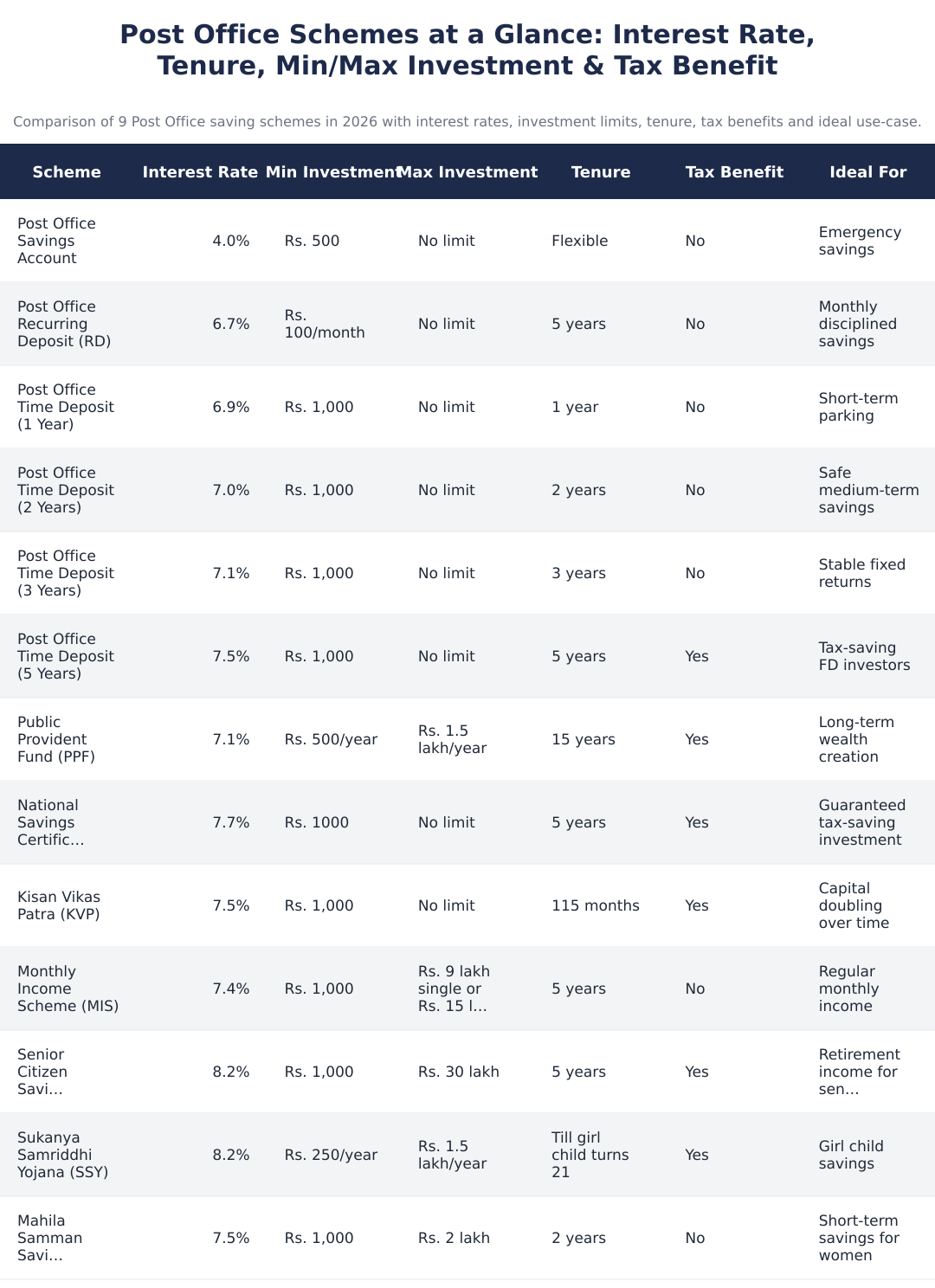
There is a broad set of post office savings schemes available through the postal network covering savings accounts, time deposits, recurring deposits, long-term retirement-oriented funds and special-purpose products (for example, schemes aimed at supporting children or senior citizens). The exact list of schemes, their names and operational parameters are published by the postal department and may be updated periodically.
Since scheme details and eligible features evolve, treat any list as a starting point for research. Use the verified PPF facts in this guide when you are considering long-term allocations: a PPF commitment is a 15-year tenure product with a Rs. 500 annual minimum deposit requirement and a commonly used planning cap of Rs. 1.5 lakh per year under Section 80C.
Post office saving schemes remain a core choice for conservative, government-backed saving and tax-aware investing. For long-term commitments, PPF stands out with a confirmed 15-year tenure, annual interest crediting and a Rs. 500 minimum yearly deposit, and is typically planned up to the Rs. 1.5 lakh Section 80C limit. For all other scheme details, interest rates and procedural rules, check official post office notifications or your branch before making investment decisions.
Frequently asked questions
Which post office scheme gives the highest interest rate in 2026?
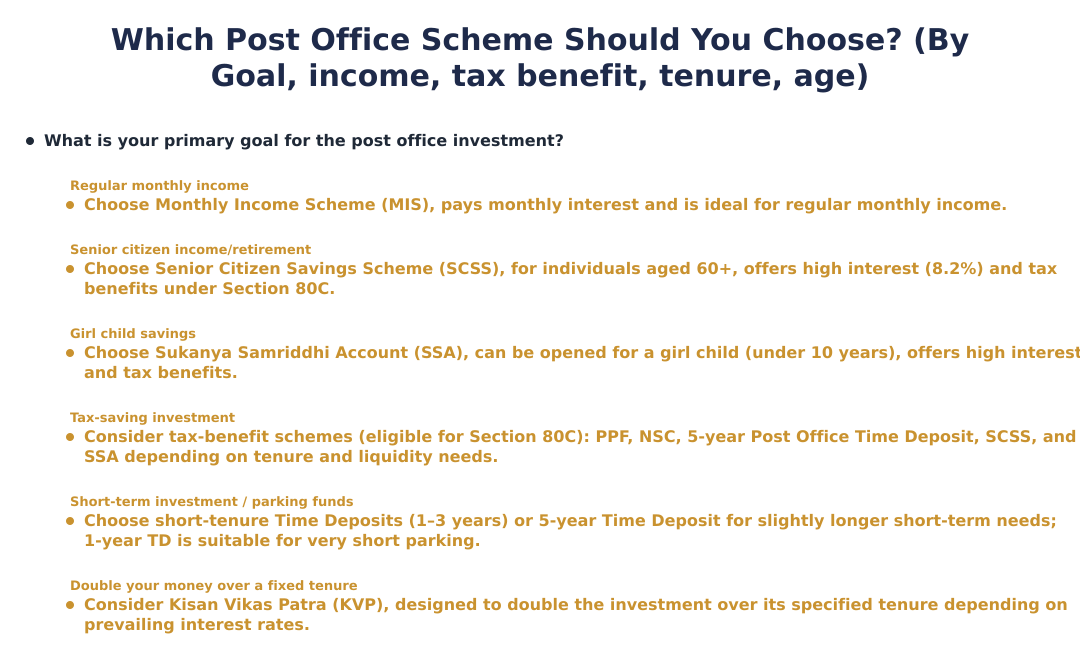
The Senior Citizen Savings Scheme (SCSS) and Sukanya Samriddhi Yojana (SSY) offer the highest rate at 8.2% in 2026. SCSS is for individuals aged 60+ (or early retirees in some cases) and has a 5‑year tenure with a maximum investment limit of Rs. 30 lakh, while SSY is for girl children (opened before age 10) and allows deposits up to Rs. 1.5 lakh per year until the account matures. Both schemes also provide tax benefits under Section 80C, making them attractive for retirement income (SCSS) and long‑term girl‑child savings (SSY).
Which post office scheme is best for regular monthly income?
The Post Office Monthly Income Scheme (POMIS/MIS) is best for regular monthly income because it pays interest monthly at 7.4% (2026) and distributes a fixed monthly payout. The minimum investment is Rs. 1,000 and the maximum single account limit is Rs. 9 lakh (Rs. 15 lakh for joint accounts), with a 5‑year tenure; premature withdrawal is allowed after 1 year but attracts a penalty. MIS is ideal for retirees or those needing predictable monthly cash flow, but interest is taxable and it does not get 80C tax deduction on principal.
Which post office scheme should senior citizens choose for best returns and tax benefits?
Senior citizens should consider the Senior Citizen Savings Scheme (SCSS) for the best combination of high returns and tax benefits; SCSS pays 8.2% in 2026 and qualifying deposits are eligible for deduction under Section 80C. SCSS has a 5‑year tenure (extendable) with a minimum deposit of Rs. 1,000 and a maximum of Rs. 30 lakh; account holders can open it individually or jointly with a spouse, and premature withdrawal penalties are 1.5% if withdrawn before two years and 1% thereafter. Interest from SCSS is taxable but the scheme’s principal qualifies for 80C, making it attractive for post‑retirement income planning.
Which post office scheme is best for saving for a girl child?
Sukanya Samriddhi Yojana (SSY) is the best post office scheme for girl‑child savings as it offers the highest rate (8.2% in 2026) and full tax benefits under Section 80C. SSY accounts can be opened for a girl child below age 10, accept a minimum annual deposit of Rs. 250 and up to Rs. 1.5 lakh per financial year, and remain active until the girl turns 21; withdrawals are restricted and marriage‑related closure has timing conditions. The combination of high interest, government backing, and EEE tax treatment (exempt-exempt-exempt) makes SSY ideal for funding education and marriage costs.
Which post office scheme should I pick for tax savings under Section 80C?
For Section 80C tax savings, choose from the 5‑year Post Office Time Deposit (5‑year TD), Public Provident Fund (PPF), National Savings Certificate (NSC), Sukanya Samriddhi Account (SSY) or Senior Citizen Savings Scheme (SCSS), as all these schemes' principal contributions are eligible for deduction up to Rs. 1.5 lakh per year. PPF offers long‑term wealth creation with a 15‑year lock‑in and 7.1% interest (2026) and provides EEE tax treatment, while NSC (7.7%) and 5‑year TD (7.5%) are shorter fixed‑tenure options but interest treatment differs, NSC interest is taxable though also notionally qualifies for 80C via reinvestment. Choose based on tenure and liquidity needs: PPF for long horizon, 5‑year TD/NSC for mid‑term tax saving, and SSY if saving specifically for a girl child.
How do post office schemes compare to bank fixed deposits (FDs)?
Post office schemes are government‑backed and considered very safe, often offering competitive and stable interest rates compared with bank FDs, and several schemes also provide tax benefits (e.g., PPF, SCSS, NSC, 5‑year TD) which most bank FDs do not. Liquidity and premature withdrawal rules differ: post office schemes generally have stricter premature‑withdrawal conditions and specific lock‑ins (e.g., PPF 15 years, NSC 5 years) while bank FDs typically offer more flexible break‑options subject to penalty; banks are insured by DICGC up to limits. Choose post office schemes for safety, tax saving and guaranteed returns; choose bank FDs for greater flexibility and potentially higher promotional rates from banks.
What documents do I need to open a post office savings scheme account?
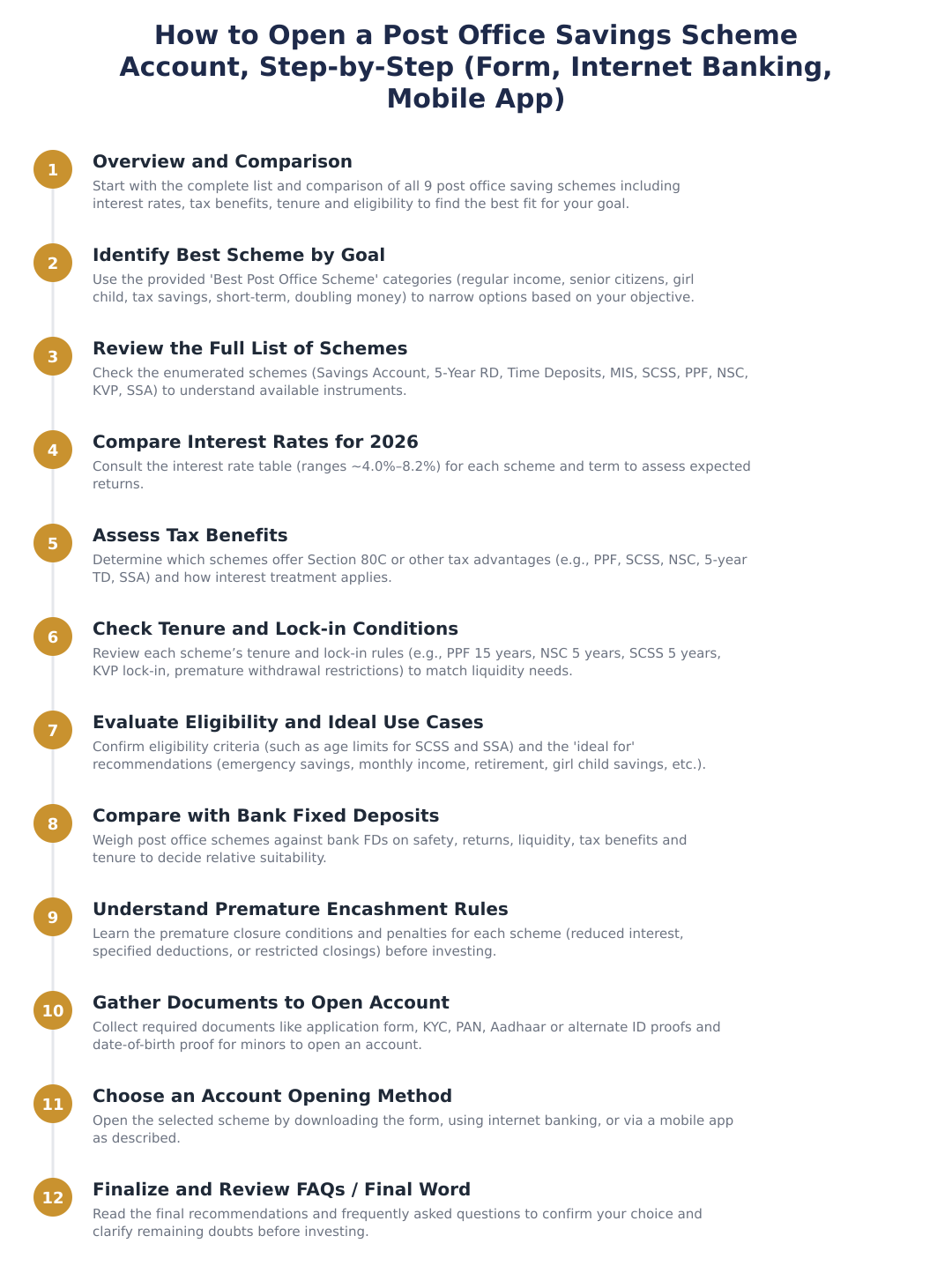
To open any post office savings scheme account you need the account opening form, a KYC form, PAN card and proof of identity/address such as Aadhaar (preferred) or passport, driving licence, voter ID, MNREGA job card or a National Population Register letter. For minors, you must provide proof of date of birth or a birth certificate; joint accounts require KYC for all holders and a guardian’s ID for minor accounts. Some schemes may also require scheme‑specific declarations (for example, SSY requires proof of the child’s age), and Aadhaar makes e‑KYC and online opening easier via internet banking or the mobile app.
What are the premature withdrawal rules and penalties for post office schemes?
Premature withdrawal rules vary by scheme: many post office schemes allow early closure only after a minimum period and with reduced interest, for example, Time Deposits can be closed after 6 months with lower interest if closed before 1 year, RD can be closed after 3 years with reduced interest, and MIS can be closed after 1 year subject to a 1–2% penalty. SCSS allows premature withdrawal with a penalty of 1.5% if closed before two years and 1% after two years; PPF allows premature closure only under specified conditions with reduced interest; NSC generally disallows premature withdrawal except for death or court order. Always check scheme‑specific lock‑in periods (e.g., PPF 15 years, KVP lock‑in 2 years 6 months, SSY till maturity) before investing if liquidity is a concern.
How does Kisan Vikas Patra (KVP) help double my money and what is the tenure?
Kisan Vikas Patra (KVP) is designed to double the invested capital over a predetermined period based on the prevailing interest rate; in 2026 KVP offers 7.5% and the stated maturity/lock‑in period is 115 months (9 years 7 months) for doubling. KVP investments start at Rs. 1,000 with no upper limit, the certificate can be pledged as collateral with banks, and premature closure is allowed after the initial lock‑in period with reduced returns. KVP is suitable for investors seeking a simple, guaranteed capital‑doubling instrument backed by the government, but interest is taxable and it does not offer Section 80C deductions for the invested amount unless specified under prevailing rules.
Need help staying Calculators compliant?
MoneyGence's AI Finance OS tracks your compliance, wallet share, and finances in one place, built for agencies and growing businesses.
Get started with MoneyGence