Private Limited Company Registration in India: Step-by-Step (2026)
This guide explains how to register a private limited company in India and why selecting the right business structure matters. You will learn the main types of business structures available, sole proprietorship, partnership, One Person Company (OPC), Limited Liability Partnership (LLP), private limited company (PLC) and public limited company, their typical use cases, minimum membership and director requirements, and the practical steps and documents required to incorporate a private limited company through the MCA/SPICe+ process. The guide also summarises typical fees and timelines, how company name and capital rules work, post‑incorporation compliance you must plan for, and a concise checklist to help prevent common errors. Understanding these points matters because the chosen structure affects legal liability, compliance burden, investor perception and the company's ability to scale. A private limited company is the most common choice for businesses targeting growth and outside investment because it limits personal liability and is investor‑friendly; however, it also brings recurring statutory compliances such as annual filings and audits. This article focuses on practical, actionable information you need to register a private limited company: the documents needed, the registration steps (including DSC and DIN), how name reservation works, what capital requirements apply, typical government and professional fees, and the timeline you should expect. Use this as a checklist while planning incorporation or discussing next steps with your professional adviser.
What are the Types of Business Structures in India?
India offers multiple business structures to suit different needs: Sole Proprietorship, Partnership, One Person Company (OPC), Limited Liability Partnership (LLP), Private Limited Company (PLC) and Public Limited Company. Each structure differs by how liability is allocated, how many owners are required, and the compliance and reporting obligations that follow incorporation. Choosing the appropriate structure at the start helps control future costs and legal exposure.
The structure you choose affects tax and compliance. For example, sole proprietorships generally have minimal compliance (only income tax return filing), while companies must file income tax returns as well as annual returns with the Registrar of Companies, maintain books of account and, in most cases, have mandatory audits. Investor preference also varies, investors typically prefer recognised legal entities such as LLPs or companies over sole proprietorships.
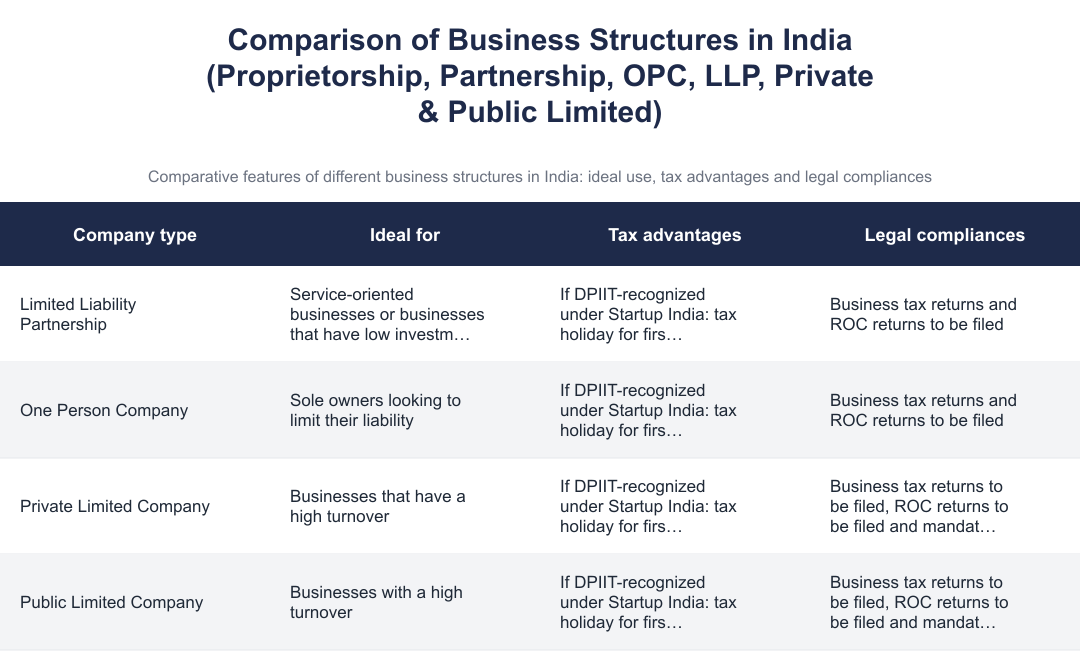
Comparative List of Different Types of Business Structures in India
| Company type | Ideal for | Tax advantages | Legal compliances |
|---|---|---|---|
| Limited Liability Partnership | Service-oriented businesses or businesses that have low investment needs | If DPIIT-recognized under Startup India: tax holiday for first 3 years and benefit on depreciation | Business tax returns and ROC returns to be filed |
| One Person Company | Sole owners looking to limit their liability | If DPIIT-recognized under Startup India: tax holiday for first 3 years, higher benefits on depreciation and no tax on dividend distribution | Business tax returns and ROC returns to be filed |
| Private Limited Company | Businesses that have a high turnover | If DPIIT-recognized under Startup India: tax holiday for first 3 years and higher benefits on depreciation | Business tax returns to be filed, ROC returns to be filed and mandatory audit to be done |
| Public Limited Company | Businesses with a high turnover | If DPIIT-recognized under Startup India: tax holiday for first 3 years | Business tax returns to be filed, ROC returns to be filed and mandatory audit to be done |
How to Register a Company in India
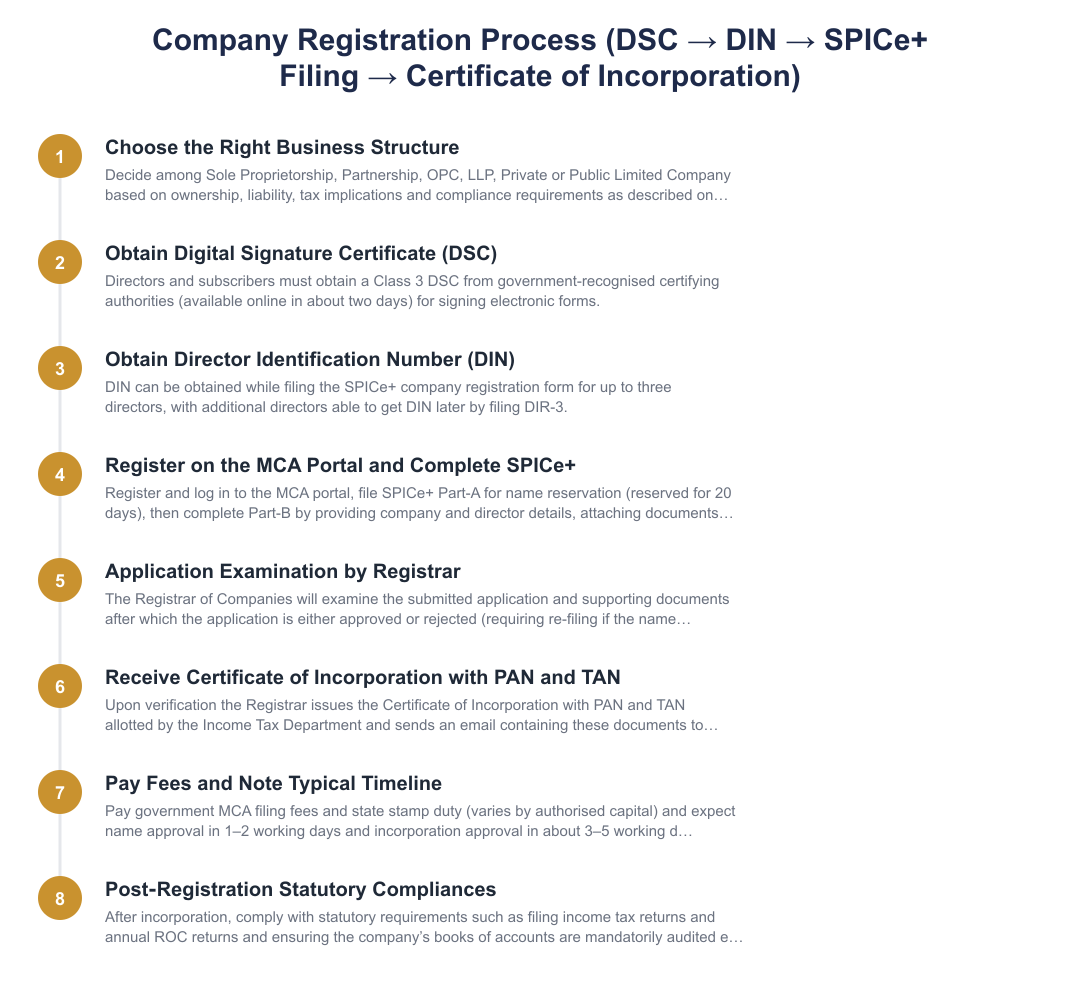
Directors and subscribers must obtain Class 3 DSC from government‑recognised certifying authorities; DSC can also be obtained online usually within two days.
DIN can be obtained while filing the SPICe+ company registration form; SPICe+ allows DIN for up to three directors. If you have more directors who need DIN later, they can be appointed after incorporation and apply using DIR‑3.
The applicant director must register on the MCA portal to access filing services, fill Part‑A of SPICe+ to reserve the company name, and after name approval (reserved for 20 days) complete Part‑B with company and director details, attach DSC and documents, and submit online.
Registrar of Companies examines the application and, upon verification, issues the Certificate of Incorporation along with PAN and TAN issued by the Income Tax Department and sends them by email as attachments.
Documents Required for Company Registration
| Document category | Permissible documents / notes |
|---|---|
| Proof of identity (directors and shareholders) | PAN card; Aadhar card; Driving licence; Passport |
| Proof of address (directors and shareholders) | Latest telephone bill (not older than 2 months); Latest electricity bill (not older than 2 months); Bank account statement having address |
| Registered office proof (company/LLP) | Tenancy/rental agreement; Letter or NOC from landlord allowing use as registered office; Sale deed in the name of the company/LLP |
| Company constitutional documents | Memorandum of Association (MoA) and Articles of Association (AoA); LLP agreement in case of an LLP |
| Other mandatory credentials | DIN (or DPIN for LLP) and DSC of all directors/designated partners |
Checklist, Name Rules and Capital Requirements
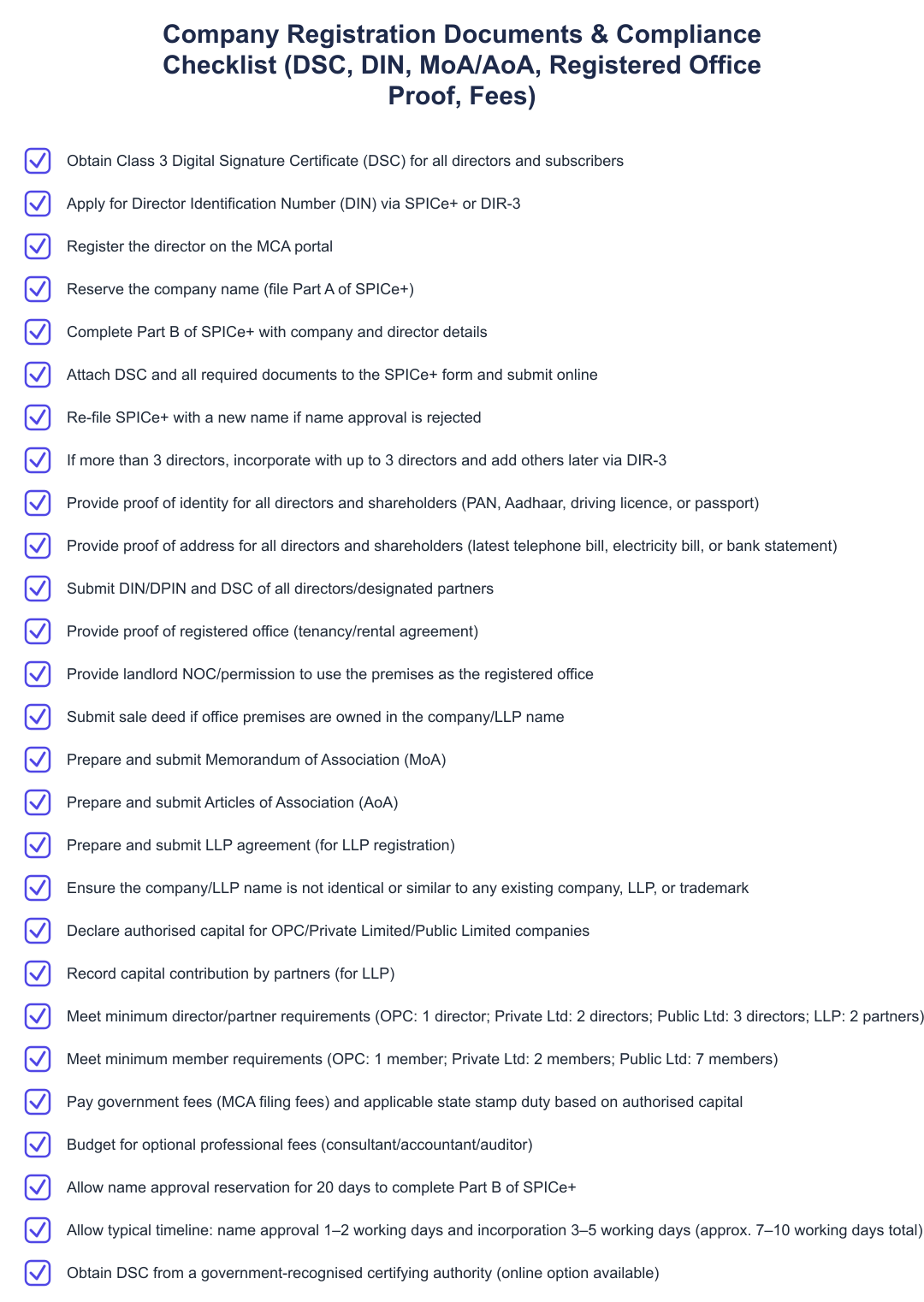
Checklist items you must confirm before filing include the minimum directors/members requirement (minimum of one director for OPC; minimum of two directors for private limited companies; minimum of two partners for LLP; and minimum membership counts which vary by entity), DSC and DIN availability for proposed directors, a unique company name not identical to any existing company/LLP/trademark, MoA/AoA or LLP agreement as applicable, proof of registered office and details of authorised capital.
Name rules: propose the company name in the SPICe+ application (one preferred name plus reason). The proposed name must not be similar to any existing company, LLP or trademark; if rejected you must reapply and pay the prescribed fee. Entity type must reflect in the name format: OPC typically ends with "(OPC) Private Limited", a private company with "Pvt. Ltd." and a public company with "Limited".
Capital rules: there is no minimum paid‑up capital requirement for private limited companies or OPCs; however, a public limited company must have minimum paid‑up capital of Rs.5 lakh. The authorised capital of any company must be at least Rs.1 lakh and must be stated in the MoA. Paid‑up capital is the amount received from shareholders in exchange for shares.
Company registration in India – Fees and Timeline (2026)
| Item | Notes / typical range |
|---|---|
| Approximate fees | Government fees: MCA filing fees and state‑wise stamp duty (varies by authorised capital); Professional fees optional. Cost examples: One Person Company: Rs.7,000 - 10,000*; LLP: Rs.7,000 - 15,000*; Private Limited Company: Rs.6,000 - 30,000*; Public Limited Company: Rs.6,000 - 30,000* |
| Typical timeline | Name approval: 1–2 working days; Incorporation approval: 3–5 working days; Total timeline: Approximately 7–10 working days |
What to Do After Company Registration?
After incorporation, immediate compliance actions include appointing the first auditor within 30 days of incorporation in the first board meeting, holding the required board meetings (every company must conduct a minimum of four board meetings during the calendar year at stipulated intervals), and preparing proper books of account. The company must file profit and loss account, annual return and balance sheet every financial year along with the auditor’s report before the due date with the Registrar of Companies.
Running a company also means maintaining good corporate governance and meeting recurring statutory filings and audit obligations. Planning for professional fees (auditors, accountants, tax consultants) and administrative processes in advance will reduce the risk of missed filings and penalties.
Registering a private limited company in India involves selecting the right entity, securing DSC and DIN, reserving a unique name via SPICe+, submitting required documents and waiting for incorporation and PAN/TAN issuance. Costs and timelines vary by authorised capital and service providers, but incorporation can typically be completed within 7–10 working days. Post‑incorporation compliance, appointing an auditor, holding board meetings, maintaining books and filing annual returns, is essential to preserve the company’s legal and financial standing. Use the checklist and documents table in this guide to prepare before you or your advisor file the SPICe+ application.
Frequently asked questions
What are the different types of business structures available in India?
The main business structures in India are Sole Proprietorship, Partnership Firm, One Person Company (OPC), Limited Liability Partnership (LLP), Private Limited Company (PLC) and Public Limited Company. Each structure differs in ownership, liability, taxation and compliance, for example, a sole proprietor files only an income tax return while a company must file income tax returns and annual ROC returns and undergo a mandatory audit. LLPs and companies are more investor‑friendly and offer limited liability, whereas proprietorships and partnerships involve greater personal liability. Your choice should reflect number of owners, capital needs, willingness to accept compliance obligations and plans for outside investment.
How do I register a private limited company in India?
To register a private limited company you must obtain DSCs, get DINs (if not already held), register and file the SPICe+ form on the MCA portal (name reservation in Part A and incorporation details in Part B), submit required documents with DSCs and await issuance of the Certificate of Incorporation. Class 3 DSCs are required for the directors and subscribers, and SPICe+ can issue DINs for up to three proposed directors while filing incorporation. After verification, the Registrar issues the Certificate of Incorporation along with PAN and TAN by email; if the name application in Part A is not approved, you must reapply and pay the prescribed fee. Typical overall timeline is about 7–10 working days assuming documents and name are accepted.
What documents do I need to register a private limited company?
You need identity and address proof of all directors and shareholders (PAN, Aadhaar, passport, driving licence), proof of the company’s registered office (rental/tenancy agreement plus NOC from landlord or sale deed), DIN and DSC of directors, and the company’s Memorandum of Association (MoA) and Articles of Association (AoA). For address proofs, utility bills such as telephone or electricity bills should not be older than two months, and bank statements with address are also acceptable. LLPs require LLP agreement and capital contribution details instead of MoA/AoA; ensure all documents are signed and attached to SPICe+ when filing.
What is a Digital Signature Certificate (DSC) and who needs it for company registration?
A Digital Signature Certificate (DSC) is an electronic signature used to sign e‑forms on the MCA portal, and directors and subscribers to the MoA/AoA must obtain Class 3 DSCs before filing. Class 3 DSC is the required category for company incorporation and can be obtained from government‑recognised certifying authorities, often within two days and available online. All DSCs must be attached to the SPICe+ form and other ROC filings, so ensure each director designated for filing has a valid DSC.
How do I get a Director Identification Number (DIN) and what if my company has more than three directors?
DIN can be obtained while filing the SPICe+ incorporation form for up to three proposed directors, so you can apply for DINs during incorporation for those directors. If there are more than three directors and they do not have DINs, you can incorporate the company with up to three directors (obtaining their DINs via SPICe+) and later appoint additional directors who must obtain DINs by filing Form DIR‑3. Note that only proposed directors of an existing company can apply for DIN via DIR‑3, so plan director appointments and DIN applications accordingly.
How long does it take and how much will it cost to register a private limited company in India?
Name approval typically takes 1–2 working days, incorporation approval 3–5 working days, and the total registration timeline is approximately 7–10 working days under normal circumstances. Government fees include MCA filing fees and state‑wise stamp duty (which varies by authorised capital), while professional fees depend on the consultant; approximate total costs for Private Limited Company registration range from around Rs.6,000 to Rs.30,000. Delays can occur if the name is rejected or documents are incorrect, which will require re‑filing and additional fees.
What are the advantages of registering a company instead of running as a proprietorship or partnership?
Registering a company gives limited liability protection, better access to investors and bank credit, stronger goodwill with customers and suppliers, and formal protection of the company’s assets. Investors and lenders generally prefer recognised legal structures such as LLPs or companies over proprietorships, making fundraising and credit easier. However, companies have higher ongoing compliance, annual ROC filings, mandatory audits, and related costs, so the benefits should be weighed against these obligations.
What are the minimum number of directors and members required for different company types?
Minimum requirements are: One director and one member for an One Person Company (OPC); at least two directors and two members for a Private Limited Company (PLC); at least three directors and seven members for a Public Limited Company; and at least two partners for a Limited Liability Partnership (LLP). These minimums determine who can incorporate which type of entity and must be met at the time of filing SPICe+ (or LLP incorporation forms). If you plan investor or public‑listing ambitions, choose the appropriate structure (private vs public) and membership levels accordingly.
What happens after I receive the Certificate of Incorporation?
After incorporation you receive the Certificate of Incorporation along with PAN and TAN allotted by the Income Tax Department, typically sent by email as attachments. Once incorporated you must comply with ongoing requirements such as filing income tax returns, ROC annual returns and carrying out the mandatory annual audit for companies, and you should proceed with statutory formalities necessary to commence operations. Keep the Certificate, PAN and TAN safe for bank account opening, tax registrations and future ROC filings; failure to meet post‑incorporation compliances can attract penalties and legal consequences.
Need help staying Company Registration compliant?
MoneyGence's AI Finance OS tracks your compliance, wallet share, and finances in one place, built for agencies and growing businesses.
Get started with MoneyGence