Private Limited vs LLP vs OPC, Compare Company Structures in India
Choosing the right legal form when starting or restructuring a small business is one of the most important decisions an entrepreneur makes. This guide compares three common private-company structures, a Private Limited company, a One Person Company (OPC), and a Limited Liability Partnership (LLP), so you can understand how each model works, what practical advantages and limitations they typically bring, and which is likely to fit your growth plans and risk appetite. You will learn the distinct governance styles, capital and ownership characteristics, liability protection, and typical compliance expectations that differentiate these entities. The aim is not to provide granular regulatory thresholds or fees, but to help you think strategically about which structure aligns with your operational needs, desired level of formality, plans for external investment, and preferences for decision-making. By the end of this guide you should be able to: evaluate which structure supports single-founder vs multiple-founder scenarios; weigh the trade-offs between a corporate framework and a partnership-style vehicle; anticipate how each form tends to affect fundraising, transferability of ownership, and managerial control; and identify the kinds of compliance and administrative effort you should expect. Use this as a conceptual roadmap to frame discussions with your chartered accountant, company secretary, or legal advisor, who can apply current statutory details and thresholds to your specific case.
Private Limited Company
A Private Limited company is commonly chosen by entrepreneurs who want a clear separation between ownership and management while preserving limited liability for shareholders. It typically offers a formal corporate structure with a board of directors, issuance of shares, and procedures for appointments and meetings. This model is often well-suited to businesses that anticipate external investment, want to keep ownership transferable under set conditions, or aim for a governance structure that supports scaling.
In practice, a Private Limited company tends to involve more formal compliance and record-keeping than less structured alternatives. There are usually recurring filings, maintenance of statutory registers, and formal decision-making processes. For many founders these requirements are an acceptable trade-off for enhanced credibility with investors, customers, and vendors, and for the clear legal framework around shareholding and director responsibilities.
One practical consideration is suitability for fundraising: the Private Limited form is commonly preferred by equity investors because share classes and transfer restrictions can be structured to reflect investor protections. However, founders should weigh this against the administrative overhead and the need to adhere to corporate governance norms. Consulting a professional will help align the entity’s memorandum and articles with the founders’ long-term plans.
Limited Liability Partnership
A Limited Liability Partnership blends elements of a partnership and a company. It offers partners limited liability for the obligations of the business while preserving the flexibility and tax transparency characteristics often associated with partnerships. Decision-making in an LLP can be less formal than in a private company, which may appeal to professional firms or small businesses run by a stable group of partners.
Operationally, LLPs usually permit a more flexible internal arrangement for profit sharing and management duties, often set out in a partnership agreement. This flexibility can reduce the need for frequent formal meetings while allowing partners to tailor governance to their working relationship. At the same time, LLPs typically require certain statutory filings and maintenance of records to preserve limited liability status.
LLPs are often chosen when founders want the simplicity and operational ease of a partnership but still need protection against unlimited personal liability. The structure is a pragmatic compromise between informality and legal protection, but businesses that plan to seek formal equity investment or to scale rapidly may find a private company structure more aligned with those objectives.
One Person Company
A One Person Company is designed for sole entrepreneurs who want the benefits of a corporate entity, notably limited liability, while retaining full control. It typically allows a single individual to be the sole member of the company and to exercise management authority without the need for multiple shareholders. This can be attractive to solo founders who want a simple corporate wrapper for their business activities.
Compared with multi-member private companies, the OPC form generally involves fewer internal stakeholders, which simplifies decision-making. Nonetheless, it still carries the corporate formalities associated with companies, such as maintaining certain records and complying with filings that sustain the company’s legal status. For a sole entrepreneur, the OPC offers a balance between operational simplicity and the legal separation of personal and business assets.
Before choosing an OPC, a founder should consider future plans: if they expect to bring in co-founders, investors, or convert the business into a multi-member company, it is important to understand the conversion mechanisms and any implications for governance. Speaking with a professional advisor will clarify how an OPC aligns with growth objectives and the transition path to other entity forms if needed.
How to choose the right form
Start by assessing your ownership structure, growth ambitions, and tolerance for administrative compliance. If you expect external equity investment, need share-based governance, or want a structure that supports scaling and professional boards, a Private Limited company often aligns well. If you are a solo entrepreneur seeking limited liability with straightforward control, an OPC can offer a clean solution. If you prefer partnership-style flexibility with liability protection and do not plan to seek formal equity investors, an LLP may be more appropriate.
Consider practicalities like ease of management, transferability of ownership, and the kind of external relationships you want to build, customers, vendors, banks, and investors all react differently to different entity types. Also weigh the ongoing compliance effort you are prepared to handle or outsource. Ultimately, the right choice balances strategic objectives with operational realities and should be confirmed with up-to-date professional advice tailored to your situation.
Selecting between a Private Limited company, an LLP, and a One Person Company depends on your founders’ structure, growth plans, and appetite for formal governance and compliance. Use this guide to clarify which features matter most to your venture, and consult a qualified professional to apply current legal and tax specifics to your decision. The right entity will fit your operational style today and provide a pathway for the future you envision.

Frequently asked questions
Which is better for a startup that plans to raise venture capital: Private Limited, LLP or OPC?
Private Limited Company is generally best for startups planning to raise venture capital because investors prefer share-based equity and well-established governance. Venture capitalists and angel investors typically invest in private limited companies as they allow issuance of different classes of shares, easy transferability, and clear shareholder protections; LLPs are less attractive because partnership interests are harder to convert into equity and investors face tax and exit complications. OPCs are unsuitable for most VC funding because they have a single member, restrictions on who can be a member, and limits on converting to a private company once certain turnover or capital thresholds are exceeded. If you expect external funding, register as a Private Limited from the start to avoid costly restructuring later.
Which structure gives the most limited liability protection: Private Limited, LLP or OPC?
All three, Private Limited Company, Limited Liability Partnership (LLP) and One Person Company (OPC), provide limited liability protection, meaning personal assets of members are generally protected from business debts. In a Private Limited and OPC, shareholders' liability is limited to the unpaid amount on their shares; in an LLP, liability of partners is limited to their agreed contribution and they are not personally liable for LLP’s debts except in specific circumstances like fraud. Practical differences arise in governance and regulatory protections: companies have stricter compliance and corporate governance that can strengthen creditor and investor confidence compared with LLPs and OPCs. For high-risk businesses you may prefer a company structure for stronger external credibility despite similar basic limited liability principles.
Can a single entrepreneur register as a company, and which option should they choose: OPC or Private Limited?
Yes, a single entrepreneur can register as an One Person Company (OPC), which is specifically designed for sole entrepreneurs who want limited liability while remaining the lone member. OPC requires one natural person as member and a nominee, has simpler compliance than a Private Limited company, and is useful when you do not plan to take on partners or outside investors initially. However, if you expect to bring co-founders, raise equity funding, or expand ownership, registering as a Private Limited company from the start is better because OPCs face restrictions on members and may have to convert to a Private Limited if turnover or paid-up capital thresholds are crossed. Choose OPC for sole-proprietor-like simplicity with limited liability, otherwise choose Private Limited for future fundraising and multiple shareholders.
What are the minimum number of owners and directors required for Private Limited, LLP and OPC?
A Private Limited company needs at least two shareholders (members) and two directors; an LLP needs at least two partners with at least two designated partners (one of whom must be a resident in India); an OPC requires only one member and at least one director. Specifically, Private Limited companies must maintain a minimum of two members and directors at all times, LLPs must have at least two partners (no upper limit) and designate partners for statutory compliance, and OPCs are designed for sole ownership with a nominee appointed to take over in case of incapacity. These statutory minimums affect suitability: choose OPC only if you truly want single ownership, choose LLP if you prefer partnership flexibility, and choose Private Limited if you need multiple founders or shareholders.
How do compliance and annual filing requirements compare between Private Limited, LLP and OPC?
Private Limited companies have the highest compliance burden, LLPs have moderate and simpler filings, and OPCs have reduced but company-level compliance. A Private Limited must hold board meetings, file annual financial statements and annual returns (e.g., AOC-4, MGT-7), and follow stricter corporate governance and audit requirements; an LLP files Form 11 (annual return) and Form 8 (statement of accounts and solvency) and typically faces fewer formal meetings and procedural rules. OPCs follow company law filings similar to Private Limited but enjoy some exemptions and simplified compliance until they convert; nevertheless OPCs must file annual financials and returns with the Registrar of Companies. Choose based on your capacity to manage compliance and the advice of a company secretary or professional.
Which structure is more tax-efficient: Private Limited company or LLP?
Tax efficiency depends on profits and distribution plans: LLPs are taxed as partnerships and profits are taxed at the firm level without dividend tax, while Private Limited companies are taxed at corporate tax rates and dividends received by shareholders may have different taxation implications. LLP profits are taxed in the hands of the LLP at the applicable rates and partners are taxed on share of profit only in specified situations, whereas companies pay corporate tax and shareholders pay tax on dividends or on capital gains when shares are sold. For high retained profits and plans to reinvest earnings, corporate tax regimes and incentives for companies may be beneficial; for pass-through-like profit distribution and lower compliance, an LLP can be attractive. Always compare effective tax rates, potential dividend/DTL outcomes and professional tax advice for your specific revenue and profit projections.
Can foreigners or foreign investment be used in Private Limited, LLP or OPC?
Private Limited companies generally allow foreign direct investment (FDI) under the Government’s sectoral rules and are the preferred vehicle for inbound foreign investment; LLPs can also accept foreign investment but are subject to FEMA and sectoral restrictions and may be less preferred by foreign investors. OPCs are usually limited to a single natural person who must be an Indian resident, so OPCs are not suitable for foreign-owned businesses or foreign investors; OPCs have eligibility restrictions on the member being an Indian resident for most cases. If you plan to take FDI, form a Private Limited company or consult legal/FEMA counsel for LLP structures because investor, reporting and sectoral rules differ significantly.
How easy is it to convert between these forms, can LLP convert to Private Limited or OPC convert to Private Limited?
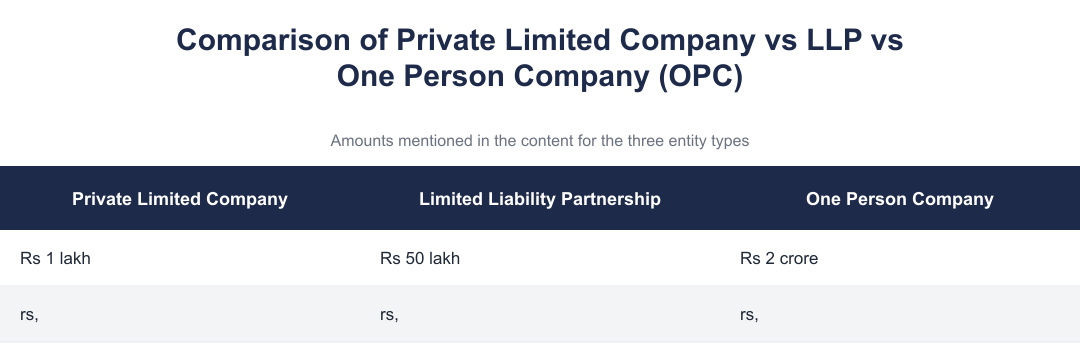
Conversions are possible but involve regulatory procedures: an LLP can be converted into a Private Limited company through Registrar of Companies following prescribed steps, and an OPC can convert into a Private Limited company, especially when it exceeds statutory thresholds, but each route requires compliance with Companies Act provisions and ROC filings. OPCs are mandated to convert to a Private Limited if paid-up capital or turnover crosses thresholds (e.g., paid-up capital beyond Rs. 50 lakh or turnover beyond Rs. 2 crore under current rules), and conversion requires board/resolution processes, incorporation formalities and filings. Because conversion can be time-consuming and may have tax and legal consequences, entrepreneurs who foresee growth or external investment often incorporate in the desired final form from the start to avoid restructuring.
Which structure is best for professional services firms like consultants, lawyers or accountants?
Many professional services firms prefer Limited Liability Partnership (LLP) because it blends partnership flexibility with limited liability and easier internal profit sharing. LLPs allow partners to manage the business directly, define profit-sharing in the LLP agreement, avoid some corporate formalities, and still provide protection of personal assets from business liabilities, which suits firms of consultants, architects, lawyers and accountants. However, certain regulated professions (like lawyers) may have specific regulatory restrictions on the corporate form they can adopt, and some large service firms prefer Private Limited for client perception and growth plans. Check professional regulations and consider LLP if you value operational flexibility and lower compliance, or Private Limited if you expect external capital or complex governance needs.
Need help staying Company Registration compliant?
MoneyGence's AI Finance OS tracks your compliance, wallet share, and finances in one place, built for agencies and growing businesses.
Get started with MoneyGence