Professional Tax: Rates, Due Dates, Compliance Guide
This guide explains professional tax, what it is, who levies it, how it affects employers and professionals, and the key compliance points you need to know. You will learn which authority can levy professional tax, how collection and payment usually work for salaried employees, what obligations apply when an employer is also carrying on a trade or profession, and the kinds of penalties that can follow non‑compliance. Understanding professional tax matters because it is a state‑level direct tax that can affect payroll processes, business registrations, and the final taxable income reported under the Income Tax Act. Proper handling avoids penalties, ensures correct employer withholding, and preserves the benefit that professional tax payments can be claimed as a deduction under the Income Tax Act (under the old tax regime). This guide focuses on practical compliance realities: who must deduct and remit the tax, when separate registrations may be needed, the fact that procedures vary by state, and the common categories of relief states may offer through monetary thresholds or specific exemptions. Read on for clear, actionable explanations that will help employers, salaried individuals, freelancers and small business owners understand where professional tax fits into their compliance calendar and payroll operations.
What is Professional Tax, and Who Levies it?
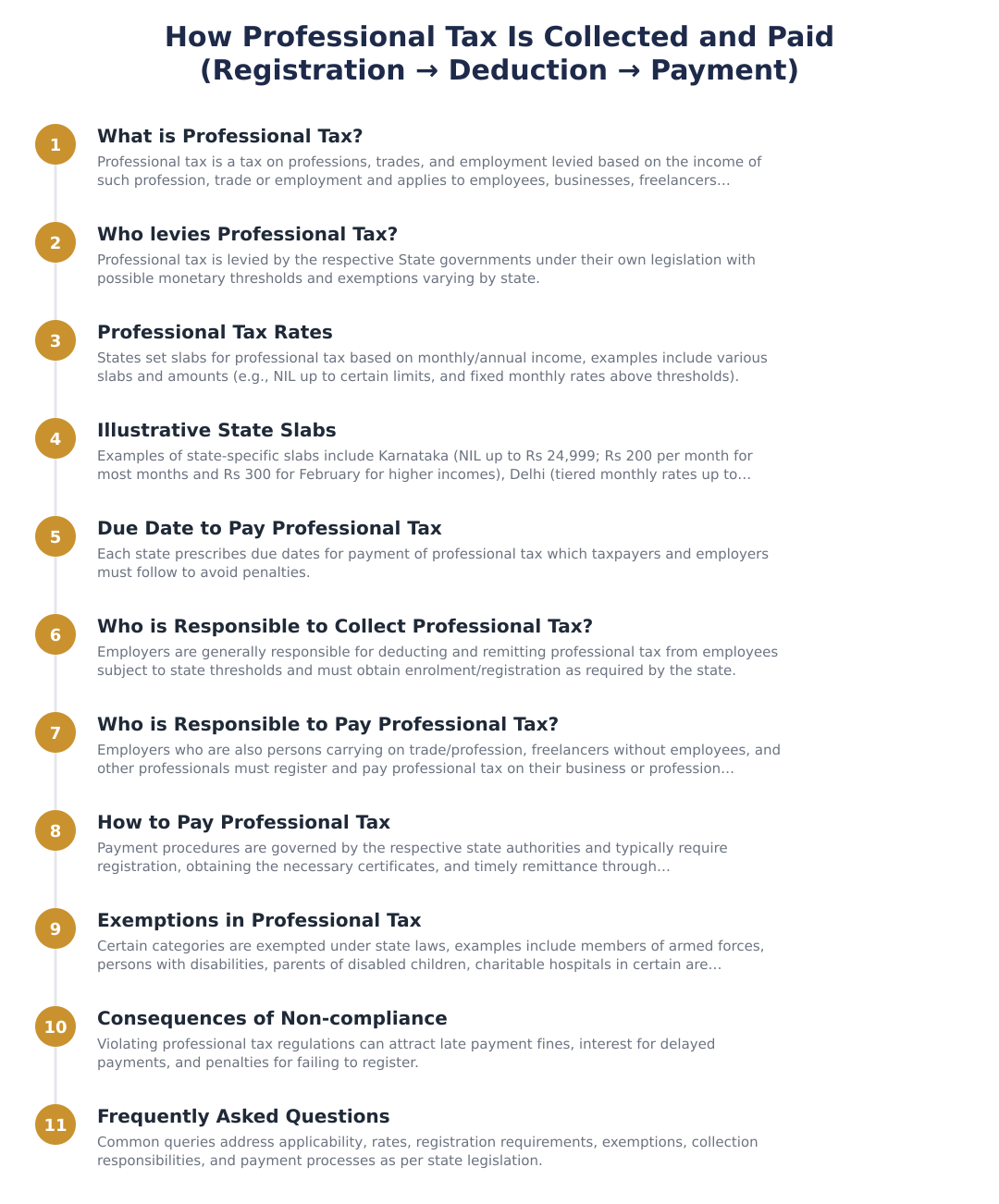
Professional tax is a state‑level direct tax on professions, trades and employment. It is levied based on the income derived from a profession, trade or employment and applies to individuals and entities as defined under the respective state laws.
Importantly, the power to levy professional tax rests with state governments, and not every state in the country chooses to impose this levy. Because it is a state subject, the precise scope, exemptions and procedures are set out by each state’s legislation rather than by a single central statute.
Professional Tax Rate
There is no single national professional tax rate. Rates, slabs and exemptions are defined by each state that chooses to impose the tax. That means the applicable monthly or annual amounts, and any thresholds below which tax is not payable, vary from state to state.
Because state governments set both the rates and the procedural rules, payment methods (for example, online portals or offline challans) and the specific forms you must file will differ. Businesses and individuals must therefore check the provisions and notifications of the particular state where the tax liability arises.
Who is Responsible to Collect and Pay Professional Tax?
For employees, the typical mechanism is employer withholding: an employer is generally responsible for deducting professional tax from employee remuneration and paying it to the state government, subject to any monetary thresholds that the state legislation provides. This places a payroll compliance obligation on employers to apply the correct deduction rules for their state.
When an employer is also a person carrying on a trade or profession (for example, a firm, proprietor or company), the employer may separately be liable to pay professional tax on the business/profession itself. In many states this will require the employer to obtain registrations and enrolment certificates so they can both remit tax on the business and deduct tax from employees; states may require separate registration for each office or establishment depending on local law.
How to Pay Professional Tax
Payment processes for professional tax are governed by state rules. Some states provide online portals and payment gateways, while others may continue to use offline forms or challans. Employers and professionals should consult the specific state authority’s instructions to know the accepted payment modes, forms to be filed and the frequency of payment.
Salaried individuals usually have their professional tax collected and remitted by employers as part of payroll. Self‑employed professionals or employers paying tax on their trade/profession must follow the state’s registration and payment procedures. Because requirements differ, it is important to maintain documentation of registrations, enrolment certificates and payment receipts as evidence of compliance.
Exemptions and Monetary Thresholds
Many states build monetary thresholds or specific exemptions into their professional tax laws so that low income earners or certain categories of persons are not liable. These thresholds and exempt categories vary across states and are specified in state legislation and notifications.
States may also provide targeted exemptions for particular groups or circumstances, for example, persons with defined disabilities, senior citizens, or charitable entities, depending on local policy choices. To determine whether an individual or entity qualifies for an exemption, check the specific provisions of the state where the professional activity or employment is located.
Consequences of Violating Professional Tax Regulations
States enforce compliance through financial consequences. Violations can attract late payment fines (frequently calculated as a percentage of the overdue amount), interest on delayed payments, and penalties for failing to register when registration is required under state law.
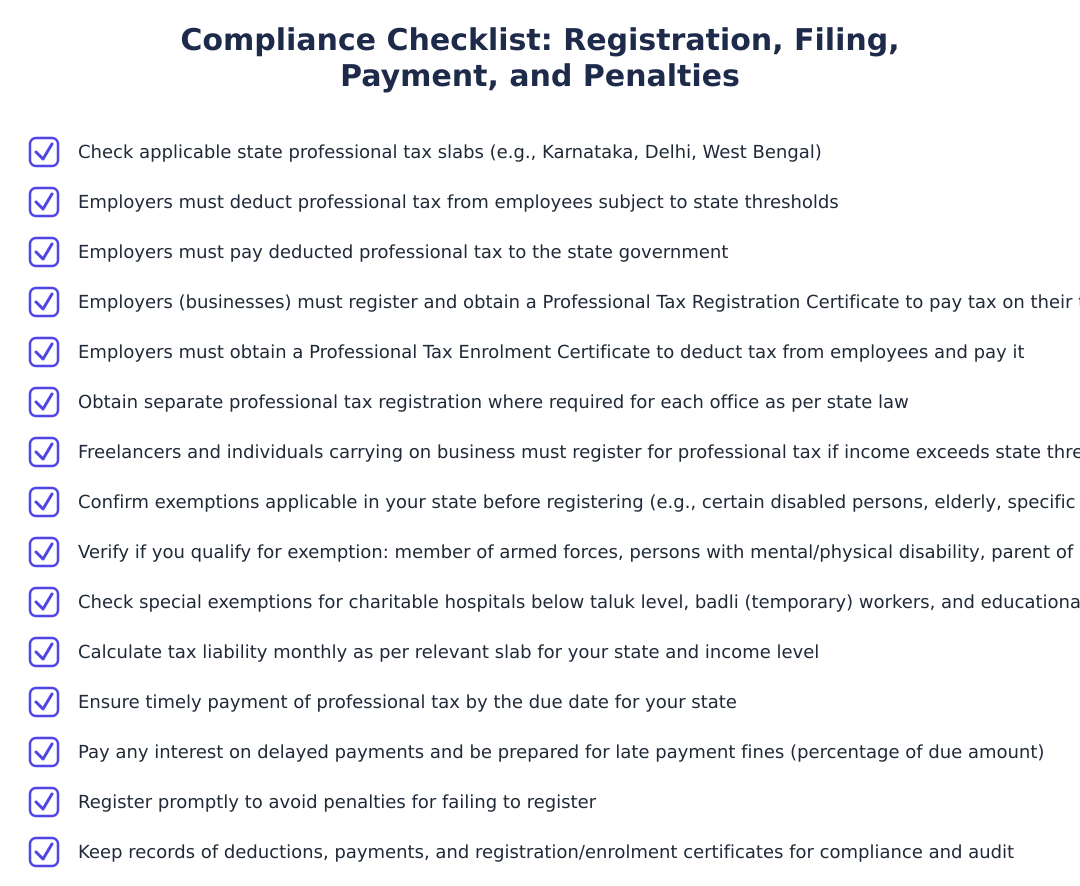
Because penalties and interest can accumulate and registration failures can invite additional sanctions, employers and professionals should treat professional tax as an active compliance requirement, verifying threshold applicability, completing required registrations, deducting correct amounts from payroll where applicable, and maintaining proof of payment.
Professional tax is a state‑levied direct tax that affects both salaried employees (through employer withholding) and individuals or entities carrying on trade or profession. Because rates, exemptions, thresholds, registration rules and payment procedures differ by state, you should consult the relevant state authority for precise slabs, due dates and forms. Treat professional tax as part of your routine payroll and business compliance: determine threshold applicability, secure any required registrations or enrolment certificates, remit payments on time, and retain payment evidence to avoid fines, interest and penalties. Remember that professional tax paid is allowable as a deduction under the Income Tax Act (reported under the old tax regime), so correct payment also supports proper income‑tax reporting.
Frequently asked questions
What is professional tax and who has to pay it?
Professional tax is a tax levied by state governments on all kinds of professions, trades and employment, and it must be paid by salaried employees, persons carrying on business (including freelancers and professionals) subject to the monetary thresholds specified by each state. Each state that chooses to levy the tax sets its own rules and slabs, so liability depends on where the person works or carries on business; not all states levy professional tax. Employers are generally responsible for deducting the tax from employees’ salaries and remitting it, while self-employed professionals and freelancers must register and pay their own tax if their income exceeds the state threshold. The tax paid is allowed as a deduction under the Income Tax Act (old regime) for salaried taxpayers where applicable.
Who levies and collects professional tax in India?
Professional tax is levied by state governments and collected by the respective state Commercial Tax Department or other designated authority (for example municipal bodies in some states). The law for professional tax, including rates, slabs, exemptions and registration requirements, is made state-wise, so collection procedures and online portals vary by state. Once collected, the receipts are credited to the state’s revenue and, in some cases, local municipal funds as per state rules. For compliance, taxpayers must follow the specific portal and guidelines published by the state where they are liable.
What are typical professional tax rates and give some state examples?
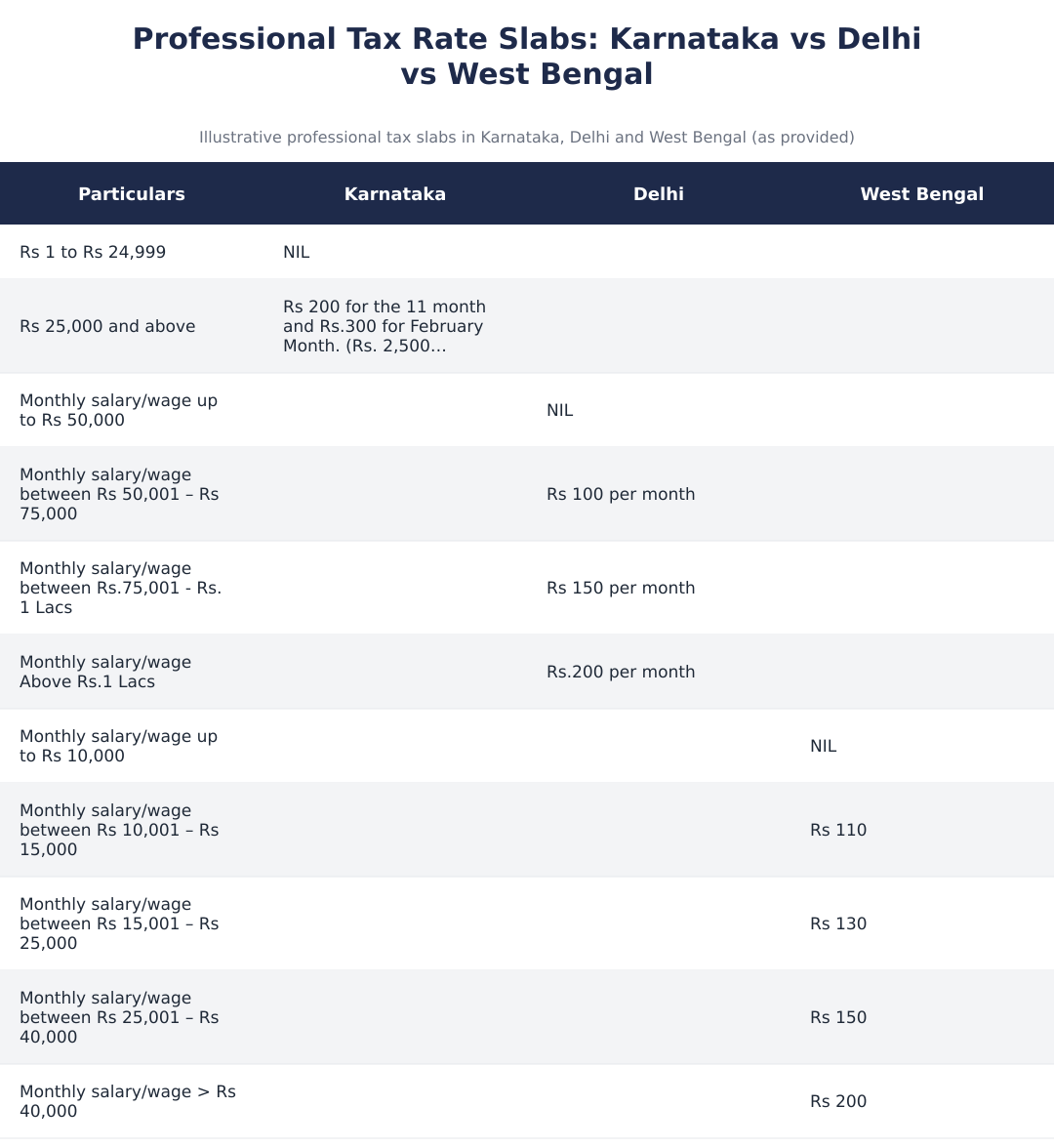
Professional tax rates vary by state and are typically slab-based on monthly salary or annual income; for example, Karnataka charges NIL up to Rs 24,999 and Rs 200 per month for 11 months plus Rs 300 in February (total Rs 2,500 per annum) for those above the threshold. Delhi’s slab example shows NIL up to Rs 50,000 monthly, Rs 100 per month for Rs 50,001–75,000, Rs 150 per month for Rs 75,001–1,00,000 and Rs 200 per month above Rs 1,00,000. West Bengal’s illustrative slabs include NIL up to Rs 10,000 monthly, Rs 110 for Rs 10,001–15,000, Rs 130 for Rs 15,001–25,000, Rs 150 for Rs 25,001–40,000 and Rs 200 for monthly salary above Rs 40,000. These are examples, you must check the exact slab applicable in your state as rates and thresholds differ across states and can change.
Who is responsible for deducting and remitting professional tax for employees?
The employer is responsible for deducting professional tax from employees’ salaries and remitting it to the state government, subject to the monetary threshold specified by the relevant state law. Employers (including companies, firms and sole proprietors) may also have to pay professional tax on their own business/profession and therefore often need separate registrations for employer-business liability and employee deduction enrolment. If an employer fails to deduct or remit professional tax, the employer can be held liable for the unpaid amount, interest and penalties under state rules. Employees should verify deduction on their payslips and ask the employer for the professional tax certificate or payment proof when needed.
Do self-employed persons and freelancers need to register and pay professional tax?
Yes, self-employed persons and freelancers must register for professional tax and pay it directly if their income exceeds the monetary threshold set by the state in which they carry on business. Registration requirements and thresholds differ by state, and some states require separate registration for each business location; for instance, a sole proprietor may need multiple registrations if they operate from multiple offices. Certain categories may be exempt under state laws (for example, some disabled persons, elderly above 65, or specific charitable institutions), so freelancers should check state-specific exemption rules before paying. Failure to register when liable can attract penalties and interest as per state legislation.
When is professional tax due and what are the common due-date patterns?
Professional tax due dates vary by state, but typically employers must deposit deducted professional tax monthly or quarterly through the state’s designated portal and file periodic returns as prescribed by the state law. Some states require monthly payment of tax deducted from salaries, while others allow quarterly or annual deposits for certain categories; for example, certain slabs reference monthly deduction amounts (e.g., Rs 100–200 per month in Delhi/West Bengal examples). In addition to payment, timely filing of enrolment/return forms and renewal of registration (if applicable) must be done by the dates specified by the state to avoid penalties and interest on late payments. Always confirm the exact due dates and return schedules on your state’s professional tax website because non-compliance penalties differ by state.
What exemptions exist for professional tax?
State laws provide specific exemptions and these commonly include categories such as members of the armed forces governed by the Army/Air Force/Navy Acts, individuals with disabilities (blindness, deafness, etc.), parents of children with disabilities, certain charitable hospitals below taluk level, temporary 'badli' workers, proprietors of educational institutes up to 12th standard for their branches, foreign individuals employed by the state, persons above 65 years, and specific women under government schemes. Exemptions differ from state to state, for example, Karnataka explicitly exempts parents/guardians of mentally retarded or blind persons under its rules. To claim an exemption you usually must apply to the state authority or produce the prescribed documentary evidence and follow the state’s exemption procedure.
What are the consequences of not complying with professional tax rules?
Non-compliance with professional tax regulations can lead to late payment fines (often a percentage of the unpaid amount), interest on delayed payments, and penalties for failure to register or file returns as mandated by the state. Enforcement action may include demand notices, recovery proceedings and, in extreme cases, prosecution under the state professional tax legislation; employers can face additional liability if they fail to deduct or remit employees’ tax. Each state prescribes its own penalty and interest rates and administrative steps for recovery, so prompt payment, correct registration and timely filing of returns are essential to avoid escalating liability. Keeping documentation of payments and filings helps defend against any compliance disputes with state authorities.
How do I pay professional tax, online and offline options?
Professional tax can be paid either online through the respective state’s professional tax or commercial tax portal or offline at designated bank branches or state offices, depending on the state’s procedures. Salaried individuals typically have the tax deducted and remitted by their employer, while self-employed persons must use the state’s registration number and payment challan or online form to deposit the tax; some states require separate forms for registration and employee enrolment. Payment methods, challan formats, return filing and renewal processes differ by state, so always use the official portal or guidance issued by the state Commercial Tax Department to ensure correct payment and obtain receipts or certificates for record-keeping. Retain payment receipts and registration/enrolment certificates as proof of compliance and to produce if requested by tax authorities or employers.
Need help staying Payroll compliant?
MoneyGence's AI Finance OS tracks your compliance, wallet share, and finances in one place, built for agencies and growing businesses.
Get started with MoneyGence