Proforma Invoice Format: Samples, Templates & How to Choose
This guide explains practical proforma invoice formats, what to include, and how to choose or customise a format for your business. You will learn which fields are essential on a proforma invoice and why they matter for clarity with customers, customs, and internal record-keeping. The guide focuses on compliance-friendly items you should always show on a proforma invoice, and it will help you decide how to adapt the layout to different buyers, sales channels, and internal workflows. Whether you issue proforma invoices as formal estimates before sales or for international shipments, getting the format right reduces disputes, speeds up approvals, and makes subsequent invoicing and accounting simpler. The sections that follow cover the benefits of standard formats, common format choices and naming, the ideal contents you must include, practical steps to pick the right format, and which fields you can safely customise for branding and process efficiency.
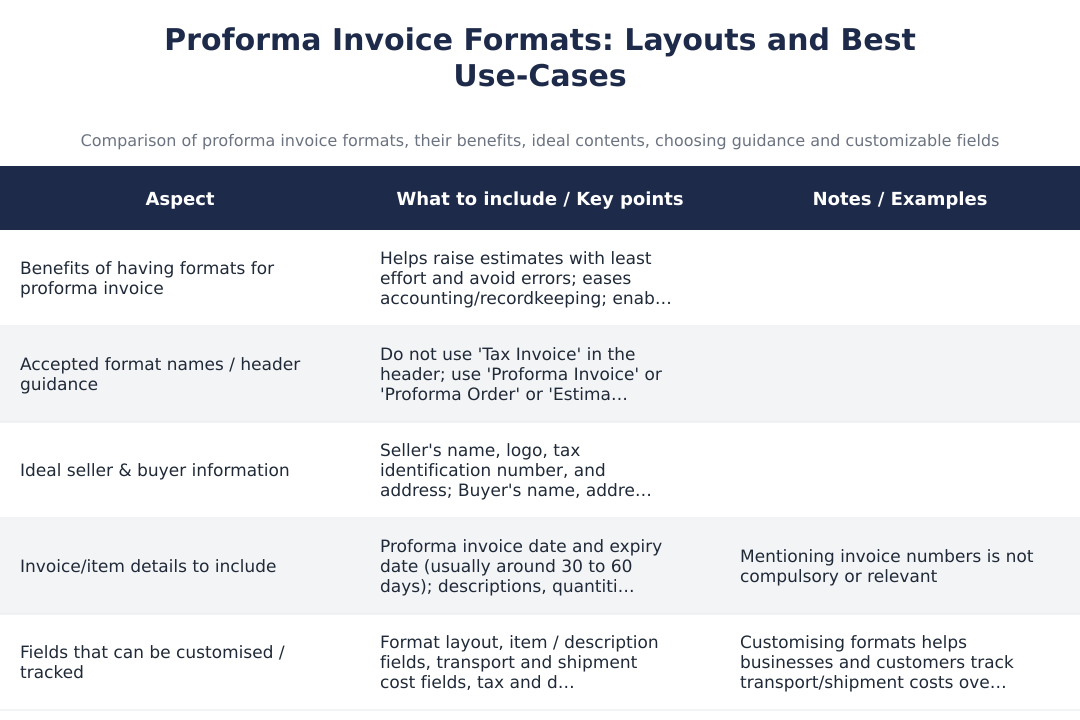
Benefits of having formats for proforma invoice
Using a standard proforma invoice format reduces the chance of missing information and avoids confusion between what the seller is offering and the final tax invoice. Standard templates make it easier for sales teams to prepare estimates quickly and consistently so customers receive clear, comparable quotes.
A consistent format also helps internal teams and external stakeholders such as customs or procurement to find key details at a glance. When important data, seller and buyer identification, item descriptions, quantities, prices, and applicable taxes, appear in predictable places, approvals and reconciliations take less time.
From an operational standpoint, standard formats simplify record keeping and support automation. When the same fields are used across proforma invoices, data can be extracted reliably for forecasting, order planning, and integrating with accounting systems. Finally, a clear, correctly labelled proforma invoice reduces the risk of it being mistaken for an actual tax invoice.
Various formats for a Proforma Invoice
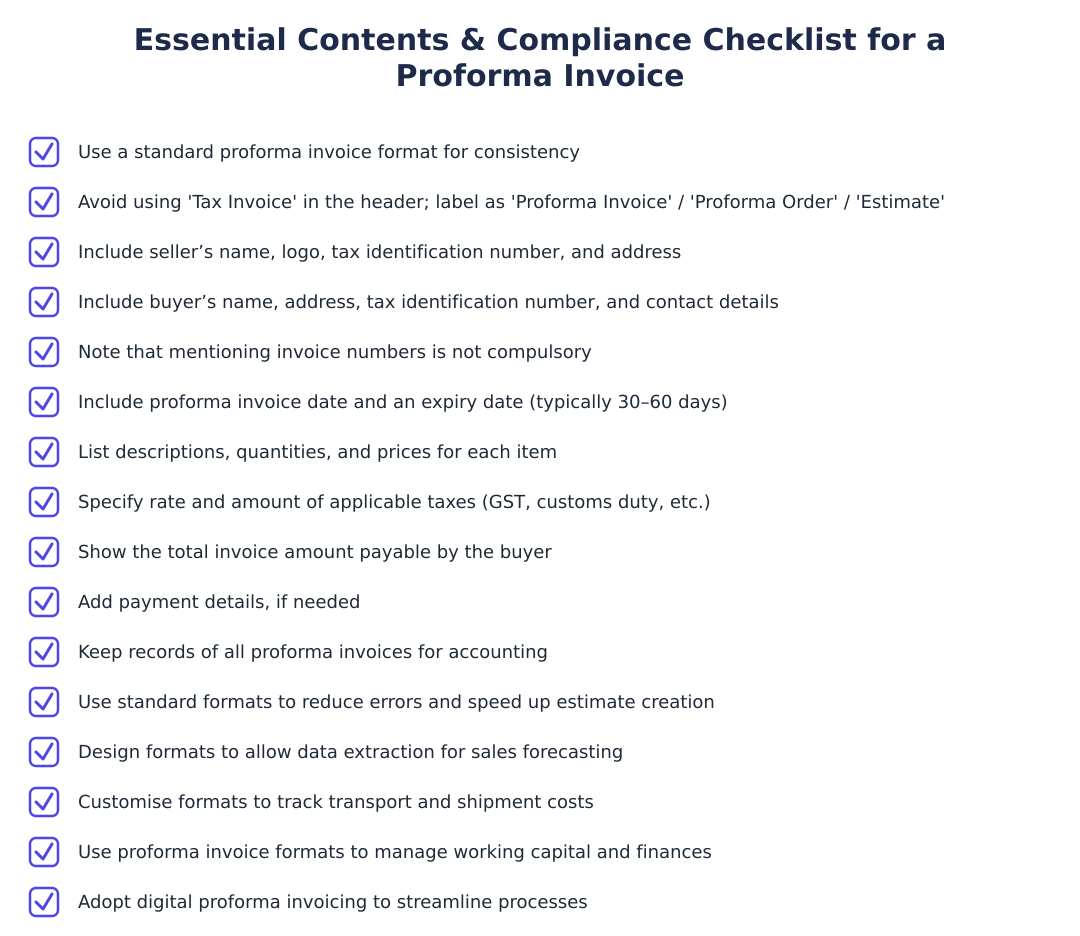
A key formatting rule to observe is the header label: do not use the words ‘Tax Invoice’ on a proforma. Instead, the document should be clearly titled ‘Proforma Invoice’, ‘Proforma Order’, or ‘Estimate’ so recipients understand it is not the final tax invoice.
Beyond the header, formats vary by how prominently they show seller and buyer details, the line-item table, and payment information. Some businesses choose a compact single-page layout for quick estimates, while others use a multi-section layout that separates commercial terms, tax details, and shipment information. The chosen layout should always ensure required identification and itemisation elements are easy to find.
Ideal contents of a proforma invoice
| Field | Why it matters |
|---|---|
| Seller’s name, logo, tax identification number, and address | Identifies the issuing business and supports tax and customs checks |
| Buyer’s name, address, tax identification number, and contact | Shows the intended recipient and helps match the estimate to a buyer account |
| Descriptions, quantities, and prices of each item | Provides the commercial details of what is being offered so the buyer can evaluate the quote |
| Rate and amount of applicable taxes such as GST or customs duty | Displays tax and duty components so the buyer understands total payable and tax implications |
| Payment details (optional) | Included when you want to give the buyer bank or collection instructions ahead of the final invoice |
Choosing the right format for a proforma invoice
Ensure the header reads ‘Proforma Invoice’, ‘Proforma Order’, or ‘Estimate’ and avoid using ‘Tax Invoice’ so it cannot be confused with the final tax invoice.
Make sure the seller’s and buyer’s names, addresses, tax IDs, and contact details are placed prominently to support verification and processing.
Provide descriptions, quantities, prices for each line item and show the rate and amount of applicable taxes or duties so the recipient can assess total costs.
If you wish to provide bank or collection instructions before the final invoice, include payment details; this is optional and should be added based on commercial practice.
Fields of an estimate that can be customised
While certain items are essential, many layout and presentational elements can be tailored to your business. You can customise branding elements such as the seller logo, typography, and colours to match your company stationery while still keeping mandatory identification visible.
The arrangement of line items, addition of internal reference numbers, terms and conditions text blocks, and any explanatory footnotes about delivery, warranties, or packing can be adapted to the transaction. However, customisations should never hide or replace required fields like party identification, item descriptions, quantities, prices, and tax breakdowns.
Finally, decide whether to include optional elements such as payment instructions or buyer-specific notes. These custom fields improve usability for particular customers or markets but must be clearly labelled so the document remains an estimate and not a tax invoice.
A well-designed proforma invoice balances clear mandatory information with flexible presentation. Always label the document correctly and include seller/buyer identification, full itemisation, and tax details. Use layout and optional fields like payment instructions to suit your commercial needs while keeping the document clearly an estimate rather than a tax invoice.
Frequently asked questions
What is a proforma invoice and when should I use it?
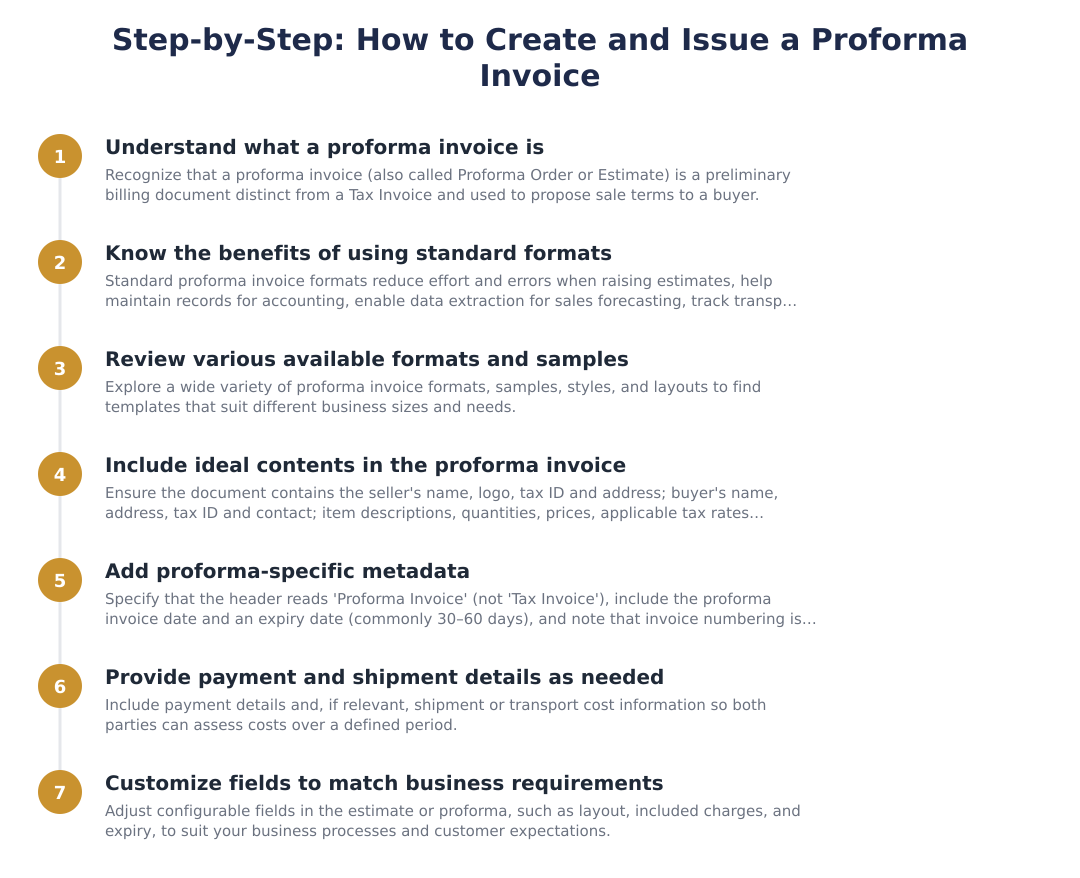
A proforma invoice is a preliminary bill of sale sent to a buyer before goods or services are supplied, and you should use it when you need to provide a formal price estimate, shipment details or customs documentation prior to final billing. It outlines the seller and buyer details, item descriptions, quantities, prices, applicable taxes such as GST or customs duty, and payment terms, but it is not a demand for payment like a tax invoice. Businesses commonly issue proforma invoices for export shipments, large B2B orders, or when a buyer needs documentation to arrange funds or import clearances. Because it is not the final tax invoice, it should be clearly labelled 'Proforma Invoice' or 'Estimate' and typically includes an expiry date (often 30–60 days) after which the quoted prices may change.
What information must be included in a proforma invoice?
A proforma invoice should include seller and buyer names and addresses, tax identification numbers, item descriptions, quantities, unit prices, applicable taxes (like GST or customs duty), total payable amount, and payment details if required. It should also state that it is a 'Proforma Invoice' (not a 'Tax Invoice'), include a proforma date and an expiry date (commonly 30–60 days), and may optionally show delivery terms, shipment costs, and validity conditions. Including these fields ensures the buyer has enough information to arrange payment, obtain import clearances, or compare quotes, and it helps the seller track estimates for forecasting and accounting. Omitting the label 'Proforma Invoice' or including 'Tax Invoice' can cause confusion with final billing or tax compliance.
Do I have to put an invoice number on a proforma invoice?
No, including an invoice number on a proforma invoice is not compulsory or relevant, though many businesses add a reference number for internal tracking. Since a proforma is not the final tax document, numbering is optional and mainly useful for record-keeping, forecasting or matching with a subsequent tax invoice. If you do use numbers, maintain a separate series from your tax invoices to avoid compliance confusion and make data extraction for sales forecasts easier. Using consistent reference IDs can also help the billing team and customers communicate about specific estimates or orders.
How long should a proforma invoice remain valid?
A proforma invoice should state a clear expiry date, commonly between 30 and 60 days, indicating how long the quoted prices and terms are valid. This validity period protects the seller against price fluctuations, exchange-rate changes or increased shipping costs, and gives the buyer a defined window to accept the offer. You can shorten or extend the period based on industry norms, inventory life, or negotiation, but always mention the expiry date on the proforma to avoid disputes. If the buyer accepts after expiry, you should issue an updated proforma or confirm any changes in price or terms before supply.
What formats and layouts can I use for a proforma invoice?
Proforma invoice formats and layouts can vary widely, from simple one-page estimates to detailed multi-page documents with company branding, tables for line items, and sections for shipment and payment terms, and you should choose a layout that captures required fields clearly for your business use. Typical formats include basic text templates, Excel or Google Sheets with itemised rows for quantity, rate and tax columns, PDF templates with company logo, and ERP-generated proformas that feed into accounting and forecasting tools. The right format depends on business size, frequency of issuance, need for data extraction (for forecasting), and whether customers require customs or shipping details. Ensure your format labels the document 'Proforma Invoice' and avoids using 'Tax Invoice' to prevent regulatory confusion.
What are the benefits of using standard proforma invoice formats?
Standard proforma invoice formats save time, reduce errors, improve accounting records and enable easier data extraction for forecasting and reporting. They help billing teams raise consistent estimates quickly, allow businesses to track shipment and transport costs over time, and support digital invoicing adoption and better working capital management. Consistent formats also make it easier for customers to compare quotes and for sellers to comply with internal controls, especially when precise sale prices and tax details like GST or customs duty are included. Overall, standardized proformas streamline operations for businesses of all sizes and improve communication with buyers and logistics partners.
Which fields on a proforma invoice can I customise for my business?
You can customise many proforma invoice fields, including header labels, company logo, line-item descriptions, quantity/units, pricing columns, tax types (GST, customs), shipping and insurance charges, payment terms, and validity/expiry duration. Customisable presentation elements include whether to show per-unit weights, delivery schedules, Incoterms for international trade, and optional notes like warranty or return policies, which help align the proforma with customer requirements. Make sure customisations still display mandatory identification details (seller/buyer name, address, tax IDs) and clearly label the document as a proforma to avoid confusion with final tax invoices. Custom fields can also be helpful for automatic data extraction to forecast sales or analyse transport costs by customer or product.
How do I choose the right proforma invoice format for my business?
Choose a proforma invoice format that balances the level of detail your customers and regulators need with your internal ability to process and extract data for accounting and forecasting. Small businesses may prefer simple Excel or PDF templates that clearly list items, prices, GST and payment details, while larger or export-focused firms often use ERP-generated proformas including shipment, customs duty, Incoterms and digital tracking fields. Consider how often you issue proformas, whether you need integration with billing and forecasting tools, and the buyer’s documentation requirements; prioritize formats that avoid calling the document a 'Tax Invoice' and that include expiry dates (typically 30–60 days). Finally, standardise the chosen format to reduce errors and streamline approvals across your billing and sales teams.
Need help staying Finance Templates compliant?
MoneyGence's AI Finance OS tracks your compliance, wallet share, and finances in one place, built for agencies and growing businesses.
Get started with MoneyGence