Public Limited Company, Meaning, Features & Registration Guide
This guide explains what a Public Limited Company is under the Companies Act, what makes it distinct from other kinds of companies, the core legal and structural requirements to form one, and the key documents and formalities you must prepare. You will learn who can form a public limited company, the minimum membership and board composition thresholds, the mandatory incorporation paperwork, and the filings and payments that conclude registration with the Registrar of Companies (ROC). Understanding these basics helps founders plan the steps, gather required evidence, and avoid delays at incorporation. The guide is aimed at entrepreneurs, company secretaries, and advisors who need a concise, legally accurate checklist and process outline for setting up a public limited company in India.
Characteristics of a Public Limited Company
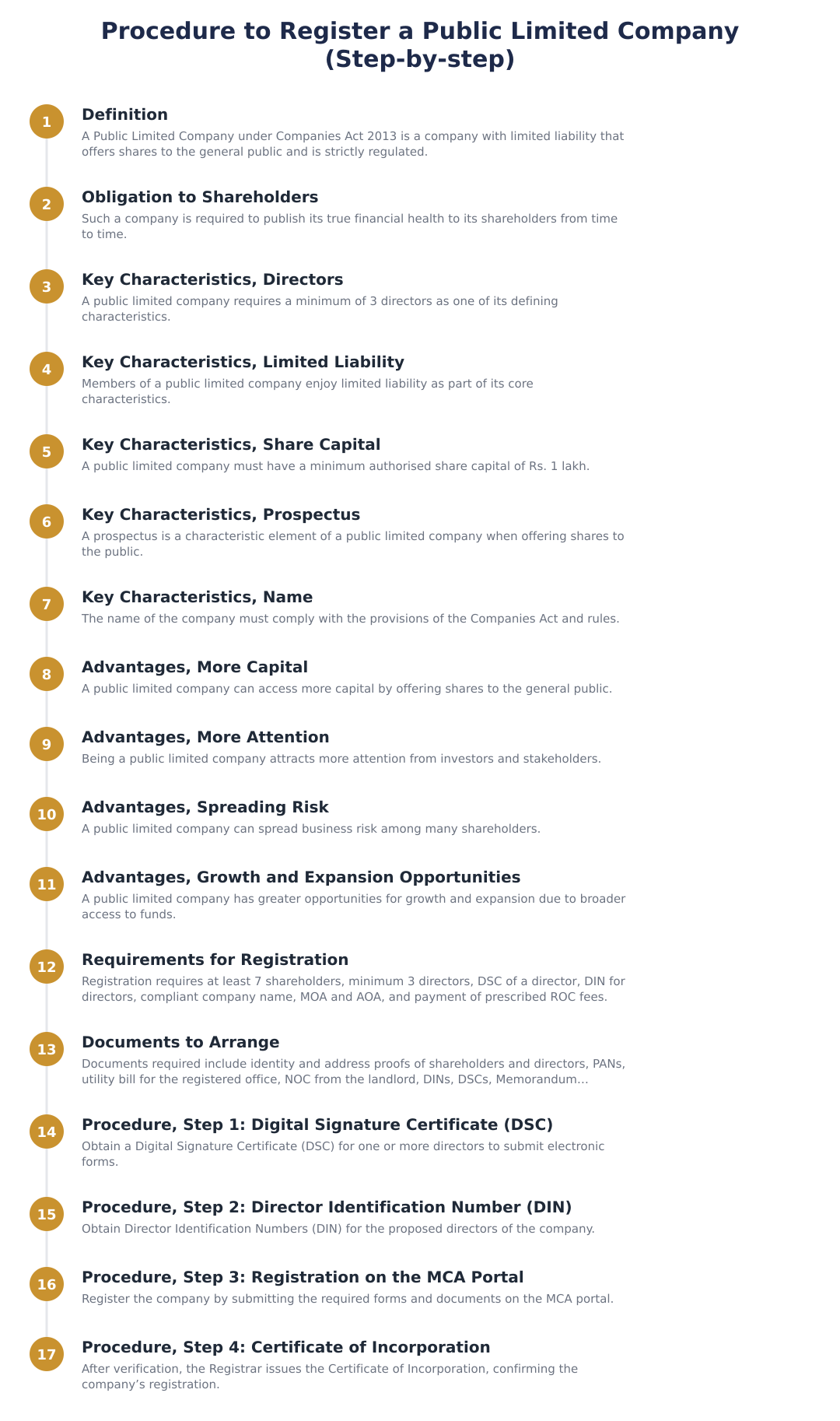
A Public Limited Company under the Companies Act, 2013 is a corporate form that combines limited liability for its members with the ability to offer shares to the general public. That combination makes the public limited company a commonly used vehicle when promoters wish to raise capital from outside investors while limiting their personal exposure to the company's debts.
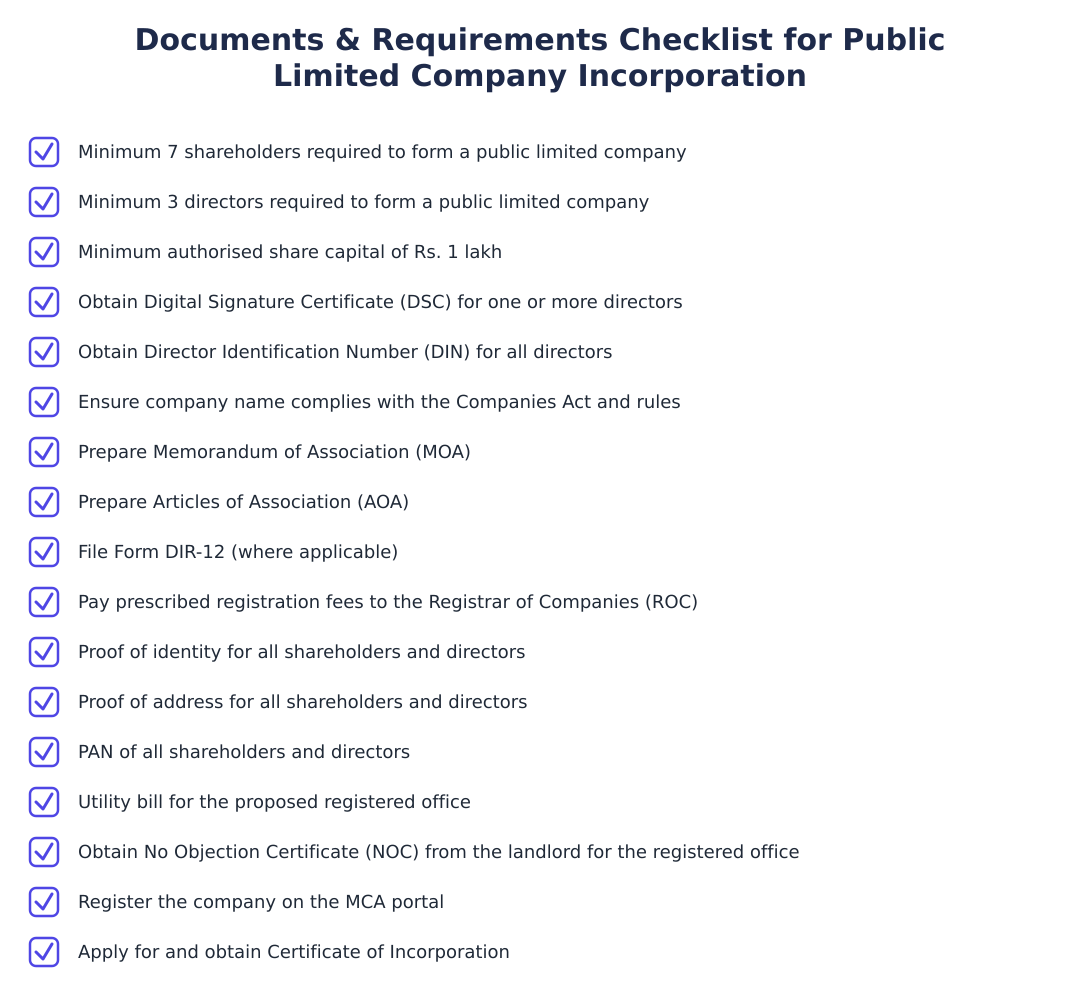
Statutory membership and board-size thresholds apply at incorporation: a minimum of 7 shareholders is required to form a public limited company, and the company must have at least 3 directors on its board. These thresholds reflect the expectation that public companies will have broader ownership and a larger governing board than closely held private companies.
Certain foundational documents are mandatory at the time of incorporation. The Memorandum of Association (MOA) sets out the company’s objects and scope, and the Articles of Association (AOA) govern internal management and company administration. Together these documents form the constitutional framework that the company and its stakeholders must follow.
The company’s name must comply with the provisions of the Companies Act and the associated rules; this ensures names are not misleading and do not infringe statutory naming requirements. Together, limited liability, the ability to offer shares publicly, prescribed membership and director counts, and prescribed constitutional documents define the legal identity of a public limited company.
Directors and Limited Liability
A public limited company must have at least three directors. Each director must be properly identified in the incorporation filings by providing the Director Identification Number (DIN); the DIN of all directors is a required element of the incorporation record. The board of directors is legally responsible for the management and statutory compliance of the company once it is incorporated.
The public limited company structure provides limited liability to its members. Limited liability means that, in general, shareholders’ financial exposure to company debts is restricted to the amount unpaid on the shares they hold, which is an important protection for investors and promoters participating in a company that solicits capital from the public.
Prospectus, Share Capital and Name
A defining feature of a public limited company is that it is permitted to offer its shares to the general public. When shares are offered to the public, formal disclosures are typically required to inform potential investors; the statutory framework for public offers and prospectuses governs how those disclosures must be made.
The company’s name must be chosen and applied for in accordance with the Companies Act and Rules. Compliance with naming provisions safeguards against confusion or misrepresentation and is a necessary precondition for incorporation.
The Memorandum of Association (MOA) documents the company’s authorized scope and share capital parameters at incorporation. The Articles of Association (AOA) set the rules for internal governance, shareholder rights, and other operational matters. Both documents are essential for registration and form part of the public record.
Documents and Mandatory Requirements for Incorporation
| Item | Requirement |
|---|---|
| Minimum shareholders | Minimum 7 shareholders are required to form a public limited company. |
| Minimum directors | Minimum of 3 directors is required to form a public limited company. |
| Director Identification Number (DIN) | Director Identification Number (DIN) of all the directors is required. |
| Proof of identity | Proof of identity of all the shareholders and directors is required for incorporation. |
| Proof of address | Proof of address of all the directors and the shareholders is required for incorporation. |
| Registered office evidence | Utility bill of the proposed registered office is required. |
| Landlord consent | A NOC (No Objection Certificate) from the landlord where the office will be situated is required. |
| Constitutional documents | Memorandum of Association (MOA) and Articles of Association (AOA) are required for incorporation. |
| ROC fees | Payment of the prescribed registration fees to the ROC is required. |
Procedure for Registration of a Public Limited Company
Obtain and include the Director Identification Number (DIN) for each proposed director as part of the incorporation filings; DIN of all directors is a mandatory requirement.
Draft and finalise the Memorandum of Association (MOA) and Articles of Association (AOA), which are required to be submitted at the time of incorporation.
Gather proof of identity and proof of address for all shareholders and directors, the utility bill for the proposed registered office, and a NOC from the landlord where applicable.
Submit the incorporation filings to the Registrar of Companies along with the required documents and make the payment of the prescribed registration fees to the ROC.
Forming a public limited company requires meeting statutory thresholds for membership and directors, preparing key constitutional documents (MOA and AOA), collecting specified identity and address evidence, establishing a registered office with supporting utility proof and landlord consent, and completing the ROC filing with payment of prescribed fees. Careful preparation of these elements ahead of filing will smooth the path to incorporation and help ensure compliance with the Companies Act provisions.
Frequently asked questions
What is a public limited company in simple terms?
A public limited company is a company with limited liability that offers its shares to the general public. It must comply with the Companies Act, publish its financial position to shareholders periodically, and can raise capital from the public through share issues. Such companies are strictly regulated, have greater disclosure requirements than private companies, and are suitable for businesses planning large-scale growth or public fundraising. For incorporation and ongoing compliance they must follow prescribed procedures under the Companies Act, 2013 and file with the Registrar of Companies (ROC).
How many people are required to form a public limited company?
You need a minimum of seven shareholders and at least three directors to form a public limited company. These are statutory minimums under the Companies Act and all proposed directors must obtain Director Identification Numbers (DIN) before incorporation. Additionally, one director must provide a Digital Signature Certificate (DSC) to sign electronic forms during registration. The company must also meet the minimum authorised share capital requirement of Rs. 1 lakh.
What is the minimum authorised share capital for a public limited company?
The minimum authorised share capital required to incorporate a public limited company is Rs. 1 lakh. This is the nominal capital stated in the Memorandum of Association (MOA) that the company is authorised to issue to shareholders. The authorised capital can be increased later by following statutory procedures and paying the necessary fees to the ROC. Paid-up capital (amount actually paid by shareholders) can be different but must comply with allotment and regulatory rules.
What documents are needed to incorporate a public limited company?
To incorporate a public limited company you need identity and address proofs and PAN of all shareholders and directors, DSC of the directors, DINs of all directors, utility bill and NOC for the registered office, and the company’s Memorandum of Association (MOA) and Articles of Association (AOA). You also need the duly filled Form DIR-12 for director particulars and to pay prescribed registration fees to the Registrar of Companies (ROC). All identity and address documents must be self-attested and submitted electronically during the MCA portal filing. Missing or incorrect documents can delay issuance of the Certificate of Incorporation.
What are the main steps to register a public limited company?
The main steps are: obtain Digital Signature Certificate (DSC) for at least one director, apply for Director Identification Number (DIN) for proposed directors, register and file incorporation forms on the MCA portal, and obtain the Certificate of Incorporation from the Registrar. After DSC and DIN are ready you must file incorporation forms along with MOA, AOA, proof of office address and prescribed fees; on satisfactory verification the ROC issues the Certificate of Incorporation. Post-incorporation activities include obtaining PAN, opening a bank account and complying with statutory filings. Timelines depend on document completeness and ROC processing.
Do public limited companies have limited liability for shareholders?
Yes, shareholders of a public limited company have limited liability, meaning their personal liability is limited to the unpaid amount on their shares. If the company is wound up, shareholders are only required to pay any remaining unpaid value on shares they hold, and personal assets are not at risk beyond that. This limited liability protection applies whether shareholders are individuals or institutional investors, but it does not protect against personal guarantees given by directors. It is one of the chief advantages that encourages public investment.
What is a prospectus and when must a public limited company issue one?
A prospectus is a formal document a public limited company issues to invite the public to subscribe for its shares and provides full particulars of the company’s financial health and business. It is required when a company offers shares to the public and must contain true and detailed disclosures so investors can make informed decisions. The prospectus is a statutory requirement under the Companies Act and must comply with prescribed content, filing and circulation norms; misleading statements can attract civil and criminal liability. Private placements to a limited group do not require a public prospectus.
What naming rules apply when choosing a name for a public limited company?
The company name must comply with the Companies Act and the Rules, meaning it should not be identical or deceptively similar to an existing company, must avoid prohibited words unless permitted, and typically must include 'Limited' as a suffix for a public limited company. The proposed name must be reserved through the MCA portal and is subject to ROC approval; names requiring approval from other authorities (e.g., RBI, SEBI) must obtain such permissions beforehand. Using an inappropriate or reserved name can lead to rejection of the incorporation application or directions to change the name later.
What are the main advantages of converting into or forming a public limited company?
Key advantages include access to more capital by issuing shares to the public, spreading business risk among a larger number of shareholders, increased public visibility and credibility, and greater opportunities for growth and expansion through public fundraising. Public companies attract institutional and retail investors, which can make large projects and acquisitions feasible, but they also face greater regulatory scrutiny and disclosure obligations. These companies benefit from limited liability for shareholders and can leverage listing on stock exchanges to further mobilise funds.
Need help staying Company Registration compliant?
MoneyGence's AI Finance OS tracks your compliance, wallet share, and finances in one place, built for agencies and growing businesses.
Get started with MoneyGence