QRMP Scheme GST: Quarterly Return Filing & Monthly Payments
This guide explains the Quarterly Return Filing and Monthly Payment of Taxes (QRMP) scheme under GST: who can opt in, how the monthly payment obligation is computed and paid, how the Invoice Furnishing Facility (IFF) works for the first two months of a quarter, relevant due dates, and the consequences of non-payment. QRMP was introduced to reduce compliance burden for small taxpayers by allowing eligible taxpayers to file GSTR-3B quarterly while making smaller monthly tax payments. Understanding QRMP matters for cashflow management, compliance planning and for ensuring that outward-supply invoice data reaches your buyers’ auto-populated purchase statements on time. In this article you will learn the eligibility threshold for QRMP, the two methods available to compute monthly instalments (Fixed Sum Method and the Self-Assessment Method), what the IFF permits and when it applies, the filing and payment due dates you must watch for, and the interest implications of missing the monthly payment deadline. Practical examples are used only as illustrations of the standard FSM percentage where needed. The guidance here references the QRMP rollout date and the key operational features that affect small and medium taxpayers so you can decide whether QRMP suits your GST compliance workflow.
Who is Eligible for the QRMP Scheme?
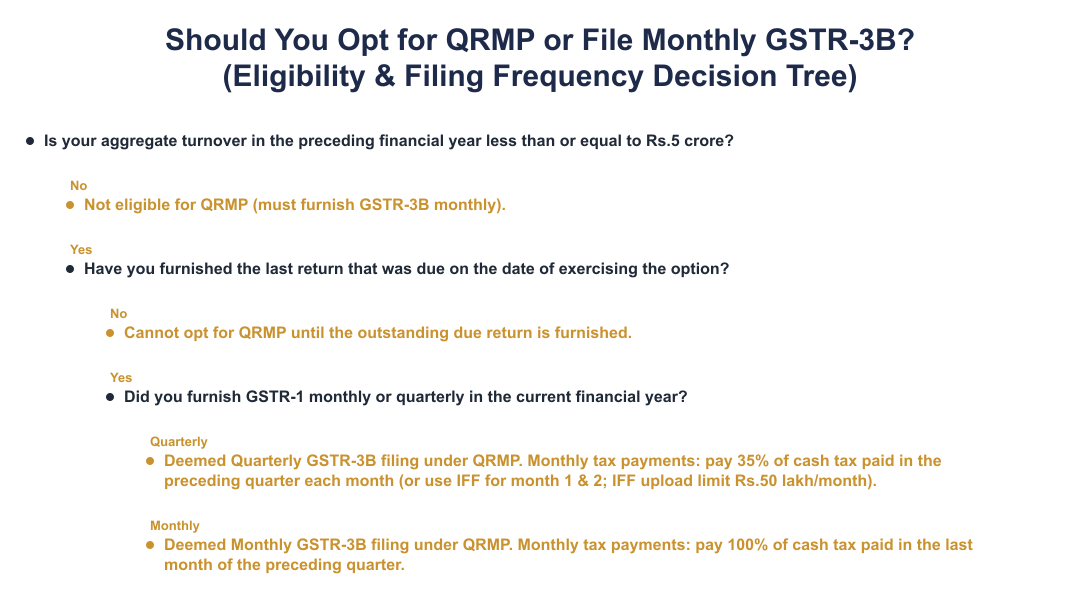
The QRMP scheme is intended for smaller registered persons to reduce return frequency. A registered person whose aggregate turnover in the preceding financial year was up to Rs.5 crore is eligible to opt for the QRMP scheme. The scheme became available from 1st January 2021.
Eligibility is subject to ongoing turnover monitoring. If the aggregate turnover exceeds Rs.5 crore during any quarter in the current financial year, the taxpayer will cease to be eligible for QRMP from the next quarter. Also, a registered person cannot opt to furnish quarterly returns if the last return that was due on the date of exercising such an option has not been filed, timely compliance of the previously due return is therefore a precondition for opting in.
How to Exercise Option for QRMP Scheme?
Confirm that the last return that was due on the date you plan to opt for QRMP has been furnished, because non-filing makes you ineligible to opt.
Verify that your aggregate turnover in the preceding financial year does not exceed Rs.5 crore to qualify for QRMP.
Use the prescribed option mechanism on the GST portal (portal steps and UI are provided by the authorities) to choose quarterly filing; this becomes effective as per the portal timelines and eligibility conditions.
Invoice Furnishing Facility (IFF): what it allows and limits
The Invoice Furnishing Facility (IFF) was introduced alongside QRMP and came into effect from 1st January 2021. IFF allows QRMP taxpayers to upload B2B invoice details for the first two months of each quarter so that recipients can get those invoices reflected in their auto-drafted inward supplies statements.
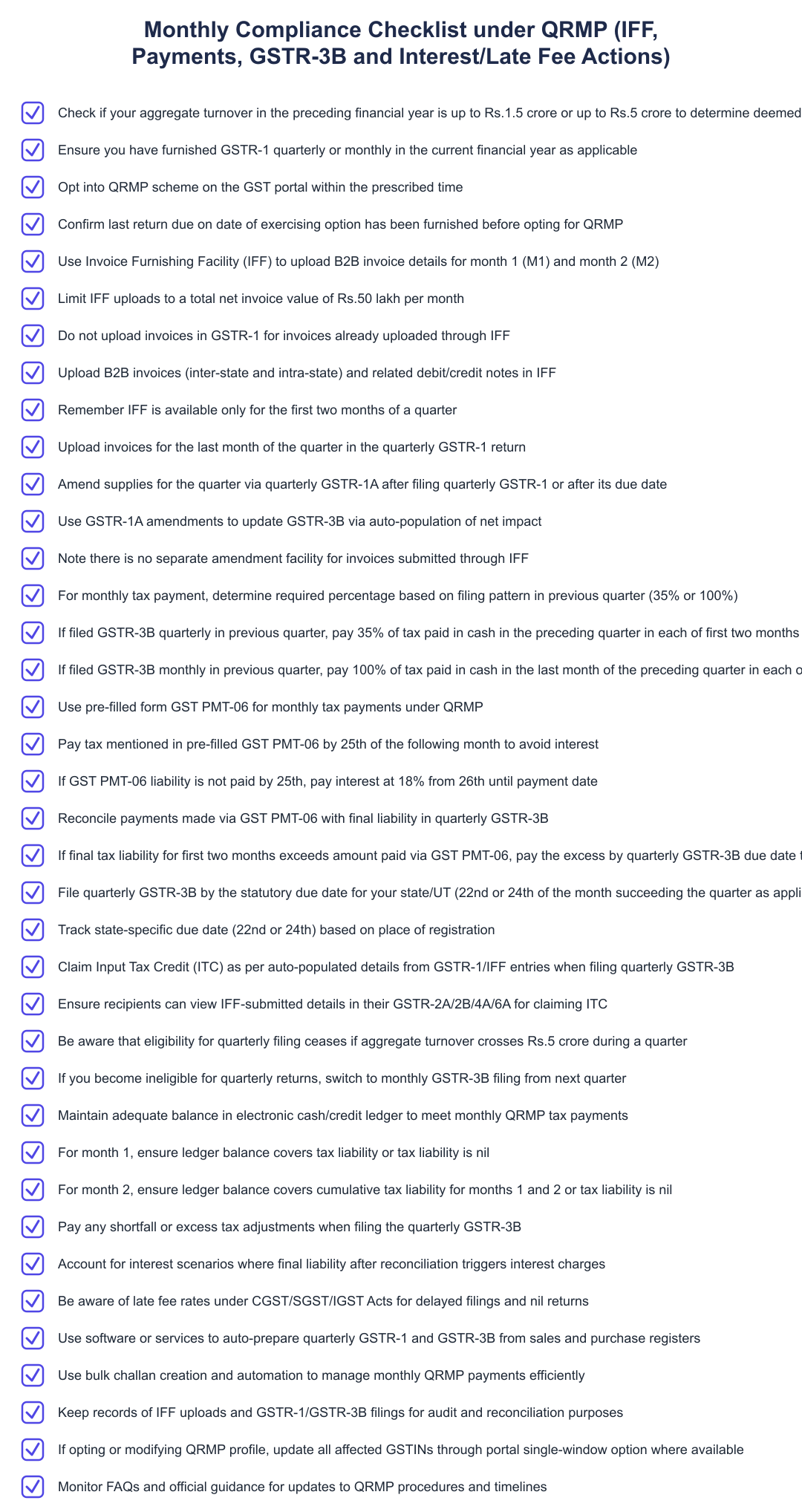
IFF has important operational limits: it can be used only for the first two months of a quarter; invoices pertaining to the last month of the quarter must be uploaded in the quarterly GSTR-1. There is a cap on the total net value of invoices that can be uploaded through IFF, this is restricted to Rs.50 lakh per month. Details submitted via IFF are reflected in the recipients’ GSTR-2A, GSTR-2B, GSTR-4A or GSTR-6A, as applicable.
How to make Monthly Tax Payments under QRMP: FSM and SAM
QRMP gives two alternatives to determine the monthly instalment of tax: the Fixed Sum Method (FSM) and the Self-Assessment Method (SAM). Under FSM, the system pre-fills the monthly amount in form PMT-06 based on a percentage of the cash tax paid in the relevant preceding period. Specifically, if a taxpayer furnished GSTR-3B quarterly in the preceding quarter, the monthly pre-filled payment under FSM is 35% of the tax paid in cash in that preceding quarter. If the taxpayer furnished GSTR-3B monthly during the last quarter, FSM will pre-fill 100% of the tax paid in cash in the last month of the immediately preceding quarter as the monthly payment.
SAM is available as an alternative to FSM; under SAM the taxpayer computes and pays the actual self-assessed tax liability for each month. Taxpayers should choose between FSM and SAM based on which method better matches their expected monthly liabilities and cashflow. The monthly payment obligation (whether FSM pre-filled PMT-06 or self-assessed SAM liability) must be deposited using form PMT-06 by the 25th of the following month.
Due dates and payment timing under QRMP
| Item | Relevant date / action |
|---|---|
| QRMP scheme rollout | Available from 1st January 2021 |
| IFF effective date | IFF will come into effect from 1st January 2021 |
| Monthly tax payment via PMT-06 | Deposit by 25th of the following month |
| Loss of eligibility when turnover exceeds threshold | If aggregate turnover exceeds Rs.5 crore during any quarter, not eligible from the next quarter |
| Recipient auto-population of IFF invoices | IFF details will be reflected in GSTR-2A / 2B / 4A / 6A of recipients as applicable |
Interest and consequences of missing payment deadlines
Timely payment of the PMT-06 liability by the 25th of the following month is critical. Where the pre-filled liability in PMT-06 is not paid by the 25th, interest becomes payable. The prescribed rate of interest for delayed payment in these circumstances is 18% per annum.
The same 18% per annum rate applies for other delayed payments as specified under the rules tied to QRMP. Choosing the correct payment method (FSM or SAM) and ensuring timely deposit through PMT-06 helps avoid interest chargeable on late payments.
Input Tax Credit (ITC) flow under QRMP
A principal aim of IFF is to ensure recipients receive inward supply details earlier in the quarter so they can reconcile and claim input tax credit where applicable. The details uploaded through IFF for the first two months are made visible to recipients via their auto-populated statements (GSTR-2A, GSTR-2B, GSTR-4A or GSTR-6A), which facilitates reconciliation ahead of the quarterly GSTR-3B.
Since invoices for the last month of the quarter are uploaded only with the quarterly GSTR-1, suppliers and recipients should coordinate timings: the IFF helps shorten the lag for the first two months, while the quarter-end GSTR-1 captures the remaining invoices and finalises what is reported in the quarterly GSTR-3B.
Practical issues QRMP taxpayers commonly face
Common operational challenges include deciding whether FSM or SAM is more appropriate for the taxpayer’s cashflow and ensuring the PMT-06 pre-filled liability is paid by the 25th to avoid interest. Because IFF is limited to the first two months and has a monthly Rs.50 lakh upload cap, businesses near that cap must plan which invoices to upload and reconcile with the quarterly GSTR-1.
Another practical constraint is that taxpayers who cross the Rs.5 crore threshold during a quarter will need to switch out of QRMP from the next quarter, so monitoring turnover intra-year is important to avoid surprises in return frequency and payment timing.
QRMP simplifies GST return frequency for eligible small taxpayers while preserving monthly tax payments through PMT-06 and improving early availability of supplier invoices via IFF. If your preceding-year turnover is up to Rs.5 crore, consider QRMP but plan carefully: choose FSM or SAM according to your cashflow, use IFF within its limits for early invoice reporting, pay PMT-06 by the 25th to avoid 18% p.a. interest on late payments, and monitor turnover during the year to remain compliant. For any transition or operational questions, consult your tax advisor or the GST portal guidance.
Frequently asked questions
Who can opt for the QRMP scheme under GST?
A registered person with aggregate turnover up to Rs.5 crore in the preceding financial year can opt for the QRMP scheme. The scheme is optional and available from 1st January 2021; however, if the aggregate turnover exceeds Rs.5 crore during any quarter in the current financial year, the taxpayer will become ineligible from the next quarter. Smaller taxpayers (for example, those with turnover up to Rs.1.5 crore) may have a deemed filing frequency based on whether they filed GSTR-1 monthly or quarterly in the current year. The eligibility calculation uses turnover details furnished on the GST portal for the preceding financial year.
How do I exercise the option to file quarterly under the QRMP scheme?
You must opt for quarterly filing on the GST portal between the 1st of the second month of the preceding quarter and the last day of the first month of the quarter for which you want quarterly filing. For example, to file quarterly for Apr–Jun 2025 you must opt between 1st February 2025 and 30th April 2025. Once opted, you must continue quarterly filing for future periods unless you become ineligible (e.g., turnover exceeds Rs.5 crore) or you fail to furnish the last due return at the time of exercising the option. The portal enforces continuity and will prevent opting if the last due return hasn’t been filed.
What is the Invoice Furnishing Facility (IFF) and how does it work in QRMP?
The Invoice Furnishing Facility (IFF) lets QRMP taxpayers upload B2B invoice details for the first two months of each quarter so recipients can view them in their auto-drafted purchase registers. IFF can be used only for months M1 and M2 of a quarter, with a monthly upload limit of Rs.50 lakh (net value) and the invoices for the last month (M3) must be reported in the quarterly GSTR-1. Details uploaded via IFF will appear in recipients' GSTR-2A/GSTR-2B/GSTR-4A/GSTR-6A and there is no separate amendment facility for invoices submitted through IFF (amendments are via quarterly GSTR-1A after filing). The IFF became effective from 1st January 2021.
How do I make monthly tax payments under the QRMP scheme?
Under QRMP you must deposit monthly tax for the first two months using Form GST PMT-06 by the 25th of the following month, either via the Fixed Sum Method (FSM) or the Self Assessment Method (SAM). In FSM the pre-filled PMT-06 challan will generally require you to pay 35% of the tax paid in cash in the preceding quarter (or 100% of the tax paid in the last month of the preceding quarter if you had filed monthly GSTR-3B in that quarter). In SAM you estimate your actual tax liability for the month and pay that amount in PMT-06; any shortfall or excess is reconciled while filing the quarterly GSTR-3B. The PMT-06 challan is pre-filled on the portal, and payment must be done by the 25th to avoid interest.
What are the due dates for filing the quarterly GSTR-3B under QRMP?
Quarterly GSTR-3B due dates depend on the State/UT of registration: for many states (including Maharashtra, Karnataka, Tamil Nadu, Andhra Pradesh, Telangana, Kerala and others) the due date is the 22nd of the month succeeding the quarter, while for several other states (including Uttar Pradesh, Bihar, West Bengal, Delhi, Rajasthan etc.) the due date is the 24th of the succeeding month. The exact state-wise due date is specified on the GST portal and must be followed for timely quarterly filing. Failure to file by the due date attracts late fees as per the CGST/SGST/IGST Acts.
What is meant by 'deemed monthly/quarterly filing' of GSTR-3B under QRMP?
Deemed filing determines whether your GSTR-3B is considered monthly or quarterly based on past filing behaviour and turnover slabs; certain classes of taxpayers are assigned a deemed option automatically. For example, registered persons with turnover up to Rs.1.5 crore who furnished GSTR-1 quarterly in the current financial year will have deemed quarterly GSTR-3B, while those up to Rs.1.5 crore who furnished GSTR-1 monthly will have deemed monthly GSTR-3B; persons with turnover exceeding Rs.1.5 crore and up to Rs.5 crore in the preceding year are generally deemed quarterly filers. This automatic classification helps the portal pre-fill options but taxpayers can still actively opt within the allowed window subject to eligibility rules.
How can I claim Input Tax Credit (ITC) under the QRMP scheme?
You can claim Input Tax Credit in your quarterly GSTR-3B using the details auto-populated from suppliers' invoices submitted via IFF and GSTR-1, subject to usual ITC conditions and reconciliation. ITC utilisation follows the standard priority order and the IFF uploads for M1 and M2 will reflect in recipients' auto-drafted returns (GSTR-2A/2B) enabling reconciliation before claiming credit. Remember that invoices uploaded in IFF are available to recipients only after the supplier files quarterly GSTR-1 or the due date of quarterly GSTR-1, and any mismatch must be corrected through supplier amendments or in quarterly GSTR-1A as applicable.
What interest and late fees apply if I miss QRMP monthly payments or quarterly filing deadlines?
If the tax indicated in the pre-filled GST PMT-06 is not paid by the 25th of the following month you must pay interest at 18% per annum from the 26th day until payment date; if paid by the 25th no interest applies. If the final tax for the two months is higher than what was paid in PMT-06 but the excess is paid by the quarterly GSTR-3B due date, no interest is payable; otherwise interest at 18% applies from the quarterly due date to payment. Late fees for delayed GSTR-3B filing are Rs.25 per day under CGST/SGST and Rs.50 per day under IGST (lower amounts apply for nil-tax returns: Rs.10 per day CGST/SGST and Rs.20 per day IGST), subject to statutory caps.
What practical issues do taxpayers face under QRMP and how can software help?
Common issues include managing monthly IFF uploads, reconciling sales and purchases across IFF and quarterly GSTR-1/GSTR-3B, preparing pre-filled PMT-06 challans and tracking payments, and handling changes in filing frequency when turnover thresholds are crossed. GST/ERP software (like Clear GST solutions) can help by automating QRMP profile updates across multiple GSTINs, auto-preparing quarterly GSTR-1 and GSTR-3B from sales/purchase registers, uploading B2B invoices to IFF, automating challan creation and payments, and reconciling sales with monthly IFF and quarterly GSTR-1. Using such tools reduces manual errors, speeds up compliance and helps optimize tax payments through dashboards and bulk operations.
Need help staying GST compliant?
MoneyGence's AI Finance OS tracks your compliance, wallet share, and finances in one place, built for agencies and growing businesses.
Get started with MoneyGence