Retirement Planning Calculator, Estimate Your Retirement Corpus
A retirement planning calculator helps you estimate how much money you will need when you stop working and shows how much to save today to reach that goal. This guide explains what a retirement calculator does, how to use one effectively, and the key inputs and assumptions behind the calculations. You will learn how to translate your desired retirement lifestyle into a target corpus, how inflation and investment returns change that target over time, and how existing savings and expected contributions affect the monthly or annual savings required. Understanding these concepts will make your retirement plan realistic and adaptable as life changes. Whether you are just starting your career, midway through your working life, or approaching retirement, using a retirement planning calculator can provide clarity and a practical roadmap. This guide focuses on the conceptual steps and practical considerations, what information to prepare before you begin, how the calculator transforms inputs into outcomes, and common adjustments people make to keep their plan on track. By the end you will be better equipped to interpret calculator outputs, ask the right questions of financial advisers or tools, and make informed choices about saving and investing for retirement.
How to Use the Retirement Planning Calculator?
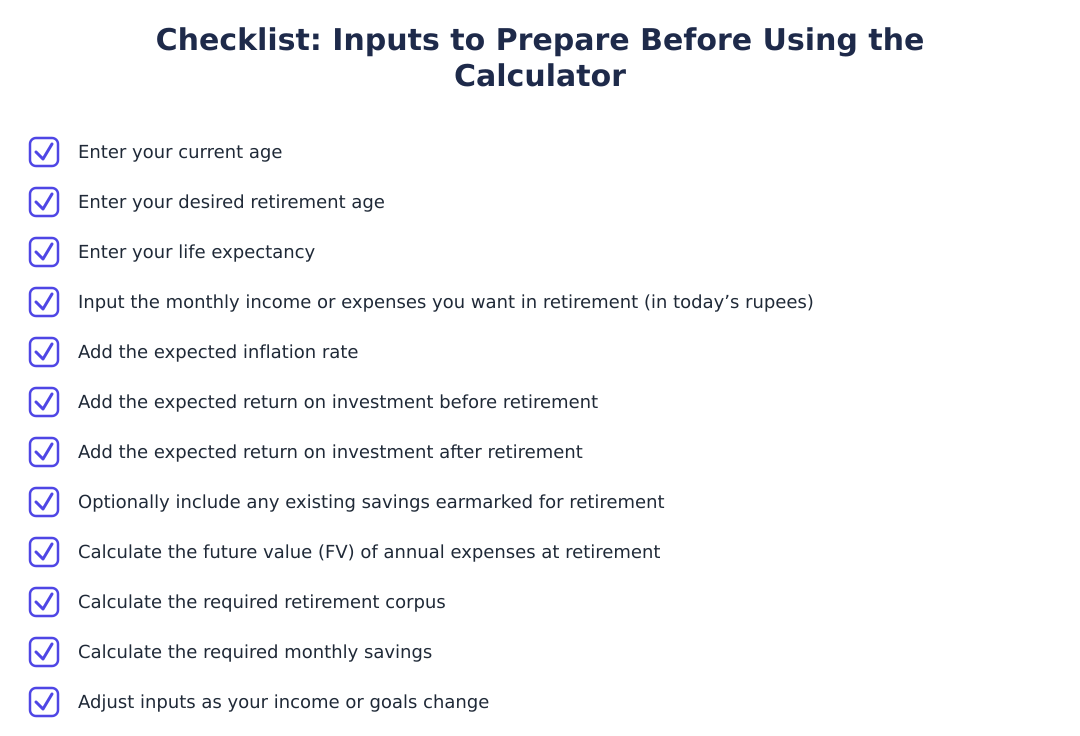
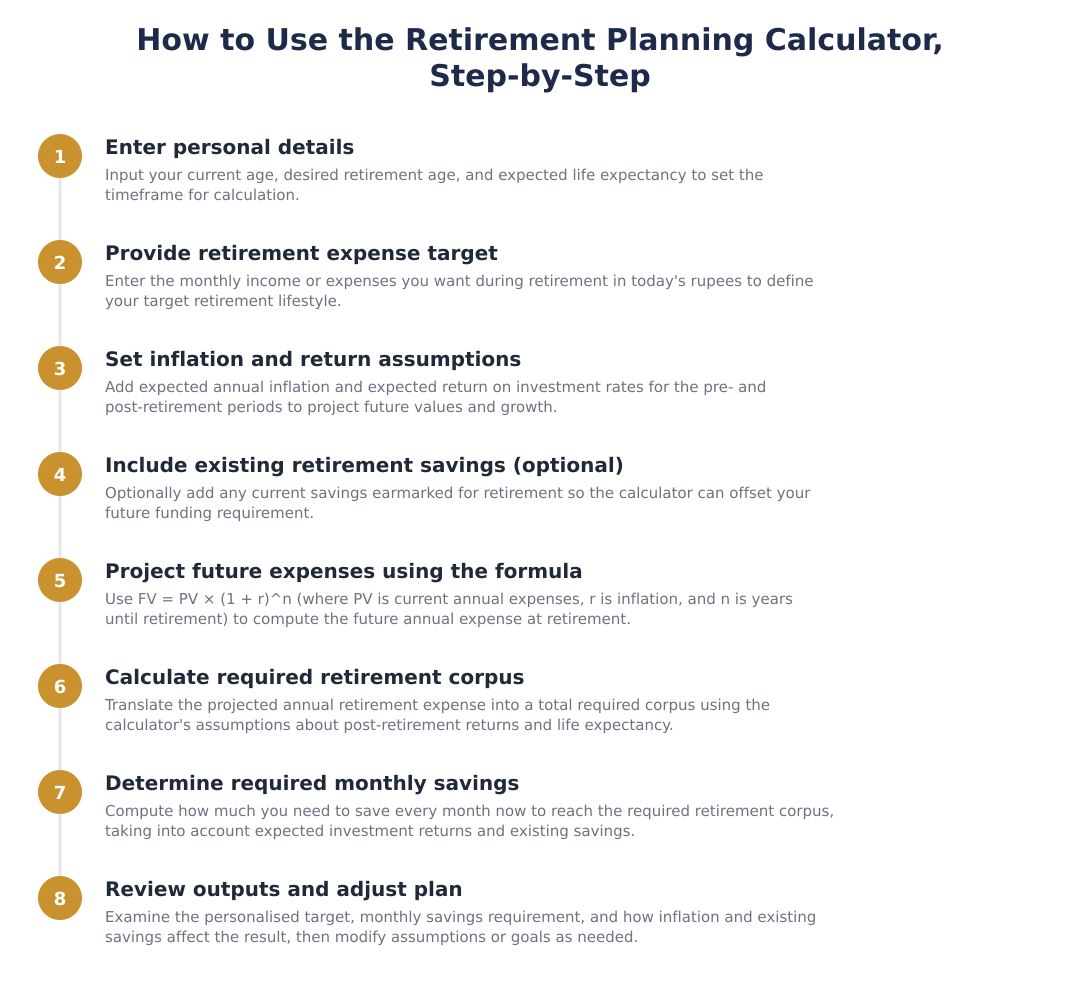
A retirement calculator typically asks for a few personal details and financial assumptions. You will be prompted to enter your current age and the age at which you expect to retire, together with an estimated life expectancy or the number of years you expect to spend in retirement. These time parameters set the planning horizon that the calculator uses to project needs and resources.
Next, provide an estimate of the monthly or annual income you would like to have in retirement expressed in today’s purchasing power. The calculator needs this to determine the future value of your desired lifestyle after accounting for inflation. You will also supply assumptions for average inflation and expected investment return rates during both the accumulation (pre-retirement) and decumulation (post-retirement) phases.
If you already have savings or investments earmarked for retirement, include their current value and any expected future contributions. The calculator will treat existing savings as a starting corpus that reduces the additional amount you must accumulate. Finally, the tool computes a required retirement corpus and often shows the monthly or annual savings needed to reach that corpus given your assumptions.
Retirement Planning Calculator Formula.
At its core, a retirement calculator applies time-value-of-money concepts. It projects your desired retirement expenses forward to the retirement date using an assumed inflation rate to estimate what those expenses will cost in future currency. That projected expense becomes the basis for determining the total corpus required to fund your retirement years.
Once future annual or monthly needs at retirement are estimated, the calculator converts that stream of future payments into a lump-sum corpus by applying an expected post-retirement investment return and the expected duration of retirement. Conversely, to determine how much to save each period before retirement, the calculator works backward: it determines the future corpus required and then computes the periodic contribution needed over the accumulation period given an assumed pre-retirement return rate.
Because these calculations rely on multiple assumptions, the formula used is essentially a set of present-value and future-value computations layered together. Thoughtful sensitivity testing, changing inflation, return, or longevity assumptions, shows how the required savings and corpus respond to each factor.
How Much do You Need to Retire Comfortably in India?
There is no one-size-fits-all figure for a comfortable retirement because needs vary by lifestyle, location, health, and family responsibilities. A practical approach is to start from your current expenses and adjust for the lifestyle you desire in retirement, whether that means maintaining current expenditure levels, downsizing, or increasing discretionary spending for travel and hobbies.
Translate your chosen retirement lifestyle into an annual or monthly figure in today’s terms, then let the calculator project that number to retirement using an inflation assumption. Consider also non-discretionary costs such as healthcare or support for dependents which can significantly change required savings. Running multiple scenarios, conservative, moderate, and optimistic, helps you see a range of plausible outcomes and set a saving target that matches your risk tolerance and priorities.
Benefits of Using the Retirement Planning Calculator
A calculator turns abstract goals into concrete numbers, giving you a personalised target for a retirement corpus and a clear sense of the periodic savings required. This makes it easier to prioritise savings, choose investment vehicles, and adjust spending to stay on track.
It also highlights the long-term impact of inflation and investment returns, showing how small changes in assumptions can materially alter outcomes. Including existing savings in the calculation demonstrates how current assets reduce future saving needs, and sensitivity testing lets you quickly explore how extending working years, changing retirement age, or altering return assumptions affects the plan.
Finally, such tools make ongoing management simpler: as income, expenses, or market assumptions change, you can update inputs and immediately see revised targets, helping you make timely course corrections rather than discovering shortfalls late in life.
Frequently Asked Questions
What should I prioritise when using the calculator? Focus first on the retirement lifestyle you want and an honest assessment of current expenses. Then select reasonable assumptions for inflation and returns, and include any existing dedicated retirement savings.
How often should I revisit my plan? Revisit your retirement inputs regularly, after major life events, changes in income, or shifts in investment outlook. Regular reviews help detect deviations early and allow incremental adjustments in savings or investment strategy.
Can a calculator guarantee a comfortable retirement? No tool can guarantee outcomes because they depend on future events and market behaviour. A calculator provides informed estimates under stated assumptions; prudent planning involves conservative assumptions, diversification, and contingency buffers to manage uncertainty.
A retirement planning calculator is a practical starting point to convert your retirement aspirations into actionable savings goals. By supplying honest inputs and testing multiple scenarios, you can build a resilient plan that adapts as circumstances change. Use the outputs as a guide to set savings habits, choose appropriate investments, and schedule regular reviews so your retirement remains on track.
Frequently asked questions
What does the Retirement Planning Calculator do?
The Retirement Planning Calculator estimates the retirement corpus you need and the monthly savings required to reach it. It takes your current age, desired retirement age, life expectancy, desired monthly income in today’s rupees, expected inflation, expected investment returns before and after retirement, and any existing retirement savings to compute a personalised target. The calculator shows both the future annual expense at retirement (adjusted for inflation) and the lump-sum corpus required using a safe withdrawal rate or projected post‑retirement returns. Results help you compare scenarios (different inflation or return assumptions) and plan how much to save every month.
How do I use the Retirement Planning Calculator step by step?
Enter your current age, desired retirement age, life expectancy, and the monthly income or expenses you want in retirement expressed in today’s rupees as the first step. Next add the expected annual inflation rate and expected returns on your investments before and after retirement, and optionally include any existing retirement savings. The tool then computes the future value of your current annual expenses at retirement, the required retirement corpus (often using a safe withdrawal rate or post‑retirement return), and the monthly savings needed to achieve that corpus. You can adjust assumptions like inflation or returns to see how the required corpus and monthly savings change.
What formula does the Retirement Planning Calculator use to estimate future expenses?
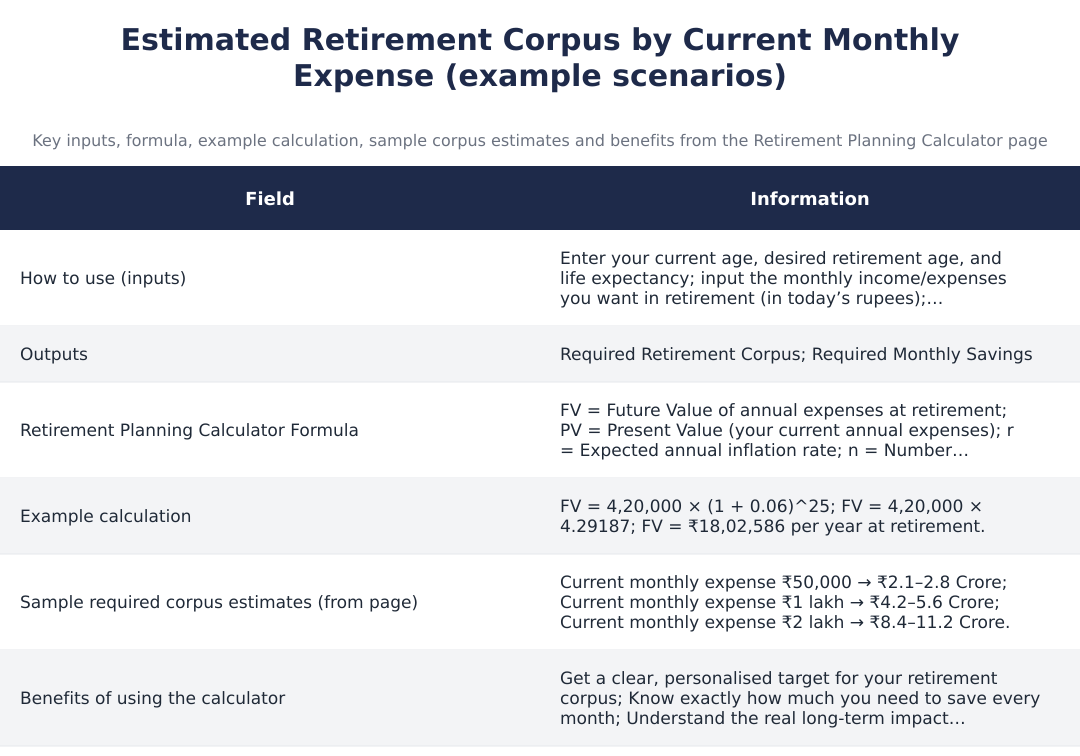
The calculator uses the future value formula FV = PV × (1 + r)^n to project current annual expenses to retirement, where PV is your current annual expense, r is the expected annual inflation rate, and n is the number of years until retirement. For example, ₹4,20,000 annual expense growing at 6% for 25 years becomes FV = 4,20,000 × (1 + 0.06)^25 = about ₹18,02,586 per year at retirement. After computing inflated annual expenses, it multiplies by a factor (like 25× or uses a post‑retirement return/safe withdrawal model) to derive the required lump‑sum corpus. Finally it calculates the monthly savings required today by discounting expected investment returns over the saving period.
Can you show an example calculation using the Retirement Planning Calculator?
Yes, for example, if your current annual expense is ₹4,20,000 (₹35,000 per month), expected inflation is 6% and retirement is in 25 years, the future annual expense is FV = 4,20,000 × (1 + 0.06)^25 ≈ ₹18,02,586 per year at retirement. If you use the common 25× rule to convert annual retirement expenses into corpus, you would need roughly ₹4.5 crore (18,02,586 × 25) as the retirement corpus. The calculator would then compute how much you must save monthly today to reach that corpus based on your assumed pre‑retirement return and any existing savings.
How much do I need to retire comfortably in India according to the calculator?
Indicative figures from the calculator suggest that required corpuses at age 60 vary by current monthly expense: ₹50,000 today implies about ₹2.1–2.8 crore, ₹1 lakh today implies about ₹4.2–5.6 crore, and ₹2 lakh today implies about ₹8.4–11.2 crore, depending on inflation and return assumptions. These numbers use projected inflation and typical safe withdrawal or post‑retirement return estimates and are meant as illustrative ranges rather than guarantees. Your actual need will vary by lifestyle, expected healthcare and travel costs, life expectancy, and the real investment returns you achieve. Review and update assumptions regularly to keep targets realistic.
What are the main benefits of using the Retirement Planning Calculator?
Using the calculator gives you a clear, personalised retirement target (required corpus) and the exact monthly savings needed to hit that target, saving guesswork. It shows how inflation erodes purchasing power over time so you can budget for future costs rather than relying on today’s rupees. The tool also demonstrates how existing retirement savings reduce future savings requirements and lets you model different return and inflation scenarios to test plan sensitivity. Finally, it’s easy to update as your income, goals, or assumptions change, helping you stay on track.
Which inputs should I be most careful about when using the Retirement Planning Calculator?
Be particularly careful with the inflation rate and the assumed investment returns because small changes in these rates significantly alter the required corpus and monthly savings. Also ensure you accurately state your desired retirement monthly income in today’s rupees (not future rupees) and correctly include years until retirement (n) and life expectancy for withdrawal horizon. If you have existing retirement savings, include their current value and expected growth so the calculator can net them off the required corpus; ignoring existing savings will overstate what you need to save. Finally, factor in higher healthcare costs or a contingency buffer if you expect significant medical expenses.
Can I include my current savings like PF, PPF or mutual funds in the calculator?
Yes, the calculator lets you include existing savings earmarked for retirement, and it deducts their projected future value from the required corpus so you save less each month. You should enter the current balance and the expected pre‑retirement return for those savings so the tool can grow them to retirement. Including existing savings gives a realistic net corpus requirement and shows how much additional monthly contribution you need beyond what you already have. If you omit existing savings, the calculator will show a higher corpus and larger monthly savings requirement.
How often should I update my retirement plan using the Retirement Planning Calculator?
You should review and update your retirement plan at least annually or whenever you have a major life change (promotion, job loss, birth of a child, large medical expense, or change in retirement age). Annual updates let you incorporate actual investment returns, changes in salary, revised expense goals, and fresh inflation expectations to keep the corpus target and monthly savings realistic. Also re-run the calculator if market conditions materially change expected returns or if you decide to change retirement age or desired post‑retirement lifestyle. Regular reviews help you correct course early rather than making large catch‑up contributions later.
Need help staying Calculators compliant?
MoneyGence's AI Finance OS tracks your compliance, wallet share, and finances in one place, built for agencies and growing businesses.
Get started with MoneyGence