Reverse Charge Mechanism GST: Complete RCM Guide
This guide explains the Reverse Charge Mechanism (RCM) under GST in plain language, focusing on what RCM means for the recipient of supplies, how it affects input tax credit, invoicing when the supplier is unregistered, and the compliance steps a business must follow. You will learn why RCM exists, who becomes liable to pay GST under RCM, what documentation the recipient must maintain, and the practical compliance consequences of getting RCM wrong. The guide also explains the interplay between paying tax and claiming Input Tax Credit (ITC) when supplies fall under RCM and why timely reporting matters. Understanding RCM is important because it changes the normal flow of tax responsibility: rather than the supplier collecting and remitting GST, the recipient must account for and pay the tax in specific, notified situations. For businesses that buy supplies subject to RCM, this creates additional responsibilities, on payment, record-keeping, and claiming credit, which, if overlooked, can create cash-flow surprises and exposure to penalties. This article is useful for procurement teams, finance professionals, tax compliance officers, and small-business owners who receive supplies that may be covered by reverse charge. Read on to learn the core rules that govern RCM, how to document purchases from unregistered suppliers, the conditions for claiming ITC, and the compliance actions you must take to stay on the right side of GST law.
What is Reverse Charge Mechanism?
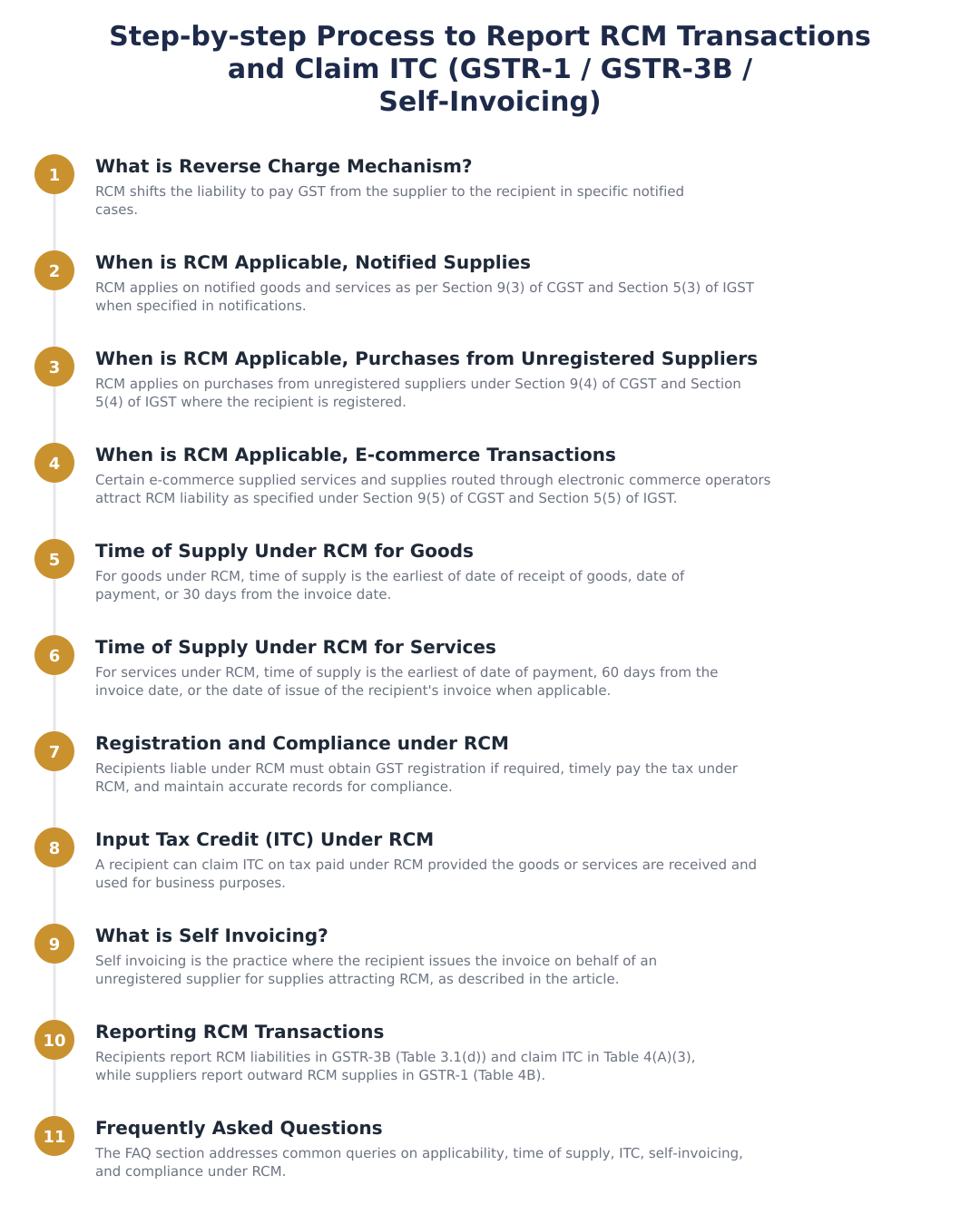
Reverse Charge Mechanism (RCM) reverses the usual GST collection process: instead of the supplier charging and remitting tax, the recipient of goods or services becomes liable to pay GST in certain specified situations. The rule exists to ensure tax collection in circumstances where tracking and collection from the supplier is considered impractical or risky, or where legislation explicitly shifts liability to the recipient.
Practically, RCM shifts administrative and cash-flow responsibilities to the buyer. The recipient must determine when a received supply falls under RCM, make the required payment of GST, and ensure the transaction is correctly recorded for both tax-payment and input tax credit purposes. Getting these steps right avoids liability surprises and supports accurate financial reporting.
When is RCM Applicable?
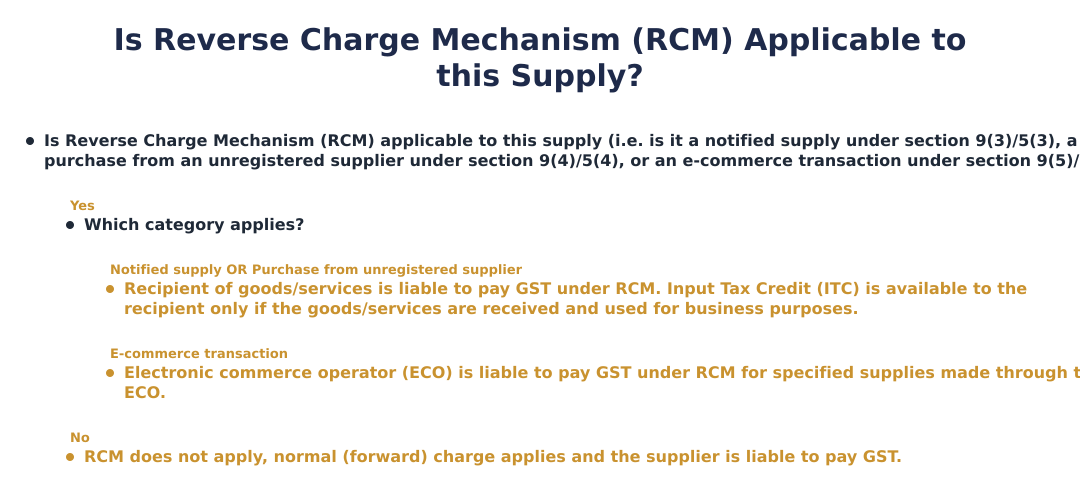
RCM applies in specific, notified cases where law or government notification shifts the tax liability from the supplier to the recipient. These cases are identified by statute or notification and typically target supplies where supplier-side compliance is uncertain or where policy aims to capture tax from the recipient directly.
Because RCM is triggered only in notified situations, recipients must review the nature of each inward supply and any applicable notifications to determine whether reverse charge applies. When in doubt, the recipient should treat the supply as potentially liable under RCM until the tax position is clarified, and should document the basis for its determination.
Time of Supply Under RCM
Determining the time of supply is important because it fixes the tax period in which the recipient must discharge the RCM liability. Under RCM, time-of-supply rules connect to events such as receipt of goods or services, payment, or issuance of invoices depending on the underlying statutory provisions.
Recipients should assess the event that triggers tax liability for each transaction and ensure GST is paid in the correct tax period. Accurate assessment prevents under- or over-statement of tax liabilities and supports a clean trail for audit and compliance.
Registration and Compliance under RCM
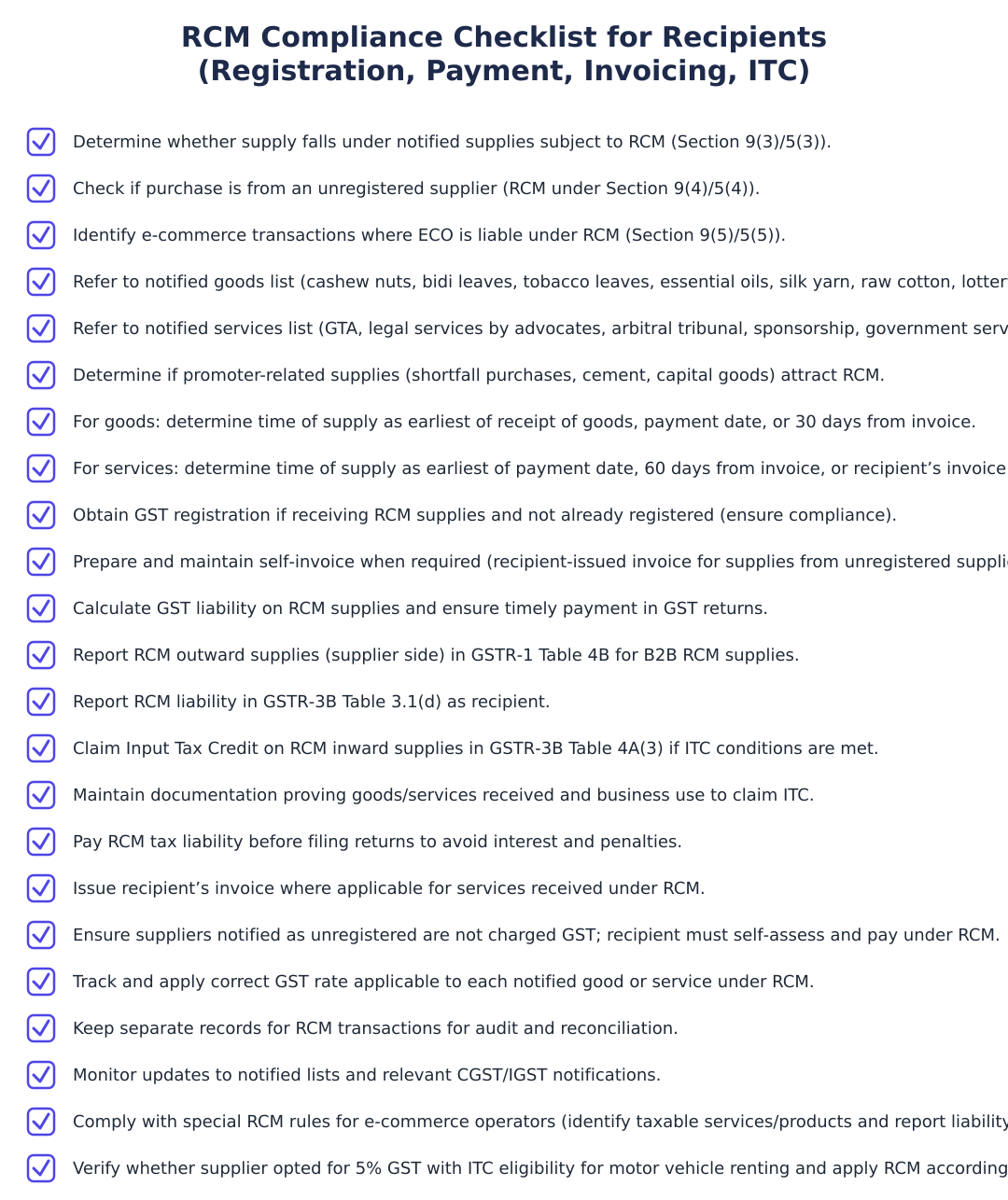
When a recipient is liable to pay tax under RCM, they must ensure they are registered under GST if registration requirements apply, and must make timely payment of the GST due on such supplies. Compliance involves both payment and maintaining records that substantiate why and when RCM applied to a transaction.
Timely payment and accurate reporting of RCM transactions in the periodic returns is essential. Non-compliance, such as late payment, incorrect reporting, or failing to register when required, can attract penalties under GST law. Therefore, businesses should embed RCM checks into procurement and accounting workflows so that RCM liabilities are captured and discharged promptly.
Input Tax Credit (ITC) Under RCM
Input Tax Credit on tax paid under RCM is available to the recipient provided two conditions are met: the goods or services have been received, and they are used for business purposes. Meeting these conditions allows the recipient to claim credit for the GST they discharged under reverse charge, subject to the broader ITC rules that govern eligibility and documentation.
Recipients should maintain clear records showing receipt and business use of the inward supplies for which RCM was paid. Proper documentation supports ITC claims and reduces the risk of disallowance during assessment or audit. Because ITC eligibility is tied to receipt and use, simply paying tax under RCM without evidence of both will jeopardize the credit claim.
What is Self Invoicing?
Self-invoicing is the process by which the recipient issues and maintains an invoice when the supplier is unregistered. This practice ensures there is a proper tax invoice record even though the supplier cannot issue a GST invoice because they are not registered.
Under GST compliance for reverse charge, self-invoicing serves two purposes: it creates the documentary basis for discharging RCM by the recipient and it provides the invoice needed to substantiate input tax credit claims. Recipients must retain these self-invoices along with other supporting documentation to justify both the payment of tax and any ITC claimed.
Reporting RCM Transactions
Recipients must report RCM transactions in their periodic GST returns and ensure the tax due under reverse charge is paid within the prescribed timelines. Accurate reporting means recording both the liability and any corresponding ITC claim (where eligible) so that returns reflect the true tax position.
Maintaining reconciled accounts between inward supplies, self-invoices (where applicable), and return entries reduces discrepancies at the time of assessment or audit. Because reporting obligations accompany the payment obligation, businesses should establish controls to capture RCM events at the point of procurement and follow through to return filing.
Frequently Asked Questions
Who ultimately bears the tax cost under RCM? Under reverse charge, the recipient is legally liable to pay GST where RCM applies; commercial allocation of that cost between supplier and recipient is a contractual matter between the parties.
Can a recipient claim ITC for tax paid under RCM if the supply is later returned or not used for business? Input Tax Credit is available only when the goods or services are received and used for business purposes. If the economic reality changes (for example, goods are returned), the recipient should adjust the ITC claim in line with the underlying facts and record-keeping requirements.
What happens if RCM is not reported or tax not paid? Failure to make timely payment, accurate reporting, or obtain required GST registration can attract penalties under GST law. Prompt remediation and disclosure are advisable to minimise compliance exposure.
RCM changes the usual GST flow and places important obligations on the recipient: identify notified supplies, make timely payment, maintain self-invoices when the supplier is unregistered, and claim ITC only when supplies are received and used for business. Good procurement controls, timely recording, and accurate return reporting are key to managing RCM risk and avoiding penalties.
Frequently asked questions
What is Reverse Charge Mechanism (RCM) under GST?
Reverse Charge Mechanism (RCM) under GST is a levy where the recipient of goods or services, instead of the supplier, is liable to pay the GST. Under Indian law RCM arises mainly under Section 9(3)/5(3) (notified supplies), Section 9(4)/5(4) (purchases from unregistered suppliers) and Section 9(5)/5(5) (certain e‑commerce transactions), so the buyer must pay tax directly to the government and often self‑invoice when the supplier is unregistered. RCM is used for supplies that are high‑risk or hard to track (like certain agricultural goods, services by advocates, GTA services, etc.), and the recipient can claim Input Tax Credit (ITC) on such tax if the goods/services are used for business. The recipient must also register for GST (if otherwise required), pay tax timely and report the RCM transactions in their returns (e.g., GSTR‑3B Table 3.1(d) and Table 4(A)(3)).
When does RCM apply to notified goods and services?
RCM applies to notified goods and services specifically listed by the government where the recipient must pay GST instead of the supplier. Examples include supplies from agriculturists like cashew nuts or raw cotton, services such as legal services by individual advocates, services by Goods Transport Agencies (GTAs) to specified entities, sponsorships to corporates, and several other items listed in the notifications; the supplier/recipient categories are specified for each entry. These notified supplies are covered under Section 9(3) of the CGST Act and Section 5(3) of the IGST Act, and the notifications include both goods (e.g., metal scrap supplied by unregistered person) and services (e.g., security services supplied by individuals). If the supply is notified, the recipient must pay GST under RCM even if the supplier is registered.
When does RCM apply on purchases from unregistered suppliers?
RCM applies on purchases from unregistered suppliers when a registered recipient buys goods or services from a supplier who is not registered and the relevant statutory provision (Section 9(4)/5(4)) requires the recipient to pay tax. In such cases the recipient must pay GST on the inward supply under RCM and typically issue a self‑invoice because the unregistered supplier cannot issue a GST invoice; this covers situations like rent of immovable property by an unregistered person to a registered person (with some exclusions). The recipient can claim ITC on the tax paid under RCM if the goods/services are used for business, provided other ITC conditions are met, and must report these transactions in GSTR‑3B (Table 3.1(d) for liability and Table 4(A)(3) for claiming ITC).
How is the time of supply determined under RCM for goods?
For goods under RCM, the time of supply is the earliest of: the date of receipt of the goods, the date of payment, or 30 days from the date of issue of the invoice. This means if you receive the goods before you pay, the receipt date determines liability; if you pay earlier, the payment date can trigger the tax point; otherwise the 30‑day fallback applies from the supplier’s invoice date. The recipient must accordingly pay GST under RCM by the due date applicable to that time of supply and reflect the liability in the return for the tax period in which the time of supply falls.
How is the time of supply determined under RCM for services?
For services under RCM, the time of supply is the earliest of: the date of payment, 60 days from the date of issue of the invoice, or the date of issue of the recipient’s invoice (if the recipient issues one). Thus, if the recipient pays before 60 days, the payment date creates the tax liability; if neither payment nor recipient invoice occurs, the 60‑day rule from the supplier’s invoice governs. The recipient must pay GST based on that time of supply and claim ITC only when the goods or services are received and used for business purposes.
When can a recipient claim Input Tax Credit (ITC) on tax paid under RCM?
A recipient can claim ITC on tax paid under RCM only when the goods or services are received and are used or intended to be used for business purposes. The recipient must have paid the GST under RCM, possess the required documents (such as the self‑invoice if applicable), and meet normal ITC conditions (e.g., tax charged was actually paid to the government and the recipient has filed required returns). ITC on RCM inward supplies is reported in GSTR‑3B Table 4(A)(3) and the RCM liability itself is disclosed in Table 3.1(d); exceptions and blocked credits (like personal consumption) still apply.
What is self‑invoicing under RCM and when is it required?
Self‑invoicing under RCM is when the recipient issues an invoice on behalf of the supplier and it is required mainly when the supplier is unregistered and cannot issue a GST invoice. The self‑invoice must contain all mandatory invoice particulars (like supplier/recipient details, description, value, tax amount) and should be maintained in the recipient’s books to support payment of GST under RCM and claim of ITC. Self‑invoices are particularly common for purchases from unregistered persons and must be used to determine time of supply for services if the recipient issues the invoice, plus they must be reported appropriately in returns. Failure to maintain proper self‑invoices can lead to non‑allowance of ITC or compliance issues.
What GST registration and compliance steps does a recipient need to follow for RCM?
A recipient required to pay tax under RCM must be GST registered (if turnover or thresholds mandate registration) and comply by paying GST on time, maintaining invoices/self‑invoices, and reporting the transactions in returns. RCM liabilities are reported in GSTR‑3B Table 3.1(d) and inward supplies under RCM (for claiming ITC) are shown in Table 4(A)(3); suppliers must report outward RCM supplies in GSTR‑1 Table 4B (B2B RCM supplies). Timely payment based on the time‑of‑supply rules and accurate documentation are essential to claim ITC and avoid interest or penalties. Electronic commerce operators and certain specified persons may have additional RCM obligations under Section 9(5)/5(5), where the ECO can be made liable to pay tax for supplies made through them.
How should RCM transactions be reported in GST returns?
RCM transactions must be reported by the recipient in GSTR‑3B (RCM liability in Table 3.1(d) and claim of ITC on RCM inward supplies in Table 4(A)(3)), while suppliers report outward supplies under RCM in GSTR‑1 Table 4B (B2B RCM supplies). Accurate reporting requires matching the tax liability with the correct tax period based on the time‑of‑supply rules and maintaining supporting documents like self‑invoices when the supplier is unregistered. Electronic commerce operators who are made liable must report and pay tax for supplies done through their platform according to separate entries; failure to report RCM correctly can disallow ITC and attract interest and penalties.
Need help staying GST compliant?
MoneyGence's AI Finance OS tracks your compliance, wallet share, and finances in one place, built for agencies and growing businesses.
Get started with MoneyGence