Section 115BAC new tax regime 2026: Slabs, Deductions & Benefits
This guide explains the New Tax Regime set out in Section 115BAC of the Income Tax Act and what it means for taxpayers considering a switch. You will learn what Section 115BAC covers, who can opt into the new regime, why many taxpayers evaluate it against the old regime, and how to approach a decision that fits your financial situation. The New Tax Regime is often presented as an alternative framework with a simpler set of rates and fewer deductions and exemptions; understanding its practical implications helps you decide whether the trade-offs, between lower headline tax rates and reduced scope for traditional tax breaks, work in your favour. Reading this guide will help you identify the kinds of taxpayers for whom the regime is designed, the high-level mechanics of comparing regimes, and the practical steps to take before you switch. It also highlights special eligibility points you should be aware of. While this article avoids itemising specific rate figures or detailed lists of allowed or disallowed deductions, it gives you a clear framework for the analysis you should perform and the questions to ask your accountant or tax advisor when evaluating Section 115BAC for the relevant assessment year.
What is Section 115BAC?
Section 115BAC of the Income Tax Act defines the New Tax Regime. It establishes an alternative method for computing income tax that is intended to simplify taxation by providing a distinct set of rules compared with the traditional (old) tax framework.
In practice, 'new regime' frameworks like the one under Section 115BAC present taxpayers with a choice: they can either continue with the existing set of exemptions and deductions under the older framework or opt for the alternative calculation under Section 115BAC. The choice typically involves a trade-off between simplified rates and the loss of several commonly claimed deductions and exemptions.
Who can opt for Section 115BAC?
Among eligible entities, Hindu Undivided Families (HUFs) are specifically noted as eligible to opt for the New Tax Regime under Section 115BAC. That means HUFs have the option to be taxed under the rules laid down by that section, subject to any other conditions the law prescribes.
Beyond that specific eligibility point, taxpayers generally need to consider personal and business circumstances, such as whether they routinely claim multiple deductions or rely on certain exemptions, before electing the new regime. Because the New Tax Regime changes the interaction between taxable income and commonly used tax provisions, eligibility alone does not determine whether it is beneficial.
Income tax slabs and how to approach them
Section 115BAC operates through a set of tax rates and slabs that apply to taxable income computed under the new regime. Rather than memorising figures, focus on the comparative approach: calculate your tax liability under both regimes for the relevant assessment year and compare the final tax outgo.
When comparing, use full-year income projections and include the impact of forgone deductions and exemptions under the new regime. For salaried taxpayers and businesses alike, this comparison should include recurring elements such as salary structure, investment-linked deductions, and losses, because those items can sway which regime results in lower tax.
Deductions, exemptions and practical trade-offs
The main practical effect of moving to the New Tax Regime under Section 115BAC is a change in the availability and value of deductions and exemptions. In exchange for a streamlined set of rates, many taxpayers will find that commonly claimed deductions or exemptions under the old framework are restricted or not available when they opt for the new regime.
This trade-off means that the new regime tends to favour taxpayers who have relatively fewer deductions to claim or whose tax planning relies more on rate simplicity than on tax-saving investments and allowances. Conversely, taxpayers who regularly use a range of deductions and exemptions may find the old regime more favourable despite its more complex structure.
How to decide whether to opt for the new regime
Run a side-by-side calculation of tax payable under the old regime and under Section 115BAC for the same projected income and year. Include all elements that affect taxable income, salary components, investment deductions you usually claim, interest and rental outcomes, and any business or professional losses, to see which regime gives the lower tax bill.
If you are unsure how particular items (for example, certain allowances or loss set-off rules) interact with the new regime, consult a tax professional or official guidance before switching. Eligibility, such as the confirmed point that HUFs may opt in, is only one part of the decision; the financial outcome should drive your choice.
Section 115BAC provides an alternative route for tax computation designed to simplify rates and reduce reliance on multiple deductions. HUFs are explicitly eligible to opt for this regime, but eligibility alone does not determine whether it is beneficial. Compare projected tax under both regimes for your specific situation and seek professional guidance where needed before making the switch.
Frequently asked questions
What are the income tax slab rates under Section 115BAC for FY 2025-26 (AY 2026-27)?
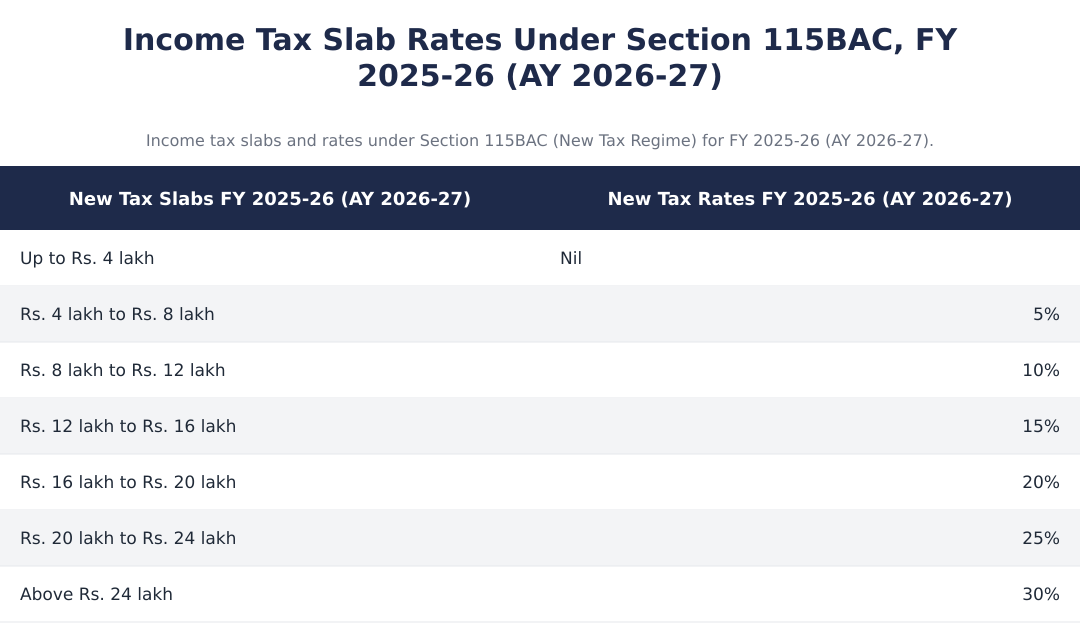
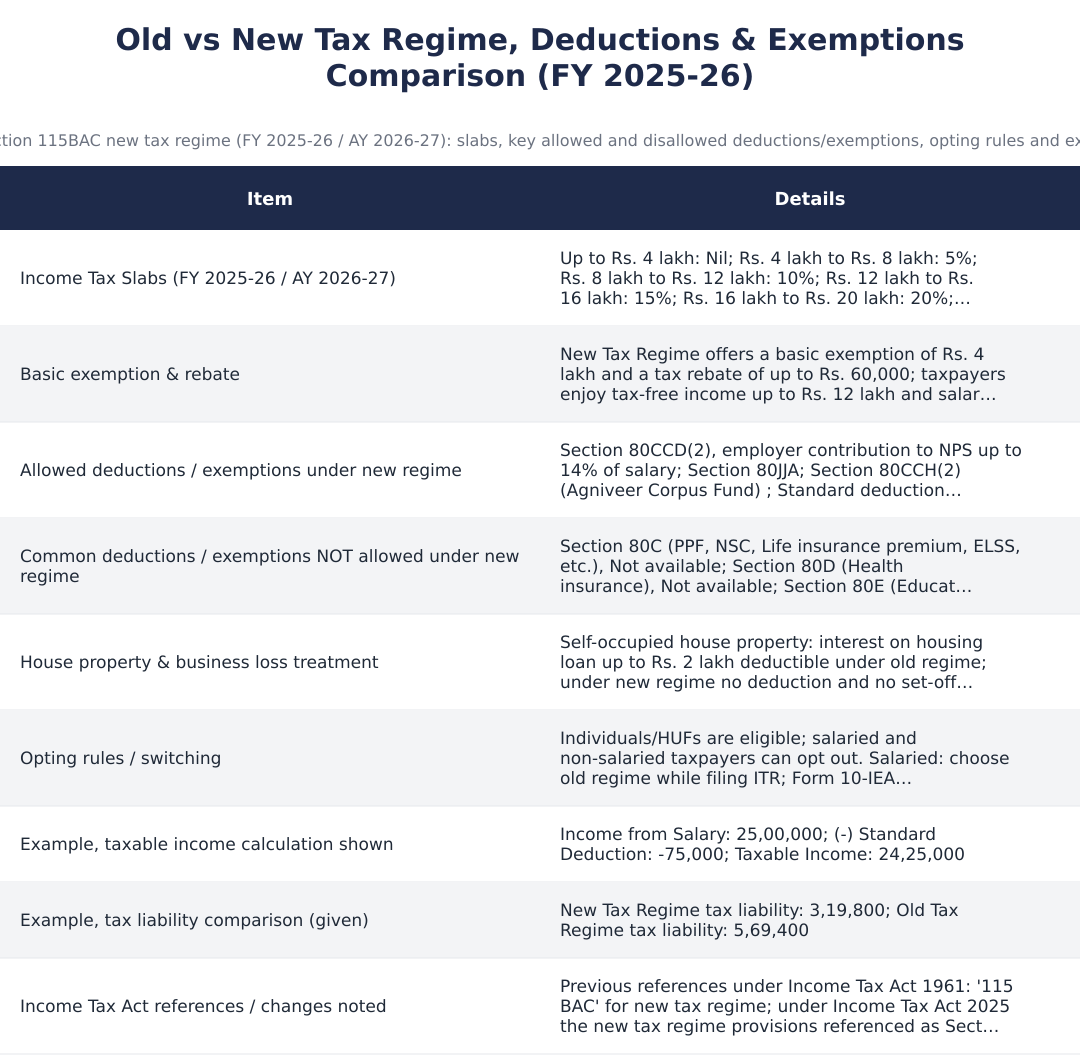
Under Section 115BAC for FY 2025-26 the income tax slabs are: nil up to ₹4 lakh, 5% for ₹4–8 lakh, 10% for ₹8–12 lakh, 15% for ₹12–16 lakh, 20% for ₹16–20 lakh, 25% for ₹20–24 lakh and 30% above ₹24 lakh. These rates apply to individuals and HUFs who opt for the new regime and are exclusive of cess and applicable surcharge. The regime also offers other features like a higher standard deduction and a rebate which affect final tax payable. Use these slab breakpoints when computing taxable income under the new regime.
Is there a rebate under the new tax regime and how much can I get?
Yes, the new tax regime provides a rebate of up to ₹60,000 (under section 87A as applicable) which can reduce your final tax liability. Practically this means taxpayers with modest taxable income may get tax reduced to zero subject to the rebate conditions and taxable-income thresholds. The rebate interacts with the slab rates, for instance, taxpayers whose computed tax before rebate is ≤ ₹60,000 will see their tax reduced accordingly. Check your taxable income after deductions allowed under the new regime to know if you qualify for the full rebate.
Who is eligible to opt for Section 115BAC (the new tax regime)?
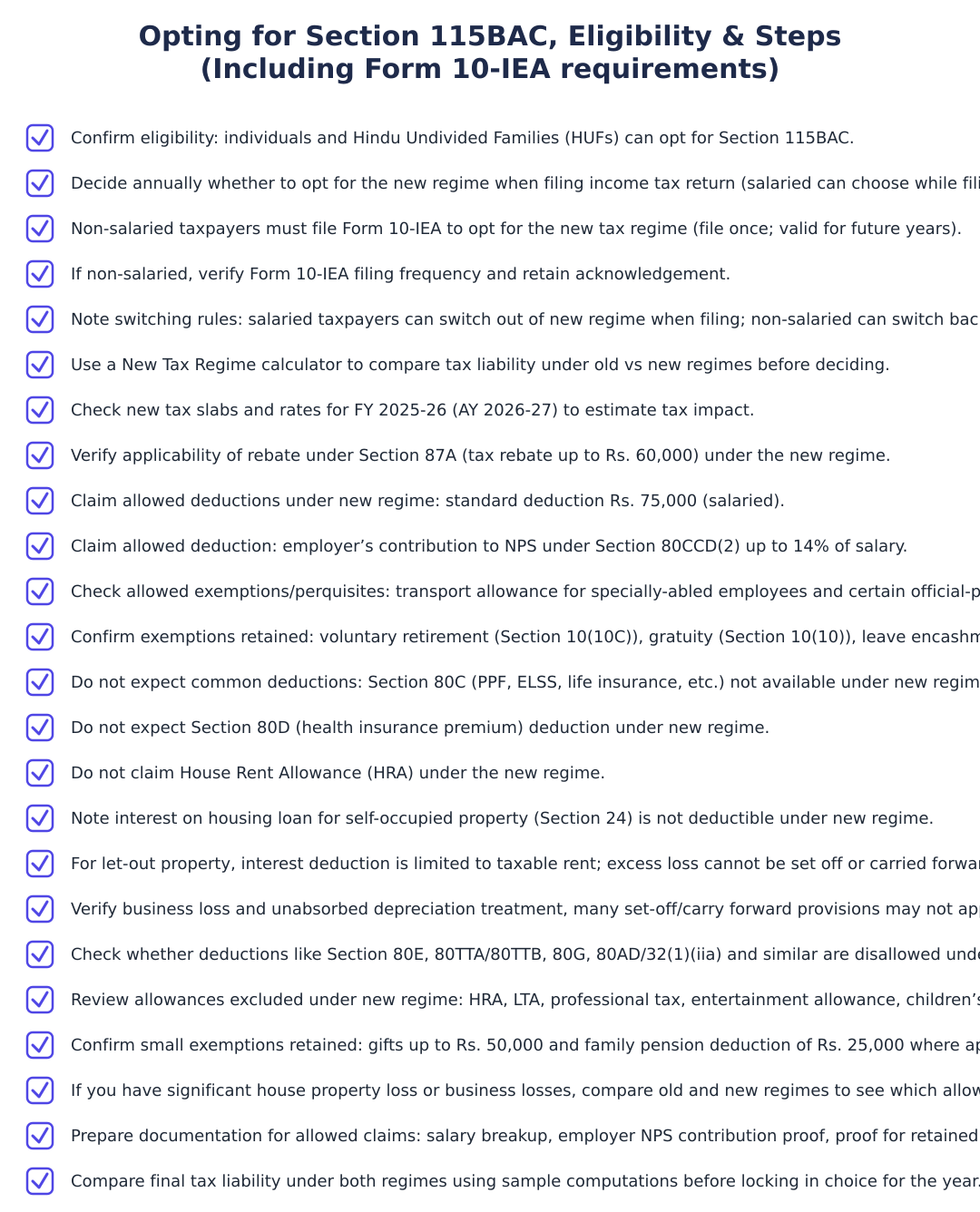
Individuals and Hindu Undivided Families (HUFs), including resident and non-resident taxpayers and senior citizens, are eligible to opt for Section 115BAC. The new regime is available as the default option for FY 2025-26 but taxpayers can choose the old regime if it results in a lower tax liability. Certain procedural differences apply: salaried taxpayers can simply choose the old regime while filing the ITR, whereas non-salaried taxpayers must file Form 10-IEA to opt out and that filing is generally a one-time exercise valid for future years. HUFs can also opt in or out subject to the same procedural rules that apply to individuals.
Which deductions and exemptions are allowed under the new tax regime?
The new tax regime allows a limited set of deductions and exemptions: a standard deduction of ₹75,000 for salaried taxpayers, employer’s contribution to NPS under section 80CCD(2) up to 14% of salary, certain additional deductions like section 80JJAA, and specific exemptions such as transport allowance for specially-abled employees and certain duty-related travel allowances. Additionally, exemptions like voluntary retirement (section 10(10C)), gratuity and leave encashment under specified sections remain available. While the list is narrow, these permitted items should be included when computing taxable income under Section 115BAC.
Which common deductions and exemptions are not available under Section 115BAC?
Many widely used deductions are not permitted under the new tax regime, Section 80C (₹1.5 lakh investments like PPF/ELSS), Section 80D (health insurance), HRA, Section 24 interest on self‑occupied home loan (₹2 lakh), 80TTA/80TTB (savings interest), 80E, 80G, professional tax, entertainment allowance and most special allowances are not available. Business-related deductions like additional depreciation under section 32(1)(iia) and several investment‑linked or sectoral deductions (sections 32AD, 35AD, 35CCC, etc.) are also excluded. Because of these exclusions, taxpayers who rely on these deductions should run a comparison between the old and new regimes before opting in.
How does house property income and housing loan interest work under the new regime?
Under the new tax regime deduction for interest on self‑occupied house loan (section 24 up to ₹2 lakh) and set‑off of house property loss against other income are not allowed. For let‑out property interest is limited to taxable rent and excess loss cannot be set off or carried forward under the new regime. This means taxpayers with significant housing loan interest or recurring property losses will often find the old regime more beneficial because those deductions and loss‑set‑off rules are preserved there.
Can I switch out of the new tax regime once I’ve chosen it, and what is the process?
Yes, you can switch out of the new tax regime; salaried taxpayers may simply select the old regime while filing the ITR for that year, whereas non‑salaried taxpayers must file Form 10‑IEA to opt out, filing is generally required once and remains valid for subsequent years. Switching back from old to new is allowed but for non‑salaried taxpayers there can be restrictions (for example, switching back to the new regime may be allowed only once in a lifetime). Make the choice based on a year‑by‑year tax comparison because the availability of deductions and set‑offs differs significantly between regimes.
How do I calculate income tax under the new regime, any example?
To calculate tax under the new regime first compute total income, subtract only the deductions allowed under Section 115BAC (for example standard deduction ₹75,000 and employer NPS contribution up to 14% of salary), then apply the new slab rates and finally apply rebate/cess/surcharge as applicable. Example from the guide: a salaried taxpayer with salary ₹25,00,000 minus standard deduction ₹75,000 gives taxable income ₹24,25,000; using the new slabs the computed tax was ₹3,19,800 versus ₹5,69,400 under the old regime, showing potential savings. Always verify with actual numbers and include cess and any surcharge when finalising tax payable.
What are the main benefits of choosing Section 115BAC compared with the old regime?
The main benefits of Section 115BAC are simplified tax computation with lower slab rates at many income levels, a higher standard deduction (₹75,000), limited but targeted deductions like employer NPS contribution (80CCD(2)) and special allowances for official travel or for specially‑abled transport, and a rebate that can reduce tax up to ₹60,000. The regime reduces compliance and investment‑related paperwork because many popular investment‑linked deductions (like 80C and 80D) are not required, which may suit taxpayers who prefer lower documentation and simpler filing. However, taxpayers with large deductible items (home‑loan interest, 80C investments, business depreciation) should compare both regimes to decide which yields lower tax.
Need help staying Income Tax compliant?
MoneyGence's AI Finance OS tracks your compliance, wallet share, and finances in one place, built for agencies and growing businesses.
Get started with MoneyGence