Section 193 TDS: Interest on Securities | Guide & Rates
This guide explains Section 193 of the Income Tax Act, the provision that governs Tax Deducted at Source (TDS) on interest paid on securities. You will learn who is required to deduct TDS under this section, what constitutes interest on securities in broad terms, which details must be recorded when deducting TDS, and the consequences of delayed deduction or payment. Understanding Section 193 matters for treasurers, company secretaries, finance teams, mutual fund and bond issuers, and investors: non-compliance can trigger interest liabilities and administrative follow-up. This guide focuses on the legal obligation to deduct tax at source when paying interest on securities, the information required in TDS records, and the two-tier interest penalty framework that applies when deduction or deposit is delayed. It does not provide every operational deadline or the specific prescribed rates (these are set elsewhere), but it will clarify practical responsibilities under Section 193 and what information must accompany a TDS transaction to ensure transparency and easier compliance.
What is Section 193?
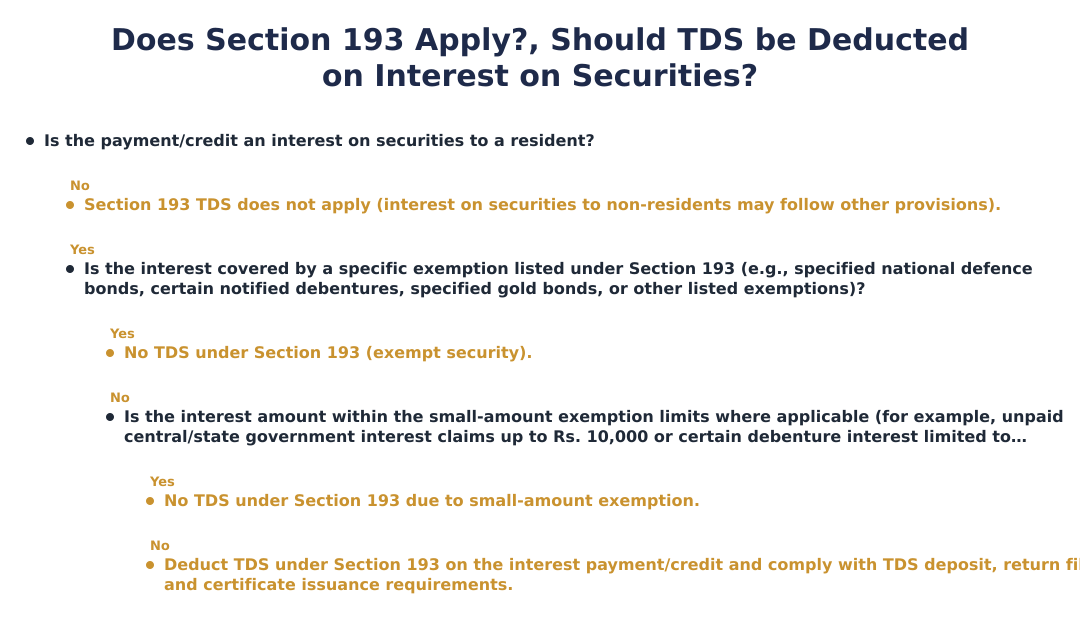
Section 193 of the Income Tax Act deals specifically with the deduction of tax at source on interest paid on securities. The provision makes it obligatory for any person who is responsible for making such interest payments to deduct tax at the rate prescribed under the law at the time of payment or credit, as applicable.
In practical terms, Section 193 places the initial compliance duty on the payer of interest rather than on the recipient. That means organisations or persons disbursing interest on securities must incorporate TDS deduction into their payment processes so that tax is withheld at source in accordance with the prescribed rate.
What is Interest on Securities?
Interest on securities broadly refers to any financial return payable to the holder of a security as remuneration for lending funds, holding a bond, debenture, or similar instrument. The concept covers periodic coupon payments, and in certain circumstances may include other income components linked to the security that are treated as interest under tax law.
For compliance under Section 193, the critical point is whether an outflow from the payer to the holder is characterised as interest on a security, if it is, the payer must consider the TDS obligation. The exact boundary of what is treated as interest is determined by the statute and relevant rules, so payers commonly consult their tax advisors when structuring payments to ensure correct treatment.
Who Should Deduct the Tax?
Under Section 193, the person responsible for making the payment of interest on a security is required to deduct tax. This places the primary compliance responsibility on the payer rather than the recipient, so any entity or individual that pays interest on securities must evaluate whether TDS applies before disbursing funds.
Because the obligation is on the payer, organisations typically embed TDS checks into their payment workflow: verifying whether the payment is classed as interest on a security, applying the prescribed rate, and capturing the requisite deductor and payee details. Where there is uncertainty about classification, obtaining tax advice helps avoid downstream disputes or interest liabilities.
Details to record when deducting TDS under Section 193
| Required detail |
|---|
| Deductor’s name and PAN details |
| Payee’s name and PAN details |
| TDS amount |
| Other relevant information |
Penalties if TDS is Delayed Under Section 193
Section 193 is backed by an interest-based penalty structure that applies when tax is not deducted or when deducted tax is not paid to the government on time. The regime uses two separate interest calculations to capture delay at two stages: the delay in deduction and the delay in deposit.
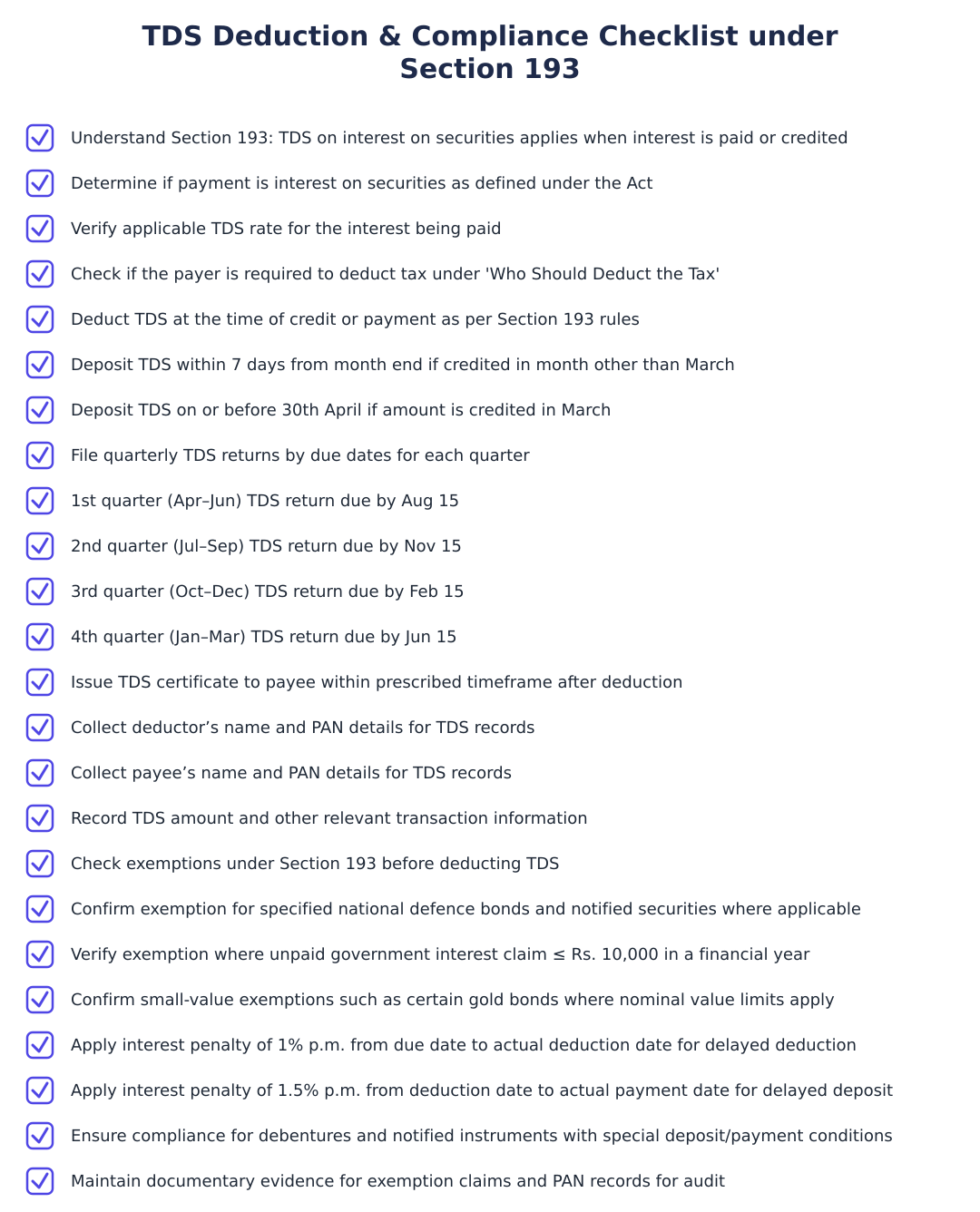
If the payer fails to deduct tax when it should have been deducted, interest is charged at 1% for every month or part of a month on the tax amount from the date the tax was supposed to be deducted to the date it is actually deducted. After the tax is deducted, if the payer then delays in depositing that deducted tax with the government, interest is charged again at 1.5% for every month or part of a month on the tax amount from the date when the tax was deducted to the date it is paid to the government. These two components are applied sequentially and are intended to incentivise timely deduction and prompt remittance.
Section 193 places the onus of deducting TDS on interest on securities squarely on the payer and requires accurate recording of key details such as deductor/payee names, PANs and TDS amounts. Non-compliance triggers an interest-based penalty framework that first charges interest for failure to deduct and then additional interest for failure to remit deducted tax. For operational compliance, organisations should ensure payment processes capture the necessary information and consult tax advisors for specific rates and timelines that apply in their situation.
Frequently asked questions
What exactly does Section 193 of the Income Tax Act cover?
Section 193 of the Income Tax Act requires that tax be deducted at source (TDS) on interest paid on securities by the person responsible for making the payment. This means any person (resident or non-resident) paying interest on securities such as government securities, debentures or other notified instruments to a resident payee must deduct tax at the prescribed rate before making the payment. The provision covers interest on securities as defined under section 2(28B) and applies unless a specific exemption or a lower withholding certificate is available. Failure to deduct and deposit TDS attracts interest and penalties under the Act.
What is considered 'interest on securities' under Section 193?
Interest on securities under Section 193 includes interest payable on securities issued by the central or state government, debentures, or securities issued by local authorities or corporations as defined in section 2(28B) of the Income Tax Act. In practice this covers coupon payments on government bonds, interest on notified debentures, and other similar interest-bearing instruments specified by law. The definition is broad and includes interest whether paid periodically or on maturity, subject to any specific notifications or exclusions in the statute. If you receive such interest and you are a resident payee, the payer must normally deduct TDS before making the payment.
What is the TDS rate on interest on securities under Section 193?
TDS on interest on securities under Section 193 is to be deducted at the rate prescribed by the Income Tax Act, which is commonly applied at 10% for resident payees unless a different statutory rate or exemption applies. The actual rate may change by finance act or specific notifications, and non-resident or special instruments may attract different withholding rates as per tax treaties or other provisions. If the payee provides a valid declaration, exemption, or lower withholding certificate, the payer must apply that instead of the standard rate. Always check the latest finance act or official notifications for current applicable rates before deducting.
Who is required to deduct TDS on interest under Section 193?
Any person responsible for paying interest on securities to a resident must deduct TDS under Section 193 before making the payment. This includes companies, financial institutions, government authorities, trustees, or any other payer of interest on specified securities. If the payer fails to deduct TDS, they become liable for the tax amount plus interest and penalties for late deduction and deposit. The obligation to deduct applies irrespective of whether the payer is a resident or non-resident, subject to the Act's other provisions and treaty relief if applicable.
What are the common exemptions from TDS under Section 193?
Certain securities and payees are exempt from TDS under Section 193 as specifically notified or by virtue of limits and conditions; examples include some national defence bonds with low interest, specified savings certificates, small-value unpaid central or state government interest claims up to Rs.10,000 in a financial year, and some old gold bonds with limited nominal value. Other exemptions include specific notified debentures, interest on listed dematerialised securities for listed companies, and cases where the instrument or payee is expressly excluded by law or notification. Each exemption has distinct conditions (for example, nominal value caps or requirement of listed/dematerialised status), so verify the exact notification or rule that grants the exemption before relying on it.
How is TDS actually deducted, can you give a simple example under Section 193?
TDS under Section 193 is deducted when interest on securities is paid or credited; for example, if a company pays Rs.100,000 interest on a debenture to a resident and the applicable TDS rate is 10%, the company must deduct Rs.10,000 as TDS and pay the net Rs.90,000 to the payee. The deducted TDS must be deposited with the government within the specified time limits and reported in the payer’s TDS return for the relevant quarter. The payer must also furnish a TDS certificate to the payee showing details such as payer and payee PAN, TDS amount and other particulars to enable the payee to claim credit while filing income tax returns.
What are the due dates for depositing TDS deducted under Section 193?
The due date for depositing TDS under Section 193 depends on when the interest is credited: if the interest is credited in March, the TDS must be deposited on or before 30th April; if credited in any other month, the TDS must be deposited within 7 days from the end of that month. These timelines ensure timely remittance to the government and alignment with the quarterly TDS return cycle. Missing these deadlines leads to interest and potential penalties under the Income Tax Act, so payers should plan deposits immediately after deduction.
What penalties or interest apply if TDS under Section 193 is delayed?
If TDS is not deducted on time, interest at 1% per month or part of a month is payable on the tax amount from the date it was supposed to be deducted to the date it was actually deducted; additionally, if the deducted tax is not paid to the government on time, interest at 1.5% per month or part of a month is payable from the date of deduction to the date of payment. These interest provisions are cumulative and calculated separately for delay in deduction and delay in deposit, increasing the total liability for the deductor. Beyond interest, the deductor may also face penalties and prosecution risks under the Income Tax Act for failure to comply with TDS obligations.
When and how must the TDS certificate for interest under Section 193 be issued?
The deductor must issue a TDS certificate (Form 16A) to the payee showing details such as the deductor and payee names and PANs, the amount of TDS deducted, and other relevant particulars, and this is normally issued after the TDS return for the quarter is filed. The certificate enables the payee to claim credit for the tax deducted in their income tax return and typically contains the challan details of deposit and quarter-wise breakup. While exact timing is governed by the Income Tax Rules, in practice certificates are issued soon after the quarterly TDS filing deadlines to ensure payees get proof of deduction for filing returns.
Need help staying TDS compliant?
MoneyGence's AI Finance OS tracks your compliance, wallet share, and finances in one place, built for agencies and growing businesses.
Get started with MoneyGence