Section 194 TDS on Dividend: Thresholds, Rates & FY 2025–26 Updates
This guide explains the mechanics and practical implications of TDS on dividends under Section 194 of the Income Tax Act, with a focus on the 2025–26 period. You will learn what Section 194 covers, who generally falls within its scope, how dividend income is ultimately taxed for recipients, and where to look for official updates or exemptions that can change withholding obligations. Although withholding rules are administered at the time of payment, ultimate tax liability on dividend income follows the recipient’s applicable slab rates, so understanding both deduction at source and end-of-year tax treatment matters for cashflow, compliance, and accurate reporting. The guide also highlights how taxpayers can confirm that the TDS deducted by payers has been credited to their tax account (through Form 26AS and the AIS) and why keeping an eye on government notifications is important because the central government can notify institutions that are exempt from TDS under this section. Read on for clear explanations of applicability, what to watch for in the 2025–26 window, steps to verify TDS credit, and practical FAQs to help you stay compliant and avoid surprises at assessment time.
TDS under Section 194 - Applicability
Section 194 provides for tax deduction at source (TDS) on dividends. The provision requires a payer, typically the entity making a dividend payment, to consider withholding tax at the time of payment, as part of the statutory TDS framework.
Understanding that withholding is a pre-payment mechanism is important: TDS reduces the immediate cashflow to the payee but does not determine the final tax outcome. The payer’s responsibility to deduct at source keeps the tax system efficient by collecting tax closer to the point of distribution of income.
New TDS Threshold for FY 2025-26
Thresholds and specific numeric limits that determine when TDS must be deducted can be updated by the government from year to year. For taxpayers and payers operating in FY 2025–26, it is therefore important to consult the official notifications, circulars or the Finance Act text for that year to know precise numeric triggers.
In practice, businesses and investors should monitor authoritative sources (income-tax department releases and the Finance Act) so they apply any changed threshold correctly at the time of dividend payment. Changes to thresholds affect who must deduct TDS and can materially change the compliance burden for payers.
TDS Rates under Section 194 for 2026
While TDS is deducted at the time of dividend distribution under Section 194, the ultimate tax on dividends for the recipient is determined by the recipient’s applicable slab rates. This means the recipient’s final tax liability will be computed as per regular income-tax rules and slab rates applicable to their residential status and total income.
For payers and recipients planning for FY 2025–26 and the calendar year 2026, it is critical to distinguish between the withholding action (TDS at source) and the recipient’s final tax computation. Any adjustment, credit, or refund related to excess TDS will arise when the individual files their income-tax return and claims credit for tax already deducted.
Institutional Exemptions
The central government has the power to notify specific institutions as exempt from TDS under Section 194. Such exemptions are issued by notification in the official gazette and can affect particular payees or categories of institutions.
Payers should keep an updated list of exempt entities as per the latest notifications before deciding whether to deduct TDS. Relying on outdated information can lead to improper withholding or unnecessary compliance work for both payers and recipients.
Verifying Tax Credit in Form 26AS & AIS
Payees should obtain their Form 26AS and Annual Information Statement (AIS) from the income-tax portal or their account to see recorded TDS entries.
Compare the TDS entries in Form 26AS/AIS against dividend statements or payee records to ensure amounts deducted by payers are accurately reported.
If entries in Form 26AS or AIS do not reflect the TDS you expect, follow the prescribed mismatch resolution process with the payer and the tax department to claim proper credit.
Frequently Asked Questions
Q: Does Section 194 mean the dividend is taxed only once? A: No. Section 194 relates to withholding tax at the point of distribution. The dividend remains taxable in the hands of the recipient and is ultimately taxed according to the recipient’s applicable slab rates.
Q: Where do I check whether my TDS on dividends has been credited? A: Payees should verify TDS credit and related entries in Form 26AS and the Annual Information Statement (AIS). These records show taxes reported and credited against the taxpayer’s PAN.
Staying compliant with Section 194 requires understanding that TDS on dividends is a withholding mechanism while the recipient’s ultimate tax is governed by their slab rates. Keep abreast of official notifications for any exemptions the government may publish, and always verify TDS credits in Form 26AS and the AIS so you can reconcile payments and claim correct credit at the time of filing your return.
Frequently asked questions
Who has to deduct TDS on dividend under Section 194?
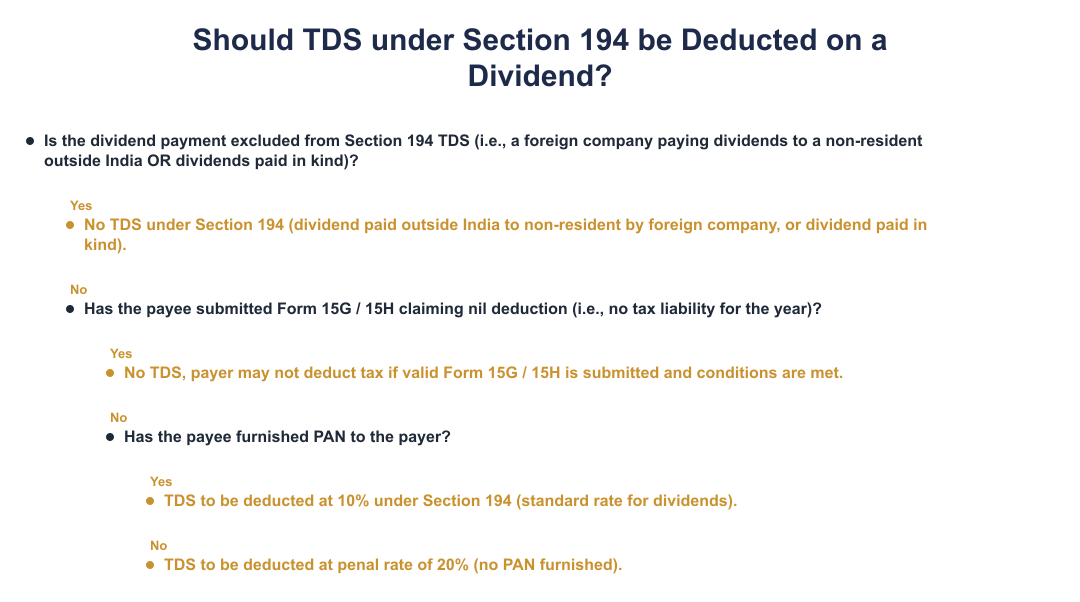
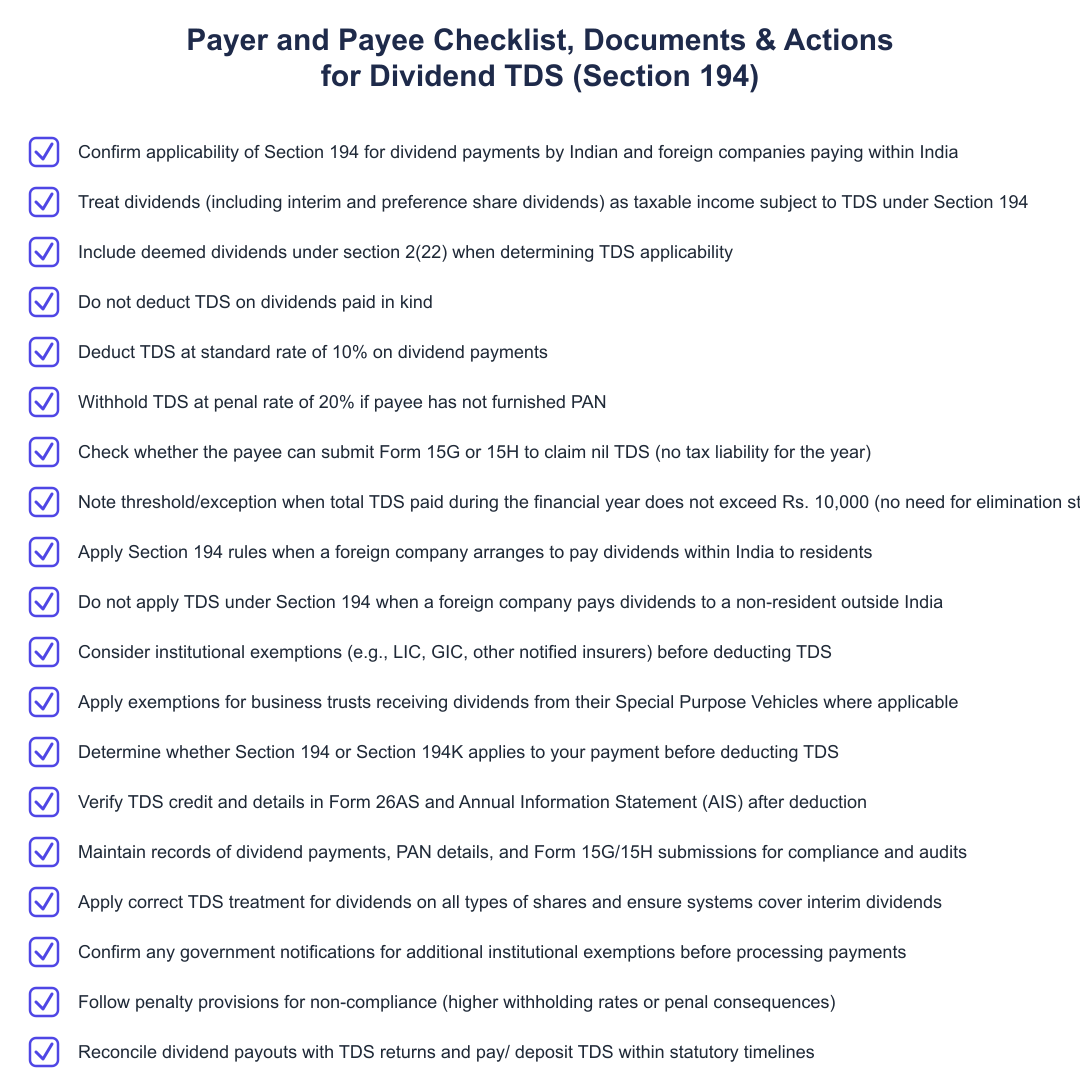
The payer (the company or entity paying the dividend) must deduct TDS under Section 194 when it pays dividends to shareholders in India. This applies to Indian companies paying dividends and foreign companies that have arrangements to pay dividends within India; payments by a foreign company to shareholders outside India are not subject to Section 194. The provision covers dividends on equity and preference shares and also deemed dividends under section 2(22), while dividends paid in kind are excluded. TDS must be deducted even for interim dividends and when the recipient is a resident or non-resident whose Indian income is taxable.
What is the new TDS threshold for dividend payments for FY 2025–26?
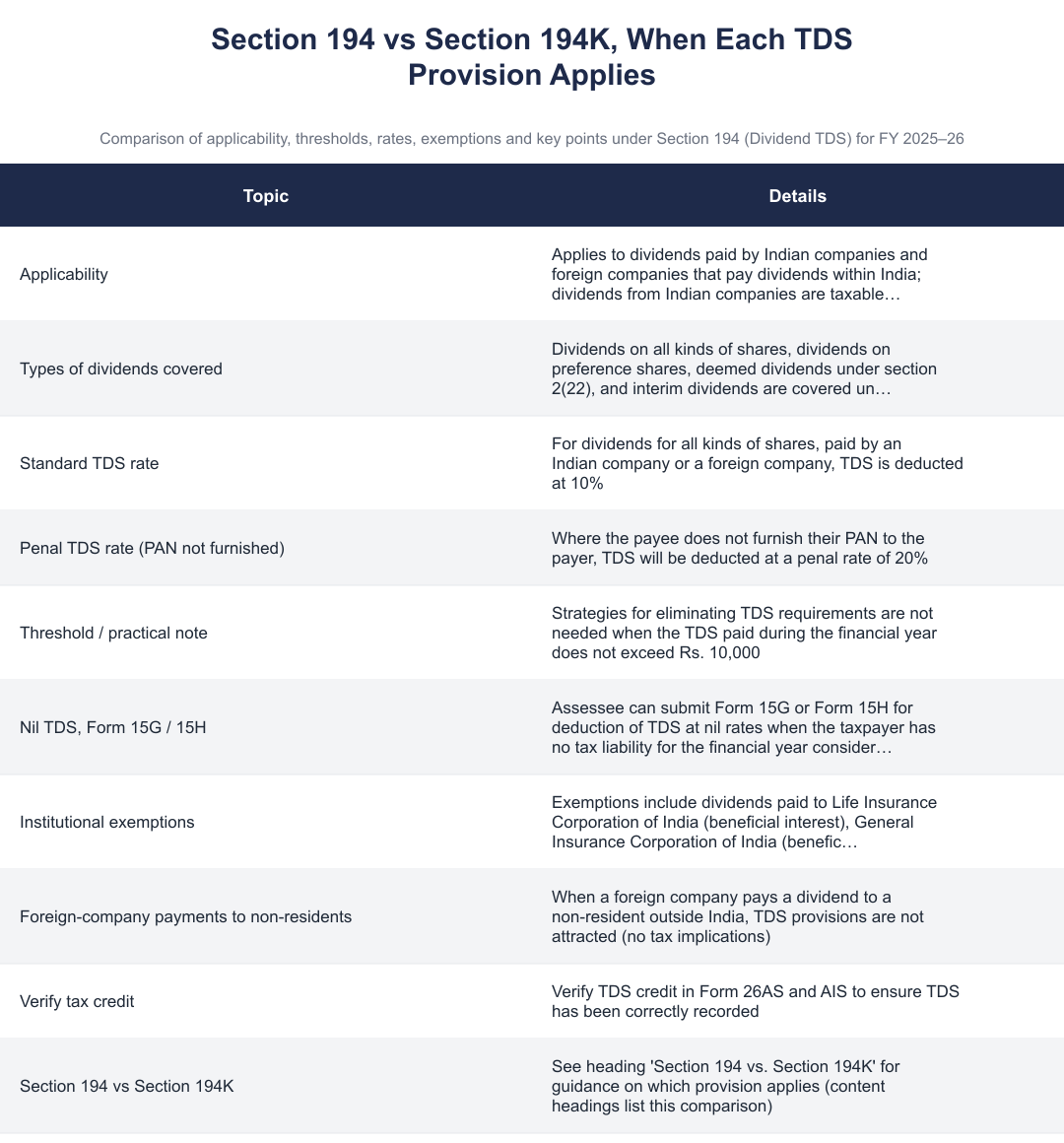
For FY 2025–26, no TDS is required on dividend payments if the total TDS liability on such payments during the financial year does not exceed Rs. 10,000. This means payers need not worry about TDS compliance for dividends when their cumulative TDS on dividend payments in the year remains at or below Rs. 10,000. If cumulative TDS exceeds Rs. 10,000, the payer must deduct TDS as per the applicable rates and remit it to the government. The Rs. 10,000 limit is evaluated across the financial year, not per transaction.
What is the standard TDS rate on dividends under Section 194 for residents?
The standard TDS rate on dividends under Section 194 for resident payees is 10%. This 10% rate applies to dividends paid on all kinds of shares by Indian companies and by foreign companies that pay dividends in India. Tax is to be deducted at the time of payment or credit, whichever is earlier, and deposited with the government. Recipients can claim the TDS as tax paid while filing their income tax returns, where dividends are taxed at the recipient's applicable slab rate.
What happens if the payee does not furnish PAN to the payer?
If the payee does not furnish their PAN to the payer, TDS on dividends will be deducted at a higher, penal rate of 20%. This penal rate is mandatory and applies irrespective of the normal 10% rate, increasing the tax withheld at source. The payer should deduct TDS at 20% and report the same in TDS returns; the payee can later claim credit for the higher TDS while filing their income tax return, provided PAN is quoted subsequently. It is therefore important for recipients to provide PAN to avoid higher withholding.
When can a recipient submit Form 15G/15H to avoid TDS on dividends?
A recipient can submit Form 15G (for individuals other than seniors) or Form 15H (for senior citizens) to the payer to claim nil deduction of TDS on dividends if they have no tax liability for the financial year considering all sources of income. These forms are eligible only when the recipient’s total estimated tax liability is nil, and they must be furnished before each payment where they seek non-deduction. If accepted by the payer, no TDS will be withheld on dividend payments, but incorrect submission may lead to penalties, so the recipient should ensure their total income indeed results in zero tax. The forms are not valid if the payer is legally required to deduct TDS (for example, where lower deduction certificates or other conditions are not met).
Which institutions are exempt from TDS on dividends under Section 194?
Certain institutional recipients are exempt from TDS on dividends under Section 194 as notified by the government, including Life Insurance Corporation of India, General Insurance Corporation of India, other insurers holding beneficial interest, and qualifying business trusts receiving dividends from their special purpose vehicles. The central government can notify additional institutions in the official gazette that will also be exempt. Payers should verify the recipient’s eligibility and maintain records of the exemption notification to support non-deduction. Exemptions are specific and must be confirmed against the latest government notifications and the recipient’s status.
How does Section 194 differ from Section 194K for dividend-like payments?
Section 194 applies to dividends paid by companies (including preference and deemed dividends), while Section 194K applies to dividends and certain income distributions from mutual funds and securities transaction-related payments. In practice, dividends from mutual funds are subject to Section 194K, not Section 194, so mutual fund houses deduct TDS under 194K at its prescribed rates. For direct shareholding in companies, Section 194 governs TDS, and payers should identify the nature of the payer (company vs mutual fund) to determine the correct section. Misclassification can lead to incorrect TDS deduction and difficulties in claiming tax credits.
How can I verify that dividend TDS has been credited to my account in Form 26AS or AIS?
You can verify dividend TDS credits by checking Form 26AS and the Annual Information Statement (AIS) in your income tax account, where TDS deducted by the payer should appear against your PAN. Form 26AS consolidates TDS/TCS details reported by deductors and is updated periodically, while AIS provides additional transaction-level information; any TDS on dividends should be visible with the deductor’s TAN, amount, and date. If TDS is missing or incorrect, contact the payer to file corrected TDS returns or raise a grievance with the tax department; retain dividend payment proofs and communication for reconciliation. Regularly reviewing Form 26AS helps ensure you claim correct tax credit while filing your return.
Need help staying TDS compliant?
MoneyGence's AI Finance OS tracks your compliance, wallet share, and finances in one place, built for agencies and growing businesses.
Get started with MoneyGence