Section 194A TDS: TDS on Interest (Rates, Thresholds & Deposit Rules)
This guide explains Section 194A, the Income Tax Act provision that governs deduction of tax at source (TDS) on interest other than interest on securities. You will learn what payments fall under this section, who it applies to, the basic compliance responsibilities of the payer, how a recipient can avoid or obtain a lower rate of deduction where permitted, and the statutory timeline for depositing TDS. Understanding Section 194A matters because interest payments are a common outflow for banks, financial institutions, and many entities; incorrect handling of TDS can lead to disputes, interest, or penalties for the payer and unexpected tax withholding for the recipient. This article summarises the practical implications and the administrative routes available to recipients (declarations and certificates) so both payers and recipients know their rights and duties under the law.
What is Section 194A?
Section 194A of the Income Tax Act, 1961 mandates the deduction of tax at source on interest other than interest on securities. In plain terms, when certain persons make interest payments to residents (except interest on securities), the law requires tax to be deducted at the time of payment or credit, and remitted to the government by the payer.
The provision is intended to ensure collection of tax at the point of payment and to create a record of taxable receipts for the recipient. It places a compliance obligation primarily on the payer (the deductor) to deduct and deposit tax timely, and to furnish appropriate information to the tax authorities and payees.
Applicability of Section 194A
Section 194A applies only to residents. That means interest payments made to resident recipients (other than interest on securities) fall within the scope of this section. Payments of interest to non-residents are not covered by Section 194A; instead, such payments are governed by Section 195 of the Income Tax Act.
For payers, this distinction is important because different withholding rules, rates, documentation and procedures apply for resident versus non-resident recipients. Payers must therefore determine the residential status of the recipient and apply the correct withholding provisions to avoid misapplication of the law.
When is TDS under Section 194A Deducted?
The statutory framework makes the payer (the person responsible for making the interest payment) responsible for deducting TDS under Section 194A where the provision applies. Practically, this means the payer must assess whether the payment falls under Section 194A and, when required, deduct tax at the point of payment or credit to the recipient.
Failure by the payer to deduct TDS when required can expose the payer to compliance consequences, because the onus of deduction and deposit lies with the payer. Recipients should also be aware of this because they may receive net payments that are subject to withholding; recipients can use available declarations or certificates to avoid or reduce withholding where eligible.
What is the rate of TDS?
Specific TDS rates and threshold limits for Section 194A are set out in tax rules and notifications, but those specific figures and conditions are not reproduced in this guide. Rates can vary depending on factors such as the type of payer, the nature of the recipient and whether prescribed documentation (for example, PAN) has been furnished.
If you need the exact rate or threshold applicable to a particular payment, consult the official Income Tax notifications, speak with your tax advisor, or review guidance issued by the tax department. Payers should ensure they apply the correct rate to avoid under- or over-deduction.
When is Tax Deducted at NIL Rate or Lower Rate?
Recipients have two principal administrative options to prevent or reduce TDS at source where conditions are satisfied. First, resident recipients whose total tax liability is nil (or who meet the form conditions) can submit Form 15G (for non-senior citizens and certain others) or Form 15H (for senior citizens) to the payer. When a valid declaration is made and the payer accepts it, the payer should not deduct TDS on the relevant interest payments.
Second, a recipient may apply to the Assessing Officer under Section 197 (using Form 13) to obtain a certificate authorising the payer to deduct tax at a lower rate or not to deduct tax. This certificate, once issued, is provided to the payer and governs the rate of deduction for the period specified in the certificate. Both routes require adherence to the conditions laid down in the relevant forms and rules; payers should verify and retain copies of submitted declarations or certificates before adjusting withholding.
What is the Time Limit for Depositing TDS?
There is a statutory timeline for depositing tax deducted under Section 194A. Tax deducted during the months April through February must be deposited on or before the 7th day of the month following the month in which the deduction was made.
For tax deducted in the month of March, the deposit deadline is on or before 30th April. Adhering to these timelines is critical because delayed deposits can attract interest and other compliance consequences; payers should maintain processes to ensure timely remittance each month.
Frequently Asked Questions
Q: Does Section 194A apply to payments made to non-residents? A: No. Section 194A is applicable only to residents. Payments to non-residents are covered under Section 195.
Q: How can a recipient avoid TDS on interest? A: A resident recipient who meets the conditions can submit Form 15G (or Form 15H if a senior citizen) to the payer to avoid deduction. Alternatively, a recipient can seek a lower or nil deduction certificate from the Assessing Officer under Section 197 (Form 13).
Section 194A creates a clear withholding obligation on payers for interest (other than interest on securities) paid to residents, and provides recipients with administrative mechanisms (declarations and AO certificates) to prevent or reduce withholding where appropriate. Payers must also follow the statutory deposit timelines to avoid compliance issues. For transaction-specific rates, thresholds or procedural forms, consult the official Income Tax guidance or a qualified tax advisor.
Frequently asked questions
What is Section 194A of the Income Tax Act?
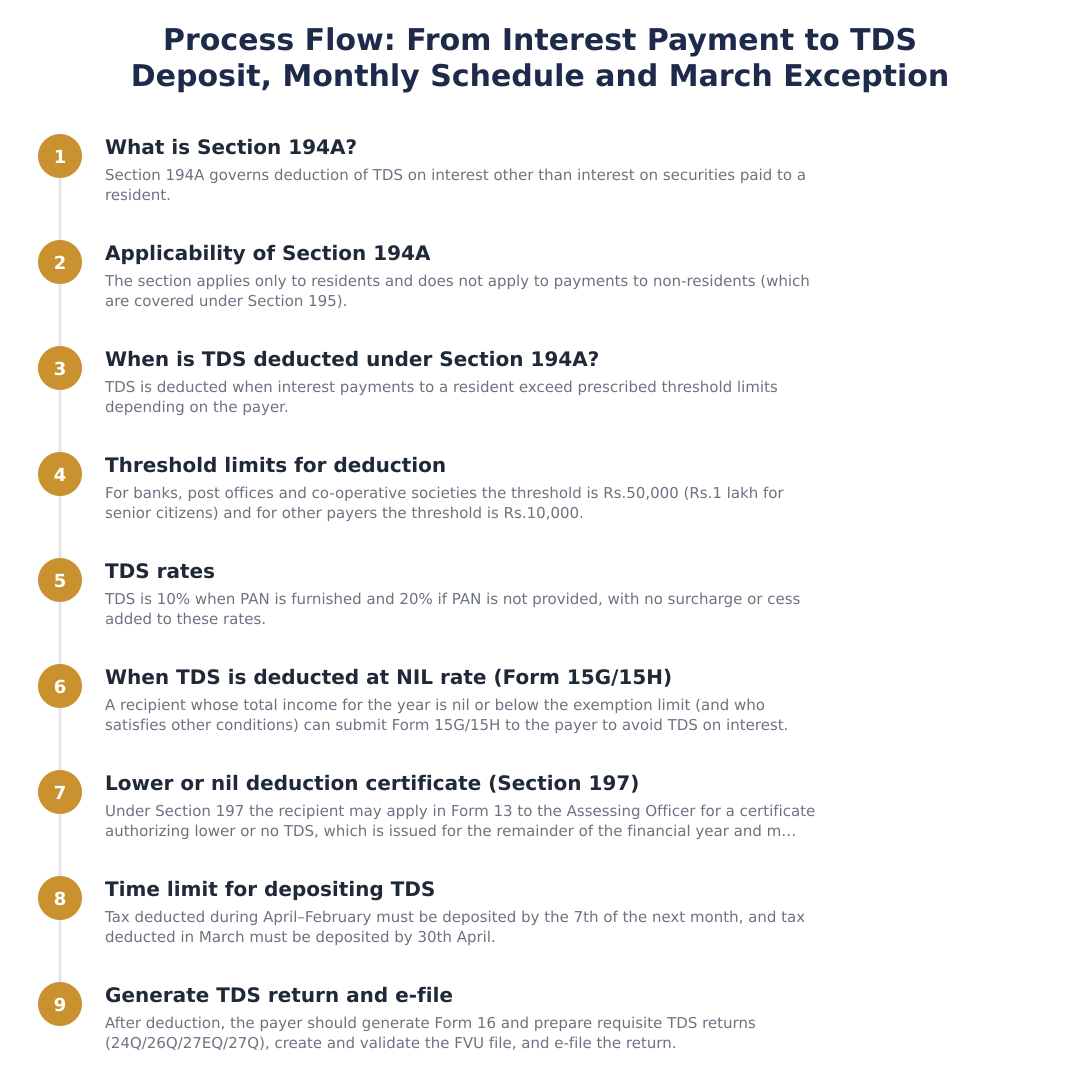
Section 194A requires deduction of tax at source (TDS) on interest other than interest on securities when interest is paid or credited to a resident. It covers interest paid by banks, post offices, cooperative societies, companies and other payers on deposits, loans, advances and similar payments. The section specifies threshold limits for when TDS must be deducted, the TDS rates (10% with PAN, 20% without PAN) and special higher thresholds for senior citizens for certain payers. Payments to non-residents are not covered by Section 194A and are dealt with under Section 195.
Who is responsible for deducting TDS under Section 194A?
The person making the payment of interest (the payer or deductor) is responsible for deducting TDS under Section 194A. That includes banks, post offices, cooperative societies, companies, and other individuals or entities paying interest where thresholds are crossed. The deductor must deduct at the prescribed rate, deposit the tax within prescribed timelines and issue TDS certificates/forms to the payee. If the payer fails to deduct, they may be liable for interest and penalties under the Income Tax Act.
What are the threshold limits for TDS under Section 194A?
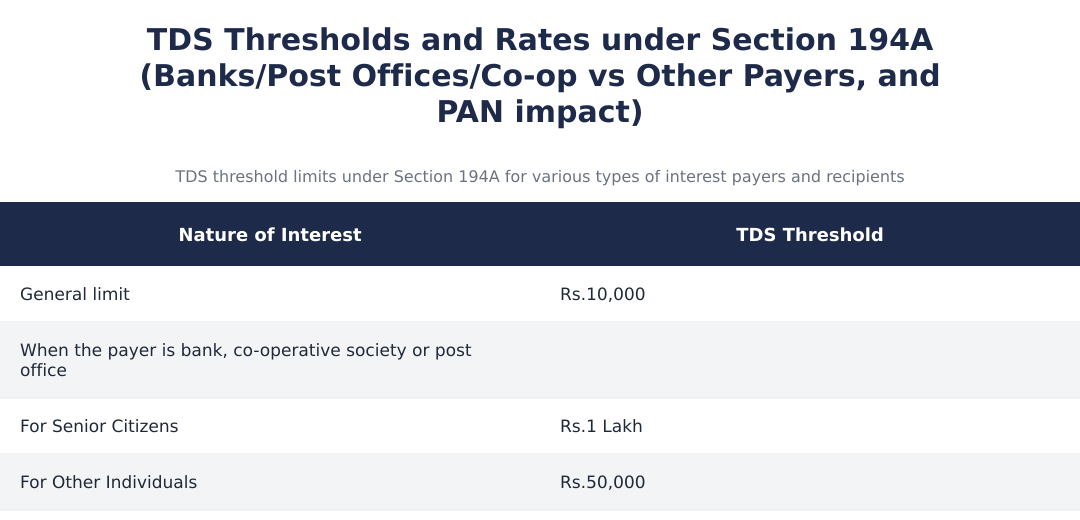
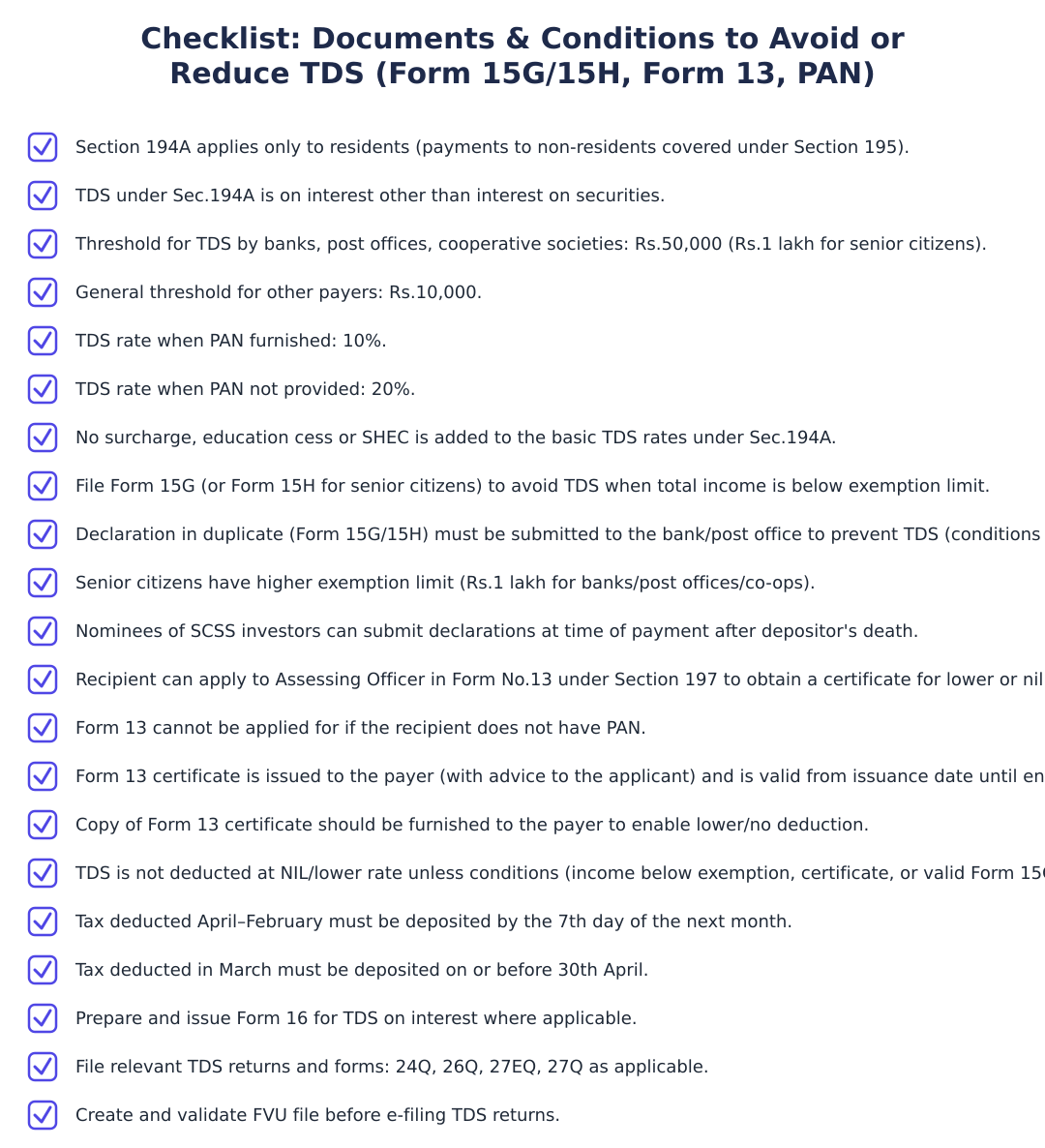
TDS under Section 194A is required only when total interest paid or credited in a financial year exceeds specified thresholds: Rs.10,000 generally; Rs.50,000 for interest from banks, post offices or cooperative societies (Rs.1 lakh for senior citizens). These thresholds apply to residents and are assessed for the financial year. For earlier years the limits differed, so always confirm the threshold for the relevant financial year before deciding whether to deduct TDS.
What are the TDS rates under Section 194A and does PAN affect the rate?
TDS under Section 194A is 10% when the payee has furnished a valid PAN and 20% when PAN is not provided. No surcharge, education cess or SHEC is added to these basic rates, tax is deducted at source at the basic rate. The higher 20% rate applies to discourage non-furnishing of PAN and will result in higher tax being deducted at source if PAN is missing. Make sure the payee’s PAN is quoted correctly to avoid higher deduction and to ensure proper credit in their tax records.
When can interest be paid without TDS using Form 15G or 15H?
Interest can be paid without TDS if the recipient submits a valid Form 15G (or Form 15H for senior citizens) and the conditions are met: the recipient is an individual or other specified person (not a company/firm), tax on estimated total income for the year is nil and total income does not exceed the basic exemption limit (this income limit condition is not required for resident senior citizens). The declaration must be submitted in duplicate to the payer before payment/credit of interest. If the payer accepts the declaration, they should not deduct TDS subject to verification of conditions; improper declarations can expose the recipient to penalties.
How can I get TDS deducted at a lower rate or nil other than using Form 15G/15H?
A recipient can apply to the Assessing Officer for a certificate under Section 197 (Form 13) to allow TDS to be deducted at a lower rate or nil; the AO issues the certificate based on estimated tax liability. There is no fixed time limit to apply, but the certificate must be obtained before actual deduction and cannot be retrospective; it is valid from issue date until the end of the financial year. The certificate is sent to the payer and the recipient should furnish a copy to the payer so that tax is deducted at the authorised lower rate.
Does Section 194A apply to non-residents or foreign payments?
No, Section 194A applies only to residents, so payments of interest to non-residents are not governed by Section 194A and should instead be dealt with under Section 195. Tax on interest payable to non-residents must be deducted at the rates and under procedures applicable to non-resident taxation, which may involve withholding at different rates and consideration of DTAA benefits. The payer should determine the correct provision and rate for non-resident payees to avoid incorrect withholding and potential penalties.
What is the time limit for depositing TDS deducted under Section 194A?
Tax deducted during April to February must be deposited on or before the 7th day of the following month; tax deducted in March must be deposited on or before 30th April. For example, TDS deducted on 25th April is payable by 7th May, and TDS deducted on 15th March is payable by 30th April. Failure to deposit TDS by these due dates attracts interest and penalties under the Income Tax Act and can affect the deductor’s compliance records.
What TDS returns or forms do deductors need to file after deducting under Section 194A?
After deducting TDS under Section 194A, the deductor must file the relevant TDS return (e.g., Form 26Q for payments to residents other than salary) and generate/issue TDS certificates such as Form 16A to the deductee. Deductors must prepare and validate the required quarterly statements (24Q, 26Q, 27EQ & 27Q as applicable) and create the FVU file for filing. Proper filing ensures credit for the deductee and compliance with deposit and reporting timelines; non-filing attracts interest and penalties.
Need help staying TDS compliant?
MoneyGence's AI Finance OS tracks your compliance, wallet share, and finances in one place, built for agencies and growing businesses.
Get started with MoneyGence