Section 194H TDS, Commission & Brokerage Rules, Rate & Threshold
This guide explains Section 194H, the provision in the Income Tax Act that governs tax deduction at source (TDS) on commission and brokerage. You will learn what commission and brokerage cover for TDS purposes, the broad circumstances when TDS may be required, the limited situations in which TDS is not deductible, and how to obtain/validate an order to deduct tax at a lower or nil rate. The guide emphasises practical compliance steps for deductors: when to consider seeking a lower deduction certificate under Section 197, what to check on that certificate before relying on it, and one special exemption you should be aware of. While the law contains detailed rates, thresholds and filing timelines that vary over time, this article focuses on the key compliance mechanics and documentation checks that remain central to correctly handling TDS on commission and brokerage. If you are a business, agency, bank, or an individual making payments that may be classed as commission or brokerage, understanding these compliance touchpoints will help you avoid incorrect deductions, mistakes in reporting, and liability for undeposited TDS.
What is Section 194H?
Section 194H is the statutory provision that addresses TDS on payments characterized as commission or brokerage. Its purpose is to collect tax at source from certain categories of payments so that tax liability is discharged progressively and compliance is improved.
Practically, the provision requires persons responsible for making specified commission or brokerage payments to evaluate whether tax must be withheld at payment time and to remit any withheld amount to the government. The rule interacts with other TDS provisions and relief mechanisms, so deductors must assess each payment against the relevant legal tests and available exemptions or certificates.
What is the Meaning of Commission and Brokerage?
Commission and brokerage generally refer to remuneration paid to intermediaries, agents or facilitators for arranging sales, purchases, services or other transactions on behalf of another. These payments are distinct from salaries and professional fees and are typically tied to successful completion of a transaction or introduction of a counterparty.
For compliance, the classification matters more than the label. A payment called ‘commission’ could be treated differently if the underlying arrangement is employment or professional services. Deductors should therefore examine the contractual terms and the nature of services rendered before deciding whether TDS under the commission/brokerage provision applies.
When does TDS under Section 194H Need to be Deducted?
Determining whether TDS must be deducted involves assessing whether the payment falls within the legal definition for commission or brokerage and whether any statutory threshold or exclusion applies. Where a payment qualifies, the payer typically withholds tax at the prescribed rate when making the payment or crediting the account of the payee, whichever is earlier.
Because multiple provisions of the Income Tax Act can apply to different kinds of payments, the payer should ensure the correct section is applied. For example, payments that are effectively salary are governed by the salary TDS provisions, and payments that are professional fees may fall under separate TDS rules.
Checklist to validate a Section 197 certificate
| Checklist item |
|---|
| Validate the PAN of the deductee |
| Certificate should be valid for the PAN, section, rate and relevant financial year |
| Verify that the threshold limit for the certificate has not been exceeded in previous quarters |
| Correct certificate number should be quoted in the statement |
Under What Circumstances TDS u/s 194H is Not Deductible?
There are specific situations and exemptions in the tax law where TDS is not required. One factual rule to note is that no TDS deduction applies on interest accrued on NRE accounts. While this particular exemption relates to interest income rather than commission or brokerage, it illustrates that certain income types are carved out from TDS obligations.
Beyond statutory carve-outs, taxpayers can also seek administrative relief from deduction by applying to the assessing officer under Section 197. If granted, the order permits deduction of tax at nil rate or a lower rate for the relevant payments and period; however, the deductor must retain and verify the validity of the certificate before relying on it.
TDS at a Lower Rate
If a deductee believes that deduction at the statutory rate would cause undue hardship or result in excess withholding, they may apply for a certificate under Section 197. The assessing officer can then allow deduction at nil or a lower rate based on the circumstances and tax liability projections.
Before acting on such a certificate, the deductor must perform the validations listed in the checklist above. Relying on an invalid or inapplicable certificate can expose the deductor to liability for the tax that should have been deducted, plus interest and penalties where applicable.
Points to Remember about TDS on Commission and Brokerage
Correct classification of the payment, timely verification of any lower/nil deduction certificate under Section 197, and meticulous record-keeping are the three practical pillars of compliance. Always confirm that any certificate you accept is valid for the PAN, section and financial year in question and that the certificate number quoted in filings matches the document you hold.
Where statutory exemptions or different TDS provisions apply, document the rationale in your files so that assessments or audits can be navigated with evidence. When in doubt about the applicable section or the need for a Section 197 application, consult a tax advisor or reach out to the assessing officer for clarity.
Section 194H compliance hinges on correct payment classification and careful document verification when relying on exemptions or lower deduction certificates. Use the checklist provided to validate any Section 197 certificate and remember that specific exemptions, such as the rule excluding TDS on interest accrued in NRE accounts, exist for certain income types. When unsure, obtain a formal certificate or professional advice to avoid exposure to disallowances or liabilities.
Frequently asked questions
What is Section 194H and who does it apply to?
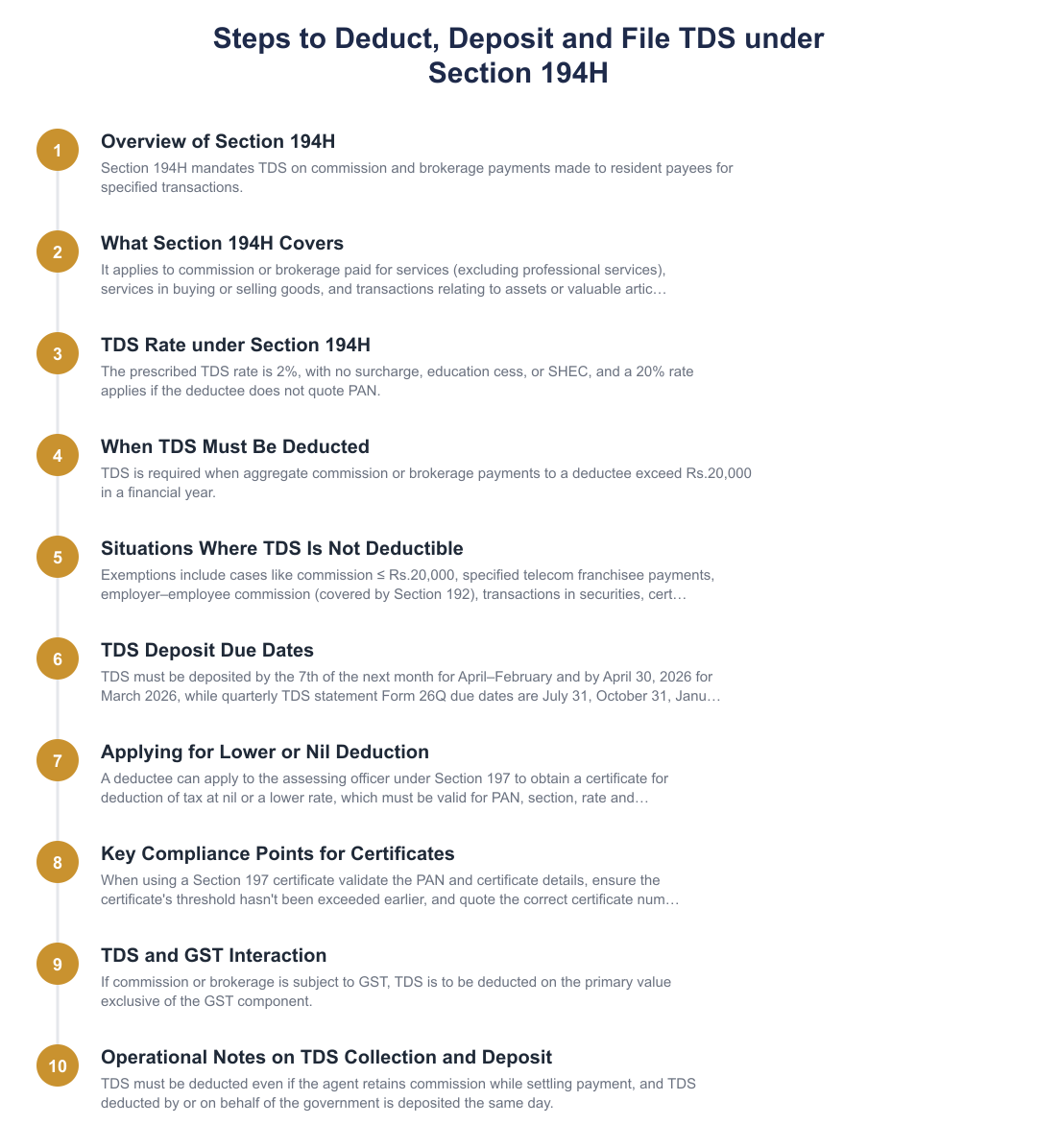
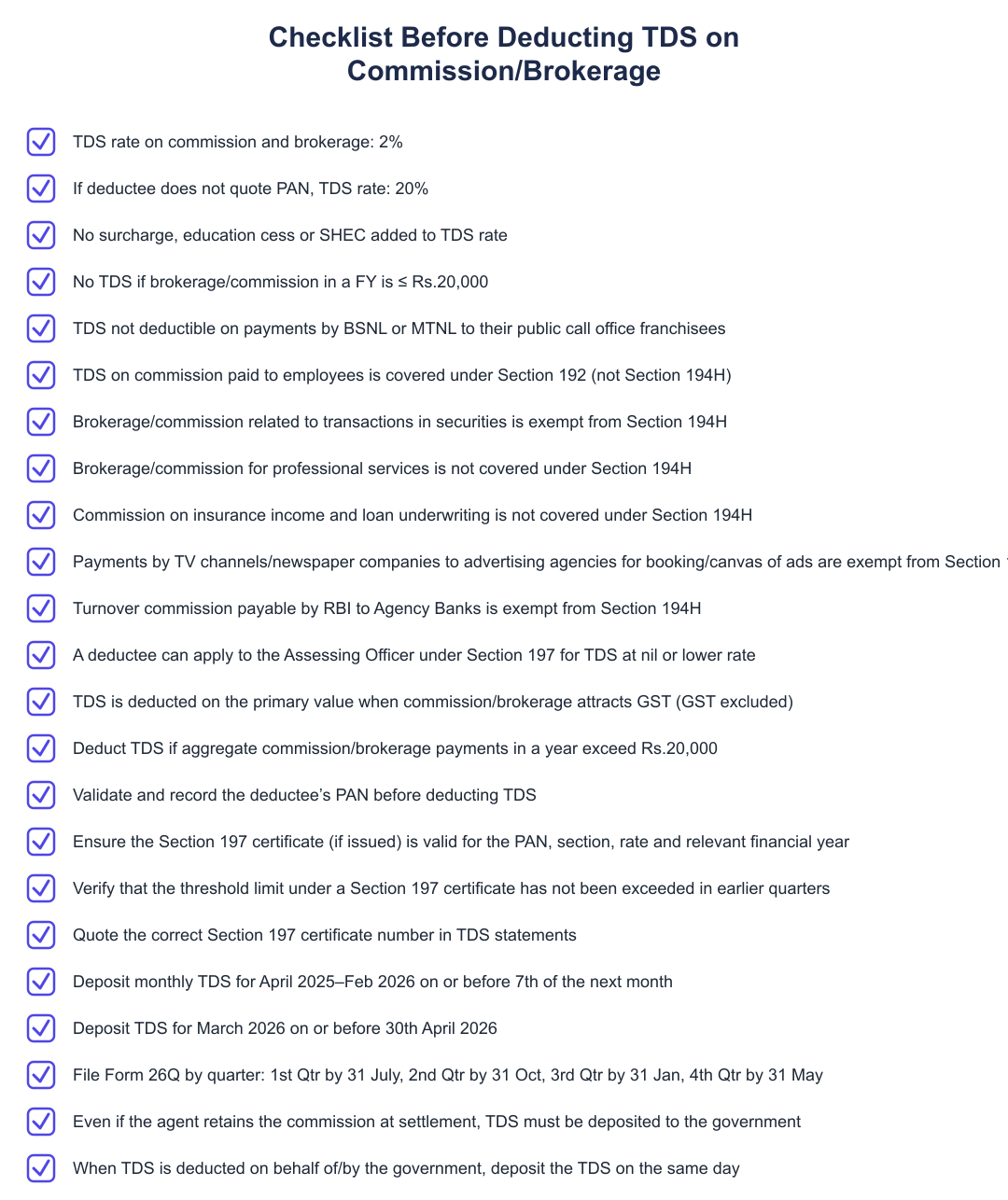
Section 194H requires deduction of TDS on payments of commission or brokerage made by a resident payer to a resident payee at the prescribed rate when aggregate payments in a financial year exceed the threshold. It applies to any resident person or entity (individual, HUF, company, firm, etc.) making commission or brokerage payments, provided the payer’s total sales, gross receipts or turnover exceeded Rs.1 crore in case of business or Rs.50 lakh in case of profession in the previous financial year. The threshold for TDS under Section 194H is Rs.20,000 in a financial year (effective 1 April 2025), so no TDS is required if the total commission/brokerage does not exceed this amount. Note that certain payers and payments are excluded (for example, some government or specified agency payments and employer–employee commissions which fall under Section 192).
What is the rate of TDS under Section 194H?
The TDS rate under Section 194H is 2% on the amount of commission or brokerage payable or credited, whichever is earlier. No surcharge, education cess or SHEC is added to this 2% rate. If the deductee fails to furnish a valid PAN, TDS is required to be deducted at the higher rate of 20% (as per current provisions for missing PAN).
How do you define ‘commission’ and ‘brokerage’ for Section 194H?
Commission and brokerage under Section 194H mean any amount received or receivable, directly or indirectly, by a person for acting on behalf of another in relation to services (other than professional services), buying or selling of goods, or transactions in assets or valuable articles, excluding securities. This covers common commercial arrangements such as sales commissions, real estate brokerage, insurance agency commissions (except some specified insurance and underwriting exceptions), and brokers’ fees. Payments that are in the nature of professional fees or relate to securities transactions are specifically excluded from Section 194H and may attract other TDS provisions instead.
When must TDS under Section 194H be deducted, at payment or credit?
TDS under Section 194H must be deducted at the time of payment or at the time of credit to the payee’s account, whichever is earlier. For example, if a company credits a commission amount to an agent’s ledger on 20th March and pays it on 5th April, TDS should be deducted on 20th March. The payer is responsible for timely deduction and deposit even if the agent subsequently retains or does not withdraw the credited amount.
What are the main exceptions where Section 194H TDS is not deductible?
TDS under Section 194H is not deductible where the aggregate commission or brokerage in a financial year is up to Rs.20,000, for certain government or specified payments (for example BSNL/MTNL payments to public call office franchisees), where the payment is salary subject to Section 192, brokerage on securities, brokerage related to professional services, and certain other specific transactions listed in the statute. Additionally, payments like turnover commissions payable by RBI to agency banks and certain advertising agency bookings are excluded. A person may also obtain a certificate under Section 197 from the assessing officer to deduct tax at nil or lower rate where justified.
What happens if the deductee does not quote PAN for commission/brokerage?
If the deductee does not quote a valid PAN, TDS must be deducted at the higher rate of 20% instead of the standard 2% under Section 194H. This higher rate applies irrespective of the nature of the transaction and is aimed at enforcing PAN compliance; the payer should validate the PAN before filing statements. The deductee can later claim credit for excess TDS when filing their income tax return by furnishing the correct PAN and TDS details.
When must TDS deducted under Section 194H be deposited and the return filed?
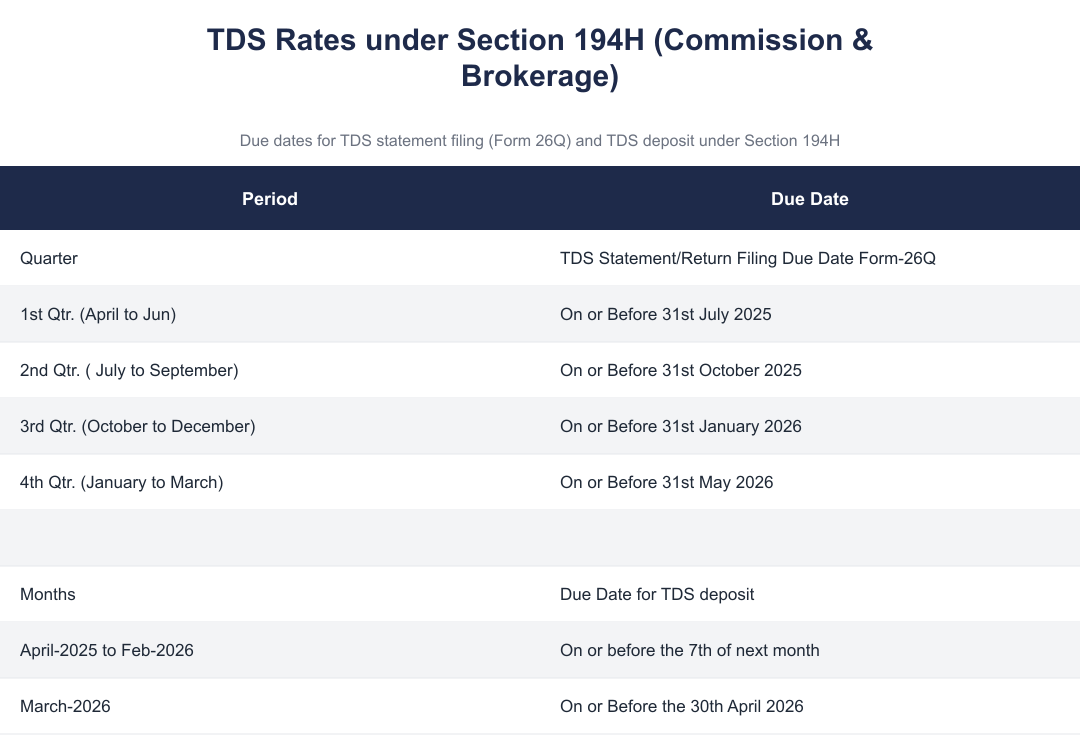
TDS deducted under Section 194H must be deposited to the government on or before the 7th day of the following month for deductions made from April 2025 to February 2026, and for tax deducted in March 2026 the deposit deadline is on or before 30 April 2026. The TDS statement/return (Form 26Q) must be filed quarterly by the due dates: 31 July (Apr–Jun), 31 October (Jul–Sep), 31 January (Oct–Dec) and 31 May (Jan–Mar) following the quarter. For example, tax deducted on 25 April must be deposited by 7 May and reported in the 1st quarter Form 26Q filed by 31 July.
Can TDS under Section 194H be deducted at a lower or nil rate?
Yes, a deductee can apply to the assessing officer under Section 197 to obtain a certificate for deduction of tax at nil or a lower rate, and the payer must then deduct TDS according to that certificate. The Section 197 certificate must be valid for the specific PAN, section, rate and relevant financial year and the correct certificate number must be quoted in the TDS statement. Before relying on a lower-rate certificate, the payer should validate the certificate, ensure the threshold limit for the certificate has not been exceeded in prior quarters, and confirm the certificate details match the PAN and assessment year.
How is GST treated when calculating TDS under Section 194H and what are other practical points to remember?
When the commission or brokerage is subject to GST, TDS under Section 194H is to be deducted on the primary value (exclusive of the GST component), i.e., TDS is calculated on the commission amount before adding GST. Practical points: validate the deductee’s PAN before filing, ensure the Section 197 certificate (if any) matches PAN, section and financial year, monitor the Rs.20,000 annual threshold across quarters, and deposit TDS even if the agent retains the commission at payment time. Also remember that correct quoting of the 197 certificate number (example format 3XXXAH7X) and compliance with return due dates are required to avoid penalties.
Need help staying TDS compliant?
MoneyGence's AI Finance OS tracks your compliance, wallet share, and finances in one place, built for agencies and growing businesses.
Get started with MoneyGence