Section 194I TDS on Rent: Rates, Limits & How to Pay
This guide explains Section 194I of the Income Tax Act, the provision that mandates deduction of tax at source (TDS) on rent payments. You will learn what kinds of payments attract TDS under this section, which arrangements are covered, when the payer is required to deduct TDS, and how the taxability of rent is treated irrespective of the recipient's classification of income. Understanding these points matters because rent is a common business and personal expense, and incorrect handling of TDS can create compliance gaps for both payers and recipients. This article focuses on the core rules laid down by Section 194I, clarifies the scope of “rent” for TDS purposes, and explains the two triggering events that require deduction. The aim is to give tenants, landlords, finance teams and tax professionals a clear, rules-based view of when TDS must be accounted for under Section 194I so they can build correct processes, avoid under-deduction or late deduction, and ensure consistent treatment of rental receipts in accounting and tax records.
What is Section 194I?
Section 194I of the Income Tax Act requires that tax be deducted at source on rent payments. In simple terms, when a person makes a rent payment covered by the section, the payer must deduct a specified amount of tax before making the payment to the recipient.
The provision places the obligation on the payer to withhold tax at source so that rental income is brought into the tax net at the point of payment. This obligation applies across different types of arrangements that fall within the definition of rent under the section.
Objective of Section 194I
The primary objective of Section 194I is to ensure that rental income is accounted for in the tax system by collecting tax at the time of payment or when the income is credited. By making the payer responsible for deduction, the law seeks to improve reporting and reduce leakage of taxable rental receipts.
This mechanism also creates a contemporaneous trail: tax collected at source links payments made by tenants or hirers to income reported by landlords or service providers. That linkage helps tax authorities and taxpayers reconcile rental receipts with returns filed by recipients.
What is the Meaning of ‘Rent’ u/s 194I?
For the purposes of Section 194I, ‘rent’ covers payments made under lease, sub-lease, tenancy, or any other agreement or arrangement relating to the use of property or assets. The definition is broad and is applied to arrangements for use of land, buildings (including factory buildings), and land attached to buildings such as parking or gardens.
Beyond immovable property, the term also extends to arrangements for the use of movable assets, specifically machinery, plant, equipment, furniture and fittings. That means payments for the use of a machine or a piece of equipment under an agreement can fall within the ambit of rent for TDS, even if economically they resemble service or hire charges.
Payments Covered u/s 194I
Section 194I captures payments made under any arrangement for use of land, building or attached land, and also payments for use of machinery, plant, equipment, furniture or fittings. The coverage is by the nature of the arrangement (lease, sub-lease, tenancy or similar agreement) rather than the label the parties put on the payment.
Because of this focus on substance over form, parties cannot avoid the TDS obligation simply by calling a payment something other than rent if the arrangement is effectively for the use of the specified assets. Parties should therefore review agreements and payment structures to determine whether payments are within the statutory definition.
When TDS needs to be deducted u/s 194I?
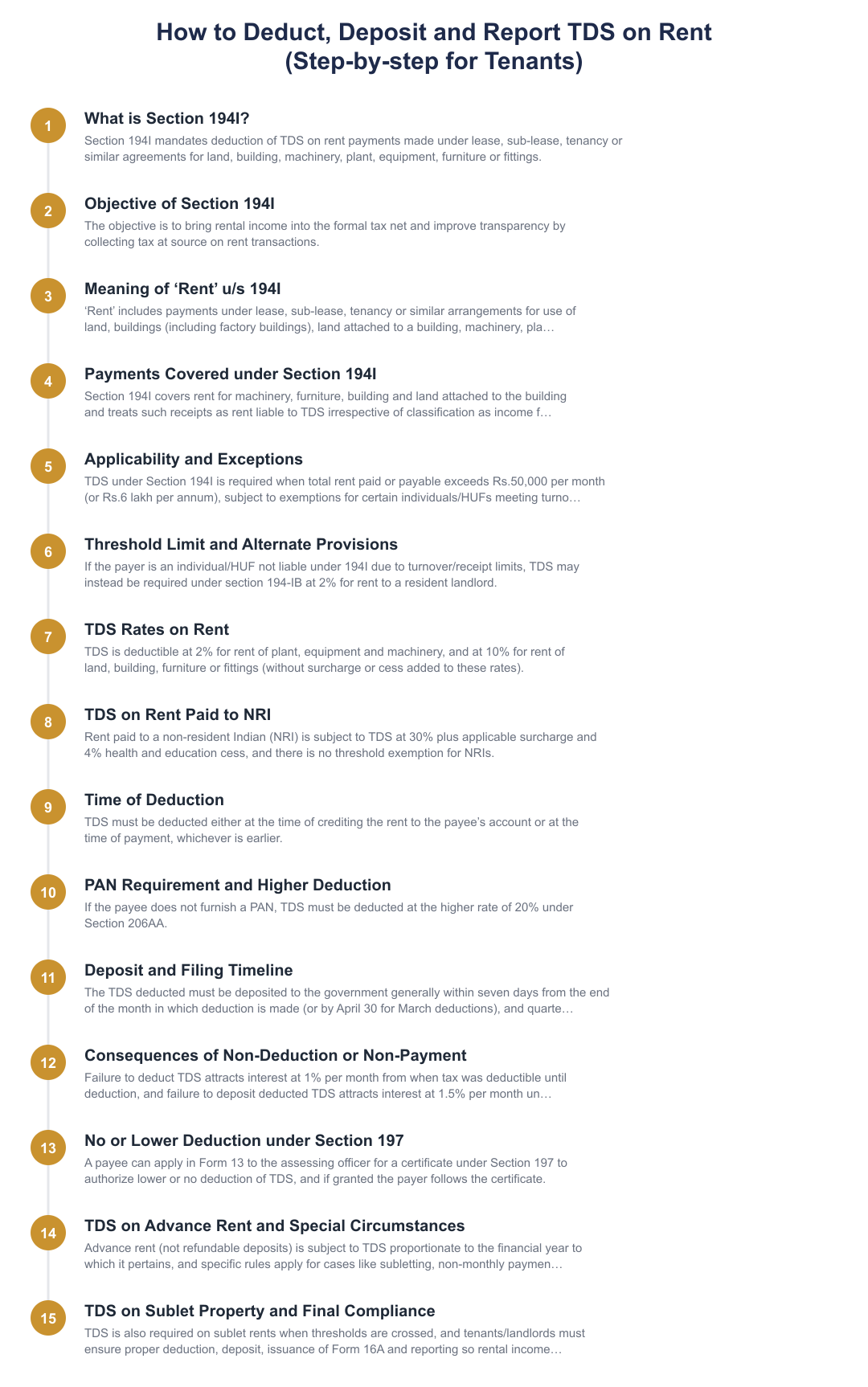
TDS under Section 194I must be deducted at the earliest of two events: when the amount is credited as 'income by way of rent' to the account of the payee or at the time of payment. In practical terms, this means the obligation arises either on accounting recognition of rent as income for the recipient, or on the actual cash/credit payment, whichever occurs first.
This rule ensures tax is collected promptly, if a payer credits rent to the payee’s account but delays actual payment, TDS must still be deducted at the point of credit. Conversely, if payment precedes accounting credit, the payer must deduct TDS when making the payment.
Applicability irrespective of income head
A key feature of Section 194I is that the obligation to deduct TDS is independent of how the recipient ultimately classifies the receipt in their income-tax return. TDS may be required even if the recipient treats the receipt as income from house property, business income, or income from other sources.
Therefore, the payer’s duty to deduct tax does not depend on the recipient’s accounting or tax classification; it depends on whether the payment falls within the statutory definition of rent and the timing rules for deduction. Payers should apply the statutory tests rather than rely on the payee’s expected tax treatment.
Section 194I places a clear, timing-based obligation on payers to deduct tax at source on a wide range of rent-like payments covering immovable and specified movable assets. The two trigger events, credit to the payee’s account or actual payment, whichever is earlier, and the broad definition of rent mean payers should review contracts and accounting practices to ensure timely TDS deduction. Proper application of these rules helps maintain compliance and creates a reliable record of rental income for both payers and recipients.
Frequently asked questions
Do I need to deduct TDS on rent I pay under Section 194I?
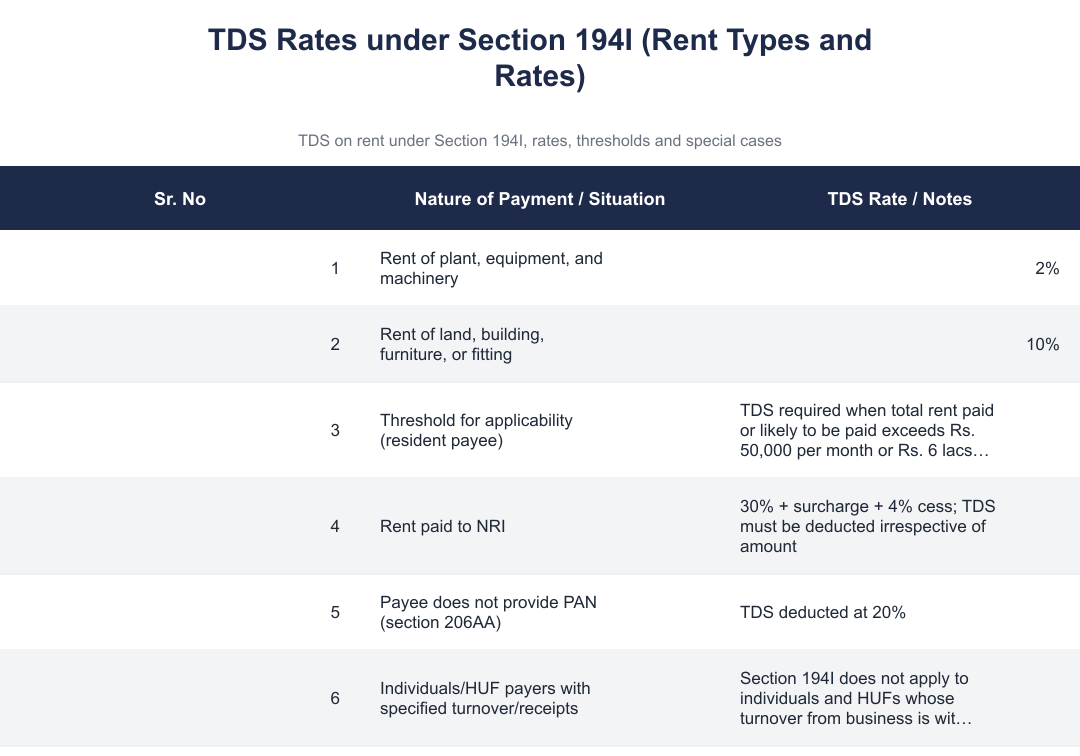
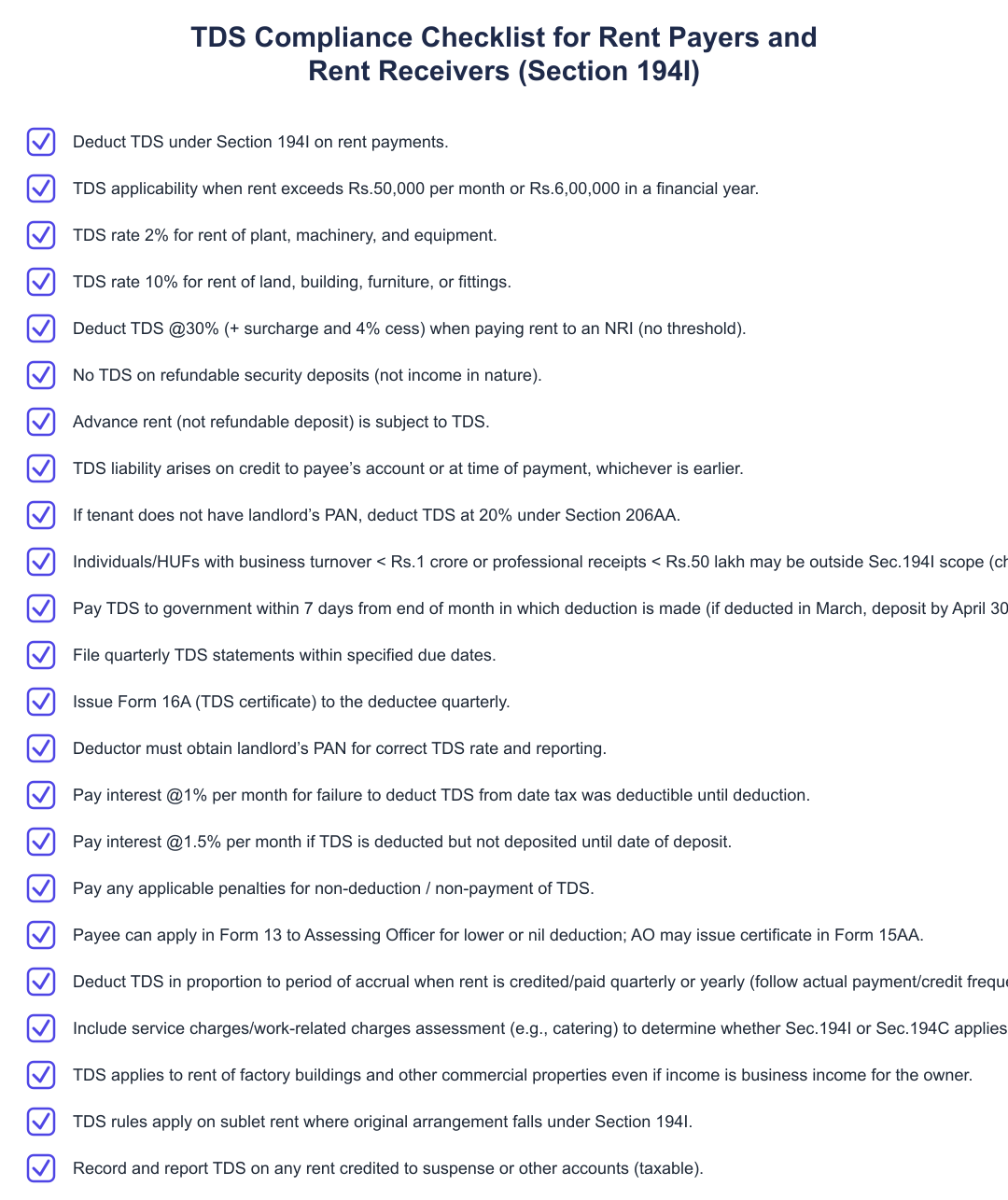
Yes, TDS under Section 194I must be deducted if the rent paid or likely to be paid to a resident exceeds Rs.50,000 per month or Rs.6,00,000 in a financial year. This applies to payments for use of land, building (including factory buildings), land attached to a building, plant, machinery, equipment, furniture or fittings, and includes amounts credited to the payee’s account or actually paid. Individuals/HUFs who are not carrying on business or profession are generally excluded, and taxpayers qualifying as small (turnover under Rs.1 crore or professional receipts under Rs.50 lakh in the previous year) may follow special rules or Section 194-IB instead. If the payee has not provided a PAN, TDS is deducted at 20% under Section 206AA instead of the normal rates.
What are the TDS rates under Section 194I for different kinds of rent?
The TDS rates under Section 194I are 2% for rent of plant, machinery and equipment, and 10% for rent of land, building, furniture or fittings. No additional surcharge or health & education cess is added while deducting TDS under this section, the payer should deduct only the prescribed percentage on the rent amount. If the payee is non-resident, a higher rate (typically 30% plus applicable surcharge and 4% cess) applies and there is no threshold exemption for NRIs.
How do I deposit the TDS and what are the due dates for Section 194I?
You must deposit the TDS deducted under Section 194I to the government by the 7th day from the end of the month in which deduction is made, except for amounts deducted in March which must be deposited by April 30. In addition to timely deposit, you must file the quarterly TDS statements (TDS returns) within their specified due dates and issue Form 16A (TDS certificate) to the deductee. Failure to deposit or file timely attracts interest and penalties as described under the Income Tax Act.
What happens if I deduct TDS but do not deposit it or I don’t deduct at all?
If you fail to deduct TDS when required you will be liable to pay interest at 1% per month from the date the tax was deductible until the date it is actually deducted, and interest at 1.5% per month if you deducted but failed to deposit the TDS with the government. Besides interest, you may face penalties and prosecution under the Income Tax Act and the deductee may have difficulty claiming credit for TDS in their tax return. It is therefore important to deduct, deposit within statutory timelines and file the required TDS returns to avoid these consequences.
Is TDS under Section 194I applicable on advance rent or refundable security deposit?
Advance rent (if not refundable security deposit) is subject to TDS under Section 194I when credited or paid, and must be considered in the year it pertains to for threshold calculations. In contrast, refundable security deposits that are truly refundable and not income in the hands of the recipient are not subject to TDS. If advance rent relates to the next financial year, TDS is apportioned to the financial year in which the income pertains; if a rental agreement is cancelled after advance payment and TDS was deducted, the landlord must reflect the refund in their return and appropriate adjustments can be made.
Does Section 194I apply to rent paid to NRIs and what is the rate?
Yes, rent paid to a non-resident (NRI) is subject to TDS and must be deducted regardless of the amount, typically at 30% plus applicable surcharge and 4% health and education cess. There is no Rs.50,000/month or Rs.6 lakh/year threshold exemption for non-residents, so TDS must be deducted even for small amounts paid to NRIs. The exact rate can vary under the Income Tax Act or a tax treaty; the payer should verify treaty benefits and obtain lower withholding certificates if applicable.
When is TDS under Section 194I not deductible or can be deducted at a lower rate?
TDS under Section 194I may not be deductible or may be deducted at a lower rate if the payee obtains a certificate from the Assessing Officer under Section 197 (Form 15AA) granting no deduction or lower deduction after examining their estimated total income. Additionally, certain payments are outside the scope of Section 194I such as amounts characterized as composite service consideration (e.g., some film distribution/exhibitor arrangements) or the catering portion charged by hotels (which may fall under Section 194C). Small individual/HUF payers meeting turnover/receipt thresholds may also have different obligations (e.g., Section 194-IB).
Are there special circumstances or exceptions I should know about under Section 194I (like cold storage, factory buildings, sublets)?
Yes, Section 194I has several specific treatments: rent for factory buildings is taxable even if shown as business income in the owner’s books and still attracts TDS; cold storage charges may be treated as payment for use of plant (possibly bringing Section 194C into play) depending on the contractual nature; and where building and furniture are let out by separate persons, TDS is to be deducted for the respective components based on who receives the payment. Also, if rent is credited or paid quarterly or yearly, TDS may be deducted on that periodic basis rather than monthly. Each such situation should be examined on facts to determine whether 194I, 194C or another provision applies.
What threshold and special rules apply to individuals and HUFs paying rent under Section 194I versus Section 194-IB?
Individuals and HUFs who are not required to deduct TDS under Section 194I because they are not carrying on business/profession or meet small turnover thresholds may still have obligations under Section 194-IB, which requires a 2% TDS on rent where the payer is an individual/HUF and rent exceeds Rs.50,000 per month but other conditions for 194I aren't met. Section 194I’s general threshold is Rs.50,000 per month or Rs.6 lakh per year, but for small landlords and certain payers, statutory exclusions or alternate sections (194-IB) apply; thus payers should verify whether they fall under 194I, 194-IB, or are exempt. If in doubt, consult the Assessing Officer or obtain a certificate under Section 197 for clarification or lower deduction.
Need help staying TDS compliant?
MoneyGence's AI Finance OS tracks your compliance, wallet share, and finances in one place, built for agencies and growing businesses.
Get started with MoneyGence