Section 194IA TDS on Property: How to File Form 26QB & Get Form 16B
This guide explains, in plain language, how tax is collected on sale of immovable property and what both buyers and sellers should expect during the transaction. You will learn the roles and responsibilities of the parties involved, the documents and information typically required to comply with tax withholding rules, the practical steps a buyer follows to remit withheld tax and obtain a certificate for the seller, and the potential consequences when withholding and reporting obligations are not met. The aim is to give property buyers and sellers a clear roadmap to follow so the transfer proceeds smoothly while meeting statutory compliance. Whether you are purchasing a residential flat, commercial space, or land, knowing the withholding and payment process helps avoid last-minute surprises at registration or during tax filings. The guide also covers common exceptions and frequently asked questions that arise in real transactions, so you can spot situations where withholding may not be required. This is practical help for first-time buyers, property investors, real estate professionals, and tax coordinators working with buyers or developers.
What is Section 194IA?
At a conceptual level, the law requires a buyer to withhold a portion of the consideration payable to the seller when certain property transfers take place, and to deposit that amount with the government on behalf of the seller. This mechanism ensures tax collection at source and helps link the sale proceeds to the seller’s tax records.
The withholding obligation shifts responsibility for initial tax collection from the seller to the buyer. Practically, this means the buyer must verify whether the transaction is covered by withholding rules before making payments to the seller, and must follow the specified process for depositing the withheld amount and reporting the transaction to the tax administration.
Requirements of Section 194IA
Before executing payment, the buyer should determine whether the transaction triggers a withholding obligation. This assessment typically depends on the nature and value of the immovable property transfer and on statutory thresholds and conditions specified in the law.
If withholding applies, the buyer must collect certain information from the seller, commonly the seller’s tax identifier and contact details, to complete the remittance and reporting process. The buyer is also expected to compute the withholding amount on the relevant consideration and remit it through the prescribed payment channel.
After depositing the withheld amount, the buyer must furnish a certificate or acknowledgment to the seller as proof that tax has been remitted to the government. This certificate is important for the seller to claim credit for the tax withheld when filing returns, and for the buyer to demonstrate compliance when registering the property or responding to queries.
Exceptions for Section 194-IA
Not every transfer of immovable property attracts withholding. There are specific exemptions carved out by law, for example, transfers to or by certain entities, transfers of particular categories of land, or where alternate tax provisions apply. When such exceptions are relevant, the parties do not need to deduct or deposit tax under the withholding provision.
Because exemptions can be technical, buyers should check the precise statutory language or consult a tax professional to confirm applicability. Misapplying an exemption could result in later liabilities, interest, or penalties for the buyer if authorities determine withholding should have taken place.
What is Form 26QB?
In practice, the law prescribes a particular online challan or payment form that buyers use to remit the withheld tax and record the transaction details. This electronic channel also collects information about the buyer, the seller and the property so the payment can be linked to the correct parties.
Filing through the prescribed online form generates an acknowledgement or challan number which serves as a reference for both the buyer and the seller. The acknowledgement is used later to obtain the formal certificate that evidences deposit of the withholding tax.
Steps to Pay TDS on Property Purchase through Challan 26QB and Get Form 16B
Assess whether the property transfer triggers the withholding obligation by reviewing the transaction facts and any available exemptions.
Obtain the seller’s tax identifier and correct contact details so the payment can be attributed to the right person.
Calculate the amount to be withheld from the consideration as per the applicable rules.
Use the specified online challan or payment portal to remit the withheld tax and furnish transaction details about buyer, seller and property.
Save the acknowledgement or challan reference generated after payment; this is required to obtain the TDS certificate.
After the payment is processed, request and download the formal certificate from the tax portal to give to the seller.
e-Payment through Challan 26QB (Online)
The recommended route for remittance is an online e-payment facility where you fill an online challan form, provide buyer and seller details, and make payment through net-banking or other supported online modes. The online flow minimizes manual errors and provides immediate electronic acknowledgement.
Ensure you use accurate details while filling the online form because errors in the seller’s tax identifier or the transaction reference can delay crediting of the withheld tax to the seller’s account. If a portal allows registration, registering as a taxpayer can simplify later downloads of the TDS certificate.
Consequences of Non-filing of Form 26QB to the Seller
If the buyer fails to withhold and remit the required tax, or fails to furnish the certificate to the seller, the buyer may remain liable to the tax authorities for the unpaid amount along with applicable interest and penalties under the tax code. The seller may also face difficulties claiming credit for tax in their returns until the withholding is properly reported.
Practically, non-compliance can complicate property registration and later tax filings. For this reason, both buyers and sellers should insist on seeing the payment acknowledgement and the formal TDS certificate before completing the transaction formalities.
Frequently Asked Questions
Q: Who is responsible for deducting the tax on property sale? A: The buyer is typically responsible for deducting the tax at source where the withholding provisions apply; the seller typically receives the sale consideration net of this deduction and is entitled to a certificate showing the tax was remitted.
Q: What documents should the buyer collect from the seller? A: Collect the seller’s tax identifier, proof of identity and contact details, and any documentation needed to support an exemption claim if one is being relied upon. Accurate details ensure the tax payment is credited correctly.
Q: How does the seller claim credit for the withheld tax? A: Once the buyer has made the payment and the transaction is reported, the seller should obtain the official certificate evidencing deposit of the withheld tax and use that information when filing returns to claim the tax credit.
Withholding tax on property sale is a compliance step designed to ensure tax collection at source. Buyers should confirm applicability up front, collect accurate seller information, remit the withheld amount through the prescribed online channel, and obtain the official certificate to give the seller. Sellers should insist on receiving the certificate so they can claim credit. When in doubt about exemptions or the correct procedure, consult a tax professional or the official tax portal to avoid downstream liabilities.
Frequently asked questions
What exactly does Section 194IA require me to do when buying a property?
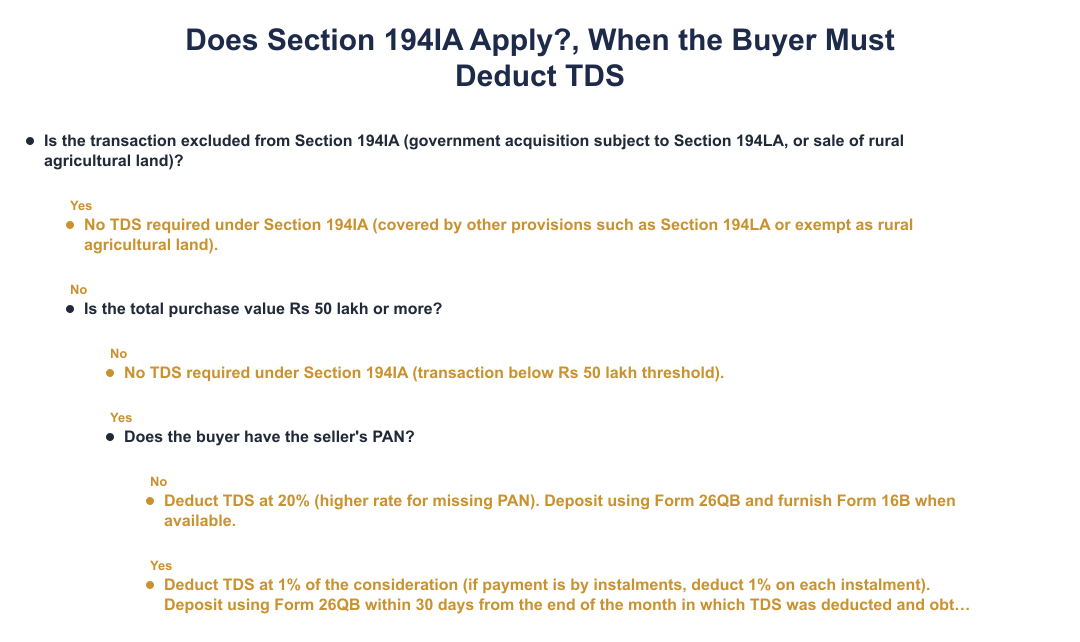
Section 194IA requires the buyer of an immovable property to deduct TDS at 1% of the total sale consideration and deposit it with the government when the purchase value is Rs 50 lakh or more. You must deduct TDS at the time of payment (including instalments) and furnish the deduction through Form 26QB within 30 days from the end of the month in which TDS was deducted. The buyer does not need a TAN to deposit this TDS but must provide the seller's PAN in Form 26QB, otherwise TDS is to be deducted at 20%. After payment, the buyer should obtain Form 16B (TDS certificate) from TRACES and give it to the seller, typically available 10–15 days after deposit.
How much TDS do I have to deduct on buying an immovable property?
You have to deduct TDS at 1% of the total sale amount for any immovable property transaction where the consideration is Rs 50 lakh or more. This 1% is calculated on the entire sale consideration (including charges like parking, club membership, maintenance, etc.) and not on the capital gains. If the buyer fails to obtain the seller’s PAN, then TDS must be deducted at the higher rate of 20%.
When do I have to deposit TDS and file Form 26QB after deducting it?
You must deposit TDS using Form 26QB within 30 days from the end of the month in which the TDS was deducted. Form 26QB is the challan-cum-statement where you enter buyer and seller PANs, property details and payment details; payment can be made online via the e-tax payment option (net banking) or at authorized bank branches. After the payment is reflected in Form 26AS (usually within 7 days), you can request and download Form 16B from TRACES, which becomes available around 10–15 days after deposit.
How do I pay TDS online using Challan 26QB step-by-step?
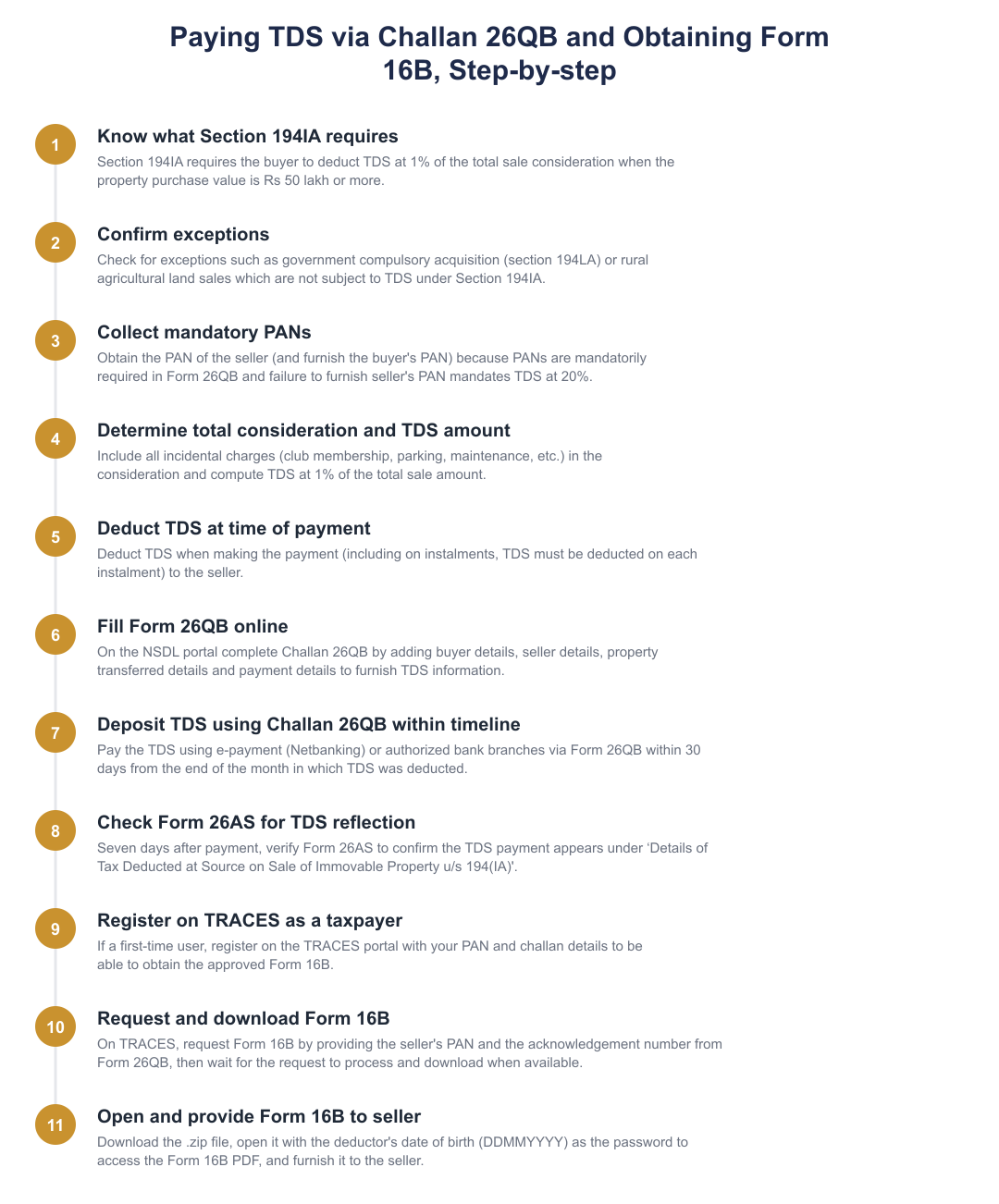
To pay TDS online you must fill Form 26QB on the NSDL website with buyer and seller PANs, property and payment details, then generate the challan and complete e-payment via net banking or at an authorised bank branch. After payment, check Form 26AS after about seven days to confirm the payment shows under 'Details of Tax Deducted at Source on Sale of Immovable Property u/s 194(IA)'. Then register as a taxpayer on TRACES (if first time), submit a request for Form 16B using the seller PAN and 26QB acknowledgement number, and download the approved Form 16B from TRACES when the status becomes 'available'.
How do I download Form 16B and what is the password for the downloaded file?
You can download Form 16B from the TRACES portal after your Form 26QB payment appears in Form 26AS and you register on TRACES as a taxpayer; request the Form 16B by entering the seller’s PAN and the 26QB acknowledgement number. Once the request is processed and the download status is 'available', download the .zip file and open it with the password equal to the deductor’s date of birth in DDMMYYYY format to access the PDF. Keep in mind the Form 16B is the official TDS certificate that you must furnish to the seller and typically appears 10–15 days after depositing TDS.
Do I need to deduct TDS if I am paying the seller in instalments?
Yes, if the total purchase value is Rs 50 lakh or more you must deduct TDS at 1% on each instalment at the time of payment to the seller. TDS is required to be deducted on each instalment paid, and each deduction must be deposited and reported through Form 26QB within the statutory timeline. Make sure to include the instalment payment details in Form 26QB so the total TDS position is correctly captured.
Are there any exemptions or situations where Section 194IA does not apply?
Yes, Section 194IA does not apply to transfer of rural agricultural land and does not cover compulsory acquisitions by the government which are taxed under section 194LA. Rural agricultural land is not treated as a capital asset under income tax provisions, so no TDS under 194IA is required. Also, the threshold of Rs 50 lakh applies, so purchases below that amount are outside Section 194IA unless other sections apply.
What happens if the buyer doesn’t file Form 26QB or deposit TDS on time?
If the buyer fails to deduct or deposit TDS and file Form 26QB on time, they may face interest, penalties and disallowance of expenses in the buyer’s tax computations, and the seller will not get the TDS credit until the buyer rectifies the default. The buyer remains liable to deposit the TDS amount with interest for delayed payment and may also face penalties for non-compliance under the Income Tax Act. To regularize the position the buyer should make the payment, deposit interest and obtain the TDS certificate (Form 16B) from TRACES to enable the seller to claim credit.
What information and documents do I need before filing Form 26QB?
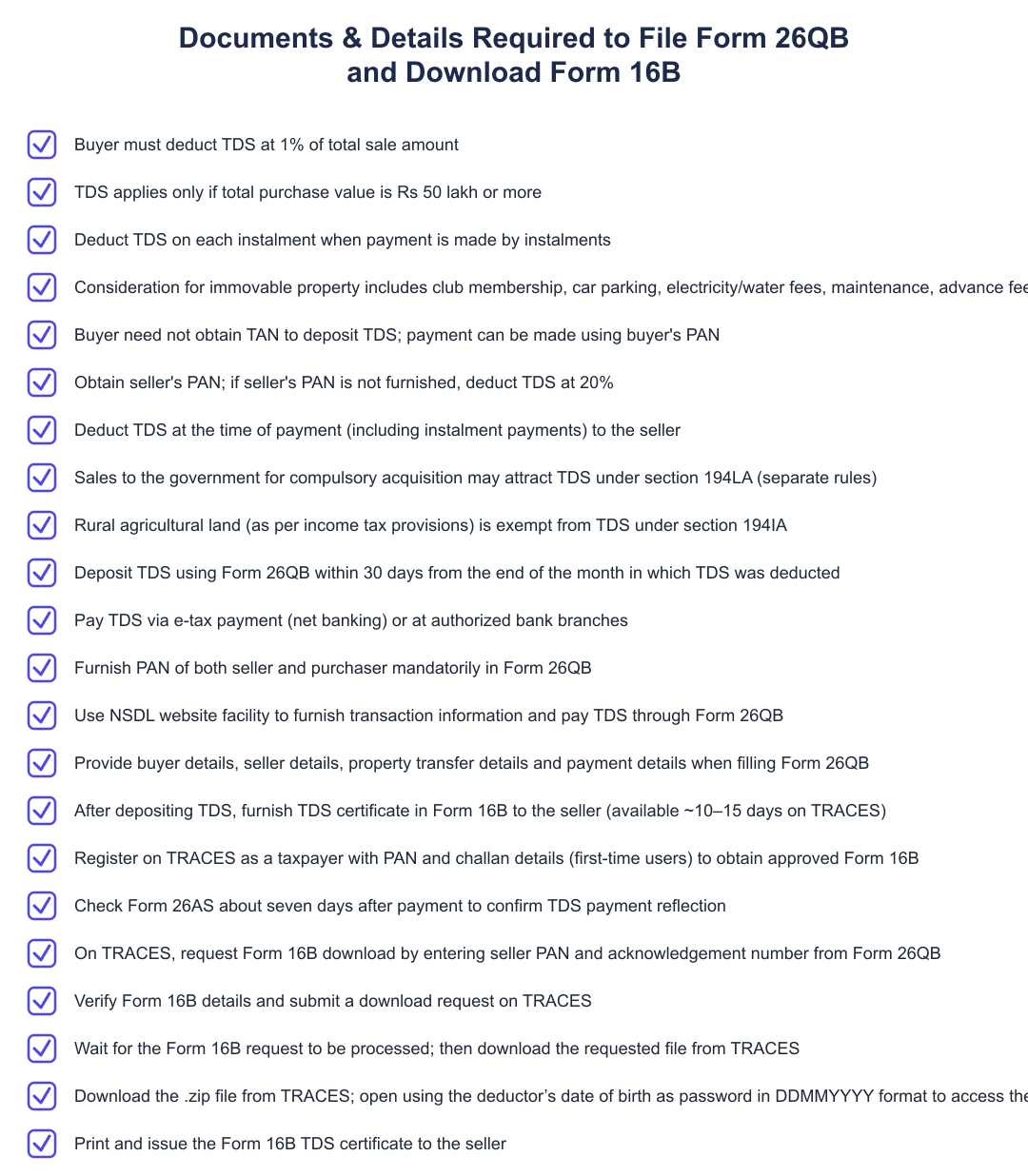
Before filing Form 26QB you need the PANs of both the buyer and seller, details of the immovable property (address/registration details), the total sale consideration including incidental charges, and the payment details for the TDS deposit. The PAN of the seller is mandatory for correct TDS rates; absence of seller PAN triggers TDS at 20%. Also keep the acknowledgement number from Form 26QB handy for requesting Form 16B on TRACES after payment is reflected in Form 26AS.
Need help staying TDS compliant?
MoneyGence's AI Finance OS tracks your compliance, wallet share, and finances in one place, built for agencies and growing businesses.
Get started with MoneyGence