Section 194J: TDS on Professional & Technical Services - Guide
This guide explains Section 194J of the Income Tax Act, the provision that governs tax deducted at source (TDS) on payments for professional and technical services, royalty, non-compete fees and certain director payments. You will learn which payments fall under Section 194J, who must deduct TDS, when TDS must be deducted, how to treat payments of a personal nature, and the practical consequences of failing to deduct or remit TDS. Understanding these points matters because incorrect TDS treatment can lead to interest liabilities and disputes with tax authorities, while correct compliance helps preserve business relationships by ensuring recipients receive timely tax credit. The guide focuses on the operational rules and compliance touchpoints businesses and practitioners encounter when handling payments covered by Section 194J. Where possible it highlights how to decide whether a payment is covered, the timing rule that determines when deduction must be made, and the interest consequences if deduction or deposit is delayed. You will also find actionable steps to follow before making a payment so you can minimise downstream compliance risk. This is aimed at accounts teams, managers who approve payments, and small business owners who need a clear, practical view of TDS obligations under Section 194J.
What is Section 194J?
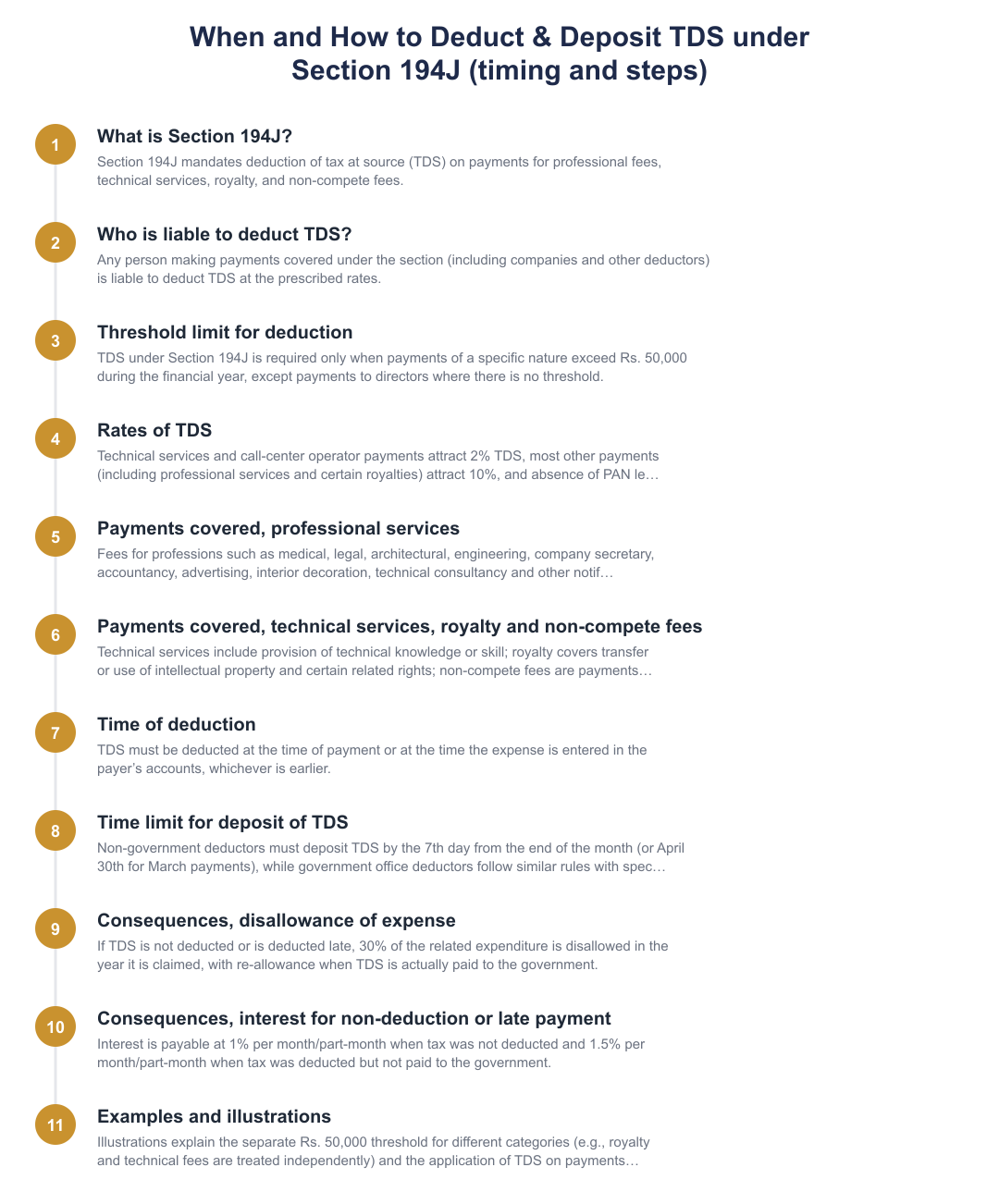
Section 194J deals with tax deduction at source on payments made towards professional fees or technical services. It brings within the TDS framework a range of non-salary payments that are commonly made by businesses to professionals, consultants and service providers.
The provision is designed to collect tax at the point of payment for specified services, so recipients receive tax credit while also ensuring reporting of such professional and technical incomes to the tax authorities. For payers, Section 194J creates an obligation to evaluate each relevant payment for TDS treatment before crediting or making the payment.
Payments covered under Section 194J
Section 194J covers a defined set of payments: royalty, non-compete fees, fees for professional services, fees for technical services and remuneration/fees/commission paid to directors where such amounts are not salary. These categories capture a broad sweep of payments made to individuals, firms and companies for specialised expertise or for transfer of certain rights.
Examples of professional services that fall within the scope include work performed by medical practitioners, lawyers, architects, engineers, accountants, company secretaries, technical consultants and information-technology professionals. Technical services are those that involve providing technical, industrial, commercial or scientific knowledge, experience or skill, often in the form of advisory or consultancy activities.
Threshold and nature of payment: when TDS applies
TDS under Section 194J applies when payments for professional and technical services in aggregate during the financial year exceed a specified threshold. This is an aggregate test, so payers need to combine amounts paid across the year to determine whether the threshold has been breached for a particular category of payment.
Payments that are purely of a personal nature are not subject to TDS under this section. Therefore, before making a deduction, the payer should confirm the purpose of the payment and whether it is business-related or personal; personal payments can be excluded from the aggregation and TDS treatment under Section 194J.
Time of deduction and payer responsibility
The rule for timing requires TDS to be deducted at the earlier of two events: when the amount is credited to the account of the payee, or when the payment is actually made. This means the obligation can arise even before cash changes hands if the payer records the expense as a payable in its accounts.
Practically, this timing rule places responsibility on the payer to consider TDS at the point of accounting entries and payment authorisation. Finance teams should therefore have a checklist to identify covered payments at the time of invoicing/credit entry to ensure timely deduction and avoid later interest or compliance issues.
Consequences of non-deduction or late deduction
If TDS is not deducted at the required time, or if tax has been deducted but not deposited with the government, the law provides for interest to be charged on the delayed amounts. Interest is calculated on a monthly (or part-month) basis from the date the tax should have been deducted or from the date it was deducted until the date of payment to the government.
Specifically, where no deduction of tax has been made the interest payable is 1% per month or part of a month from the date on which tax was required to be deducted until actual deduction. Where tax has been deducted but not paid to the government, interest is payable at 1.5% per month or part of a month from the date on which tax was deducted up to the date of payment to the government. These interest provisions create a strong incentive to both deduct and timely deposit TDS.
Practical steps for compliance under Section 194J
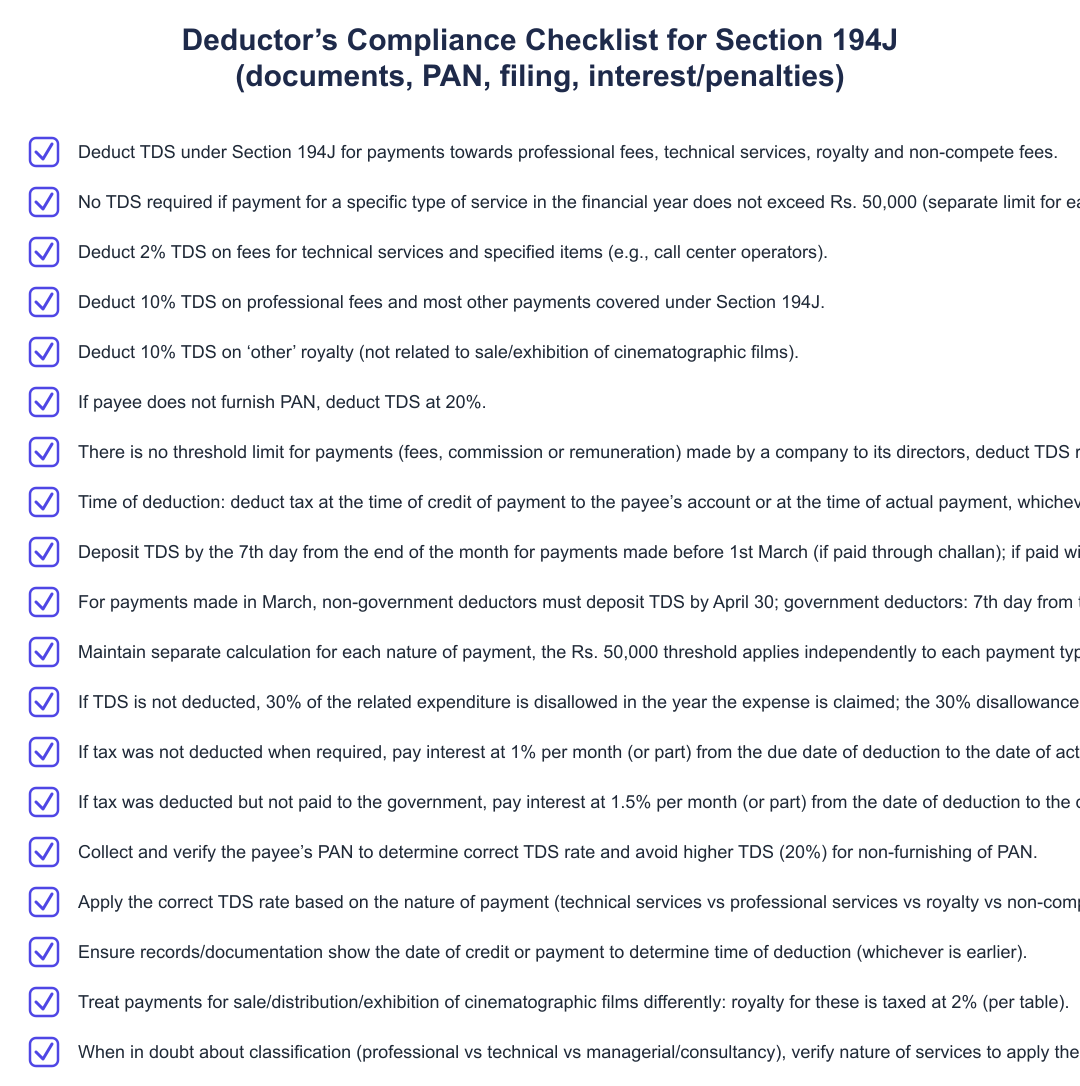
Confirm whether the payment is for professional services, technical services, royalty, non-compete fees or director remuneration (non-salary). Only these categories fall under Section 194J.
Determine whether the payment is of a personal nature; if it is purely personal, Section 194J TDS need not be applied.
Add up payments of the same category made during the financial year to check whether the aggregate exceeds the applicable threshold that triggers TDS.
If the threshold is breached, deduct TDS at the earlier of credit to the payee's account or actual payment.
Ensure timely deposit of deducted tax and maintain records; failure to deposit can attract interest calculated from the date of deduction to the date of payment to the government.
Section 194J brings a wide range of professional, technical and related payments into the TDS net. For payers the two critical compliance touchpoints are (a) correctly identifying covered payments and excluding personal payments, and (b) applying the timing rule, deducting at the earlier of credit or payment. Missing or delaying deduction exposes the payer to interest charges; therefore good processes around invoice review, accounting entries and timely deposit are essential to manage the risk.
Frequently asked questions
What is Section 194J of the Income Tax Act in simple terms?
Section 194J requires the payer to deduct TDS on certain payments such as professional fees, technical services, royalties and non‑compete fees when the payment exceeds prescribed limits. The section covers fees for professional services (like legal, medical, accountancy, architectural), fees for technical services (technical consultancy, IT-related services), royalties (use of patents, designs, films, etc.) and non‑compete fees, and sets different rates (generally 10% or 2%) and a Rs. 50,000 threshold for each category in a financial year. Payments to directors by a company (commission, fees or remuneration excluding salary) attract TDS without any threshold, and if the payee does not furnish PAN, TDS is deducted at 20%.
What are the TDS rates under Section 194J?
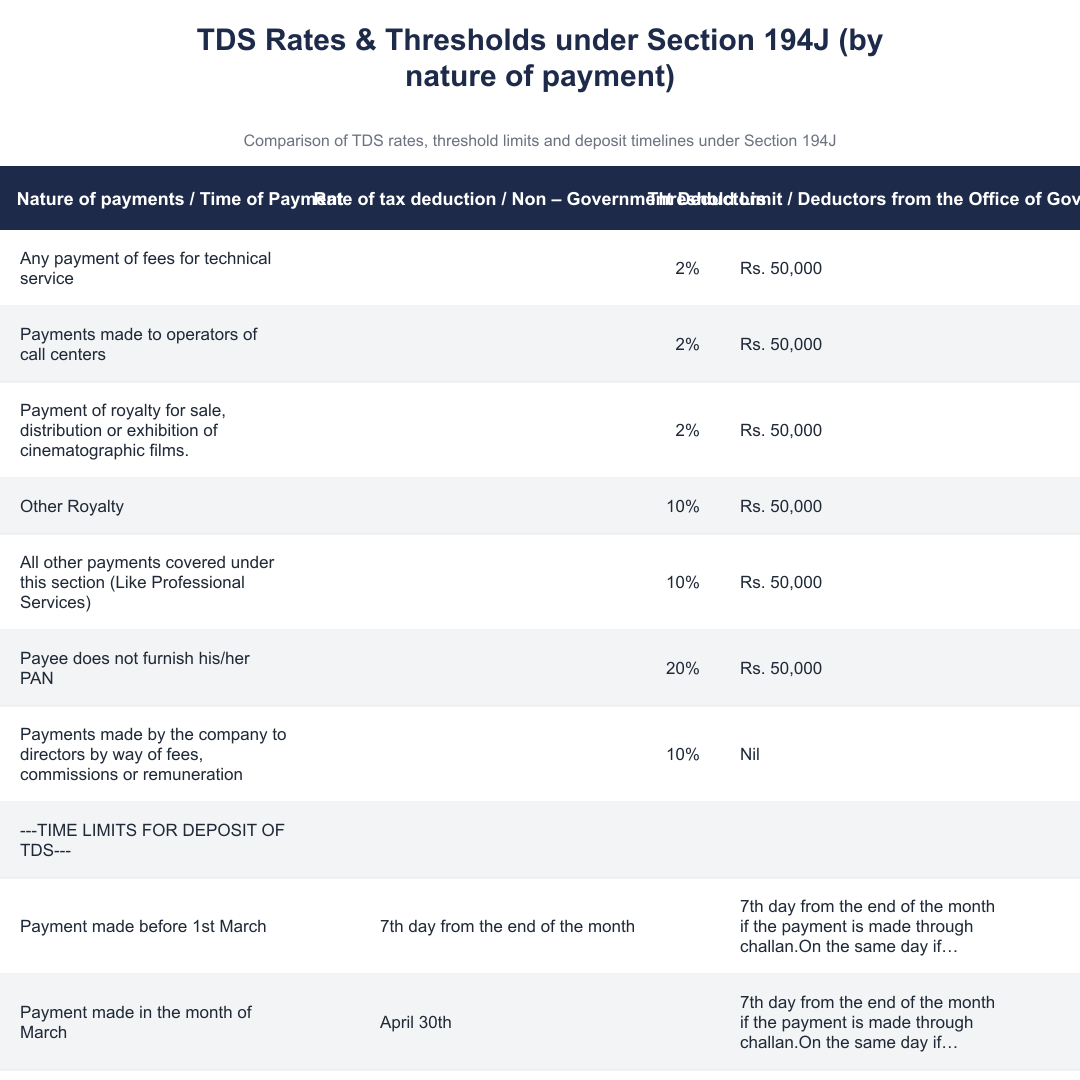
TDS under Section 194J is generally 10% for professional services, most royalties and payments to directors, and 2% for fees for technical services and call‑center operators, with a higher 20% rate if the payee has not furnished PAN. Specifically, 'technical services' and payments to call‑center operators attract 2%, 'other royalty' and 'all other payments' (including professional fees) attract 10%, directors' fees/commissions have 10% with no threshold, and absence of PAN leads to TDS at 20% regardless of the nature of payment.
What is the threshold limit for deducting TDS under Section 194J?
No TDS under Section 194J is required for a particular category of payment if the total amount paid in a financial year does not exceed Rs. 50,000 for that category. The Rs. 50,000 limit applies separately to each type of payment (for example, royalty and technical fees are counted separately), but there is no threshold for payments (fees, commission or remuneration) made by a company to its directors, TDS must be deducted irrespective of amount.
Who is liable to deduct TDS under Section 194J?
The person making the payment (the payer) is liable to deduct TDS under Section 194J at the time of payment or credit, whichever is earlier. This includes companies, firms, individuals and other entities that make payments for professional services, technical services, royalties or non‑compete fees; however, specific rules apply for government deductors (timing of deposit) and companies paying directors, companies must deduct TDS on directors' fees/commissions regardless of amount.
When should TDS under Section 194J be deposited with the government?
TDS under Section 194J must be deposited by the payer by the 7th day from the end of the month in which the deduction is made (or by April 30 for deductions made in March), and for government offices similar timelines apply but payments made without challan require same‑day deposit. If payment/credit occurs before March 1, the deposit is due by the 7th day from month end; if in March, non‑government deductors must deposit by April 30, while government offices follow the 7‑day/challan rules.
What are the consequences if TDS under Section 194J is not deducted or is deducted late?
If TDS is not deducted or is deducted late under Section 194J, the payer faces a disallowance of 30% of the related expenditure in the year of claim, interest liability and possible penalties, interest at 1% per month (or part thereof) applies where tax was not deducted, and 1.5% per month (or part thereof) applies where tax was deducted but not remitted to the government. The 30% disallowance is reversed (re‑allowed) in the year in which the TDS is actually paid to the government, but interest for the delayed period still applies; persistent non‑deduction can also attract penalty and prosecution provisions under the Income Tax Act.
What types of payments are specifically covered under Section 194J?
Section 194J covers fees for professional services (medical, legal, accountancy, architectural and other notified professions), fees for technical services (technical/managerial/consultancy/IT services), royalty (use or transfer of rights in inventions, designs, films, broadcasting rights etc.), and non‑compete fees. It also explicitly covers remuneration/fees/commission paid to directors (excluding salary) and payments to call‑centre operators are treated as technical services for a 2% rate; personal payments (for non‑business/personal purposes) are generally not subject to TDS under this section.
What happens if the payee does not furnish PAN to the deductor under Section 194J?
If the payee does not furnish PAN to the deductor, TDS under Section 194J must be deducted at a higher rate of 20% instead of the normal rates. The elevated 20% rate applies irrespective of whether the standard rate would be 2% or 10%, and the deductor should ensure documentation of PAN non‑furnishing; the payee can later claim credit of the excess TDS while filing their income tax return if PAN is subsequently provided and taxes are adjusted.
How is the time of deduction determined under Section 194J, at payment or at credit?
TDS under Section 194J must be deducted at the time of payment or at the time the expense is credited to the payee's account, whichever occurs earlier. 'Credit' means entering the amount in books or accounts (or otherwise becoming liable to pay), so even if actual cash payment happens later, TDS may still be required when the entry is made; this rule ensures deductors cannot avoid TDS by delaying payment, and the tax should be deposited within prescribed deadlines thereafter.
Need help staying TDS compliant?
MoneyGence's AI Finance OS tracks your compliance, wallet share, and finances in one place, built for agencies and growing businesses.
Get started with MoneyGence