Section 194Q: TDS on Purchase of Goods | Rate, Turnover & Examples
This guide explains Section 194Q of the Income Tax Act, the provision that requires buyers to deduct tax at source (TDS) on certain purchases of goods. You will learn when Section 194Q applies, the eligibility thresholds for buyers and seller-wise purchases, how to compute the TDS base (GST treatment), the timing for deduction and filing obligations, and a simple worked example to illustrate the arithmetic. Understanding these points matters because Section 194Q can create a new compliance obligation for businesses that buy goods, not just for sellers, and affect cashflow, accounting and supplier relationships. The guide sticks to the statutory points you need to plan for: the buyer-side turnover condition, the per-seller purchase threshold, the small TDS rate that applies on the excess, and the rule that GST is excluded from the TDS base. It also explains when during a transaction the deduction must be made and the filing requirement after deduction. If you are a procurement or finance professional, this note will help you recognise when to record TDS on purchases, how to compute the taxable amount, and what immediate bookkeeping and remittance steps will be required under Section 194Q.
What is Section 194Q?
Section 194Q is a provision in the Income Tax Act that imposes an obligation on the buyer to deduct tax at source (TDS) on purchases of goods. Unlike many traditional TDS provisions that apply to payments made by payers for services, this section specifically targets purchase transactions and makes certain buyers responsible for withholding a small portion of the purchase value as tax.
Practically, the buyer becomes the withholding agent under Section 194Q when statutory conditions are met. That means the buyer must calculate the deductable amount, withhold TDS at the prescribed rate on the eligible portion of purchases, remit the withheld tax to the government and comply with the prescribed filing requirements.
Key thresholds, rate and base for Section 194Q
| Condition / Item | Value as per verified facts |
|---|---|
| Buyer’s preceding financial year turnover, sales or gross receipts threshold | ₹10 crore |
| Per-seller purchase threshold in a financial year (purchase value beyond which TDS applies) | Purchases from a resident seller exceed ₹50 lakh |
| TDS rate on the purchase amount exceeding the threshold | 0.1% |
| Base for TDS calculation | Value of goods excluding GST |
| Timing for deduction | At the time amount is credited to seller’s account or paid, whichever is earlier |
| Obligation after deduction | Remit TDS to government and file a quarterly statement within specified due dates |
Applicability For Section 194Q
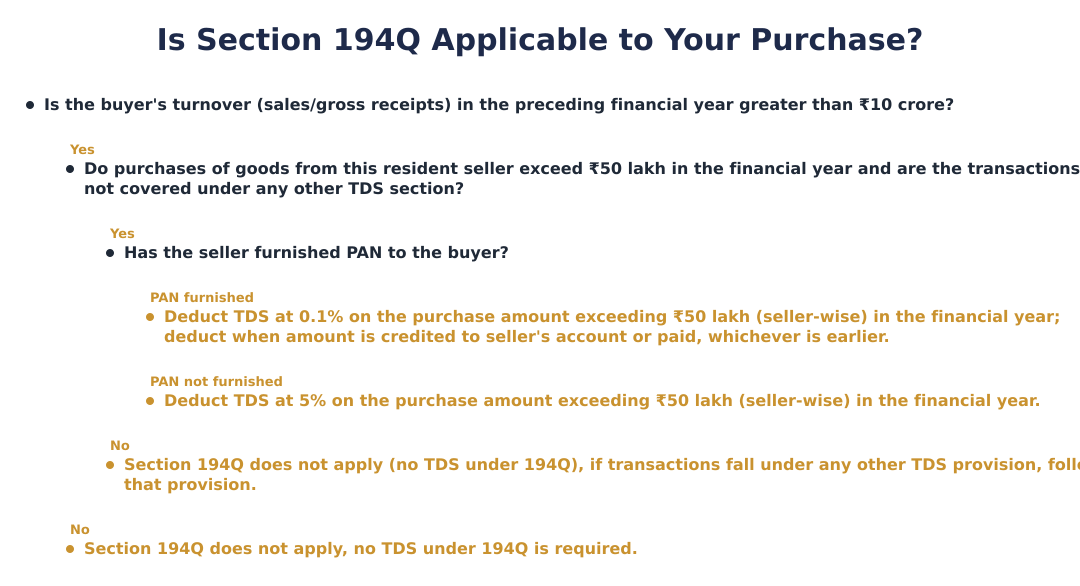
Two concurrent conditions must be satisfied for the buyer to be required to deduct TDS under Section 194Q. First, the buyer’s turnover, sales or gross receipts in the preceding financial year must exceed ₹10 crore. Second, purchases from a particular resident seller in the relevant financial year must exceed ₹50 lakh, the threshold is applied seller-wise, not on aggregate purchases from all sellers combined.
Therefore, a buyer with large turnover who makes relatively small purchases from many different sellers may avoid the obligation for each individual seller if no single seller’s purchases cross the ₹50 lakh seller-wise threshold. Conversely, even a buyer whose total purchases from all sellers are modest may have to deduct TDS if purchases from one supplier exceed the per-seller threshold and the buyer’s preceding-year turnover condition is met.
When to Deduct TDS Under Section 194Q?
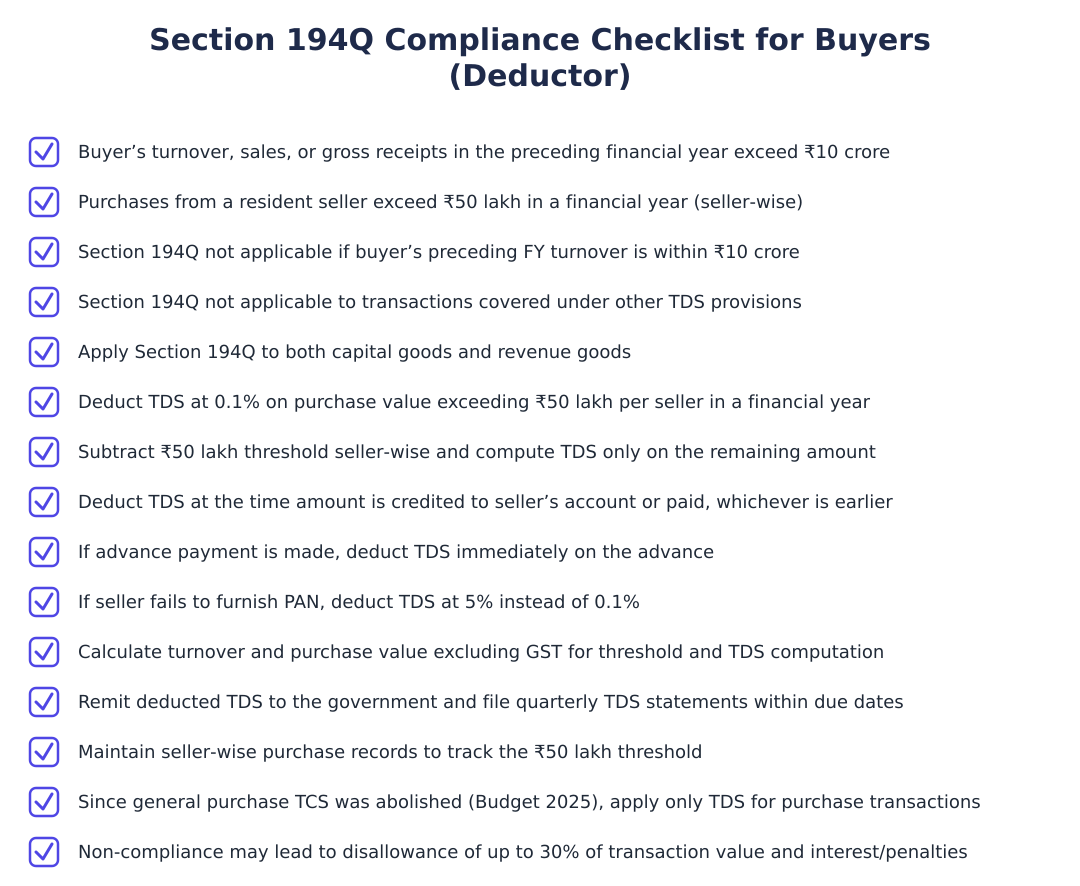
TDS must be deducted at the time the purchase amount is either credited to the seller’s account or paid to the seller, whichever happens earlier.
Track cumulative purchases from each resident seller in the financial year; once purchases from a specific seller exceed ₹50 lakh, begin deducting TDS on the portion in excess of that limit for that seller.
Calculate TDS only on the value of goods excluding GST; do not include GST in the amount on which 0.1% is applied.
After deduction, remit the withheld amount to the government and file the required quarterly statement within the due dates prescribed under law.
Example
Illustrative scenario: assume a buyer whose preceding financial year turnover exceeds ₹10 crore purchases goods worth ₹60 lakh from a single resident seller during a financial year. The per-seller threshold is ₹50 lakh, so the buyer must deduct TDS on the excess amount of ₹10 lakh.
Applying the statutory rate of 0.1% on the excess ₹10 lakh (and remembering the TDS base excludes GST), the TDS to be deducted equals ₹1,000. The buyer should deduct this amount at the time the purchase amount is either credited to the seller or paid, whichever occurs earlier, and then remit the ₹1,000 to the government and include the deduction in the quarterly statement.
TDS Rate Under Section 194Q on Non-furnishing of PAN
The verified facts provided for this guide do not include specific provisions or alternate rates that apply when a seller does not furnish PAN or other identity details. Because such scenarios can involve different procedural and rate outcomes in tax law, consult the official statute, notifications or an authorised tax adviser for the precise treatment in that situation.
In practice, buyers should maintain complete supplier records, including PAN, to ensure correct withholding, reporting and credit flow for the seller; but the specific alternate rates or measures are not set out in the verified facts used for this note.
Impact on GST on TDS Calculation
Section 194Q explicitly requires that the TDS be computed on the value of goods excluding GST. This means GST collected or chargeable on the supply is not part of the TDS base and should not be included when calculating the amount subject to the 0.1% rate.
For accounting and invoice processing, buyers must therefore separate the taxable value of goods and GST on supplier invoices. Only the net value (excluding GST) is added to the running per-seller purchase total used to determine whether the ₹50 lakh threshold has been crossed and to compute the 0.1% TDS on the excess.
Penalty for Non-Compliance Section 194Q of Income Tax Act
The verified facts available for this guide specify the deduction, remittance and quarterly statement obligations but do not list specific penalties or interest amounts for failure to deduct, remit or file. Non-compliance with withholding and remittance obligations under tax law can attract statutory consequences; therefore buyers should ensure timely deduction, payment and reporting as a matter of good compliance practice.
To manage risk, maintain documentation proving threshold calculations, dates when amounts were credited or paid, evidence of TDS remittance and copies of quarterly filings. If you need details of penalties, interest or disallowance provisions, refer to official tax notifications or seek professional advice since those specifics were not part of the verified facts used here.
Section 194Q creates a buyer-side withholding obligation on purchases of goods when two conditions are met: the buyer’s preceding-year turnover exceeds ₹10 crore and purchases from a particular resident seller in a financial year exceed ₹50 lakh. TDS is charged at 0.1% on the seller-wise excess over ₹50 lakh, computed on the value of goods excluding GST, and must be deducted at the time the amount is credited or paid, remitted to the government and reported via the quarterly statement. Track seller-wise purchases, separate GST from taxable value in your bookkeeping, and follow through with remittance and filing to stay compliant.
Frequently asked questions
What is Section 194Q of the Income Tax Act?
Section 194Q requires a buyer to deduct tax at source (TDS) on purchase of goods when certain conditions are met. It was introduced to curb tax evasion by collecting tax at the point of purchase and came into effect from 1 July 2021; TCS on sale of goods under section 206C(1H) was abolished from 1 April 2025 so now only TDS under 194Q applies for such purchase transactions. The provision covers both capital and revenue goods and applies seller-wise, subject to turnover and purchase value thresholds. Buyers must deposit deducted TDS and file quarterly statements within prescribed due dates.
Who is liable to deduct TDS under Section 194Q?
The buyer is liable to deduct TDS under Section 194Q if specific conditions are met. Specifically, the buyer’s aggregate turnover, sales or gross receipts in the preceding financial year must exceed Rs 10 crore and purchases from a resident seller must exceed Rs 50 lakh in a financial year (seller-wise). The rule applies to resident sellers only and to both capital and revenue goods, but it does not apply if other TDS provisions already cover the transaction. If the buyer’s turnover in the preceding year is Rs 10 crore or less, no TDS is required under 194Q.
What is the TDS rate under Section 194Q?
TDS under Section 194Q is to be deducted at the rate of 0.1% on the purchase amount exceeding Rs 50 lakh in a financial year, per seller. This means you subtract the Rs 50 lakh threshold for each seller in a year and apply 0.1% on the remaining purchase value from that seller; for example, if purchases from one seller total Rs 60 lakh, TDS is 0.1% on Rs 10 lakh (i.e., Rs 1,000). The 0.1% rate is calculated on the value excluding GST and applies only when buyer’s turnover exceeds Rs 10 crore in the preceding year.
What happens if the seller does not furnish PAN to the buyer under Section 194Q?
If the seller fails to furnish PAN, the buyer must deduct TDS under Section 194Q at 5% instead of 0.1%. This higher rate applies specifically to non-furnishing of PAN and is lower than the 20% default rate used in some other TDS provisions, but it still significantly increases tax withheld compared with the normal 0.1% rate. The buyer should therefore obtain and verify the seller’s PAN to avoid higher deduction and ensure correct credit to the seller.
Does Section 194Q apply to goods purchased for capital assets as well as revenue purposes?
Yes, Section 194Q applies to purchases of both capital goods and goods for revenue purposes. The provision covers all purchases of goods from resident sellers and the Rs 50 lakh threshold, TDS rates and buyer-turnover condition apply irrespective of whether the goods are for capital or revenue use. This means purchases of machinery (capital goods) and stock-in-trade (revenue goods) are both caught if other conditions are satisfied.
When must the buyer actually deduct TDS under Section 194Q?
TDS under Section 194Q must be deducted at the time the purchase amount is credited to the seller’s account or at the time of payment, whichever is earlier. If an advance payment is made to the seller, TDS must be deducted immediately on that advance; if no advance, deduction happens when the buyer credits the amount to the seller’s account. The buyer must deposit the deducted amount with the government and file the required quarterly TDS statement within due dates.
How does GST affect the calculation of TDS under Section 194Q?
GST is excluded when calculating the value on which TDS under Section 194Q is to be deducted. Both the Rs 50 lakh seller-wise threshold and the 0.1% TDS rate are to be computed on the value of goods excluding GST. Therefore, buyers should ensure invoices are considered net of GST when aggregating purchases and when computing the TDS amount to be deducted and remitted.
What are the penalties or consequences for non-compliance with Section 194Q?
Non-compliance with Section 194Q can lead to interest, penalties and disallowance of expenditure under the Income Tax Act. Specifically, interest and penalty provisions under the Act apply where TDS is not deducted or deposited timely; additionally, up to 30% of the transaction value may be disallowed as expenditure in certain cases, increasing the buyer’s taxable income. Therefore buyers should correctly determine applicability, deduct and deposit TDS on time and file the quarterly statements to avoid these consequences.
Can you give a simple example showing how Section 194Q works for multiple purchases from the same seller?
Yes, if a buyer purchases goods from a single seller totaling Rs 60 lakh in a financial year, TDS under Section 194Q applies on the amount exceeding the Rs 50 lakh threshold, so TDS is 0.1% on Rs 10 lakh = Rs 1,000. For example, three purchases of Rs 20 lakh each from the same seller aggregate to Rs 60 lakh and trigger TDS on the excess over Rs 50 lakh; if the buyer’s turnover in the preceding year was below Rs 10 crore, no TDS would be required. The threshold and TDS are reckoned seller-wise, so purchases from other sellers are treated separately.
Need help staying TDS compliant?
MoneyGence's AI Finance OS tracks your compliance, wallet share, and finances in one place, built for agencies and growing businesses.
Get started with MoneyGence