Section 195 TDS for NRI: Rules, Rates & Compliance
This guide explains Section 195 of the Income Tax Act and how Tax Deducted at Source (TDS) applies to payments made to non-residents. You will learn who counts as a non-resident under the residency rules, which kinds of payments attract TDS, what obligations fall on the person making the payment, and the procedural routes available to obtain lower or nil deduction. The aim is to give business owners, finance teams and payers clarity on when to deduct tax at source on cross-border payments and how to comply, so you avoid withholding mistakes, unnecessary cash outflows, or delayed refunds. Section 195 is central to cross-border tax compliance because it places the obligation to withhold on the payer when a payment to a non-resident is chargeable to tax in India. Practical questions, such as whether a particular recipient is a resident or non-resident, whether a specific payment is taxable in India, and what documentation or approvals are needed, drive compliance choices. This guide uses the statutory residency test and the procedural rules for withholding and relief to outline what a deductor must do and what remedies are available to a non-resident who believes tax should be withheld at a lower rate or not at all. The focus is on actionable clarity: which payments are covered, when no threshold exemption applies, the interplay with Double Taxation Avoidance Agreements (DTAAs), and the formal steps to seek relief or file returns.
What is Section 195?
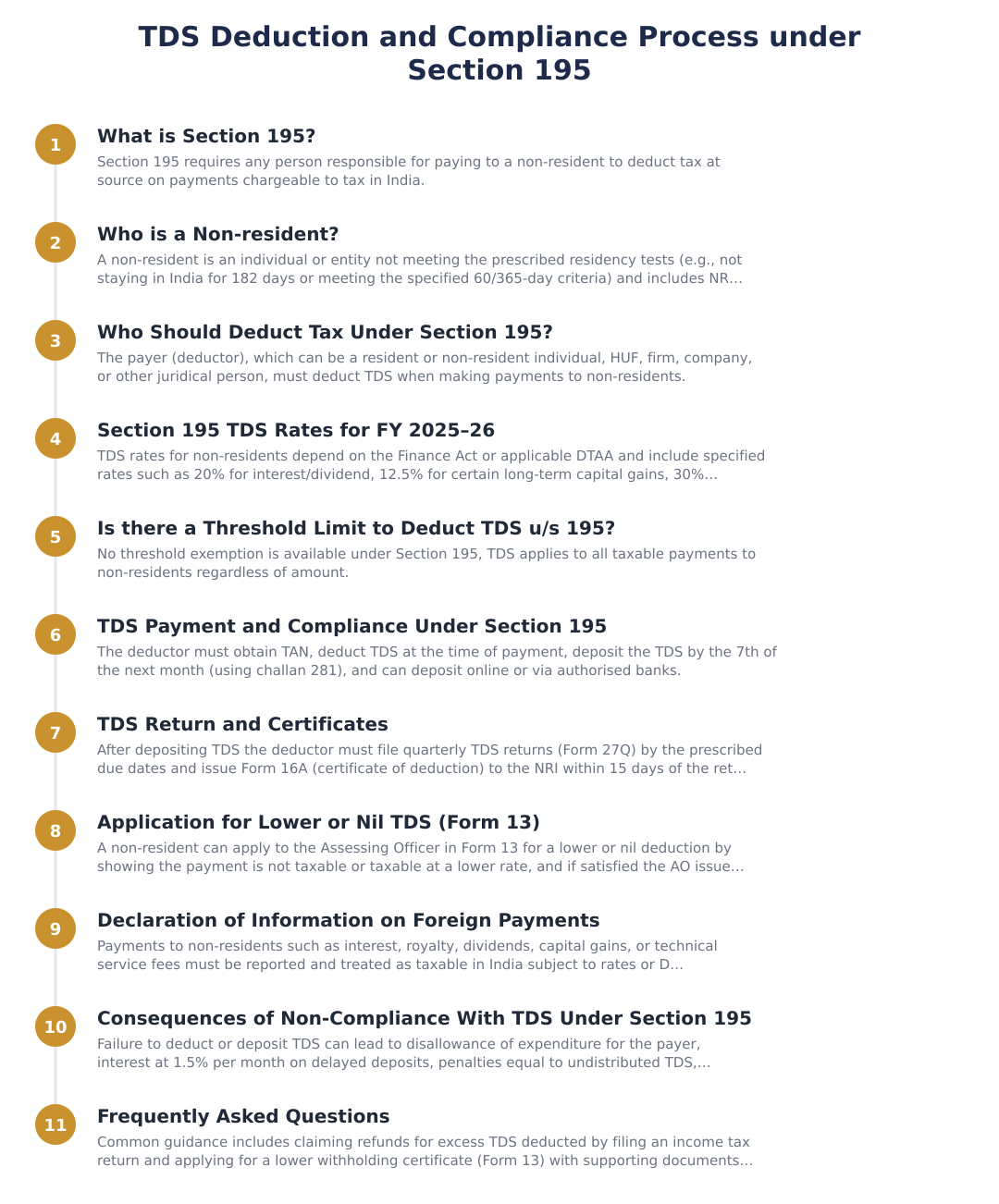
Section 195 requires any person making a payment to a non-resident (other than salary) to deduct tax at source where such income is chargeable to tax in India. The legal duty to withhold sits with the payer, commonly called the deductor, and applies at the time of making the payment or crediting the sum, as provided under the Act.
In practical terms, Section 195 is intended to secure tax on cross-border payments by collecting tax at source when the income arises in India or is deemed to arise in India. This ensures the Indian tax authority receives credit for tax on income that may otherwise be difficult to tax once it leaves the country.
Who is a Non-resident? (Residency rules)
Residency for income‑tax purposes is determined by a statutory test. A person is a resident in India in a financial year if they stay in India for 182 days or more during that financial year, or if they stay in India for 60 days or more during that financial year and 365 days or more during the immediately preceding four financial years.
Anyone who does not meet these conditions is considered a non-resident for that financial year. The distinction matters because Section 195’s withholding obligation applies to payments made to non-residents, and residency status can therefore change whether the payer must deduct TDS under Section 195.
Payments covered, exclusions and threshold position
Section 195 covers a wide range of cross‑border payments such as interest, royalty, capital gains, dividends, fees for technical services and similar heads that are chargeable to tax in India. The essential test is whether the payment is taxable in India, if it is, Section 195 can require withholding by the payer.
Certain categories are treated differently under other provisions of the law; for example, salary and particular interest provisions referenced elsewhere in the Act are excluded from the Section 195 framework in the source material. Importantly, there is no general threshold exemption under Section 195: TDS applies whenever the payment to a non-resident is taxable in India, so small amounts are not automatically excluded by a monetary threshold.
The source material also references a Rs. 15 lakh amount in relation to residency exceptions discussed elsewhere; that figure is noted in the context of residency-related substitutions but does not create a separate threshold exemption for TDS under Section 195.
TDS payment and compliance, obligations of the deductor
A person making payment to a non-resident must obtain a Tax Deduction Account Number (TAN) under section 203A before deducting TDS.
The deductor must withhold tax at the applicable rate when the payment to the non-resident is chargeable to tax in India; the applicable rate is determined by domestic Finance Act rates or the relevant DTAA.
TDS returns for payments to non-residents are filed electronically using Form 27Q on a quarterly basis.
If a non-resident finds that excess TDS was deducted, the excess can be claimed as a refund by filing an income tax return.
Application for lower or nil TDS (Form 13), process
A non-resident recipient who believes a payment (other than salary) is not taxable, only partially taxable, or should be taxed at a lower rate can apply in Form 13 to the Assessing Officer.
The Assessing Officer reviews the facts and documents to determine whether a lower or nil deduction is justified based on the nature of the payment and applicable tax law.
If the AO is satisfied, they issue a certificate under Section 197 permitting the payer to deduct tax at the reduced or nil rate specified in the certificate.
Once the certificate under Section 197 is issued, the payer/deductor may deduct TDS at the reduced or nil rate specified instead of the standard rate.
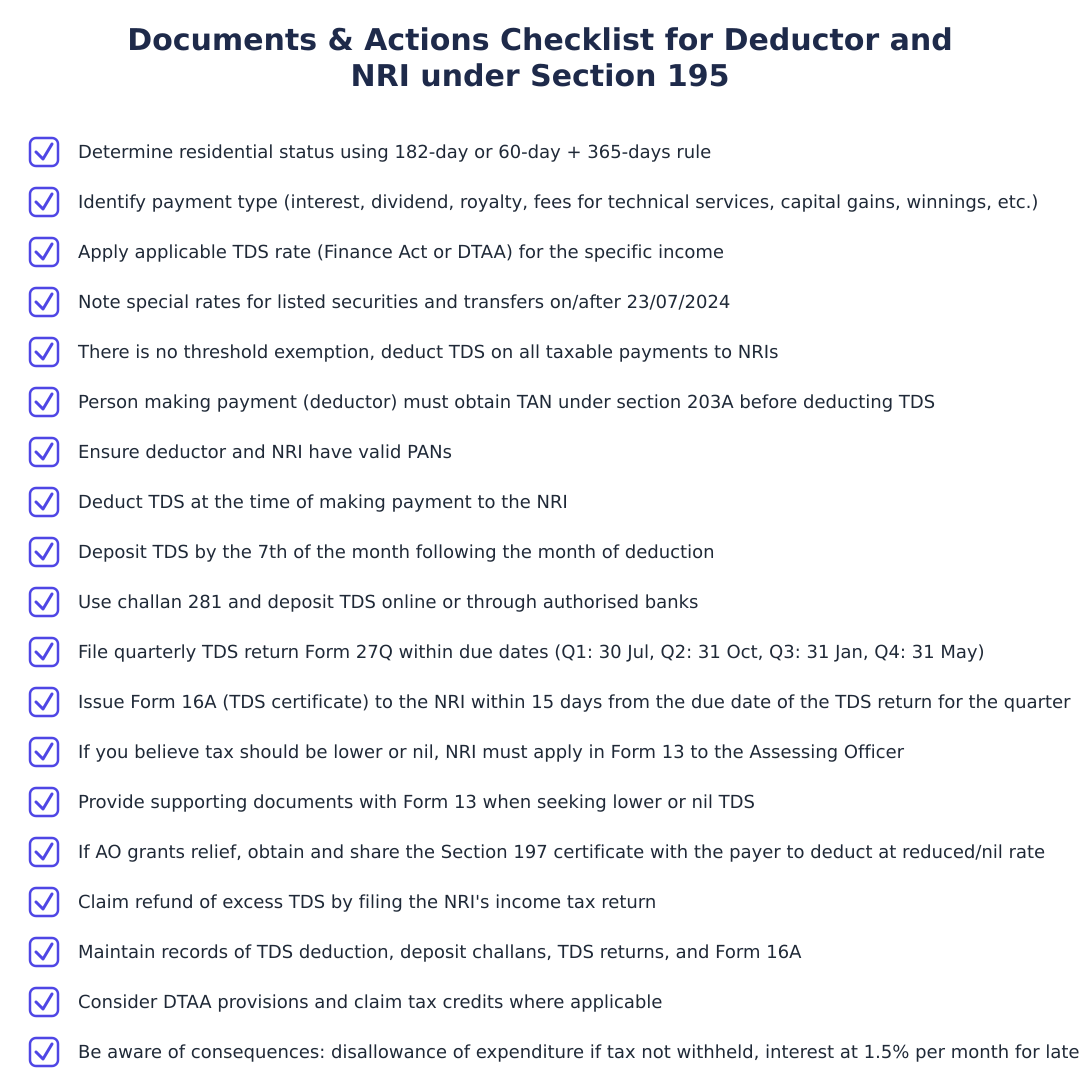
Section 195 places a compliance burden on payers of cross‑border amounts to ensure tax is collected where the income is chargeable to tax in India. Key takeaways are: determine residency correctly, identify whether the payment is taxable in India, secure a TAN before withholding, file Form 27Q quarterly, and consider Form 13 if lower or nil withholding is warranted. Where excess tax is withheld, the non-resident can seek a refund through their income tax return.
Frequently asked questions
What does Section 195 of the Income Tax Act require when paying an NRI?
Section 195 requires the person making a payment to a non-resident (other than salary) to deduct TDS if the payment is chargeable to tax in India. This covers payments such as interest, royalty, dividends, capital gains and fees for technical services, and applies to payers who can be residents or non-residents, individuals, HUFs, firms, foreign companies or other juridical persons. The payer must obtain a TAN before deducting tax, deduct TDS at the time of payment, deposit the tax using challan 281 by the 7th of the following month, and file the quarterly TDS return (Form 27Q). If TDS is deducted, the payer must also issue Form 16A to the NRI within 15 days from the due date of the TDS return for that quarter.
Who qualifies as a non-resident for TDS under Section 195?
A non-resident is someone who does not satisfy the residency conditions under Section 6 of the Income Tax Act for the financial year in question. Typically, a person is resident if they stay in India for 182 days or more in a financial year, or 60 days or more in the year and 365 days or more in the preceding four years, with special substitutions (for example 120 days if total foreign income exceeds Rs 15 lakh, or 182 days for Indian citizens leaving for employment abroad or crew members). Therefore, anyone who fails these tests for a given year will be treated as a non-resident and payments to them may attract TDS under Section 195 if taxable in India.
Are there any threshold limits before you must deduct TDS under Section 195?
No, there is no monetary threshold exemption under Section 195, TDS must be deducted whenever a payment to a non-resident is chargeable to tax in India. That means even relatively small taxable foreign payments (other than salary or incomes covered by special sections) require deduction unless the income is specifically exempt or a certificate for lower/nil deduction is obtained. The payer should therefore assess taxability and, if appropriate, either deduct TDS at the prescribed rate or obtain a Section 197 certificate (Form 13) allowing lower or nil deduction.
What TDS rates apply to typical payments to NRIs for FY 2025–26?
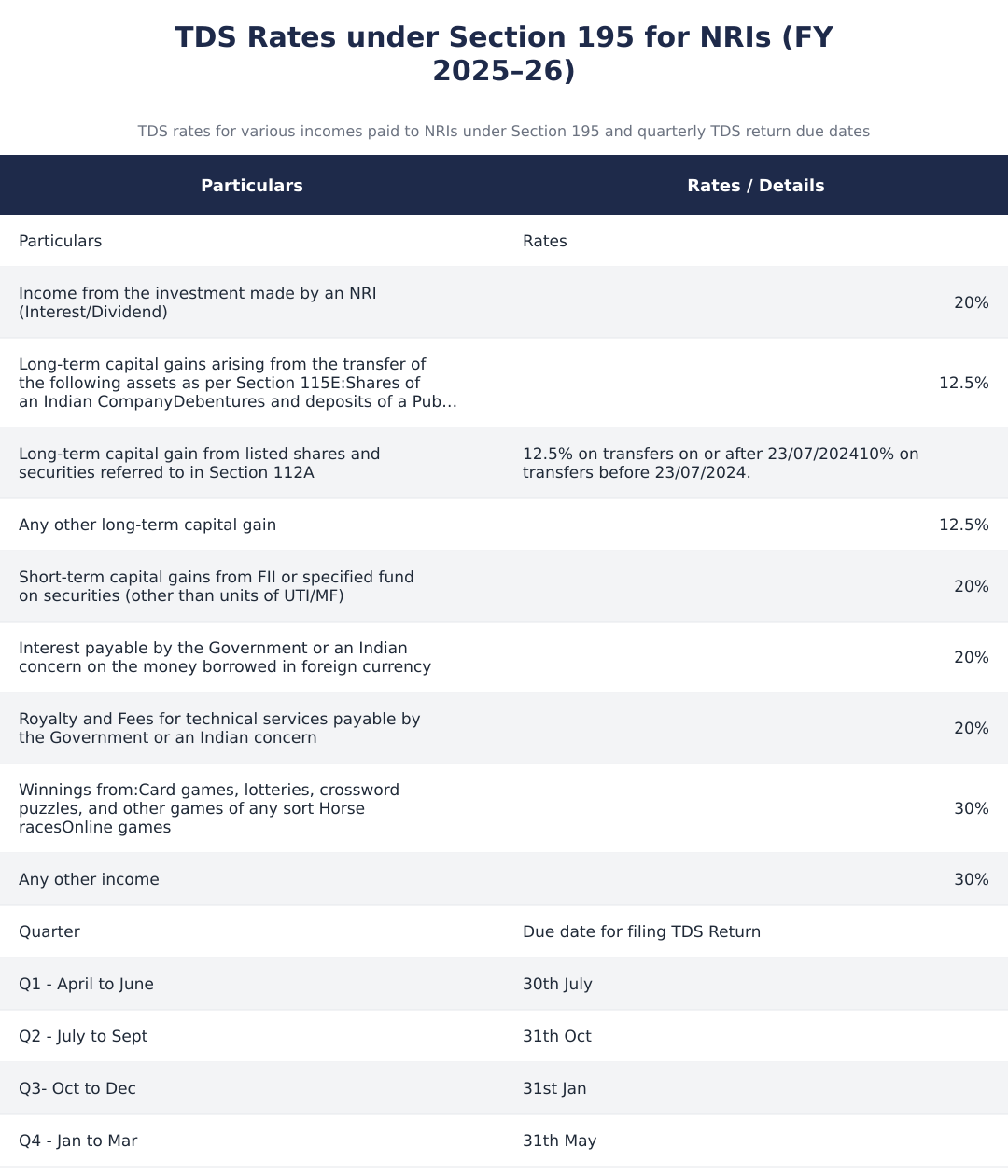
TDS rates for payments to NRIs depend on the nature of income and may follow the Finance Act or the relevant DTAA; typical rates include 20% for interest/dividend and many specified items, 12.5% for certain long-term capital gains (including specified securities and transfers under Section 115E), 30% for ‘any other income’ and 30% for winnings from lotteries, and 20% for royalties and fees for technical services. For long-term capital gains on listed shares and securities under Section 112A the rate is 12.5% on transfers on or after 23/07/2024 and 10% for transfers before 23/07/2024. Always check the relevant DTAA as it may prescribe a lower rate and allow tax credit in the country of residence.
How do I deposit TDS and file TDS returns when paying an NRI?
After deducting TDS for a non-resident, the payer must deposit the tax using challan 281 by the 7th day of the month following the month of deduction and then file the quarterly TDS return in Form 27Q. Form 27Q is filed quarterly with due dates: Q1 (Apr–Jun) by 30th July, Q2 (Jul–Sep) by 31st Oct, Q3 (Oct–Dec) by 31st Jan, and Q4 (Jan–Mar) by 31st May. Once the return is filed, the payer must issue the TDS certificate (Form 16A) to the NRI within 15 days from the due date of the TDS return for that quarter.
How can an NRI get lower or nil TDS on a payment under Section 195?
An NRI can apply for a lower or nil TDS certificate by submitting Form 13 to the Assessing Officer (AO) if they believe the payment (other than salary) is not taxable or is taxable at a lower rate in India. The AO examines the application and supporting documents and, if satisfied, issues a certificate under Section 197 authorising the payer to deduct tax at the reduced or nil rate specified. Once issued, the NRI should provide the certificate to the payer so that TDS is deducted at the lower/nil rate going forward.
What happens if TDS under Section 195 is not deducted or deposited on time?
If TDS is not deducted or deducted but not deposited on time, the payer faces consequences including disallowance of the expenditure (for business) until tax is actually paid, interest at 1.5% per month from deduction to deposit, and penalties which can equal the TDS amount for failure to deposit or the shortfall amount for short deduction. Additionally, penalties and prosecution provisions may apply in serious cases, and the deductor remains liable to deposit the outstanding tax along with interest and penalties. Therefore timely deduction, deposit, and filing are crucial to avoid significant additional cost and compliance exposure.
Can an NRI claim a refund if excess TDS is deducted under Section 195?
Yes, any excess TDS deducted from an NRI can be claimed as a refund by filing the Indian income tax return (ITR) for the relevant assessment year. The NRI must report total income, compute tax liability after allowing DTAA credit where applicable, and claim refund for the excess tax deducted; the refund will be processed by the Income Tax Department after assessment and verification. Alternatively, the NRI may have obtained a Section 197 certificate in advance to prevent excess deduction, but once excess is deducted the ITR refund route is the standard remedy.
When should the payer issue Form 16A to an NRI and what does it show?
The payer must issue Form 16A (TDS certificate) to the NRI after filing the TDS return, and it should be provided within 15 days from the due date of the TDS return for the relevant quarter. Form 16A details the amount paid to the NRI, the tax deducted, the date of deduction, and the challan details of deposit, and it serves as proof for the NRI to claim tax credit or refunds in their Indian tax return or under DTAA. Timely issuance of Form 16A is important for the NRI to substantiate taxes paid in India and to avoid delays in refund or credit claims.
Need help staying TDS compliant?
MoneyGence's AI Finance OS tracks your compliance, wallet share, and finances in one place, built for agencies and growing businesses.
Get started with MoneyGence