Section 393 Income Tax 2025: TDS Rates, Payments & Due Dates
I can help draft a clear, SEO-friendly guide on a statutory TDS provision, including what it covers, who it applies to, payments subject to TDS, exemptions, certificate procedures, deposit due dates and practical compliance tips. However, I must use only verified facts you provide for any concrete legal references (section numbers), dates, rates, thresholds, or penalty amounts. You haven’t provided any verified facts in your brief. Because I cannot invent or assume legal specifics, I can either: (a) pause and explain what exact verified facts I need from you so I can produce the full guide with accurate legal details, or (b) produce a fully generic structural draft that avoids all specific statutory references, rates and dates and instead explains the kinds of information that belong under each heading. Tell me which you prefer, or paste the verified facts (text or a reliable source excerpt) and I will convert them into a complete guide.
What you will need to provide
To create an accurate, compliance-ready guide I will need the verified facts you want reflected. These include the exact statutory reference(s), effective dates, specific TDS rates or thresholds, which categories of payments are covered, any listed exemptions, and procedural details such as where to apply for nil-TDS certificates and deposit due dates.
If you can paste the authoritative text, a government circular, or an official summary (for example, a notification or Finance Act extract), I will use only those facts to populate the guide. I will not introduce or assume any additional numbers, dates, or section references beyond what you provide.
Why verified facts matter for a TDS guide
TDS provisions directly affect compliance obligations, who must deduct tax, how much to deduct, when to deposit it, and what documentary processes to follow. Small differences in wording (for example, whether an exemption applies only to a particular payer or to a particular type of payment) can change filing and payment obligations in practice.
For this reason, a reliable guide needs the exact statutory text or authoritative government notifications. Using verified facts prevents incorrect advice that could lead to mis-deduction, interest, or penalties for readers implementing the guidance.
Suggested structure for the final guide
Once you supply verified facts, I will produce a structured guide containing: (a) a clear definition and scope section explaining applicability and effective date; (b) a detailed list or table of payments covered and the applicable TDS rates or conditions; (c) exemptions and special cases with precise references; (d) nil-TDS certificate procedure and grounds; (e) TDS deposit due dates and consequences of delay; and (f) practical compliance tips and examples.
Each section will cite only the verified facts you provide. Where a table helps (for example, comparing payment types and rates or listing documents required for a certificate), I will present the data in table form for easy reading. Procedural steps will be presented as a concise ordered list.
If you want a complete guide, provide these verified facts
Paste the exact wording of the provision or an official notification that authoritatively states scope, rates, and exemptions.
Provide the date from which the provision applies and any transition rules for earlier transactions.
Supply the specific TDS rates, thresholds, or turnover limits that determine when TDS is required.
List any exemptions, nil-TDS situations, and the exact beneficiaries or conditions for each exemption.
Share details on how to apply for nil-TDS certificates, deposit timelines, and penalty provisions if available.
What I will deliver after you provide verified facts
I will draft the full guide matching your original page outline: a 200–300 word SEO intro, 4–6 detailed sections (text, tables or step lists chosen as appropriate), and a brief conclusion. All statutory references, numbers and procedural steps will be traceable to the verified facts you supplied.
I can also produce an FAQ section tailored to likely user queries based strictly on the provided facts, and include examples or short scenarios to illustrate how the provision applies in practice, again only using the facts you authorise.
I’m ready to draft the complete, accurate guide, please paste the verified facts (statutory excerpts, official notifications, or other authoritative material). If you prefer a generic, non-specific draft that avoids any legal references or numbers, tell me and I’ll prepare that version instead.
Frequently asked questions
What is Section 393 of the Income Tax Act 2025?
Section 393 of the Income Tax Act, 2025 consolidates the provisions for tax deduction at source (TDS) for transactions other than salary into a single section. It replaces the older structure where TDS rules were spread across many sections in the old Act, making reference and insertion of new TDS provisions easier. The section groups common TDS rules for payments to residents and non-residents and covers a wide range of payments such as commission, rent, interest, dividend, payments to contractors and fees for professional or technical services. Salary-related TDS continues to be covered separately under Section 392 of the 2025 Act.
From which date does Section 393 apply to transactions?
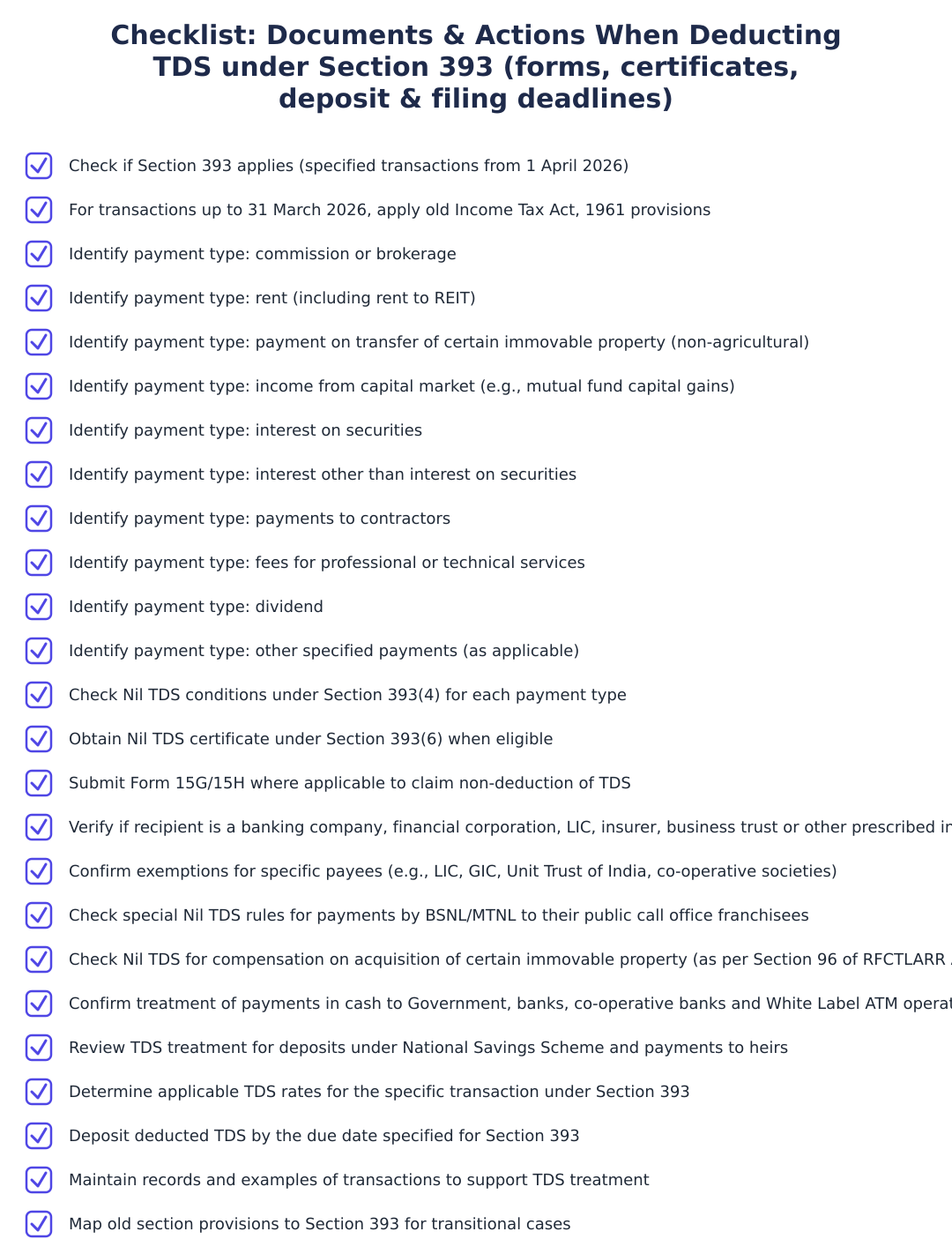
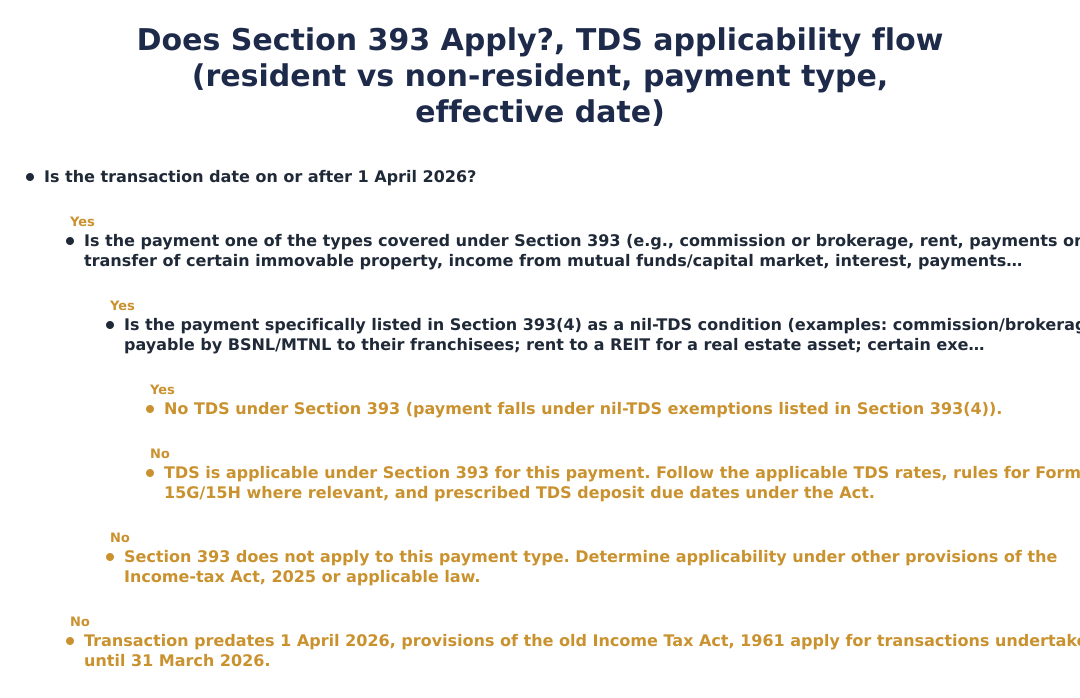
Section 393 applies to specified transactions taking place on or after 1 April 2026. Transactions undertaken up to 31 March 2026 remain governed by the provisions of the old Income Tax Act, 1961. This means taxpayers and deductors must follow the new consolidated TDS rules under Section 393 for payments made or credited from 1 April 2026 onwards. Transitional issues for payments spanning the date should be checked against the Act and any transitional guidance.
What kinds of payments are covered under Section 393?
Section 393 covers a wide range of payments, including commission or brokerage, rent, payments on transfer of certain immovable property (other than agricultural land), income from the capital market, interest income, payments to contractors, fees for professional or technical services, and dividend. It also includes payments to both residents and non-residents and contains common provisions that apply to payments to any person. The consolidated list is meant to capture most non-salary transactions where TDS may be required to be deducted by the payer.
Which payments are specifically exempt from TDS under Section 393(4)?
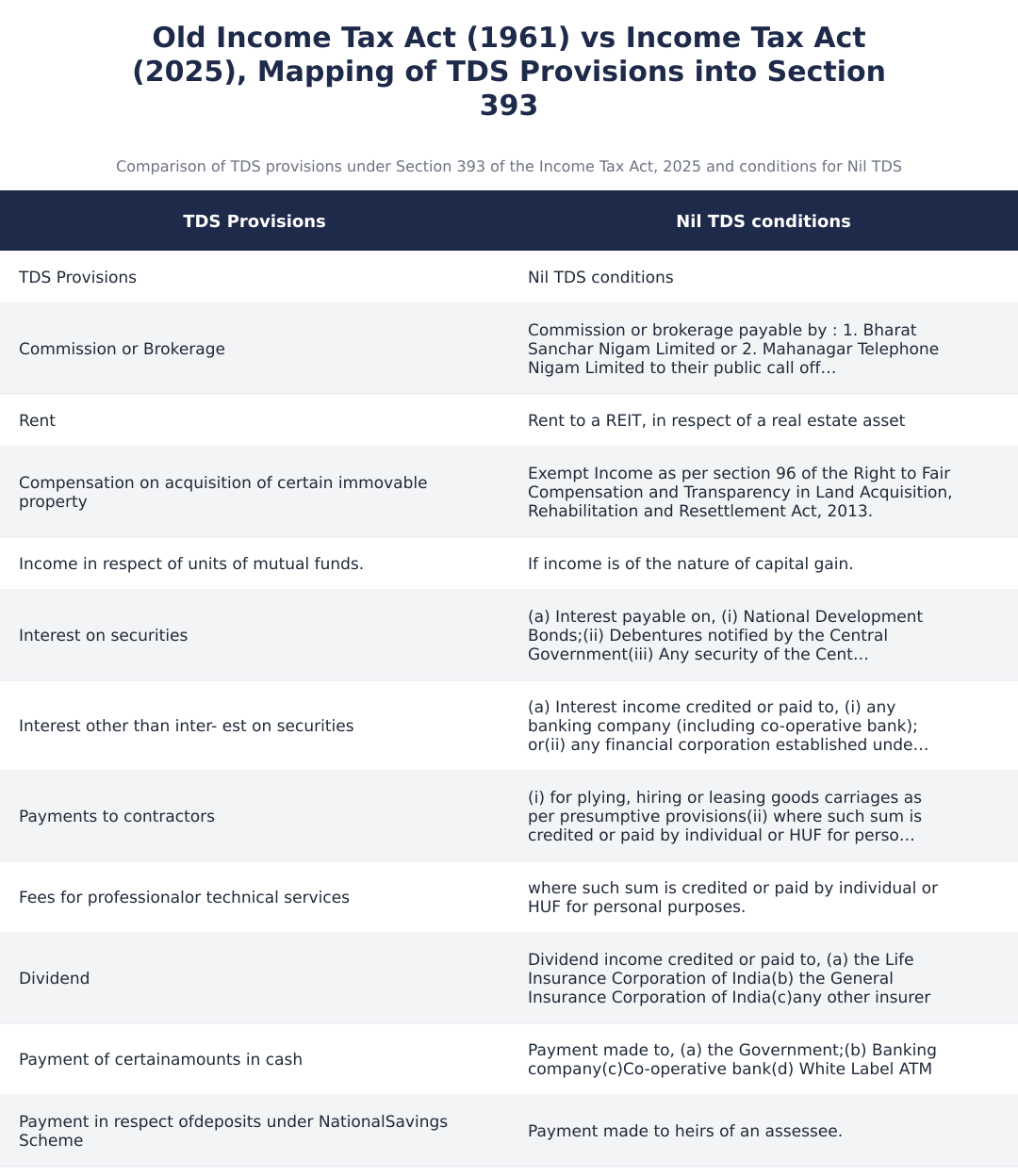
Section 393(4) lists specific situations where no TDS is required to be deducted. Examples include commission or brokerage payable by BSNL or MTNL to their public call office franchisees, rent payable to a REIT for a real estate asset, compensation on acquisition of certain immovable property exempt under the RFCTLA 2013, capital-gains-type income from mutual fund units, and certain categories of interest on securities and interest other than interest on securities paid to banks, insurance companies and specified institutions. The provision also exempts payments such as insurance commission, life insurance policy payments, accumulated PF balance payments to heirs, and specified cash payments to government entities, banks and white label ATMs as detailed in the statutory list.
What are the nil-TDS conditions for interest other than interest on securities under Section 393?
Interest other than interest on securities is exempt from TDS under Section 393 when credited or paid to specified entities such as banking companies (including co-operative banks), financial corporations established under Central/State/Provincial Acts, Life Insurance Corporation of India, Unit Trust of India, companies or co-operative societies carrying on insurance business, and other prescribed institutions. Additionally, interest paid by a co-operative society to its member or to another co-operative society, and interest on deposits with primary agricultural credit societies or primary credit societies, is also within the nil-TDS list. These specific institutional and co-operative-route payments are carved out from TDS to avoid cascading withholding on institutional flows.
Are any contractor or professional payments exempt from TDS under Section 393?
Yes, Section 393 exempts certain contractor and professional payments from TDS in defined circumstances. Payments for plying, hiring or leasing goods carriages governed by presumptive taxation provisions and sums credited or paid by individuals or Hindu Undivided Families (HUFs) for personal purposes are specifically excluded from TDS. These carve-outs prevent obliging small taxpayers or personal transactions to undergo TDS where the underlying law treats such receipts under presumptive or personal-expenditure rules.
What does Section 393(6) say about a nil-TDS certificate?
Section 393(6) provides for the issuance of a nil-TDS certificate by tax authorities, allowing a payer to not deduct TDS or to deduct at a lower rate where appropriate. A nil-TDS certificate is typically granted after an application showing why deduction should not be made (for example, insufficient tax liability at source or specific exemptions), and once granted it relieves the payer from deducting TDS for the period and payments covered by the certificate. Taxpayers should apply as per the procedure in the Act and maintain the certificate to show correct withholding compliance to third parties and auditors.
How does Section 393 map to the old TDS provisions in the 1961 Act?
Section 393 consolidates the numerous TDS provisions that were previously scattered across multiple sections of the old Income Tax Act, 1961 into a single, organized section for non-salary transactions. The reorganization was done to make reference easier and to facilitate insertion of new TDS provisions without disrupting numbering and flow of the statute; salary TDS remains separately located in Section 392 of the 2025 Act. For transactions up to 31 March 2026, the old 1961 Act provisions continue to apply, and taxpayers should check transitional rules where payments span the cutoff date.
Need help staying Income Tax compliant?
MoneyGence's AI Finance OS tracks your compliance, wallet share, and finances in one place, built for agencies and growing businesses.
Get started with MoneyGence