Section 43B(h) Income Tax: Applicability, Date, Limit & Example
This guide explains, at a practical level, how the provision commonly referred to as Section 43B(h) of the Income‑tax Act affects payments to Micro, Small and Medium Enterprises (MSMEs), who it is likely to apply to, how it changes the tax deduction timing, and what businesses should do in practice to remain compliant. You will not find statutory numbers or notification references here; instead, this article focuses on the commercial and tax-compliance implications, what businesses should track in their accounting, and prudent steps to manage the timing of payments to suppliers who qualify as MSMEs. Understanding these themes is important because timing of payments can affect which financial year a buyer may claim a deduction for the expense, influence cash‑flow planning for both buyers and suppliers, and trigger compliance or disclosure requirements for tax purposes. After reading, you should be able to identify situations that require closer attention, adopt recordkeeping and internal controls that support correct tax treatment, and know where to look for authoritative legislative updates and official notifications.
What Section 43B(h) aims to address (high-level)
At a conceptual level, this provision ties the tax-deductibility of certain business expenses to the timing of actual payment to specified categories of suppliers. The rule is intended to align tax outcomes with cash outflows: a buyer’s deduction for an expense depends not only on when the expense is incurred but also on when the payment to the supplier is actually made.
For businesses, the practical effect is that accounting entries and tax filings must reflect not just the liability created on receipt of goods or services but also the subsequent settlement behaviour. This creates an added compliance consideration: payment dates become as important as invoice dates when determining the correct year for claiming tax deductions.
Applicability, who should be concerned
Buyers and procuring entities that purchase goods or services from suppliers who qualify as MSMEs should evaluate whether this provision affects their tax position. The provision is focused on payments to a particular class of suppliers and therefore has asymmetric impact, larger buyers often need to reassess deductibility timing when dealing with small suppliers.
Suppliers who are classified as MSMEs should monitor payment patterns from their buyers because delayed receipts can have cash‑flow consequences and because the tax treatment on the buyer side may change depending on when payments are settled. Both buyers and suppliers should ensure their contracts and purchase orders clearly document agreed payment terms to provide supporting evidence in case of scrutiny.
Effective date and time limit, how to approach uncertainty
Statutory provisions that alter deduction timing often come with an effective date or transitional rules; businesses should not assume automatic retrospective application without checking official communications. Where a change is relevant, organisations must map their invoices, purchase orders and payment records against the effective date to determine the correct tax year for deductibility.
If you are unsure which payments fall into which tax year due to changes in law or notifications, document your assumptions, preserve supporting evidence (invoices, acknowledgment receipts, bank statements, contracts) and seek authoritative clarification from published notifications or a tax advisor before finalising tax returns.
Practical example, how to think about a payment scenario
When assessing a real transaction, identify the date of supply (acceptance of goods or services), the agreed credit period (if any), the actual date of payment, and whether the supplier meets the qualifying criteria as an MSME. These four datapoints determine the year in which a buyer can fairly treat the payment as deductible for tax purposes under the provision.
Keep a clear audit trail showing when goods or services were accepted and when payments were made. Where there is any ambiguity, such as disputed deliveries or payment offsets, record contemporaneous communications and agreements to support the treatment claimed in the tax return.
Penalties and consequences for non‑compliance (practical view)
Failure to follow the correct timing rules for deductibility can lead to disallowance of expense claims in the buyer’s tax computation, which in turn may increase reported taxable income and tax liability. Additionally, incorrect treatment can attract interest or other statutory consequences if adjustments are made following scrutiny.
To minimise exposure, businesses should reconcile supplier ledgers with bank payment records regularly and remediate any mismatches early. Where past filings may have incorrectly claimed deductions, consider voluntary correction routes or consult a tax professional about the appropriate remedial steps.
Benefits of the provision and commercial implications
From a public-policy and commercial standpoint, aligning tax deductibility with prompt payment to smaller suppliers incentivises timely settlement and supports the working capital needs of MSMEs. Buyers that adopt timely payment practices can enjoy stronger supplier relationships and a more stable supply chain.
For buyers, complying with the timing requirement avoids tax adjustments and fosters predictability in tax planning. Suppliers benefit from improved cash inflows and reduced disputes over overdue payments, which strengthens their operational stability.
How to check MSME status and documentation to maintain
Because the supplier’s status as an MSME is central to how the rule applies, buyers should obtain and retain evidence of that status directly from their suppliers. Maintain copies of registration certificates, self-declarations, and any government-issued documentation relied upon during supplier onboarding.
Additionally, keep clear records of invoices, purchase orders, written agreements on credit periods, delivery/acceptance acknowledgements, and bank evidence of payment. These records form the backbone of a defensible tax position should the timing of deduction be questioned.
MSME turnover limit, a note on seeking authoritative confirmation
Thresholds and classification criteria for MSME status are usually specified in government rules and can change over time. Because this guide does not reproduce statutory thresholds, businesses should consult the current official notifications or a qualified tax advisor to determine whether a supplier falls within the MSME definition for any particular year.
Rely on primary sources, official government portals or published circulars, and preserve contemporaneous proofs of the supplier’s classification as part of your compliance documentation.
Frequently asked questions
Q: If payment is delayed beyond the agreed date, which year should the buyer claim the expense? A: The answer depends on the interaction between the date of payment, the date of supply, and the supplier’s classification. Document the facts carefully and seek authoritative guidance for a conclusive position.
Q: Can contractual terms override the tax-timing rule? A: Contractual terms are evidence of parties’ intentions but will not necessarily override statutory timing rules for tax deductibility. Ensure contracts are consistent with applicable statutory requirements and maintain written agreements to support your tax treatment.
In practice, the key takeaways are to treat payment dates seriously for tax purposes when dealing with suppliers who may be MSMEs, maintain robust documentary evidence of supply and settlement, and consult official notifications or a tax advisor for precise, up‑to‑date rulings and thresholds. Careful records and proactive supplier management will reduce the risk of tax adjustments and support smoother cash‑flow and compliance outcomes.
Frequently asked questions
What is Section 43B(h) of the Income Tax Act in simple words?
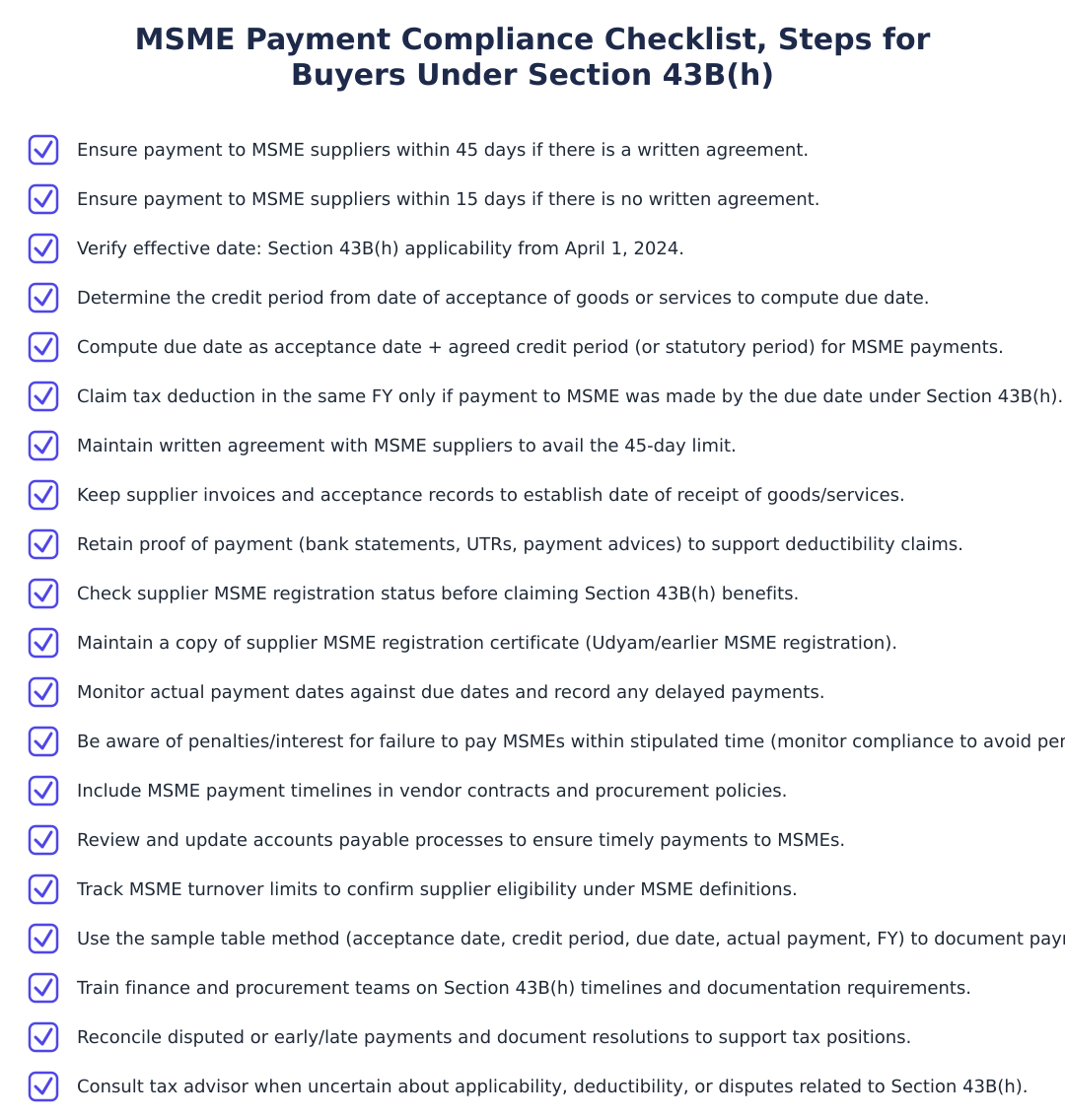
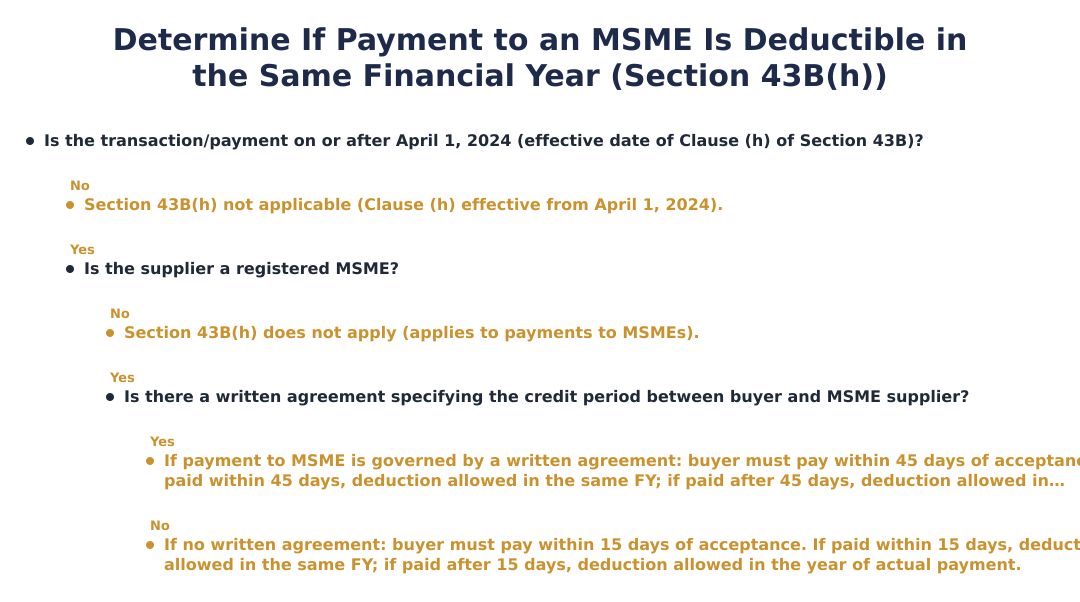
Section 43B(h) is a tax provision that requires buyers to make prompt payments to micro and small enterprises (MSMEs) within specified time limits for the buyer to claim a tax deduction in that year. Specifically, payments to an MSME supplier are expected to be made within 15 days where there is no written agreement, and within 45 days where there is a written agreement; if the buyer does not pay within these timeframes, the deduction for that expense is allowed only in the year in which actual payment is made. The clause is aimed at improving MSME working capital and cash flow and applies when the supplier qualifies as an MSME under the relevant registration (Udyam/MSME).
Who does Section 43B(h) apply to, buyers, sellers or both?
Section 43B(h) primarily affects buyers because it conditions the tax deductibility of payments made to MSME suppliers on timely payment. A buyer can claim the deduction in the same financial year only if the payment to the MSME supplier is made within 15 days (no written agreement) or 45 days (with written agreement) from acceptance of goods or services; otherwise the deduction is postponed to the year of actual payment. Sellers (MSMEs) benefit from the rule through improved likelihood of timely receipts, but compliance obligations and tax impact fall on the buying entity.
How long does a buyer have to pay an MSME under Section 43B(h)?
A buyer must pay an MSME within 15 days if there is no written agreement, and within 45 days if there is a written agreement, counted from the day of acceptance of goods or services. If payment is not made within these prescribed periods the buyer cannot claim the tax deduction for that expense in the same financial year and must claim it only in the year in which the payment is actually made. These timelines are intended to fast-track payments to micro and small suppliers and reduce their working capital stress.
From which date is Section 43B(h) effective for tax deductions?
Section 43B(h) is effective for payments made in recent financial years and is being applied from financial year 2023-24 onwards for payment-deduction timing purposes. This means transactions where the due date under MSME timelines falls in FY 2023-24 or later will be governed by the clause for determining the year of tax deduction. Practical examples in this period show supplies accepted in late 2023 and early 2024 being tested against the 15/45-day rules to decide whether deduction is allowed in FY 2023-24 or FY 2024-25.
What is the tax consequence if a buyer misses the 15/45 day payment deadline to an MSME?
If a buyer fails to pay an MSME within the prescribed 15/45 days, the tax deduction for that expense is not allowed in the year of supply and is instead allowable only in the year in which actual payment is made. In effect, the expense is disallowed for computing taxable income in the earlier year, increasing that year's taxable profits; when the buyer eventually pays, they can claim the deduction in that later year. Separate penalties or interest under the MSME Development Act may apply to the buyer as well, but the primary income-tax consequence is postponement of the deduction until the payment date.
Does Section 43B(h) apply to traders or only to manufacturers/service providers?
Section 43B(h) applies to payments made to any supplier that qualifies as an MSME, including traders, manufacturers and service providers, provided the supplier is registered and falls within the micro or small enterprise definition. The key factor is the supplier's MSME status, not the buyer's or the supplier's activity type; therefore payments to MSME traders must also meet the 15/45-day timelines for the buyer to claim deduction in that year. Buyers should verify the supplier's MSME registration (for example via the Udyam portal) before relying on the deduction in the same year.
Can you give a quick example showing how Section 43B(h) affects which financial year gets the deduction?
Yes, for example, if a buyer accepts goods on 01/04/2024 and there is a written agreement (45-day credit), the due date is 16/05/2024; if the buyer actually pays on 21/05/2024 the deduction is allowed in FY 2024-25 because payment was made after the due date but still in the same FY. Conversely, if acceptance was on 31/01/2024 with a 15-day credit and payment happens on 20/02/2024, the deduction is allowed in FY 2023-24 only if payment meets the 15-day requirement, otherwise it shifts to the FY of actual payment. Practical examples show mapping of acceptance date, credit period, due date and actual payment date to determine the fiscal year where deduction is permitted.
What penalties or other consequences can arise for failing to pay MSMEs on time under Section 43B(h)?
The primary income-tax consequence is that the buyer cannot claim the deduction in the year of supply and must claim it only in the year of actual payment; this effectively increases taxable income in the earlier year. In addition, statutory remedies under the MSME Development Act (like interest on delayed payments or other contractual penalties) may be triggered against the buyer, and prolonged non-payment can lead to disputes or reputational harm. Buyers should therefore treat the 15/45-day timelines as both a tax compliance risk and a commercial obligation to avoid additional liabilities.
How do I check whether a supplier is registered as an MSME for Section 43B(h) purposes?
You can check a supplier's MSME registration by asking for their Udyam registration certificate or by verifying their Udyam/MSME registration details on the official government Udyam portal. Buyers should retain a copy or screenshot of the supplier's registration and the registration number as supporting evidence when claiming deductions under Section 43B(h). If the supplier is not registered, the buyer should treat the supplier as non‑MSME for the 15/45-day timeline analysis and document the position accordingly.
Need help staying MSME compliant?
MoneyGence's AI Finance OS tracks your compliance, wallet share, and finances in one place, built for agencies and growing businesses.
Get started with MoneyGence