Section 44AB Tax Audit: Due Date, Criteria & Penalty Guide
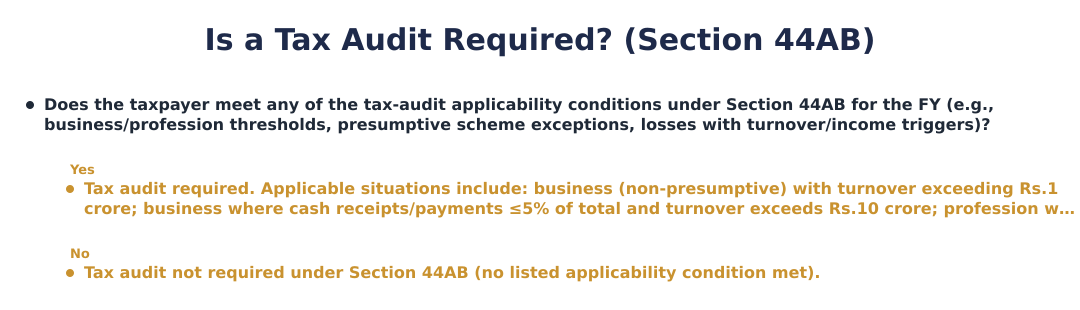
This guide explains Section 44AB tax audit in India: who must get their accounts audited, which forms are used, how the audit report is furnished, and the consequences of not complying. You will learn the key applicability thresholds that trigger a statutory tax audit, how presumptive schemes can still lead to an audit in particular situations, what audit documentation and forms are involved, and how the online filing and acceptance process works. Understanding these points matters because a statutory tax audit is a compliance milestone that affects record-keeping, timing of filings, and potential penalties. Getting clarity on the audit triggers and the reporting mechanism helps businesses and professionals plan accounting, choose suitable tax schemes, and avoid avoidable penalties. This guide uses the provisions and examples mandated under Section 44AB and related reporting forms, and it highlights reasonable causes that, if applicable, can prevent levy of penalty for non-compliance. Read on to find the specific turnover and receipt thresholds, the circumstances under which presumptive taxpayers can still face an audit, the statutory audit report forms you will encounter, the online submission workflow, and the penalty rule where auditing is not completed as required.
What is a Tax Audit?
A tax audit under Section 44AB is a statutory examination of a taxpayer’s accounts and other documents by a qualified tax auditor to ensure the correctness of income, deductions and tax computation. The audit focuses on verifying the records maintained by the taxpayer and producing a report that is included with the income tax compliance process.
The scope of a tax audit is determined by the Income Tax Act and related rules. When the conditions laid down in Section 44AB are met, the taxpayer must engage a tax auditor to carry out the audit and produce the prescribed audit report and accompanying particulars.
What are the Objectives of Tax Audit?
The primary objective of a tax audit is to provide independent assurance that the taxpayer’s accounts and claimed figures are accurate and comply with the relevant provisions of the Income Tax Act. The auditor examines records, verifies computations and identifies discrepancies that may affect taxable income or allowable deductions.
A tax audit also facilitates transparent reporting to the tax authorities through a standardised audit report and prescribed particulars. This standardisation helps the tax department assess compliance across taxpayers and simplifies the taxpayer’s own process of substantiating figures in the income tax return.
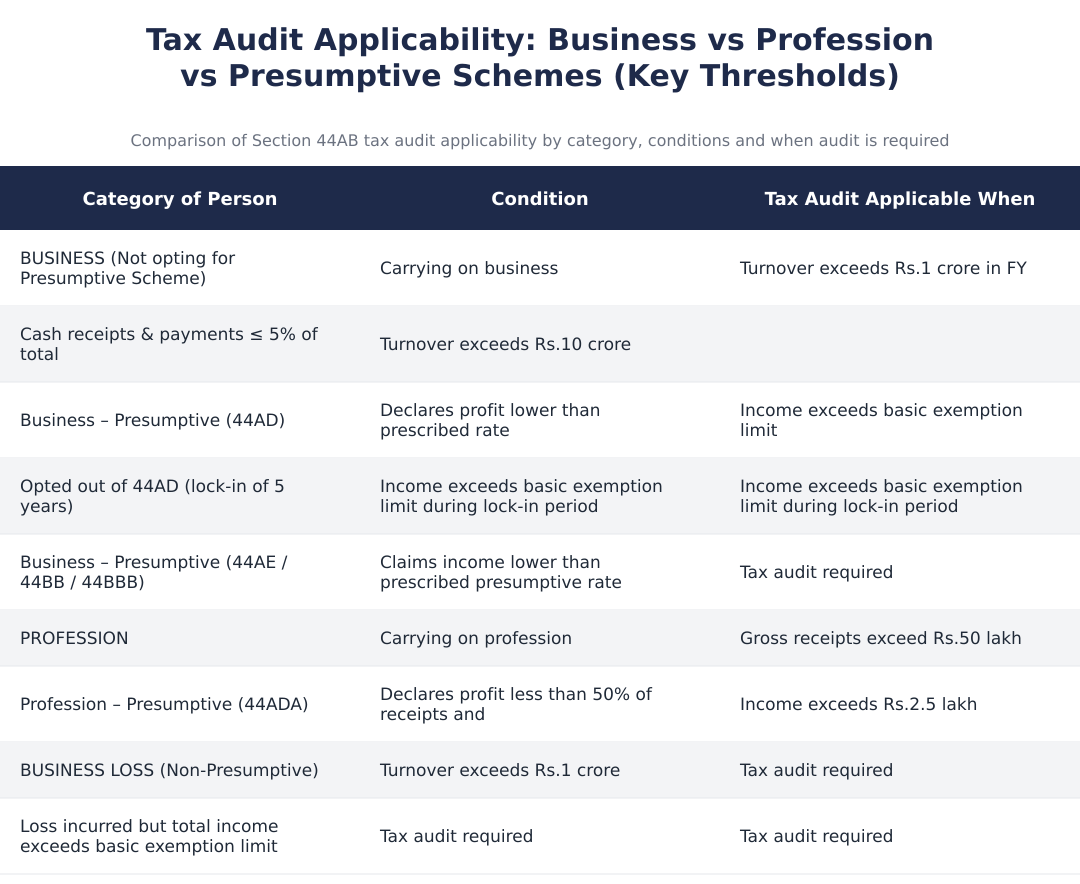
Income Tax Audit Applicability, Key Thresholds and Situations
| Category | Condition / Details | Tax Audit Applicable When |
|---|---|---|
| Business (non-presumptive) | Carrying on business | Turnover exceeds Rs. 1 crore in the financial year |
| Business (non-presumptive), low cash component | Cash receipts and payments are 5% or less of total receipts/payments | Turnover exceeds Rs. 10 crore in the financial year |
| Profession | Carrying on profession | Gross receipts exceed Rs. 50 lakh in any previous year |
| Presumptive business under section 44AD | Taxpayer declares profit lower than the prescribed presumptive rate | Income exceeds the basic exemption limit |
| Presumptive schemes 44AE / 44BB / 44BBB | Taxpayer claims income lower than the prescribed presumptive rate | Tax audit required |
| Non-presumptive business with loss | Business has turnover exceeding Rs. 1 crore and incurs a loss | Tax audit required |
| Business loss with total income exceeding exemption limit | Assessee incurs loss but total income is above the basic exemption limit | Tax audit required |
What Constitutes an Audit Report?
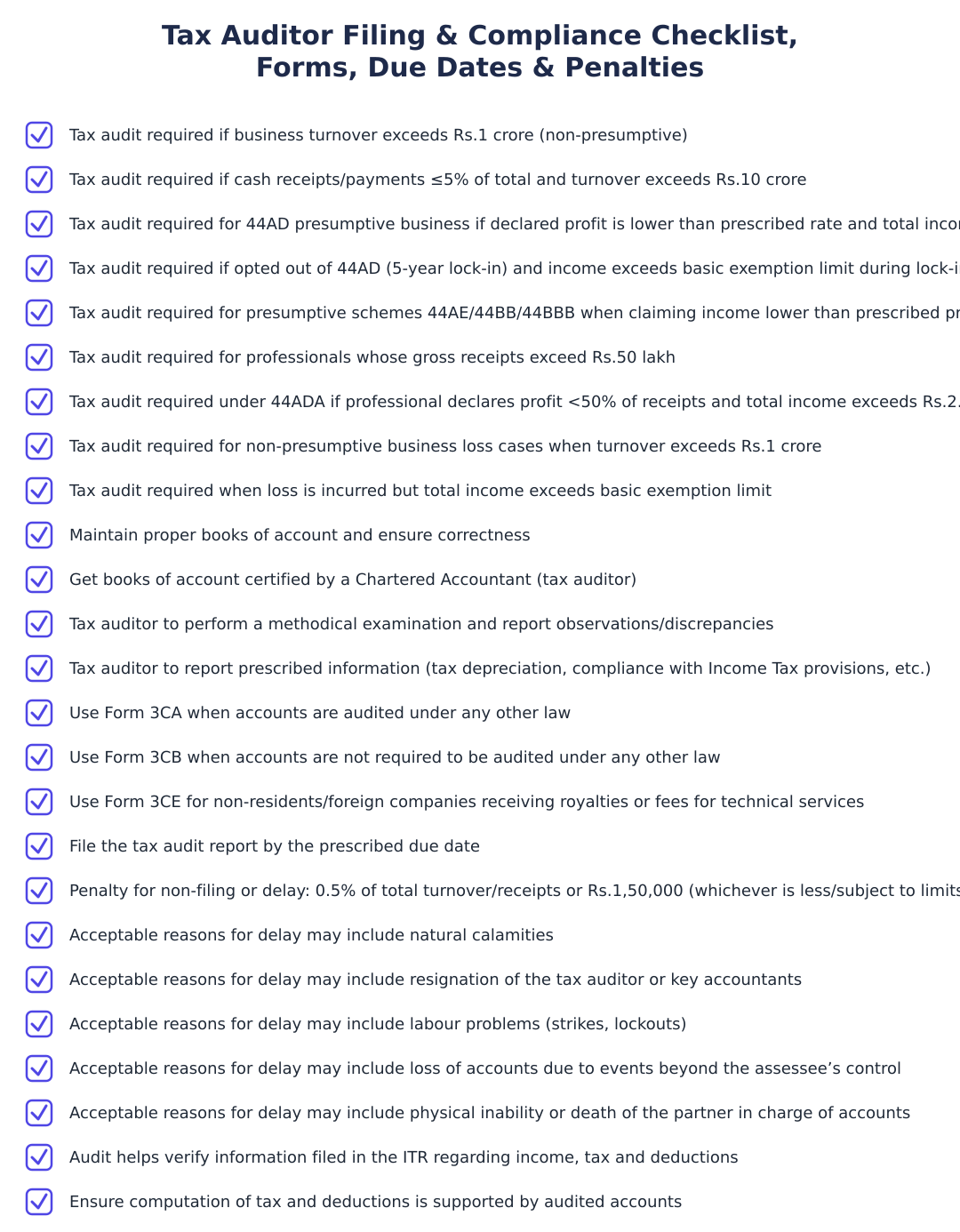
The statutory tax audit report is submitted in specified forms. When a person carrying on business or profession is already required to have accounts audited under any other law, Form No. 3CA is used. When no other law mandates an audit, the tax auditor furnishes Form No. 3CB.
In addition to the audit form, Form 3CD contains the prescribed particulars that form part of the audit report. For certain international situations, Form No. 3CE is prescribed, this is furnished when non-residents or foreign companies receive royalties or fees for technical services from the government or an Indian concern.
How and When Tax Audit Reports Should be Furnished
The tax auditor must upload and furnish the tax audit report electronically using his authorised login on the designated portal.
After the auditor uploads the report, the taxpayer needs to either accept or reject the uploaded report through their portal account.
Penalty for Non‑filing or Delay in Filing Tax Audit Report
Section 271B provides a monetary penalty where a person fails to get their accounts audited as required under Section 44AB. The penalty is the lower of 0.5% of total sales, turnover or gross receipts, or Rs. 1,50,000.
However, if the taxpayer can demonstrate a reasonable cause for the failure to obtain the tax audit, no fee shall be levied under section 271B. Examples of reasonable causes include natural calamities, resignation of the tax auditor leading to delay, loss of accounts, industrial action such as strikes or lock-outs, physical inability, or the death of the partner in charge of the accounts.
Section 44AB sets out clear triggers that make a tax audit mandatory and prescribes standard forms for reporting. Monitor the turnover and receipt thresholds applicable to your business or profession, be aware that certain actions within presumptive schemes can still cause an audit requirement, and ensure timely coordination with a tax auditor for online filing and taxpayer acceptance. If compliance slips, the statutory penalty is capped, but documented reasonable causes can prevent levy of the fee. Consult a tax auditor promptly when thresholds are approached or when exceptional events affect your ability to complete an audit.
Frequently asked questions
What is a tax audit under Section 44AB and who needs it?
A tax audit under Section 44AB is a statutory audit of books of account by a Chartered Accountant that certain taxpayers must get done when specified turnover or receipt thresholds are crossed. It applies to businesses with turnover exceeding Rs. 1 crore (or Rs. 10 crore where cash receipts/payments are 5% or less of total), professionals with gross receipts over Rs. 50 lakh, and others as specified (including cases where presumptive scheme assumptions are not met). The audit checks correctness of income, deductions and compliance, and the CA furnishes a detailed audit report and prescribed annexure (Form 26 under the new rules). Failure to comply attracts fees under section 271B unless reasonable cause is shown.
When is the due date for filing the tax audit report for FY 2025-26?
The due date to file the tax audit report for FY 2025-26 is 31st October of the subsequent assessment year for most taxpayers, and 31st October for cases involving international transactions as well. In general, the standard deadline for audit report filing is 31st October, though historically some years had 30th September for non-international-transaction cases; for FY 2025-26 the specified date is 31st October. The audit report must be uploaded online by the tax auditor and then accepted by the taxpayer in the portal to complete filing.
What are the turnover and receipt thresholds that trigger a tax audit for businesses?
A business generally requires a tax audit if its turnover exceeds Rs. 1 crore, or Rs. 10 crore where cash receipts and payments are 5% or less of total receipts/payments. Businesses opting for presumptive taxation under Section 44AD face audit if they declare profits lower than the prescribed presumptive rate and their total income exceeds the basic exemption limit, or if they opt out during the five-year lock-in and their income exceeds the exemption limit. Certain other presumptive schemes (44AE, 44BB, 44BBB) also mandate tax audit if the taxpayer claims income lower than the prescribed presumptive rate.
When is a professional required to get a tax audit under Section 44AB?
A professional must get a tax audit when gross receipts from the profession exceed Rs. 50 lakh in a previous year. For professionals under the presumptive scheme (Section 44ADA), a tax audit is required if they declare profits less than 50% of receipts and their total income exceeds Rs. 2.5 lakh. The audit ensures verification of reported income and compliance with tax provisions, and the CA will furnish the audit report online.
What forms make up the tax audit report and what changed in 2026?
The tax audit report consists of the auditor’s main report (previously Forms 3CA/3CB/3CE) together with detailed particulars in Form 3CD, but as per the new Income Tax Rules 2026 these have been replaced by a consolidated Form 26. Form 3CA was used when accounts were audited under any other law, Form 3CB when no other law required audit, and Form 3CE related to certain non-resident receipts; the detailed annexure (3CD) accompanied whichever report applied. Under the new rules, the CA uploads the audit report online using their login and taxpayers must accept the uploaded report in their portal.
How must the tax auditor and taxpayer file and accept the audit report online?
The tax auditor must furnish the tax audit report online using their Chartered Accountant login, and the taxpayer must accept or reject the uploaded report in their income tax portal to complete the submission process. If the taxpayer rejects the report, the auditor must rectify and re-upload until acceptance is obtained; the CA details must also be added in the taxpayer’s portal beforehand. Timely upload and acceptance are necessary to meet the statutory due date (31st October for FY 2025-26) and to avoid late fees under section 271B.
What is the fee or penalty for not filing or delaying the tax audit report?
If a taxpayer required to get a tax audit fails to do so, a fee under section 271B is levied equal to the lesser of 0.5% of total turnover/receipts or Rs. 1,50,000. The Budget 2026 clarified this will be treated as a fee rather than a penalty, and no fee is levied if the taxpayer can show a reasonable cause for failure. Reasonable causes accepted by tribunals include natural calamities, resignation of the tax auditor causing delay, loss of accounts, prolonged labour unrest, or death/illness of the partner in charge.
Are cases where accounts are audited under other laws treated differently for tax audit under Section 44AB?
Yes, if a person’s accounts are already required to be audited under any other law, the tax auditor furnishes Form 3CA (previous regime) or the equivalent under Form 26 as the tax audit report, instead of Form 3CB. The content of the tax audit report still requires the prescribed particulars (previously in Form 3CD) and must be uploaded online by the CA and accepted by the taxpayer. This ensures the statutory audit under other laws can also satisfy the tax audit requirements subject to inclusion of the required tax audit particulars.
When are losses or income above basic exemption liable for tax audit even if turnover is below limits?
Even if turnover is below the normal thresholds, a tax audit is required when a non‑presumptive business incurs a loss but turnover exceeds Rs. 1 crore, or when loss is incurred and total income still exceeds the basic exemption limit. Similarly, a presumptive scheme taxpayer who opts out during the five-year lock-in and reports income above the exemption limit may face audit requirements. These provisions prevent taxpayers from using losses or presumptive calculations to avoid audit when substantive taxable income or turnover triggers compliance.
Need help staying Income Tax compliant?
MoneyGence's AI Finance OS tracks your compliance, wallet share, and finances in one place, built for agencies and growing businesses.
Get started with MoneyGence