Section 44ADA: Presumptive Tax Scheme for Professionals
This guide explains Section 44ADA, the presumptive tax scheme for professionals, in clear, practical terms. You will learn what presumptive taxation means for small professionals, how Section 44ADA works, how taxable income is determined under the provision, how it relates to other presumptive provisions and what practical benefits and implications follow from using this scheme. Understanding Section 44ADA matters because it simplifies tax compliance for eligible professionals by providing a straightforward method to determine taxable income, reducing the need for detailed expense tracking and complex accounting calculations. For freelancers, consultants and small professional practitioners, this can reduce time and cost spent on bookkeeping and tax computation. This guide focuses on the core legal design of Section 44ADA and the precise rule for computing taxable income under the scheme. It also situates the section within the wider framework of presumptive taxation in the Income Tax Act, so you can see when Section 44ADA applies compared with other provisions. If you are a professional evaluating whether to use the presumptive route or a tax advisor helping clients choose the right regime, this guide gives the essential facts and practical implications you need to make an informed choice.
What is Presumptive Taxation?
Presumptive taxation is a method provided in the Income Tax Act to determine taxable income on a simplified basis rather than by calculating actual profits and expenses. Under presumptive schemes, the tax law prescribes a formula or percentage of receipts that will be treated as the taxpayer’s income, thereby streamlining computation and reducing the record-keeping burden.
The core purpose of presumptive taxation is to reduce compliance cost and complexity for small taxpayers who face relatively lower volumes of transactions. By accepting a standardized measure of income, these taxpayers and their advisors can avoid detailed accounting for each expense and extensive tax adjustments.
What is Section 44ADA of the Income Tax Act?
Section 44ADA is a specific provision in the Income Tax Act that offers a presumptive taxation scheme tailored for professionals. It was introduced to extend the simplified presumptive taxation approach to specified professionals who previously did not have access to such an option.
The section provides an alternate, simplified method for small professionals to compute taxable income, distinguishing it from standard provisions where income is determined after detailed accounting of receipts and expenses.
Presumptive Income Calculation under Section 44ADA of Income Tax
Under Section 44ADA the law prescribes that taxable income is to be shown in the income-tax return as a percentage of gross receipts. Specifically, the taxable income is presumed at 50% of the gross receipts. This means that for the purposes of the return, half of the professional’s gross receipts are treated as taxable income under the scheme.
Practically, this simplifies tax computation: instead of calculating actual profits after deducting allowed expenses, the professional declares at least 50% of gross receipts as income. The provision therefore standardizes the income figure used for tax purposes and reduces the need to justify individual expense claims for the purposes of arriving at taxable income.
Relationship between Section 44ADA and Section 44AD
Section 44ADA sits alongside Section 44AD within the broader framework of presumptive taxation under the Income Tax Act. Both sections provide simplified methods to compute taxable income for different categories of taxpayers and are part of the same policy objective to ease compliance for smaller taxpayers.
While these provisions share the presumptive approach in common, each applies to distinct classes of taxpayers and contains its own rules. Being aware of both sections helps professionals and small businesses determine which presumptive route, if any, better fits their circumstances.
Benefits and Practical Implications of Using Section 44ADA
The primary benefit of Section 44ADA is simplified compliance. By fixing taxable income at a specified percentage of gross receipts, the provision reduces the need for detailed accounts focused on proving every expense. This can save time and professional fees related to bookkeeping and tax preparation.
Using the presumptive route also brings predictability: taxable income can be estimated in advance based on expected receipts, aiding cash flow planning. However, once the presumptive scheme is adopted, the professional must align reporting and compliance with the scheme’s rules as set out in the Income Tax Act.
Frequently Asked Questions
Q: Who is Section 44ADA designed for? A: Section 44ADA is a special provision designed to provide simplified presumptive taxation for specified small professionals, extending the presumptive approach to professions.
Q: How is taxable income computed under Section 44ADA? A: Taxable income under Section 44ADA is presumed at 50% of gross receipts and must be shown as such in the income-tax return.
Section 44ADA gives eligible professionals a straightforward, standardized way to determine taxable income by treating half of gross receipts as income. It reduces compliance complexity and complements the broader suite of presumptive provisions in the Income Tax Act. Professionals should consider this option when it aligns with their business profile and consult a tax advisor to confirm suitability in their specific circumstances.
Frequently asked questions
Who can use Section 44ADA for presumptive taxation, which professionals are eligible?
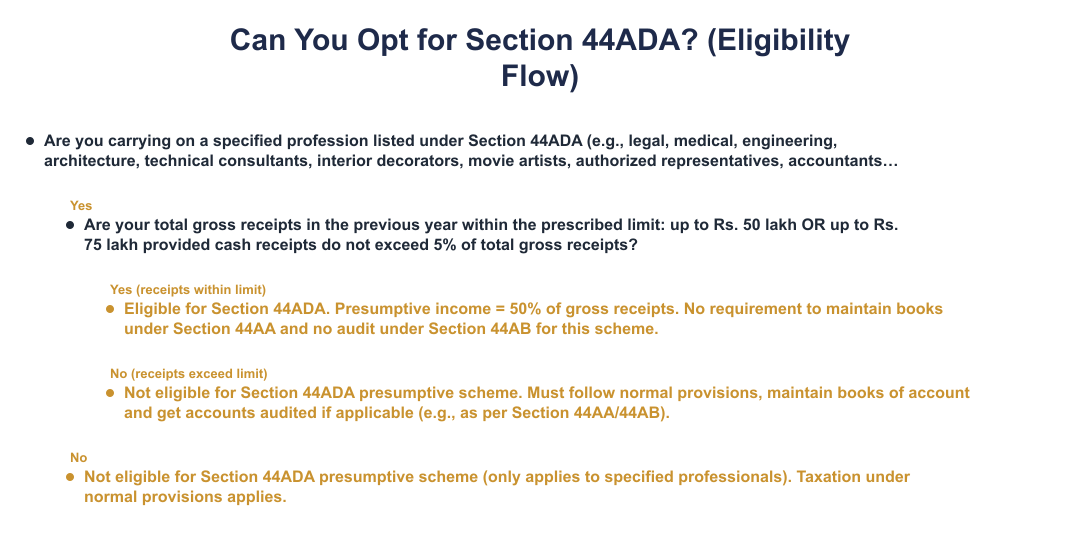
Eligible professionals under Section 44ADA include specified professions such as legal, medical, engineering, architectural, accountancy, interior decoration, technical consultancy, and other notified professionals (including movie artists and authorized representatives) who carry on a profession as per the Income Tax rules. The provision applies only to individuals, HUFs or partnerships (not LLPs or companies) running these specified professions and whose gross receipts meet the limit criteria (see the turnover limits). For movie artists the term covers producers, actors, directors, music directors, cameramen, lyricists, writers, costume designers etc., and an authorized representative means a person representing another for a fee before a tribunal or authority (but not an employee or an accountant).
What is the turnover limit to opt for Section 44ADA presumptive scheme?
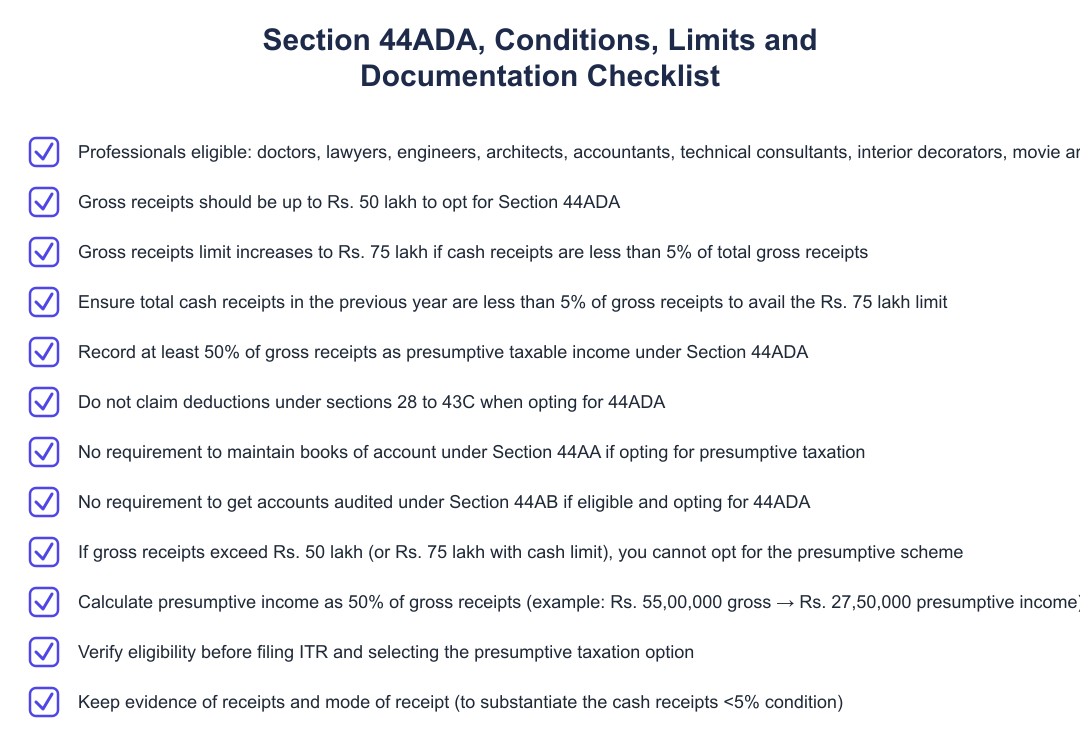
The basic turnover limit for Section 44ADA is gross receipts up to Rs. 50 lakh in the previous year, and this limit is increased to Rs. 75 lakh if cash receipts in that year do not exceed 5% of total gross receipts. If gross receipts exceed Rs. 50 lakh but cash receipts are less than or equal to 5% of total receipts, the enhanced threshold of Rs.75 lakh allows the professional to still opt for the scheme. If the receipts exceed these applicable limits, the professional cannot use Section 44ADA and must follow normal taxation and accounting rules.
How is taxable income computed under Section 44ADA?
Under Section 44ADA, taxable income is presumed to be 50% of the gross receipts or turnover of the professional for the relevant previous year, and that 50% is treated as the profession's income for taxation. For example, if gross receipts are Rs. 30 lakh, the income to be declared under the scheme is Rs. 15 lakh (50%), without detailed deduction claims under sections 28 to 43C. If a taxpayer opts for the scheme they must declare at least 50% of gross receipts as income in the ITR; claiming lower profits requires maintenance of books and an audit.
What are the main benefits of opting for Section 44ADA?
The principal benefits are simplified compliance: professionals opting for Section 44ADA do not need to maintain detailed books under Section 44AA and are generally exempt from audit under Section 44AB provided they comply with the scheme's conditions. The scheme reduces paperwork and compliance cost because income is presumed at 50% of gross receipts and no separate deductions under sections 28–43C are allowed. This also facilitates ease of doing business for small professionals with turnover within the prescribed limits.
Are there any deductions or expenses allowed if I opt for Section 44ADA?
If you opt for Section 44ADA, deductions under sections 28 to 43C that relate to business/profession income are not allowed; the scheme presumes 50% of gross receipts as taxable income which is deemed to include all business expenses. Therefore you cannot separately claim actual business expenses under these sections against professional income covered by 44ADA. However, personal deductions under other heads (like Chapter VI-A) and certain tax credits remain available as per normal income-tax rules.
When must a professional maintain books and get accounts audited even if they know about 44ADA?
A professional must maintain books and get a tax audit under Section 44AB if gross receipts exceed Rs.50 lakh (or Rs.75 lakh where cash receipts are ≤5% allowing the higher threshold), or if they declare profits lower than 50% of gross receipts and their total income exceeds the basic exemption limit. In other words, if you claim actual profits less than the presumptive 50% and your total income is above the basic exemption, you must maintain books and get accounts audited. Failure to meet these criteria disqualifies the presumptive treatment and triggers normal bookkeeping and audit obligations.
Can a professional choose Section 44ADA if all receipts are digital or bank transfers?
Yes, if a professional's total receipts are up to Rs.75 lakh and cash receipts do not exceed 5% of total gross receipts (which is satisfied if receipts are fully digital or via bank transfers), they can opt for Section 44ADA and declare 50% of gross receipts as taxable income. Fully digital receipts help meet the cash-receipt test required for the higher Rs.75 lakh threshold, making more professionals eligible. Make sure the mode of receipts is properly documented because the 5% cash test is applied on actual cash receipts during the previous year.
If my gross receipts are Rs.55 lakh and cash receipts are Rs.2.5 lakh, can I use 44ADA and how much income will be taxable?
Yes, with gross receipts of Rs.55 lakh and cash receipts of Rs.2.5 lakh (which is less than 5% of Rs.55 lakh), you can opt for Section 44ADA under the increased Rs.75 lakh threshold; taxable income under the scheme will be 50% of gross receipts, i.e., Rs.27.5 lakh. This matches the example where total receipts of Rs.55,00,000 and cash receipts Rs.2,50,000 qualified the professional to use presumptive taxation and declare Rs.27,50,000 as income. Remember that once you opt in you must report at least that amount in your ITR and cannot claim separate business deductions under sections 28–43C.
Can a professional switch between presumptive taxation under 44ADA and normal taxation in different years?
Yes, a professional can choose in any financial year to opt for presumptive taxation under Section 44ADA provided they meet the eligibility conditions (turnover limits and cash receipt test) for that year; there is no permanent lock-in across years. However, if in a year you declare profits lower than 50% of gross receipts and your total income exceeds basic exemption, normal audit and bookkeeping requirements will apply for that year, so switching requires care and proper records. Also be mindful that repeated changes without documentation may attract scrutiny, so maintain clear records when moving between schemes.
Need help staying Income Tax compliant?
MoneyGence's AI Finance OS tracks your compliance, wallet share, and finances in one place, built for agencies and growing businesses.
Get started with MoneyGence