Section 80D Income Tax: Medical Insurance Deductions & Limits
Section 80D of the Income Tax Act is the primary provision that lets individuals and Hindu Undivided Families (HUFs reduce their taxable income by claiming deductions for medical insurance-related outlays. This guide explains who can claim the deduction, what kinds of payments qualify, how multi-year policy premiums are treated, and practical points to keep in mind when planning medical-insurance investments for tax benefit. Knowing these rules helps taxpayers structure premium payments correctly, avoid rejected claims, and make informed choices about covering family members. You will learn which family members are covered, how preventive health check-ups are treated, the requirement that premiums be actually paid within the financial year, treatment of upfront multi-year premiums, and important restrictions such as the non-eligibility of employer-paid group cover and premiums paid for non-dependent relatives. The guide is aimed at salaried taxpayers, self-employed professionals, and HUFs who want clear, actionable information on claiming Section 80D without digging through legal text. By the end you will understand not only the formal eligibility rules but also practical considerations, for example, how part-payments by different people are handled and why certain commonly purchased covers may not yield tax benefits. Use this information to ensure your premium payments and documentation line up with the requirements for claiming the deduction when you file your return.
What is Section 80D?
Section 80D allows individuals and HUFs to claim deductions for specified medical insurance premiums, thereby reducing their total taxable income. The deduction is intended to encourage taxpayers to purchase health insurance and to make preventive healthcare more accessible.
Practically, this means that qualifying payments made for health cover can lower the tax burden in the year in which they are actually paid. The benefit is available only under the applicable rules and to those family members explicitly recognised under the provision.
Who is covered under Section 80D?
The persons for whom deductions can be claimed under Section 80D include the taxpayer (self), spouse, dependent children and parents. Both individuals and Hindu Undivided Families can avail of the deduction in respect of premiums paid for these categories.
This coverage means that when you pay a premium for a health insurance policy that covers any of these specified persons, that payment is eligible for the deduction subject to other conditions and limits set out in the law.
Expenses eligible for deduction under Section 80D
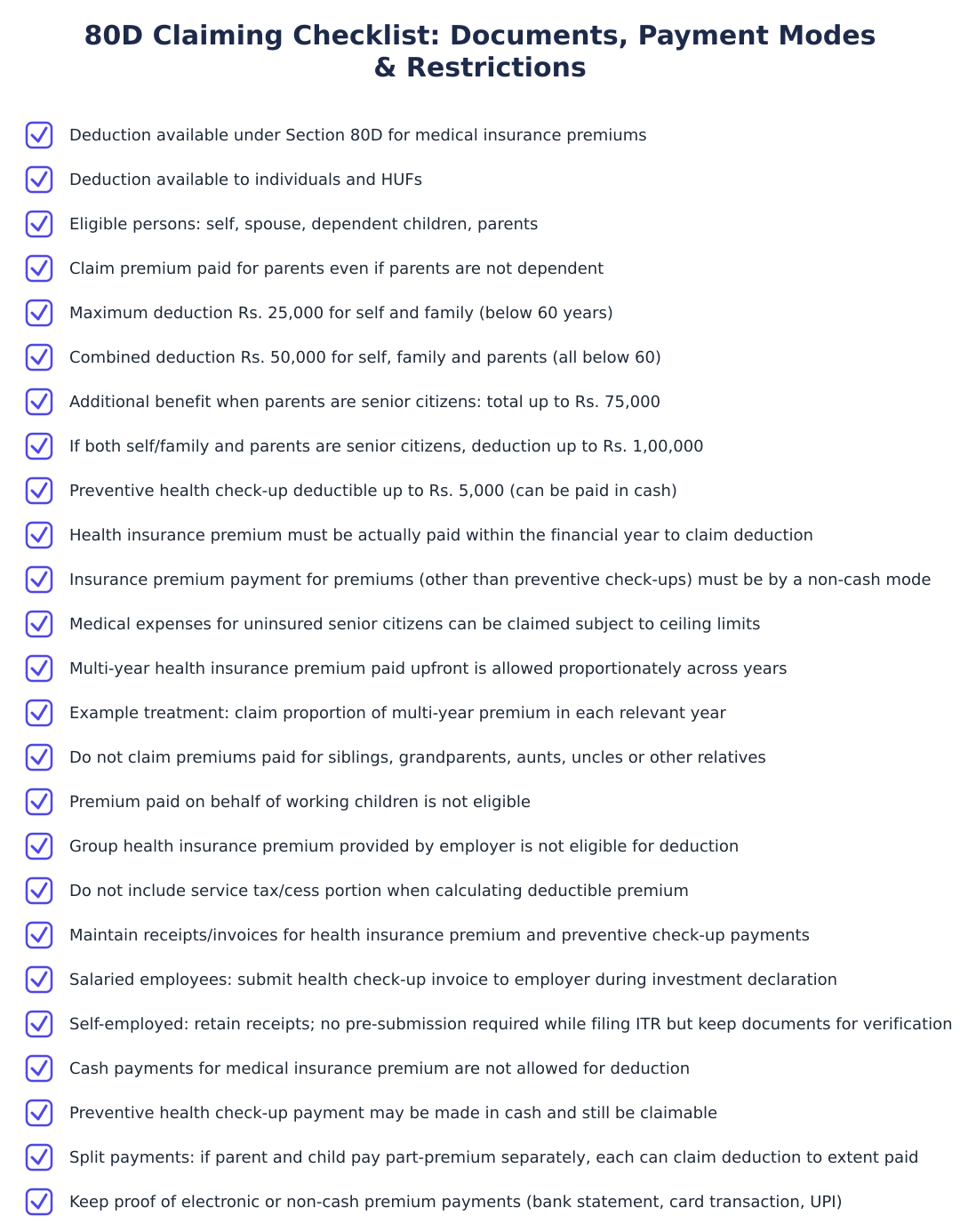
Health insurance premiums: Premiums paid for medical/health insurance policies that insure the covered persons (self, spouse, dependent children and parents) are eligible for deduction. The payment must be actually made within the financial year for which the deduction is claimed; amounts that are merely due but unpaid cannot be claimed.
Preventive health check-ups: Expenses incurred for preventive health check-ups are also eligible for deduction under Section 80D. This recognition is intended to promote early detection and routine health monitoring in addition to coverage through insurance.
Mode of payment, multi-year premiums and part-payments
A key procedural rule is that the premium must be actually paid within the financial year to be eligible for deduction; liabilities or instalments that remain unpaid at year-end do not qualify. This makes the timing of payment important for tax planning, claiming requires cashing out the payment in the relevant year.
When a taxpayer pays a premium upfront for a policy that covers multiple years, the law permits treating that payment proportionately across the policy years. In other words, the premium is apportioned and the allowable deduction is claimed in each year according to the apportioned amount.
If multiple persons share the payment for a premium, for example, a parent and a child both pay part of a premium, then each payer may claim the deduction to the extent of the amount they actually paid. This enables flexible arrangements where family members split the cost while still obtaining the tax benefit.
Restrictions and exclusions to watch for
Premiums paid for relatives who are not among the specified covered persons, such as siblings, grandparents, aunts, uncles or other non-dependent relatives, are not eligible for deduction. Buying insurance for those relatives will not create a Section 80D tax benefit.
Group health insurance provided or paid for by an employer does not entitle the employee to a deduction under Section 80D. Such employer-provided group cover is explicitly excluded from the deduction, so employees should not expect an additional Section 80D benefit from their employer’s group policy.
Taxpayers who opt for the new tax regime cannot claim deductions under Section 80D. The availability of this deduction is limited to those who remain under the old tax regime when filing their returns.
Practical points to remember
Plan the timing of premium payments so that the actual payment falls within the financial year in which you want to claim the deduction. Upfront multi-year payments must be apportioned, so consider cashflow and how the deduction will be spread over policy years.
If you share premium payments with another family member, retain proof of who paid what so each person can substantiate the portion they claim. Also, be mindful that employer-paid group cover and premiums for non-dependent relatives will not provide Section 80D benefits, so keep personal and employer-funded cover separate when planning tax claims.
Section 80D provides a useful tax incentive for purchasing health insurance and investing in preventive healthcare, but the benefit applies only within clearly defined bounds. Ensure premiums are actually paid in the relevant financial year, apportion multi-year premiums correctly, restrict claims to the designated family members, and remember that employer-paid group cover and premiums for non-dependent relatives are excluded. Finally, Section 80D deductions are available only under the old tax regime, so verify your tax regime choice before claiming the deduction.
Frequently asked questions
What is Section 80D and who can claim it?
Section 80D is a tax provision that allows individuals and Hindu Undivided Families (HUFs) to claim a deduction for medical insurance premiums and certain medical expenses paid during a financial year. The deduction can be claimed for premiums paid for the taxpayer, spouse, dependent children and parents; HUFs can claim for the family members covered under the HUF. The section also permits a deduction for preventive health check-ups (subject to limits) and special rules apply for senior citizens who don’t have insurance but incur medical expenses. The actual deduction amount is subject to specified limits based on the age of the insured persons (detailed in other FAQs).
What are the deduction limits under Section 80D for different age groups?
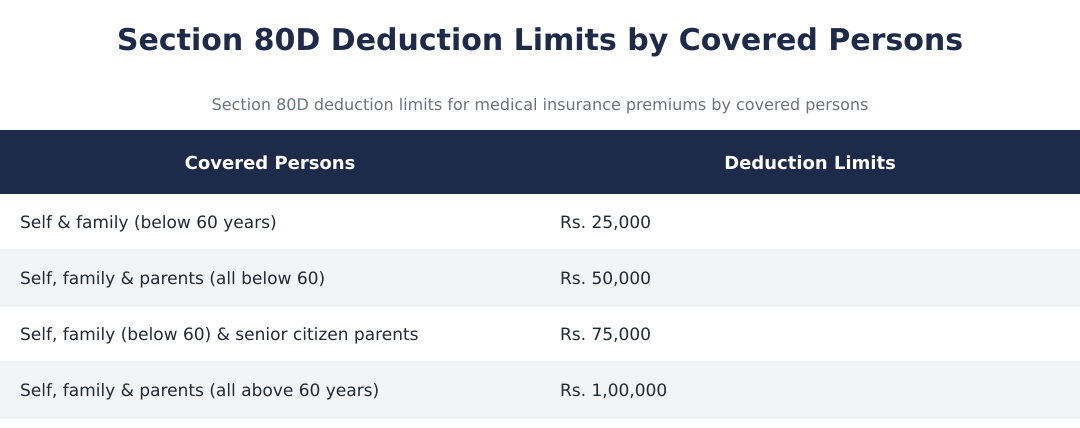
The deduction limits under Section 80D depend on the ages of the insured persons: up to Rs. 25,000 for self and family if all are below 60, up to Rs. 25,000 for self and family plus an additional Rs. 25,000 for parents if they are below 60, raising the combined limit to Rs. 50,000; if parents are senior citizens (60 or above) the limit for parents is Rs. 50,000 making the combined maximum Rs. 75,000; and if both self/family and parents are senior citizens the total allowable deduction is Rs. 1,00,000. These limits include premiums paid for health insurance and, in certain cases, actual medical expenses for uninsured senior citizens, and are the maximum that can reduce taxable income under Section 80D in a financial year. The specific cap applicable depends on the ages of the taxpayer, family and parents in that year.
What expenses are eligible for deduction under Section 80D?
Eligible expenses under Section 80D include health insurance premiums paid for the taxpayer, spouse, dependent children and parents, preventive health check-up costs (subject to an overall cap), and in the case of senior citizens without insurance, actual medical treatment expenses within the ceiling. Preventive health check-ups are allowed up to Rs. 5,000 and can be paid in cash; health insurance premiums must be paid by any mode other than cash to qualify. Expenses not covered by insurance cannot be claimed if an insurance premium has also been paid for the same person, and group health insurance paid by an employer is not eligible for deduction by the employee.
Can I pay the health insurance premium in cash and still claim Section 80D?
No, health insurance premiums must be paid by any mode other than cash to be eligible for deduction under Section 80D. Acceptable payment modes include cheque, demand draft, net banking, credit/debit card, or other non-cash methods; however, preventive health check-up payments are an exception and can be paid in cash. Also, medical expenses claimed for uninsured senior citizens must be actually paid during the financial year to qualify, and cash payments for regular medical expenses are not allowed as a deduction if claiming under Section 80D.
How does Section 80D treat preventive health check-ups and how much can I claim?
Preventive health check-ups are eligible under Section 80D and you can claim up to Rs. 5,000 for such check-ups as part of the overall deduction. The payment for preventive health check-ups can be made in cash, unlike regular insurance premiums, and the Rs. 5,000 is included within the applicable limit for your category (for example within the Rs. 25,000 or Rs. 50,000 caps). This deduction encourages health awareness and is allowable whether paid for self, family or parents, subject to the overall Section 80D ceilings for the relevant insured group.
If I buy a multi-year health insurance policy and pay the premium lump-sum, how is Section 80D applied?
If you purchase a multi-year health insurance policy and pay the premium upfront, Section 80D allows deduction only proportionately in each year covered by the policy, not the whole lump-sum in the year of payment. For example, a 2-year policy with Rs. 30,000 paid upfront would allow you to claim Rs. 15,000 in each of the two years. The yearly claim in each year remains subject to the usual age-based limits (Rs. 25,000/50,000/75,000/1,00,000 as applicable).
Can I claim Section 80D deduction for a relative like a brother or sister or for my working child?
No, Section 80D does not allow deductions for premiums paid for relatives such as brothers, sisters, aunts, uncles or for working children; the deduction is limited to self, spouse, dependent children and parents. Premiums paid on behalf of other relatives or working adult children are not eligible for tax benefits under Section 80D. In cases where you and a parent both make part payments for the same policy covering the parent, each can claim deduction only to the extent of their actual payment, subject to the overall limits.
What documents or proofs are needed to claim Section 80D when filing ITR?
For salaried taxpayers, you may submit the health insurance premium and preventive health check-up invoices to your employer during investment declaration; self-employed taxpayers do not need to submit receipts with the ITR but should retain payment proofs for assessment. Retain premium payment receipts (showing insurer and amount, and mode of payment), policy documents and bills for preventive check-ups or medical expenses (if claiming for uninsured senior citizens) as evidence. Remember the tax department may ask for these documents during scrutiny, so keep them for at least the statutory period (usually 6 years).
Is Section 80D available if I choose the new tax regime?
No, deductions under Section 80D are not available if you opt for the new tax regime; only taxpayers under the old tax regime can claim this deduction. If you choose the new tax regime (with lower tax rates and fewer exemptions/deductions), you forgo benefits like Section 80D for that financial year. Evaluate whether the tax savings from deductions such as 80D under the old regime exceed the benefit of lower rates under the new regime before deciding.
Need help staying Income Tax compliant?
MoneyGence's AI Finance OS tracks your compliance, wallet share, and finances in one place, built for agencies and growing businesses.
Get started with MoneyGence