Section 80E: Education Loan Interest Deduction – Claim Tax Benefit
This guide explains Section 80E of the Income Tax Act, the provision that allows individuals to claim a deduction for interest paid on education loans. You will learn who can claim this deduction, what types of loans and courses qualify, where the loan must be taken from, how long the deduction can be claimed, and how this benefit interacts with other deductions such as Section 80C. Understanding Section 80E matters because the interest component of an education loan can be a significant outflow for borrowers; knowing the eligibility rules and the claim period helps taxpayers plan repayments and optimise tax savings. This guide focuses on the core legal points: eligibility limited to individuals, qualifying loans for higher education (after 12th class), the requirement that loans originate from recognised financial institutions or approved charitable organisations, the absence of an upper monetary cap on the interest deduction, and the time limits for claiming the deduction once repayment begins. By the end of the article you will have a clear picture of who gets the benefit, what documentation and repayment timeline determine the claim, and how Section 80E sits alongside other common deductions.
Key Highlights
Section 80E provides a tax deduction for the interest paid on education loans. The deduction applies only to the interest portion of EMIs and not to the principal repayment.
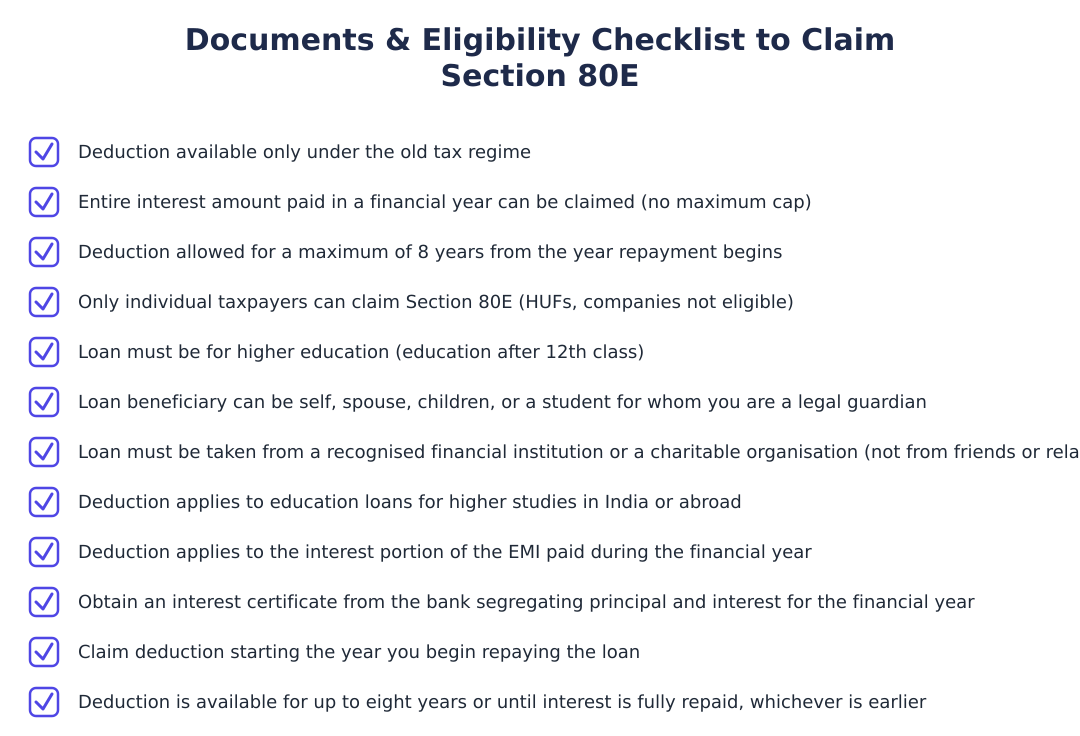
Only individual taxpayers can claim this deduction; entities such as Hindu Undivided Families and companies are not eligible. The loan must be for higher education (education after the 12th class) and may be for studies in India or abroad.
There is no upper monetary limit on the amount of interest that can be claimed under Section 80E, the entire interest component paid in a financial year can be deducted. The deduction is available only under the old tax regime and is allowed for a maximum of eight years starting from the year repayment begins or until the interest is fully repaid, whichever comes earlier.
What is Section 80E Education Loan Deduction?
Section 80E of the Income Tax Act allows an individual to deduct interest paid on an education loan from taxable income. The relief is specifically for the interest component of the EMIs paid during the financial year.
The purpose of the provision is to ease the financial burden of higher education by making the interest paid on loans tax-deductible. This reduces taxable income for the borrower in years when interest payments are being made.
Eligibility for 80E Deduction on Education Loan
The deduction under Section 80E is available only to individual taxpayers. Other forms of taxpayers such as HUFs or companies are not eligible to claim this deduction.
The education loan must be taken for higher education, defined for the purpose of this provision as education pursued after the 12th class. The loan may be for the higher studies of the assessee, the assessee's spouse, children, or a student for whom the assessee is a legal guardian.
A key qualifying condition is the source of the loan: the education loan must be obtained from a recognised financial institution or an approved charitable organisation. Loans taken from friends or relatives do not qualify for the Section 80E deduction.
Where Should You Take an Education Loan From?
To claim the Section 80E deduction, the loan must be sanctioned by a recognised financial institution or an approved charitable organisation. This requirement excludes loans taken from private sources such as friends or relatives.
Borrowers should ensure the lending entity is officially recognised or approved, because the source of the loan directly affects eligibility for the tax benefit. When in doubt, confirm the institution's status before finalising the loan.
Purpose of Education Loan
Section 80E applies to loans taken for higher education, meaning courses pursued after completion of the 12th class. The provision covers both domestic and foreign higher education programmes.
The qualifying relationship for whom the loan is taken is broad enough to include the assessee, spouse, children, and a student for whom the assessee is a legal guardian, which enables families supporting dependents to claim the benefit when eligible.
Maximum Tax Benefit Under Section 80E
There is no monetary ceiling on the interest amount that can be claimed under Section 80E. The entire interest component paid during a financial year may be deducted from taxable income.
Because the deduction applies only under the old tax regime, taxpayers should compare the benefit of claiming Section 80E against their overall tax position when choosing between the old and new regimes.
Documents Required Under Section 80E
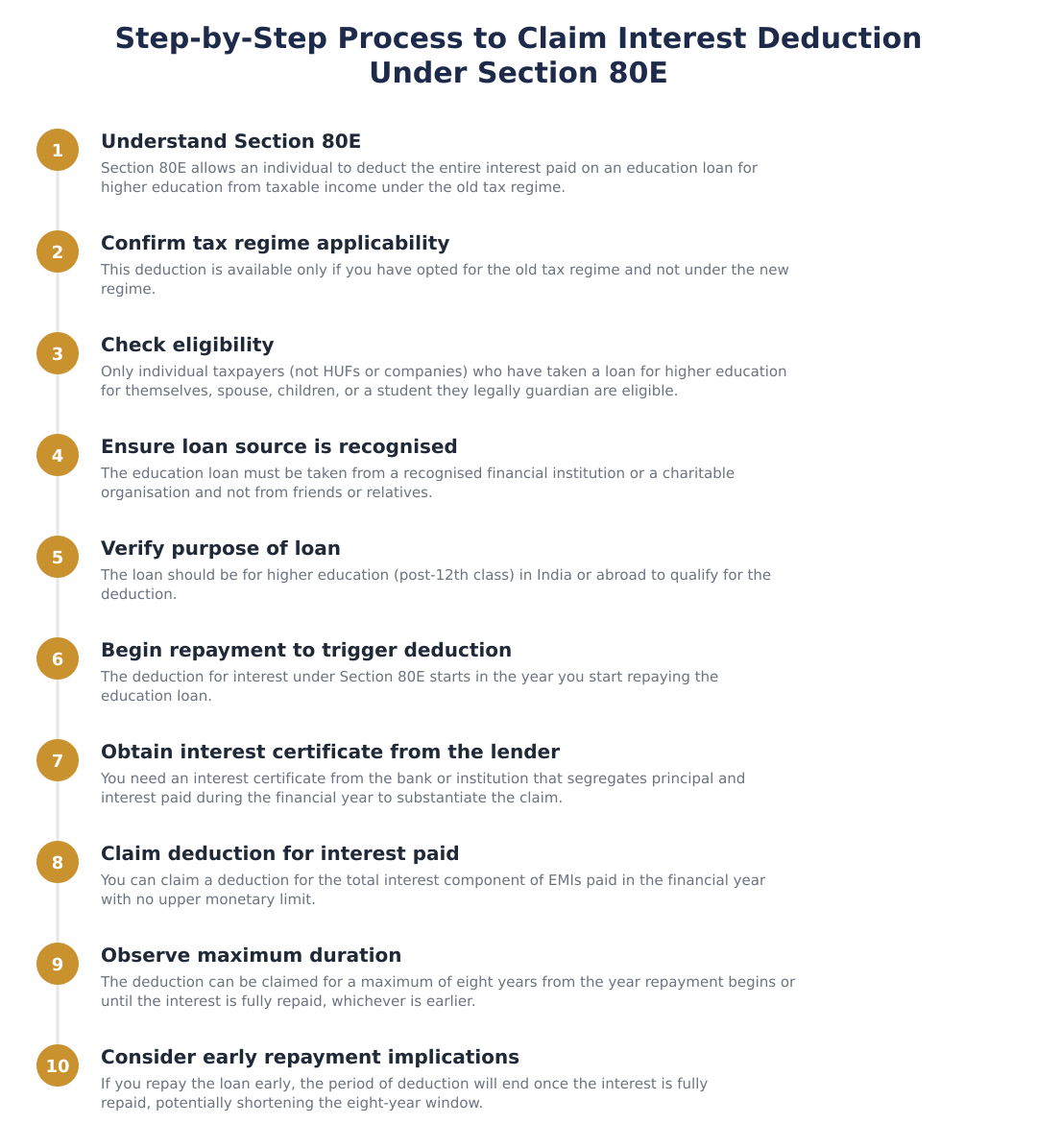
To substantiate a claim under Section 80E taxpayers should maintain documentation that clearly shows the interest component of loan repayments for the financial year. Since the deduction covers the interest portion of EMIs, records or certificates that separate principal and interest are relevant.
Proof that the loan originates from a recognised financial institution or an approved charitable organisation will be necessary to establish eligibility. Retain loan statements or interest certificates issued by the lender that itemise interest paid during the year.
Period of Deduction
The deduction for interest under Section 80E starts in the year in which repayment of interest begins. It is not available for the moratorium period on interest if repayment has not yet started.
Once repayment begins, the deduction can be claimed for a maximum of eight years from that year or until the interest is fully repaid, whichever occurs earlier. This eight-year ceiling is the outer limit even if interest payments continue beyond that period.
Early Repayment of Education Loan
If the borrower repays the loan early such that interest is fully repaid before eight years have elapsed, the deduction under Section 80E will cease once there is no interest payable. The provision allows deduction only while interest payments are being made.
Conversely, if interest continues after early repayment of principal (for example, in certain structured repayment schedules), the interest portion paid in a financial year remains eligible for deduction subject to the eight-year cap starting from the year repayment began.
Frequently Asked Questions
Who can claim the deduction under Section 80E? Only individual taxpayers are eligible to claim the deduction under Section 80E; other entities such as HUFs and companies cannot claim it.
Is there any upper limit on the deductible interest? There is no upper monetary limit, the entire interest component paid during the financial year can be claimed as a deduction under Section 80E.
Does Section 80E apply to studies abroad? Yes, the provision applies to loans taken for higher studies both in India and abroad.
How long can I claim the deduction? The deduction begins in the year repayment of interest starts and can be claimed for up to eight years from that year or until the interest is fully repaid, whichever is earlier.
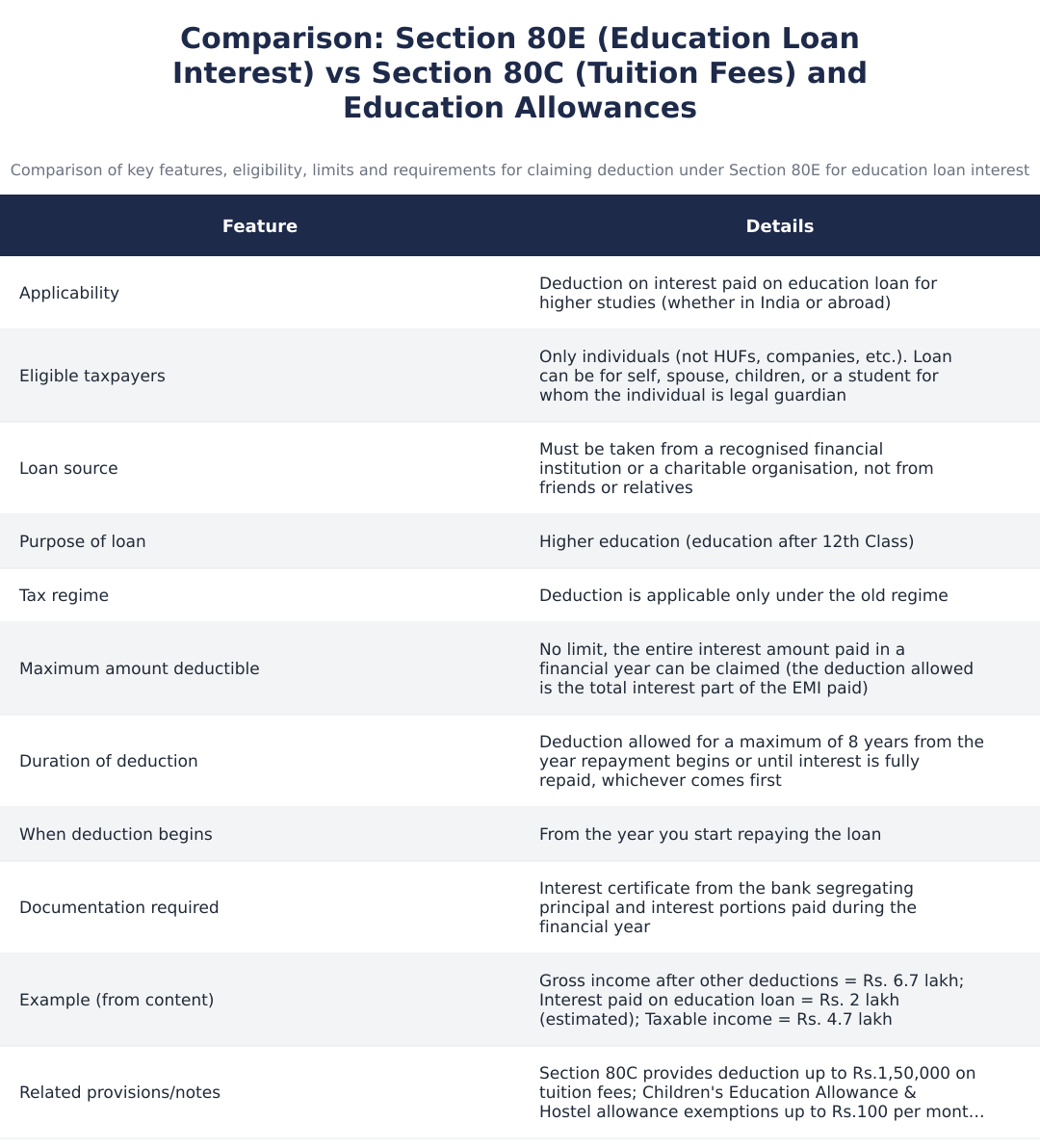
How does this interact with Section 80C? Section 80C is a separate provision that allows certain specified investments and expenditures (including tuition fees) to be claimed up to Rs.1,50,000; Section 80E is specifically for interest on education loans and has no such monetary ceiling.
Section 80E offers a focused tax benefit for individuals repaying interest on education loans used for higher studies in India or abroad. Key practical points are that only individuals can claim it, the loan must come from a recognised financial institution or approved charity, the deduction covers only the interest component with no upper limit, and it is available for up to eight years from the year interest repayment begins. Keep clear loan statements and interest certificates to substantiate claims, and consider the availability of this deduction when choosing between the old and new tax regimes.
Frequently asked questions
Who can claim deduction under Section 80E for an education loan?
An individual taxpayer can claim deduction under Section 80E for interest paid on an education loan. Only individuals are eligible, Hindu Undivided Families (HUFs), companies, firms or other entities cannot claim this benefit. The loan must be taken for higher education of the individual, their spouse, children, or a student for whom the individual is a legal guardian. The loan must also be from a recognised financial institution or an approved charitable organisation to qualify.
Is there any monetary limit on the deduction under Section 80E?
No, there is no monetary cap on the amount of interest you can claim under Section 80E; the entire interest portion of the EMI paid during the financial year is deductible. However, you must produce an interest certificate from the bank or lender that separates principal and interest components. The deduction only covers interest and not the principal repayment portion of the loan.
For how many years can I claim the Section 80E deduction?
You can claim Section 80E deduction for a maximum of eight years starting from the year you begin repaying interest on the education loan or until the interest is fully repaid, whichever is earlier. This eight-year period is continuous from the first year of repayment and does not reset if you miss claiming in any year. If the loan’s interest component is repaid fully before eight years, the deduction stops once no interest is payable.
Does Section 80E apply to education loans taken for study abroad?
Yes, Section 80E applies to education loans taken for higher studies both in India and abroad, provided the loan is from a recognised financial institution or an approved charitable organisation. The nature of the course (domestic or international) does not matter as long as it is higher education after the 12th standard. The same eight-year limit and no monetary cap on interest deduction apply for foreign study loans as well.
Can I claim Section 80E if I took the loan from a friend or relative?
No, loans taken from friends or relatives do not qualify for Section 80E deduction; the loan must be from a recognised financial institution or an approved charitable organisation. The tax benefit is specifically limited to loans sanctioned by banks, non-banking financial companies (NBFCs), or approved charities. If your loan documentation does not show a recognised lender, the interest will not be allowable under 80E.
Is Section 80E available under the new tax regime?
No, Section 80E deduction is available only under the old tax regime and cannot be claimed if you opt for the new concessional tax regime. Taxpayers must choose the old regime in their return for the financial year in which they wish to claim the 80E benefit. Before finalising your tax regime, compare the total tax liability under both regimes taking 80E and other deductions into account.
What documents do I need to claim deduction under Section 80E?
You need an interest certificate from the lender showing the interest paid during the financial year and a statement segregating principal and interest components of EMIs. Additionally, loan sanction letter and repayment schedule are useful to establish the purpose and tenure of the loan, and proof that the loan was taken for higher education (course admission letter or fee receipt) may be required. Keep bank account statements showing EMI debits as further supporting evidence for assessment or verification.
Does early repayment of the education loan affect the 80E deduction?
Early repayment does not disqualify you from claiming Section 80E, but the deduction will cease once there is no interest payable on the loan. If you prepay and interest liability reduces or ends earlier than eight years, you can claim interest deduction only for the years interest was actually paid. If prepayment is partial, you can claim interest on the interest paid in that financial year as usual.
How is Section 80E different from deductions like 80C and children's education allowance?
Section 80E specifically allows deduction of interest on education loans (with no monetary limit) while Section 80C covers tuition fees and other eligible investments up to Rs. 1,50,000 annually. Children's education allowance and hostel allowance exemptions are limited amounts (e.g., Rs. 100 per month for education allowance and Rs. 300 per month for hostel allowance) and are separate from 80E. Thus, interest on an eligible education loan is claimed under 80E, whereas tuition fees and certain allowances fall under other provisions with different caps and conditions.
Need help staying Income Tax compliant?
MoneyGence's AI Finance OS tracks your compliance, wallet share, and finances in one place, built for agencies and growing businesses.
Get started with MoneyGence