Section 80G deduction: Guide to Charitable Donation Tax Benefits
This guide explains the key provisions and practical steps to claim tax deductions for charitable donations under Sections 80G and 80GGA of the Income Tax Act, 1961. You will learn which types of payments are eligible, who can claim these deductions, how the 10% qualifying limit works, what documentation you must obtain, and how deductions are computed when some donations are fully allowable while others are subject to limits. The guide also highlights important compliance points, for example, the cash donation threshold and the applicability of these deductions only under the old tax regime, so you can plan donations to maximise tax benefit without running afoul of the rules. Whether you are an individual, a firm, an HUF, an NRI, or a company, the practical explanations and the stepwise calculation method here will help you determine the deductible amount and the paperwork you need to retain when you file returns.
What is Section 80G?
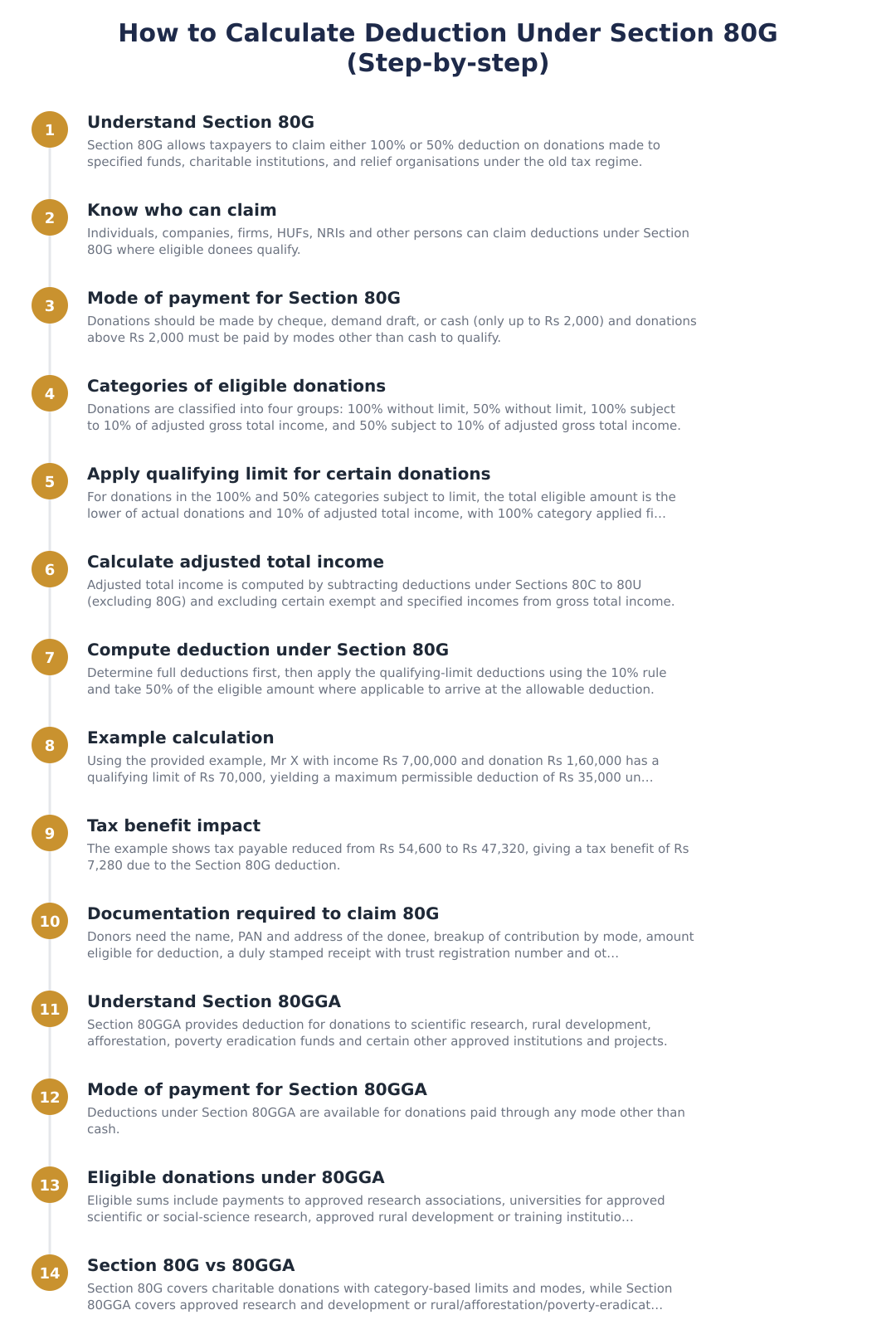
Section 80G of the Income Tax Act, 1961 allows taxpayers to claim deductions on donations made to specified funds, charitable institutions, and relief organisations. Deductions under this section may be allowed at either 100% or 50% of the donation depending on the donee and subject to applicable restrictions.
A wide range of taxpayers can claim Section 80G deductions: Individuals, Companies, Firms, Hindu Undivided Families (HUFs), Non-Resident Indians (NRIs) and 'any other person' are eligible to claim, provided the donation is to an approved recipient and other conditions (such as mode of payment and documentation) are met.
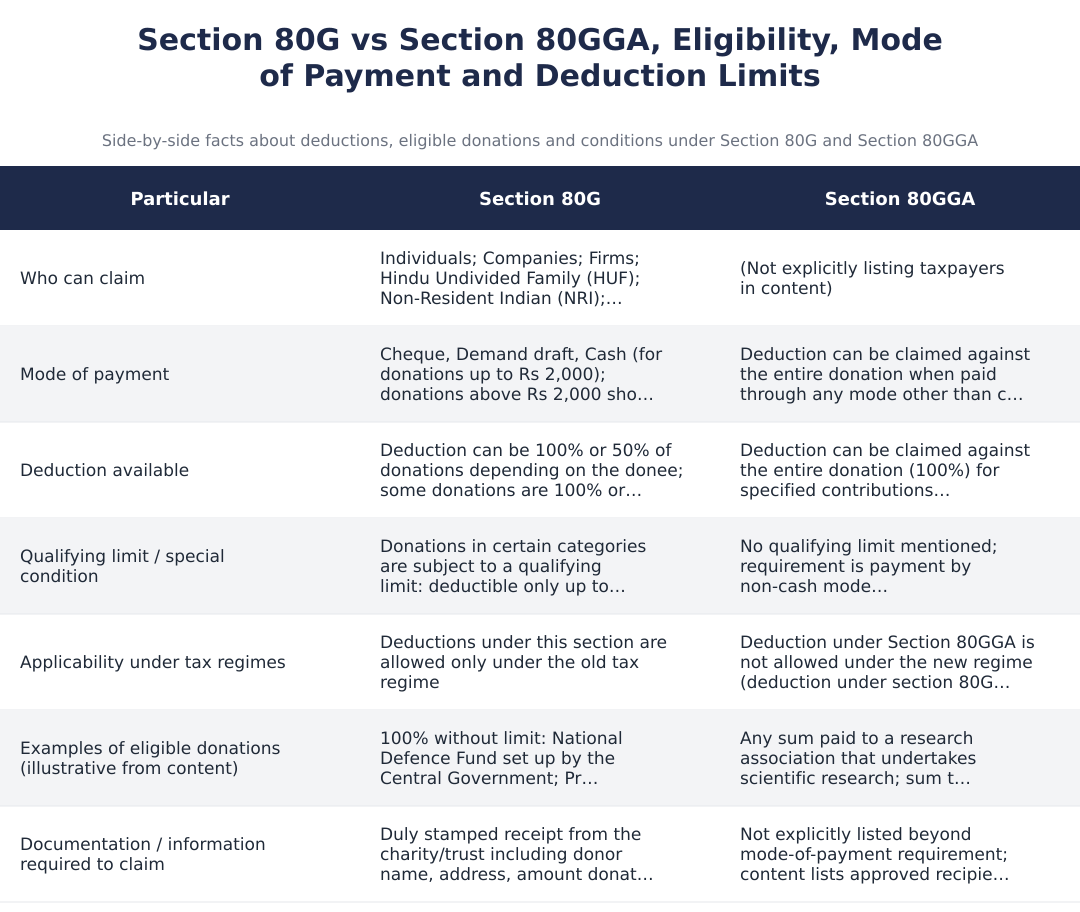
Note that deductions under Section 80G are available only under the old tax regime. If you opt for the new tax regime, you cannot claim deductions under Sections 80G or 80GGA.
Mode of Payment Under Section 80G
The mode of payment affects eligibility for the deduction. Cash donations are permitted only up to a threshold of Rs 2,000; donations above that amount must be made by any mode other than cash to qualify for Section 80G.
In-kind contributions, for example food, clothing, medicines or other material donations, do not qualify for a deduction under Section 80G. Practical planning therefore requires donors to make monetary payments (and for larger donations, non-cash modes) and to ensure they receive the proper stamped receipt from the donee.
How to Calculate the Deduction under Section 80G
Separate your donations into those eligible for full deduction (100% or 50% without limit) and those that are subject to the qualifying limit (subject to 10% of Adjusted Total Income).
Calculate Adjusted Total Income by starting with Gross Total Income and reducing deductions under Sections 80C to 80U (excluding 80G); also exclude certain incomes such as specified capital gains and incomes chargeable under sections 115A/115AB/115AC/115AD/115D.
For donations in the limited categories, the qualifying limit is the lower of the actual donation or 10% of Adjusted Total Income.
Allow full deductions for donations in the without-limit categories first. For the limited categories, set off the 100% (qualifying limit) donations first; any remaining eligible amount is considered for 50% (qualifying limit) and deduction for those is 50% of the remaining eligible donation.
What is Adjusted Total Income?
Adjusted Total Income is the figure used to calculate the 10% qualifying limit for certain donations. It is derived from Gross Total Income after reducing deductions under Sections 80C to 80U, but not including Section 80G itself.
Certain categories of income are excluded from the base when computing Adjusted Total Income for this purpose, for example specified capital gains and incomes taxed under Sections 115A, 115AB, 115AC, 115AD and 115D. Using Adjusted Total Income ensures the qualifying limit reflects the taxpayer's taxable capacity after allowable deductions (other than 80G).
Details and Documents Required to Claim Deduction under Section 80G
| Detail on Receipt | Why it is required |
|---|---|
| Donor's name and address | Identifies the claimant for the deduction |
| Amount of contribution (with breakup of cash and other modes) | Shows the exact monetary amount and mode to verify eligibility (cash limit rule) |
| PAN number of the trust / donee | Links the recipient to the authorised entity listed with the Income Tax Department |
| Trust's registration number and a duly stamped receipt | Confirms that the donee is an approved entity and provides official proof of donation |
Section 80GGA
Section 80GGA provides deduction for amounts paid for scientific research or rural development. This includes payments to approved institutions or associations, notified funds, or certain public sector companies and local authorities that undertake the qualifying activities.
Like Section 80G, Section 80GGA has its own eligibility conditions tied to the recipient being approved or notified. Also remember that deductions under Section 80GGA, like those under Section 80G, are not available if you have opted for the new tax regime; they apply only under the old regime.
How these Deductions Benefit Different Types of Taxpayers
Different categories of taxpayers, individuals, companies, firms, HUFs and NRIs, can claim these deductions when they make qualifying donations. For donors, the benefit is a reduced taxable income in the old regime, subject to the computation rules and limits described above.
Because some donations are fully deductible while others are limited by the 10% qualifying rule, taxpayers with mixed donations need to plan the order of set-off and the mode of payment carefully to maximise allowable deductions. Proper documentation and adherence to the cash limit for donations are practical steps all taxpayers should follow before claiming these benefits.
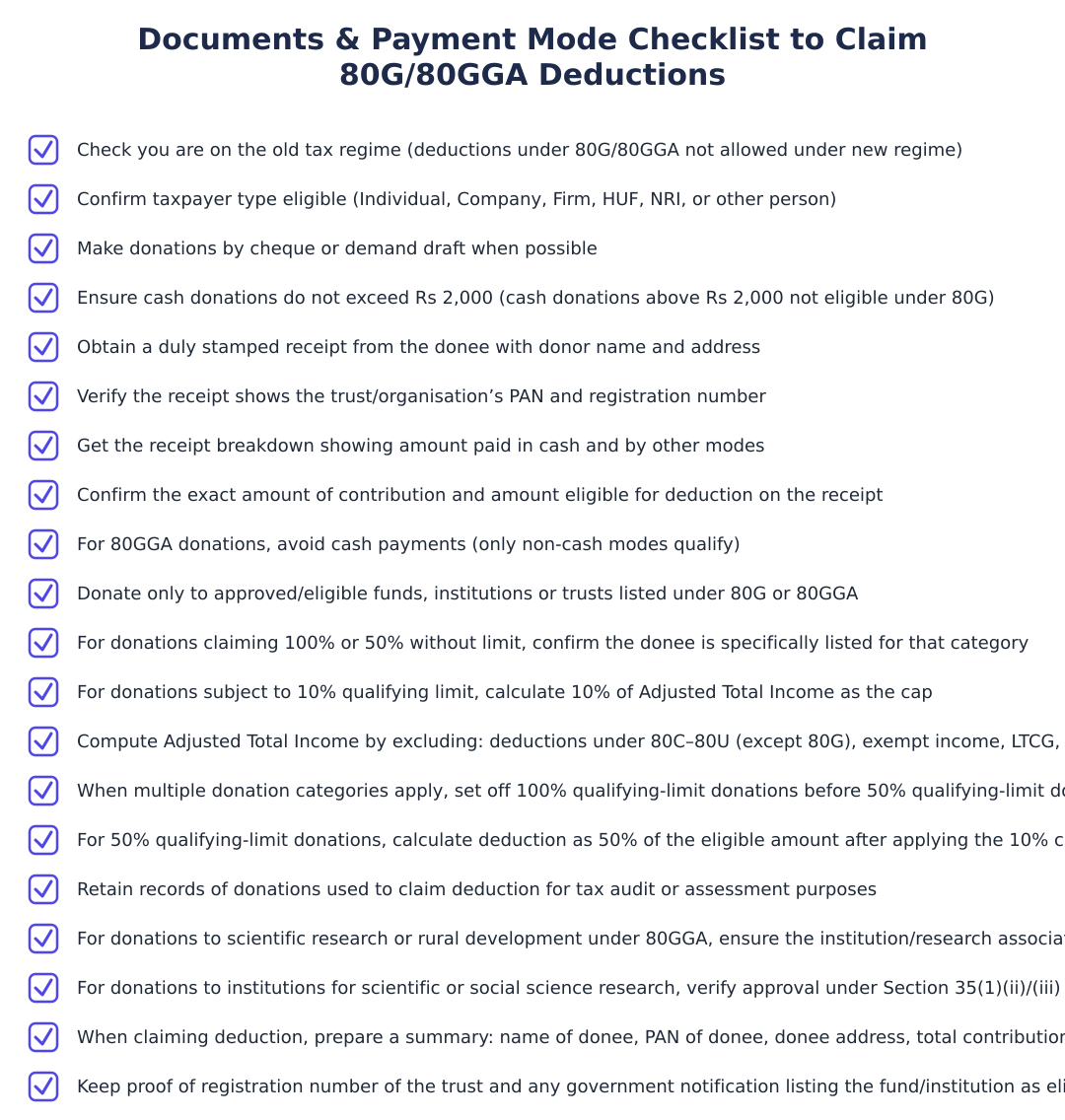
To claim deductions under Sections 80G and 80GGA effectively, ensure donations are made to approved recipients, pay larger amounts by non-cash modes, obtain a duly stamped receipt containing the required details, and compute the deduction by following the prescribed order of set-off and the 10% qualifying limit based on Adjusted Total Income. Finally, remember these benefits apply only under the old tax regime, factor that into your overall tax planning.
Frequently asked questions
What is Section 80G and who can claim deductions under it?
Section 80G allows taxpayers to claim tax deductions for donations made to specified funds, charitable institutions and relief organisations, and it can be claimed by individuals, companies, firms, HUFs, NRIs and other persons. Depending on the donee, the deduction can be 100% or 50% of the donation subject to specific restrictions; some donations have no qualifying limit while others are allowed only up to a qualifying limit calculated as 10% of your adjusted total income. Deductions under Section 80G are available only under the old tax regime and not under the new regime, so taxpayers must choose the appropriate regime to claim the benefit. To claim the deduction you must have a proper receipt showing the donee’s registration number, PAN and donation breakup (cash vs other modes).
How must I pay a donation to qualify under Section 80G, is cash allowed?
To qualify for Section 80G, donations should generally be made by cheque, demand draft or any non-cash mode; cash donations are allowed only up to Rs 2,000. Donations above Rs 2,000 made in cash do not qualify for deduction, and in-kind contributions (food, clothes, medicines etc.) are not eligible for deduction. Always keep the stamped receipt from the donee showing your name, address, PAN and the donee’s registration number and amount paid by each mode.
What is 'Adjusted Total Income' for computing the 10% qualifying limit under Section 80G?
Adjusted Total Income is your gross total income after subtracting all deductions under Sections 80C to 80U (except Section 80G) and excluding certain incomes such as exempt income, long-term capital gains, short-term capital gains under Section 111A and incomes under Sections 115A/115AB/115AC/115AD/115D. The qualifying limit for some donations is 10% of this Adjusted Total Income, and you compare your actual donations in the relevant categories with that 10% figure to compute allowed deductions. For example, if your Adjusted Total Income is Rs 7,00,000, the qualifying limit is 10% i.e. Rs 70,000 for donations subject to that limit.
How do I calculate the deduction under Section 80G when I have donations across different categories?
Calculate Section 80G deduction by first allowing full deduction for donations that qualify 100% or 50% without any qualifying limit, then applying the 10% qualifying limit on your Adjusted Total Income to donations that are 100% or 50% but subject to the limit. Concretely: (a) compute 10% of adjusted total income; (b) take the lower of actual donations in the limited categories and that 10% as the 'maximum permissible' amount; (c) apply 100% to 100%-eligible portion and 50% to 50%-eligible portion (after setting off 100% category first); and (d) final deduction is sum of full deductions plus these limited deductions. For example, if Adjusted Total Income is Rs 7,00,000 and you donated Rs 1,60,000 to an NGO where only 50% subject to limit applies, 10% is Rs 70,000, 50% of that is Rs 35,000 which is the deductible amount (as shown in the illustrative computation).
Which donations get 100% deduction without any qualifying limit under Section 80G?
Certain notified funds and institutions receive 100% deduction without any qualifying limit, for example: National Defence Fund set up by the Central Government, Prime Minister’s National Relief Fund and PM CARES, National Foundation for Communal Harmony, National Trust for Welfare of Persons with Autism/Cerebral Palsy/Mental Retardation/Multiple Disabilities, National Sports Fund, Clean Ganga Fund and Swachh Bharat Kosh (from FY 2014-15). Donations to these funds are fully deductible (100%) irrespective of the 10% qualifying limit, provided you have the required receipt and the donee is the approved entity. Always confirm the donee’s registration and the applicable financial year as lists are periodically updated.
Which donations get 50% deduction without any qualifying limit under Section 80G?
Certain organisations and funds are eligible for a 50% deduction without any qualifying limit, this means half of your donation is deductible regardless of the 10% rule; these typically include specific charitable institutions notified under the Act (examples are environment or health related institutions as notified). The exact list of 50% no-limit donees is maintained by the tax authorities and donors must ensure the donee appears on that list and produces a valid registration number on the receipt. Keep in mind that this 50% no-limit category is different from donations that are 50% but subject to the 10% qualifying limit.
What documents do I need to claim a deduction under Section 80G?
To claim Section 80G deduction you must retain a duly stamped receipt from the donee showing your name, address, PAN, the donee’s registration number and the amount donated with a breakup of cash and other modes of payment. The donor should also maintain the donee’s PAN/registration details and any acknowledgement or certificate issued by the approved authority if the donee is approved under a special provision (for example, Section 35 approvals for scientific research). These documents are essential to substantiate the claim in your income tax return and for assessment or verification by the tax department.
What is Section 80GGA and what donations are eligible under it?
Section 80GGA allows deduction for amounts donated for scientific research, social science/statistical research, rural development programmes, training for rural development, notified afforestation and poverty eradication funds, and approved projects under Section 35AC/35CCA, subject to approval where required. The entire amount of the donation is deductible under 80GGA, but the donation must not be made in cash, it should be paid by non-cash modes to be eligible. Section 80GGA can be claimed by any taxpayer except in cases where the new tax regime is chosen (deduction not allowed under new regime).
What are the main differences between Section 80G and Section 80GGA?
The main differences are: Section 80G covers donations to charitable funds and institutions with variable rates (100% or 50%, some subject to 10% qualifying limit) while Section 80GGA specifically covers donations for scientific, social science research, rural development and certain notified funds and allows 100% deduction. Payment mode rules also differ: under 80G cash donations up to Rs 2,000 are allowed while under 80GGA donations must be made by non-cash modes. Additionally, both deductions are available only under the old tax regime and proper receipts and approvals are mandatory to claim either deduction.
Need help staying Income Tax compliant?
MoneyGence's AI Finance OS tracks your compliance, wallet share, and finances in one place, built for agencies and growing businesses.
Get started with MoneyGence