Section 80TTA: Deduction on Interest Income Explained (Up to ₹10,000)
This guide explains Section 80TTA of the Income Tax Act, 1961, the provision that allows taxpayers to reduce their taxable income by claiming a deduction on certain types of interest income. You will learn who is eligible to claim this deduction, which interest incomes qualify, which do not, how Section 80TTA interacts with the separate senior-citizen provision (Section 80TTB), and how to choose the most beneficial option when more than one section could apply. Understanding 80TTA matters because interest from small savings and bank accounts is a common source of income for many individuals and Hindu Undivided Families (HUFs); claiming the correct deduction can lower your taxable income and reduce the tax you owe. This guide keeps to the precise scope of the law, stating exactly which interest receipts are covered and which are explicitly excluded, and it explains practical implications for ordinary taxpayers and senior citizens.
What is Section 80TTA?
Section 80TTA of the Income Tax Act provides a deduction specifically for interest earned on savings maintained with certain recognised institutions. The provision allows a deduction of up to Rs 10,000 on such interest income and is designed to give relief on routine savings interest that many taxpayers receive.
The deduction reduces the gross total income when computing taxable income. It targets interest from normal savings arrangements rather than returns from fixed-term or investment instruments, thereby encouraging routine savings and providing modest tax relief to individuals and HUFs.
Who can Claim 80TTA Deduction? Can NRIs Avail of a Deduction under 80TTA?
Deduction under Section 80TTA is available to an Individual and to a Hindu Undivided Family (HUF). These are the two categories of taxpayers expressly covered by the provision.
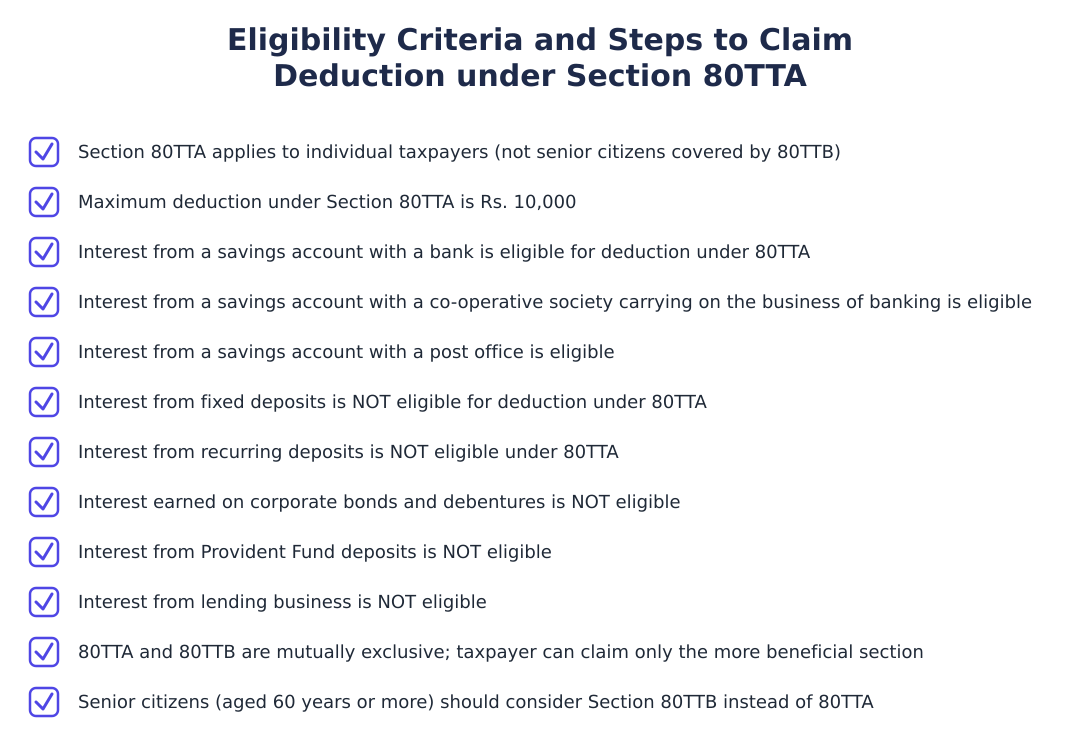
Section 80TTA is not applicable to senior citizens aged 60 years or more. Senior citizens are governed by the separate provision under Section 80TTB. Where both sections could be relevant to an assessee, they are mutually exclusive, and the assessee may choose only the deduction that is most beneficial to them.
Which Type of Interest Incomes are Allowed as Deduction Under Section 80TTA
| Source of Interest | Eligible under Section 80TTA |
|---|---|
| Interest from a savings account with a bank | Yes |
| Interest from a savings account with a co-operative society carrying on the business of banking | Yes |
| Interest from a savings account with a post office | Yes |
Interest Income Not Allowed as Deduction Under Section 80TTA
Section 80TTA does not apply to a number of interest receipts that arise from deposit or investment products. Interest from fixed deposits and recurring deposits is explicitly excluded and therefore cannot be claimed under this section.
The exclusion extends to interest earned on corporate bonds and debentures, provident fund deposits, and interest arising from a lending business. These receipts must be treated as regular income and cannot be reduced by claiming the 80TTA deduction.
Maximum Deduction Allowed Under Section 80TTA
The maximum deduction that Section 80TTA permits on eligible interest income is Rs 10,000. This cap applies to the aggregate eligible interest from the specified savings accounts.
Because the deduction is limited in amount, taxpayers should compare expected tax savings under Section 80TTA with any alternative provisions that may be available to them (for example, the senior-citizen provision) and choose the deduction that yields the greater benefit when both are relevant.
How to Claim Deduction Under Section 80TTA
Aggregate interest earned from savings accounts with banks, specified co-operative societies and post offices; exclude interest from fixed or recurring deposits and other excluded sources.
If you are a senior citizen, remember that Section 80TTA does not apply to you; instead Section 80TTB governs senior citizens and you may choose the most beneficial deduction where applicable.
When computing the deduction, ensure the total claim does not exceed Rs 10,000 across all eligible savings-interest receipts.
Declare the eligible interest under the appropriate head in your income tax return and claim the deduction under Section 80TTA while computing taxable income.
Frequently Asked Questions
Is 80TTA available to senior citizens? No, Section 80TTA is not applicable to senior citizens aged 60 years or more; they are covered by Section 80TTB instead.
Can both 80TTA and 80TTB be claimed together? No, 80TTA and 80TTB are mutually exclusive. If both sections apply, the assessee may choose only the deduction that is most beneficial to them.
Section 80TTA offers a modest but useful deduction for individuals and HUFs on interest from specified savings accounts, capped at Rs 10,000. Knowing which interest receipts qualify and which do not, and understanding the mutual exclusivity with the senior-citizen provision, helps taxpayers claim the correct deduction and optimise their tax position.
Frequently asked questions
What exactly is Section 80TTA of the Income Tax Act?
Section 80TTA allows an individual or Hindu Undivided Family (HUF) to claim a deduction of up to Rs 10,000 on interest income earned from savings accounts held with banks, co‑operative societies carrying on banking business, and post offices. The deduction applies against ‘Income from Other Sources’ and reduces your gross total income before tax is computed. Senior citizens (age 60 or above) cannot claim 80TTA; they must consider Section 80TTB instead, and you can claim only one of the two sections if both are applicable. The limit is a maximum of Rs 10,000 in a financial year irrespective of the number of eligible savings accounts or institutions.
Who can claim a deduction under Section 80TTA and can NRIs claim it?
Individuals and HUFs are eligible to claim the Section 80TTA deduction; non‑resident Indians (NRIs) can claim it only for interest from NRO savings accounts because interest on NRE accounts is tax‑exempt. Senior citizens are excluded from 80TTA because they have a separate provision (Section 80TTB) targeted at them, and you cannot claim both sections, choose the one more beneficial. Note that NRIs can generally hold only NRE and NRO accounts, so only interest from NRO savings accounts qualifies for 80TTA.
Which interest incomes are allowed as a deduction under Section 80TTA?
Section 80TTA permits deduction for interest earned on savings accounts with banks, savings accounts with co‑operative societies engaged in banking, and savings accounts with post offices. The deduction is limited to interest that is reported as ‘income from other sources’ in your return and is aggregated across all qualifying savings accounts. Only interest from savings accounts qualifies, interest credited from eligible accounts is eligible up to the overall Rs 10,000 cap in the financial year.
Which types of interest income are NOT eligible for deduction under Section 80TTA?
Interest incomes that are explicitly excluded from Section 80TTA include interest from fixed deposits, recurring deposits, corporate bonds and debentures, provident fund deposits, and interest earned as part of a lending business. In short, 80TTA covers only savings‑account interest; interest from term deposits or investment instruments is taxable normally under ‘Income from Other Sources’ without this deduction. If you have mixed interest sources, only the portion attributable to eligible savings accounts can be claimed under 80TTA.
What is the maximum deduction allowed under Section 80TTA?
The maximum deduction allowed under Section 80TTA is Rs 10,000 in a financial year, and this is the aggregate limit across all eligible savings accounts held by the assessee. If your total savings‑account interest in the year is less than Rs 10,000, you can claim the actual amount; if it exceeds Rs 10,000, the deduction is capped at Rs 10,000. For senior citizens, Section 80TTB offers a higher benefit for interest income, so they should compare both provisions and claim only the one that yields greater tax advantage.
How do I claim the Section 80TTA deduction when filing my income tax return?
To claim Section 80TTA, aggregate your eligible savings‑account interest for the financial year, enter it under ‘Income from Other Sources’ in your ITR, and then claim the deduction under the Chapter VI‑A heading for 80TTA (up to Rs 10,000). Keep supporting documents like bank/post office passbooks and interest certificates in case the assessing officer requests verification, and ensure interest from ineligible sources is excluded. If you receive Form 16 (for salaried taxpayers), the employer may not show this deduction, so claim it while filing the return; the calculation reduces your gross total income before tax liability is computed.
Do senior citizens get the benefit of Section 80TTA?
No, senior citizens (aged 60 years or more) cannot claim Section 80TTA; instead they are eligible to claim Section 80TTB, which provides a deduction on interest income up to Rs 50,000 from various sources including deposits. The two sections are mutually exclusive, if both could apply you must choose the one more beneficial to you, which for seniors is usually 80TTB because of its broader coverage and higher limit. Non‑senior residents should use 80TTA for savings‑account interest, while seniors should evaluate 80TTB for overall interest benefits.
If I have both savings account interest and fixed deposit interest, how does 80TTA apply?
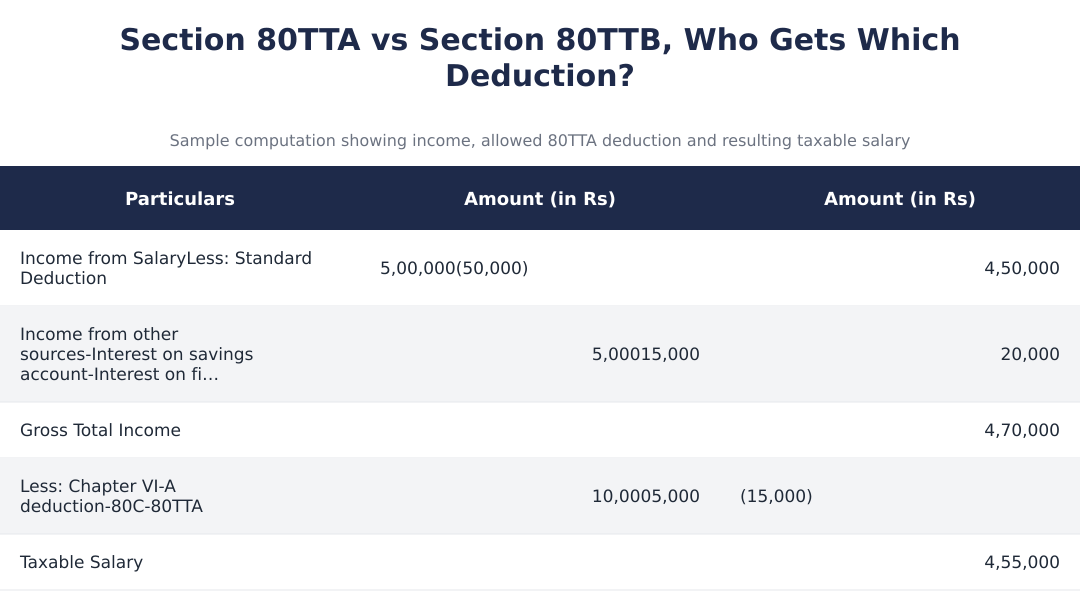
Section 80TTA will apply only to the portion of your interest income that comes from eligible savings accounts and is capped at Rs 10,000; interest from fixed deposits and recurring deposits is not eligible and remains fully taxable. For example, if you earn Rs 5,000 from savings interest and Rs 15,000 from fixed deposits, you can claim Rs 5,000 under 80TTA (since savings interest is below the cap), while FD interest of Rs 15,000 will be added to your taxable income. When filing, disclose all interest under ‘Income from Other Sources’ but claim 80TTA only against qualifying savings interest to reduce your gross total income.
Are there any special conditions or exceptions I should watch for when claiming 80TTA?
Yes, key conditions include that the deduction is available only to Individuals and HUFs, applies only to savings‑account interest from banks, co‑operative banking societies and post offices, and is limited to Rs 10,000 per year; senior citizens should consider 80TTB instead. Another practical point is that NRIs can claim 80TTA only for interest from NRO savings accounts (not NRE accounts), and interest from business of money‑lending or investment instruments are excluded. Also ensure you do not double‑claim the same interest under other sections and retain bank statements/interest certificates to substantiate the amount claimed.
Need help staying Income Tax compliant?
MoneyGence's AI Finance OS tracks your compliance, wallet share, and finances in one place, built for agencies and growing businesses.
Get started with MoneyGence