Section 80TTA vs 80TTB: Differences, Benefits & Claim Process
This guide compares Section 80TTA and Section 80TTB so you can quickly understand which interest incomes qualify for deduction, who can claim them, and how the two provisions differ in scope and limits. Both sections relate to deductions for interest earned on bank/post office/co-operative bank deposits, but they have different eligibility criteria, covered account types and maximum caps. Knowing the differences matters when you file under the old tax regime: choosing the correct deduction can reduce your taxable income and lower tax liability. In the sections that follow you will learn what each section covers, the ceilings that apply, how the eligible accounts differ, who qualifies, and practical examples that show how the caps work in real-life situations. You will also see how these deductions interact with the choice of tax regime (old versus new) and a short checklist for claiming the appropriate deduction while preparing your return. The guide keeps to the specific statutory limits and eligibility rules so you can apply them directly when computing taxable income from interest.
What is Section 80TTA ?
Section 80TTA provides an income-tax deduction for interest earned on savings accounts maintained with banks, post offices and co-operative banks. The aim of this provision is to give relief on modest interest income from savings accounts by allowing taxpayers to reduce their taxable income by the eligible amount.
The deduction under Section 80TTA is available to all assessees subject to statutory conditions, and it is capped, taxpayers can claim deduction only up to Rs 10,000 or the actual interest earned from the savings account, whichever is lower. Importantly, this deduction is available only if the taxpayer opts for the old tax regime; deductions under Chapter VI-A are not available in the new tax regime.
What is Section 80TTB?
Section 80TTB is a targeted deduction introduced to provide higher relief to resident senior and super senior citizens on interest income from deposit instruments. Unlike 80TTA, 80TTB covers a broader set of deposit accounts and offers a larger ceiling.
Under Section 80TTB, eligible resident senior and super senior citizens can claim a deduction for interest from savings accounts as well as interest from time deposits and recurring deposits (that is, deposit accounts classified as time deposits). The maximum deduction under this section is up to Rs 50,000 or the actual interest earned, whichever is lower. As with 80TTA, this deduction is available only under the old tax regime.
Key Differences Between Section 80TTA and Section 80TTB
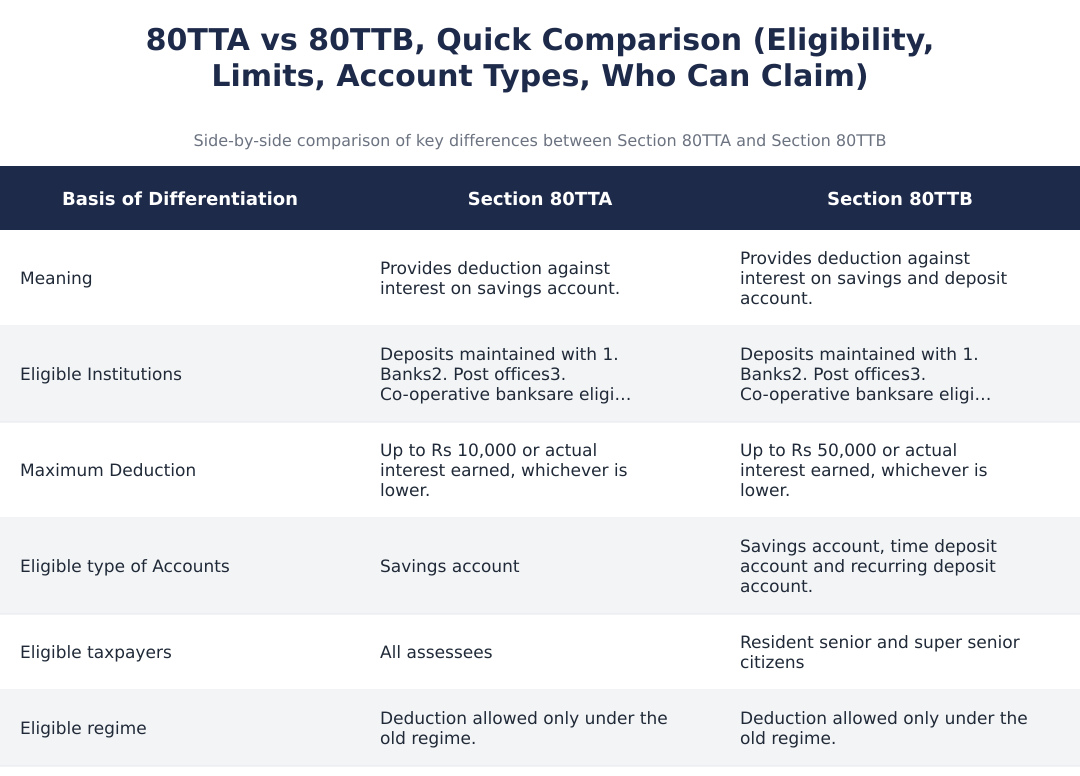
| Basis of Differentiation | Section 80TTA | Section 80TTB |
|---|---|---|
| Meaning | Deduction against interest on savings account | Deduction against interest on savings and deposit accounts |
| Eligible Institutions | Deposits maintained with banks, post offices and co-operative banks (savings accounts) | Deposits maintained with banks, post offices and co-operative banks (savings and certain time deposit accounts) |
| Maximum Deduction | Up to Rs 10,000 or actual interest earned, whichever is lower | Up to Rs 50,000 or actual interest earned, whichever is lower |
| Eligible Type of Accounts | Savings account | Savings account, time deposit account and recurring deposit account |
| Eligible Taxpayers | All assessees (subject to statutory conditions) | Resident senior and super senior citizens |
| Applicable Tax Regime | Deduction allowed only under the old tax regime | Deduction allowed only under the old tax regime |
Example Scenarios for 80TTA and 80TTB
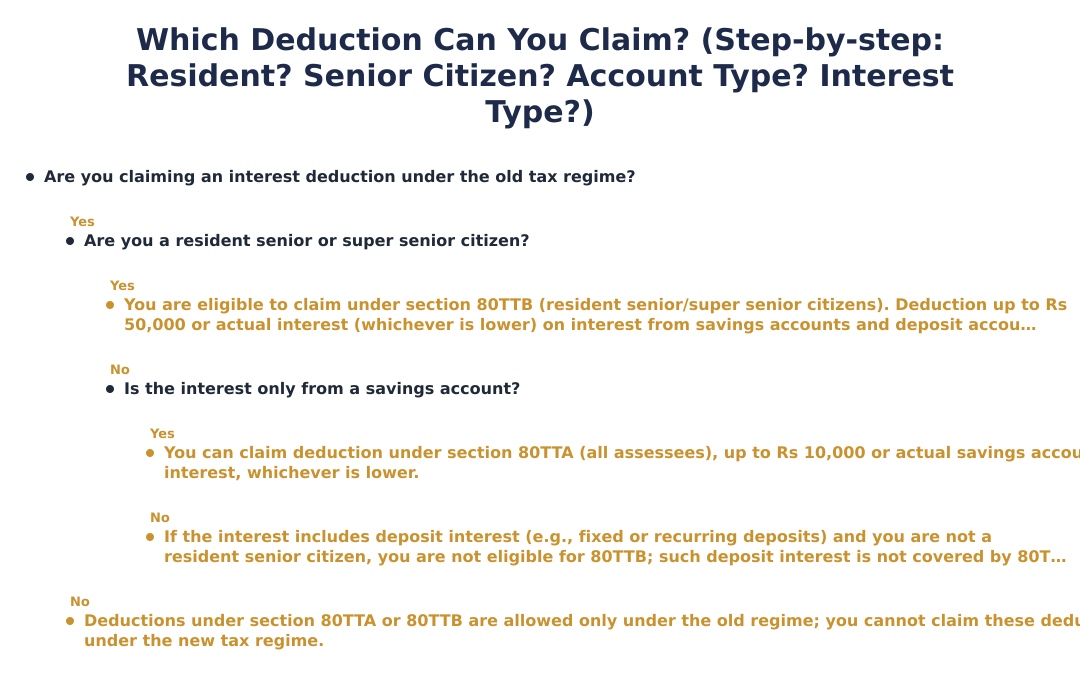
Non-senior taxpayer with savings interest: If a non-senior taxpayer earns interest solely from a savings account, they may claim deduction under Section 80TTA. The deduction cannot exceed Rs 10,000 or the actual interest received, whichever is lower. Interest from fixed deposits or recurring deposits does not qualify under 80TTA.
Resident senior citizen with mixed interest: A resident senior citizen who receives interest from both savings accounts and time deposits/recurring deposits should look to Section 80TTB. Under 80TTB the aggregate eligible deduction across the covered deposit types is limited to Rs 50,000 or the actual interest income, whichever is lower. This section therefore provides broader relief for seniors because it includes interest from fixed/term deposits as well as savings accounts.
When both sections could seem relevant: Only one deduction is applicable depending on eligibility. All assessees may consider 80TTA for savings interest, while resident senior citizens should use 80TTB for interest across savings and time/recurring deposits given its higher ceiling and wider coverage. Both deductions are capped at their stated ceilings or the actual interest, whichever is lower.
80TTA and 80TTB in the New Tax Regime
Both Section 80TTA and Section 80TTB deductions are allowed only under the old tax regime. The new tax regime does not permit deductions under these provisions as they form part of Chapter VI-A style reliefs which the new regime excludes.
Practically, before claiming either deduction you must decide whether to opt for the old regime when filing because these specific interest deductions will not be available if you choose the new regime. Comparing total deductions available under the old regime (including 80TTA/80TTB where applicable) versus the simplified slabs of the new regime will help determine which route produces the lower tax liability.
How to Claim Section 80TTA and 80TTB Deduction - Documents Required
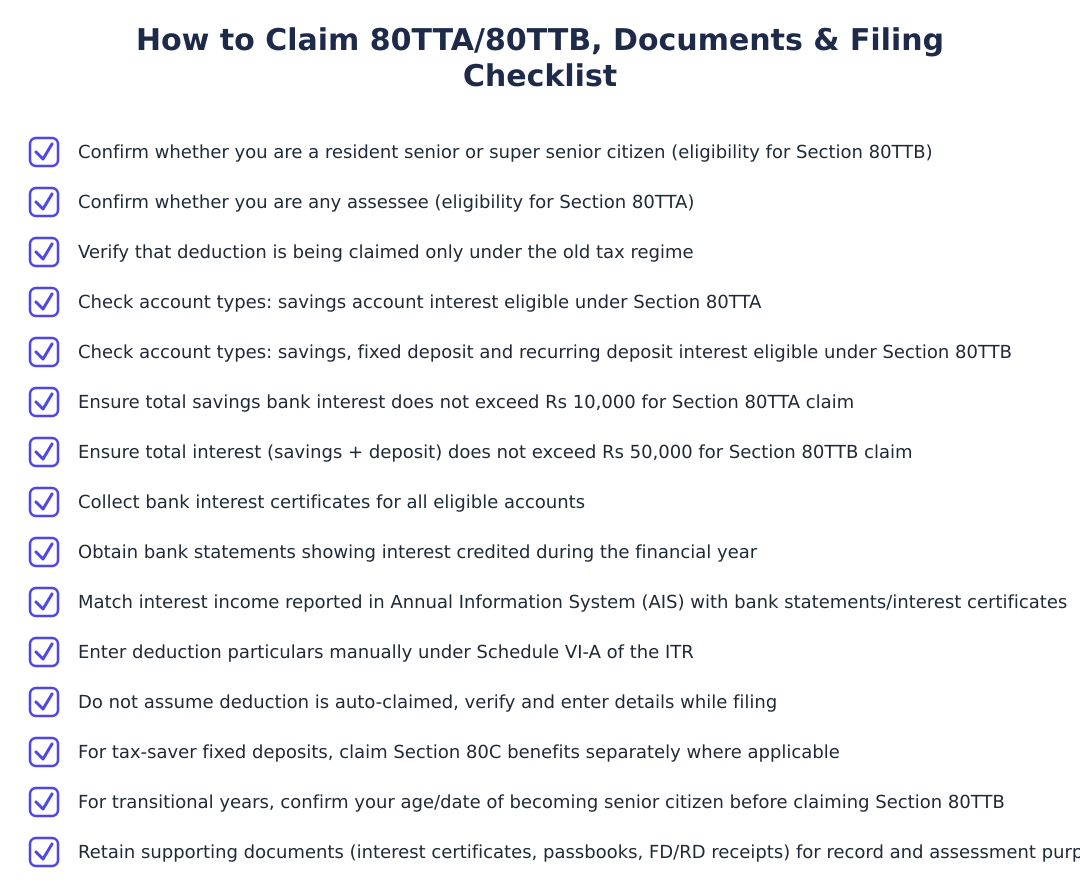
Establish whether you qualify for 80TTA (general assessees for savings interest) or 80TTB (resident senior/super senior citizens for savings and certain deposit interest).
Compute total interest income separately for savings accounts and for deposit instruments so you can apply the correct cap depending on which section you are eligible for.
For 80TTA apply a maximum deduction of Rs 10,000 or actual savings interest, whichever is lower; for 80TTB apply a maximum deduction of Rs 50,000 or actual interest from covered deposits, whichever is lower.
Ensure you are filing under the old tax regime if you intend to claim either deduction since both are not available under the new regime.
Section 80TTA and 80TTB both offer relief on interest income but differ in who can claim them, which accounts are covered, and the maximum deduction allowed. 80TTA is a modest relief on savings interest available to all assessees up to Rs 10,000, while 80TTB gives resident senior citizens broader coverage including term deposits with a higher ceiling of Rs 50,000. Remember these deductions are available only under the old tax regime, so factor them in when choosing your filing regime.
Frequently asked questions
What is Section 80TTA and who can claim it?
Section 80TTA is a tax deduction that allows assessees to claim up to Rs 10,000 on interest earned from savings bank accounts held with banks, co-operative banks and post offices. This deduction is available only to non-senior resident taxpayers and is allowed only under the old tax regime; the lesser of actual interest or Rs 10,000 is deductible. It covers interest from regular savings accounts but does not apply to fixed deposits (FDs) or recurring deposits (RDs). To claim it you must report the interest under Schedule VI-A of the ITR and keep bank interest certificates or passbooks for verification.
What is Section 80TTB and who is eligible for it?
Section 80TTB is a deduction available only to resident senior and super senior citizens, allowing up to Rs 50,000 to be deducted on interest income from savings accounts, fixed deposits, recurring deposits and other deposit accounts with banks, co-operative banks and post offices. The deduction is subject to the lower of actual interest income or Rs 50,000 and is available only under the old tax regime. It supersedes 80TTA for eligible senior taxpayers for the same financial year, so a senior citizen cannot claim both 80TTA and 80TTB on the same interest income. Claimants should retain interest certificates and match amounts with AIS or bank statements when filing.
What is the main difference between Section 80TTA and 80TTB?
The main difference is eligibility and maximum deduction: 80TTA gives up to Rs 10,000 for interest from savings accounts to all assessees, while 80TTB gives up to Rs 50,000 for interest from savings and deposit accounts but only to resident senior citizens. Both deductions apply only under the old tax regime and cover deposits with banks, co-operative banks and post offices; however, only 80TTB includes interest from FDs and RDs. Practically, a non-senior taxpayer uses 80TTA, while a senior taxpayer uses 80TTB and should claim the higher Rs 50,000 cap where applicable.
Can I claim interest on fixed deposits under Section 80TTB?
Yes, interest on fixed deposits (FDs) and recurring deposits (RDs) is eligible for deduction under Section 80TTB for resident senior and super senior citizens, subject to a maximum of Rs 50,000 or actual interest earned, whichever is lower. This is in contrast to Section 80TTA, which does not cover FD or RD interest and is limited to savings account interest up to Rs 10,000. To claim 80TTB you must be a resident senior citizen in that financial year and report the interest in your ITR; keep bank-issued interest certificates for substantiation. If total interest across eligible accounts is less than Rs 50,000, you can claim the actual amount only.
If I am not a senior citizen, can I claim 80TTB after I turn 60 partway through the year?
You can claim Section 80TTB only if you are a resident senior citizen for the relevant financial year, so becoming 60 partway through the year means you can claim 80TTB only in the following financial year after turning 60. For the current financial year in which you are still non-senior, you remain eligible for 80TTA (savings interest up to Rs 10,000) but not 80TTB; in the next FY after you attain senior status you may claim up to Rs 50,000 under 80TTB on eligible interest. Make sure to check your exact date of becoming a senior citizen relative to the financial year cutoff when filing returns.
Are these deductions (80TTA/80TTB) available in the new tax regime?
No, both Section 80TTA and Section 80TTB deductions are allowed only under the old tax regime and are not available if you opt for the new tax regime. Taxpayers who choose the new tax regime lose eligibility for these and other specified deductions, so they cannot reduce taxable income using 80TTA or 80TTB. If you want to claim these interest deductions you must file under the old regime and enter the deduction details in Schedule VI-A of the ITR. Compare your tax liability under both regimes to decide which yields lower tax after considering these deductions.
How do I claim Section 80TTA or 80TTB while filing my ITR and what documents are needed?
To claim either deduction you must manually enter the deduction amount under Schedule VI-A of the ITR and cannot expect it to be auto-applied; keep your bank passbooks or bank-issued interest certificates as proof. Also reconcile interest shown in Annual Information Statement (AIS) with your bank records to ensure accuracy, and retain Form 16A/TDS certificates if tax was deducted on interest. For 80TTB specifically, keep proof of senior citizen status (such as PAN linked DOB record) and for both sections retain account statements for audit or assessment purposes.
Can I claim deductions under Section 80TTA or 80TTB along with Section 80C investments?
Yes, claiming deduction under Section 80TTA/80TTB does not affect your ability to claim deductions under Section 80C; these are separate provisions and can be claimed concurrently as applicable, subject to their individual limits. For example, you can claim up to Rs 1.5 lakh under 80C for specified investments and also claim up to Rs 10,000 under 80TTA or up to Rs 50,000 under 80TTB for interest income if eligible. However, note that 80TTA is for non-senior taxpayers while 80TTB is for resident seniors; choose the correct section based on your status and report each deduction in the appropriate schedules of the ITR.
What if my bank has already deducted TDS on interest but I am eligible for 80TTA or 80TTB?
If your bank has deducted TDS on interest but you are eligible for 80TTA (up to Rs 10,000) or 80TTB (up to Rs 50,000 for seniors), you should still claim the applicable deduction while filing ITR to reduce your taxable income and potentially get a refund of excess TDS. Provide bank interest certificates and Form 16A (if available) to substantiate the gross interest and TDS, reconcile these with AIS, and claim the deduction in Schedule VI-A to compute net taxable interest. If TDS was over-collected because your net taxable interest after deduction falls below the TDS threshold, the excess can be claimed as refund in the return.
Need help staying Income Tax compliant?
MoneyGence's AI Finance OS tracks your compliance, wallet share, and finances in one place, built for agencies and growing businesses.
Get started with MoneyGence