Sole Proprietorship Registration in India, Procedure & Advantages
This guide explains what a sole proprietorship in India is, how it functions in legal and practical terms, the routine compliance a proprietor must follow, and the main advantages and disadvantages to consider before choosing this form for your business. You will learn why many small entrepreneurs, freelancers and local traders favour sole proprietorships, what the proprietor’s legal position looks like, which filings are mandatory, and what optional registrations can still be useful. Understanding these points helps you pick the right structure, assess risks (such as unlimited personal liability), and plan basic tax and compliance workflows so your business runs smoothly and lawfully.
What is a Sole Proprietorship?
A sole proprietorship is a business managed and controlled by a single individual. It is the simplest form of business organisation and is commonly used by small-scale entrepreneurs, independent professionals, and single-person enterprises.
Legally, a sole proprietorship has no separate identity from its owner, the proprietor and the business are the same entity for all legal and tax purposes. Because of this, the business’s status, obligations and benefits flow directly to the proprietor rather than to a distinct corporate entity.
Features of Sole Proprietorship
One core feature is the proprietor’s complete control over business decisions and operations. The owner makes strategic and day-to-day choices without needing approval from partners or boards, and retains the business’s profits fully.
At the same time, the proprietor bears unlimited liability. This means the owner is personally responsible for business debts and obligations. There is no legal separation between personal and business assets, so creditors can pursue the proprietor’s personal assets to satisfy business liabilities.
Sole proprietorships typically carry lower compliance requirements compared with formal corporate structures. Registration of the proprietorship itself is not mandatory under company law, which keeps formation formalities and recurring compliance lighter for many small businesses.
Because the proprietorship has no separate legal existence, the business’s continuity depends entirely on the proprietor. If the proprietor discontinues operations, the business effectively ends, which affects succession and long-term continuity planning.
Registration, Optional Registrations and Checklist
There is no mandatory incorporation or formal registration required to start a sole proprietorship under company law. However, proprietors commonly obtain specific registrations or records as needed for operating in regulated sectors or to access particular benefits.
One optional registration is under the Micro, Small and Medium Enterprise (MSME) regime. Registering as an MSME is not mandatory but can be beneficial for accessing government schemes and support where applicable. Proprietors should evaluate the potential advantages of MSME registration against their business needs.
Even though the proprietorship as an entity does not require formal incorporation, proprietors should keep in mind any sector-specific licences or registrations that may be required for conducting certain kinds of business activities. Such requirements depend on the nature of the business and relevant statutory frameworks.
Compliances and Tax Filings
A sole proprietor must comply with basic tax filing obligations. Specifically, proprietors are required to file an Income Tax Return annually to report the business’s income and pay taxes as applicable.
If the proprietor registers under the Goods and Services Tax (GST) regime, GST compliance follows: a registered sole proprietor must file GST returns as mandated by the GST laws. Whether a proprietor needs to register under GST depends on turnover thresholds and the nature of transactions, and registration triggers the related return filing obligations.
Because compliance requirements differ depending on registrations and business activity, proprietors should map applicable filings early and maintain records that support timely and accurate tax returns.
Advantages of Sole Proprietorship
Sole proprietorships are straightforward to operate and involve relatively low compliance, making them accessible to first-time entrepreneurs and small business owners who prefer a simple structure.
The proprietor has full control over decision-making and retains all profits generated by the business. This direct control enables quick decisions and agile responses to market needs without requiring consensus from partners or directors.
Lower operating and compliance costs compared to larger business forms are another practical advantage. For many small ventures the minimal formalities help keep start-up friction and recurring administrative burden low.
Disadvantages of Sole Proprietorship
The biggest drawback is unlimited personal liability: the proprietor is personally liable for business debts and obligations. This exposes personal assets to business risks and can be a major consideration in higher-risk activities.
Access to external funding is often limited for sole proprietorships, and growth potential can be restricted because the enterprise depends on a single owner for capital and managerial decisions. These constraints may make scaling the business more difficult compared with multi-owner structures.
Finally, since the business has no separate legal existence, continuity is tied to the proprietor. If the proprietor stops operating the business or cannot continue due to death or incapacity, the business typically ends, complicating succession planning.
A sole proprietorship is a simple and flexible structure suited to small businesses and individual entrepreneurs who value control and low compliance. However, unlimited liability, limited access to funding and the lack of continuity are important trade-offs. Evaluate the business’s risk profile, growth needs and compliance obligations before deciding; where helpful, consider optional registrations such as MSME and register under GST only when required, while ensuring annual income tax returns are filed.
Frequently asked questions
How do I register a sole proprietorship in India step-by-step?
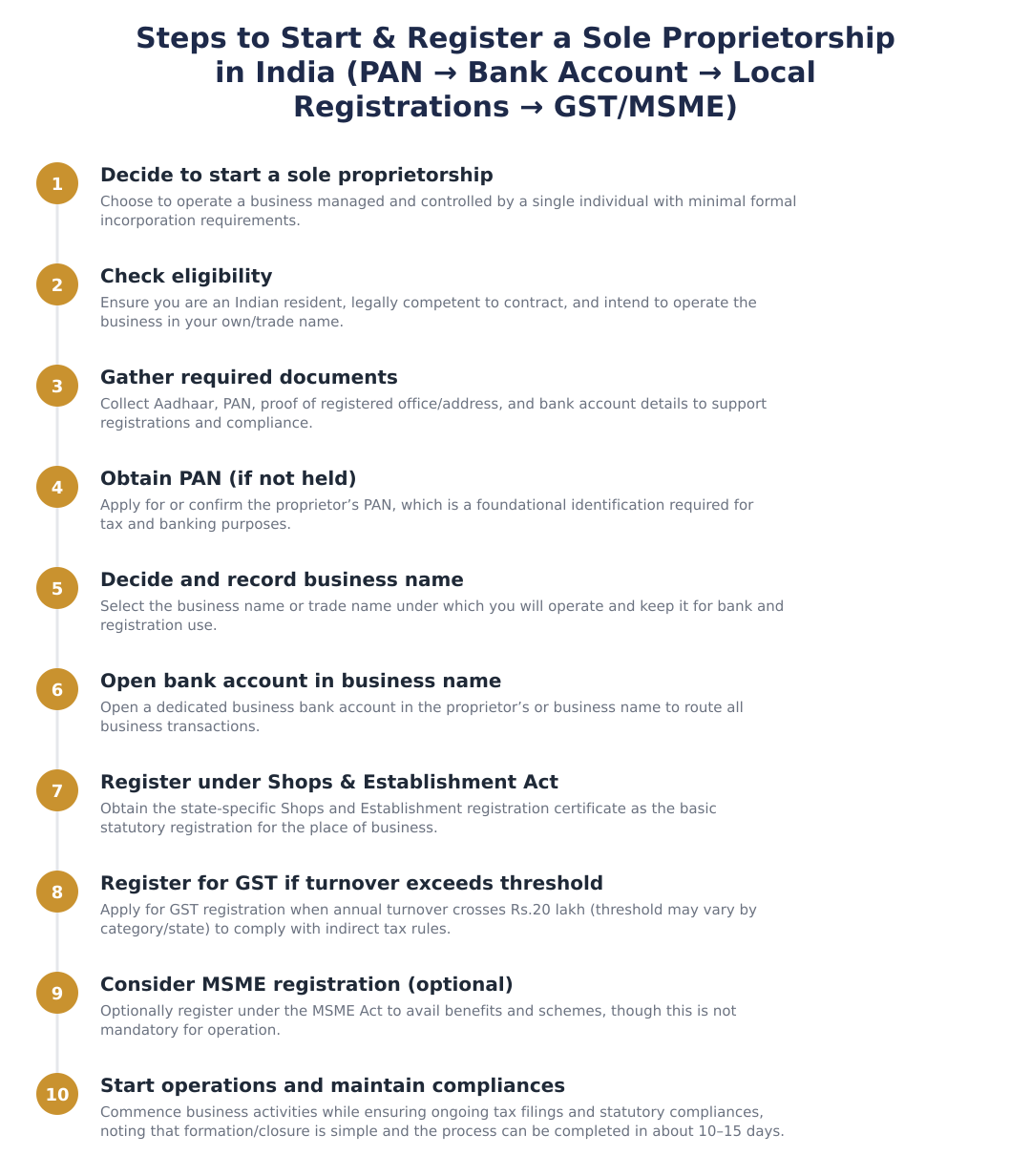
You register a sole proprietorship by obtaining a PAN, choosing a business name, opening a current bank account in the business name, and completing applicable local registrations such as Shops & Establishment and GST (if applicable). First get or confirm your PAN and Aadhaar; then decide the trade name and open a bank account to run business transactions through. Next, obtain the Shops & Establishment registration from your state municipal or labour department and apply for GST registration if your annual turnover exceeds Rs. 20 lakh (threshold varies for special categories/locations). Optionally register under MSME (Udyam) for benefits like easier credit and government schemes.
What documents are required to start a sole proprietorship?
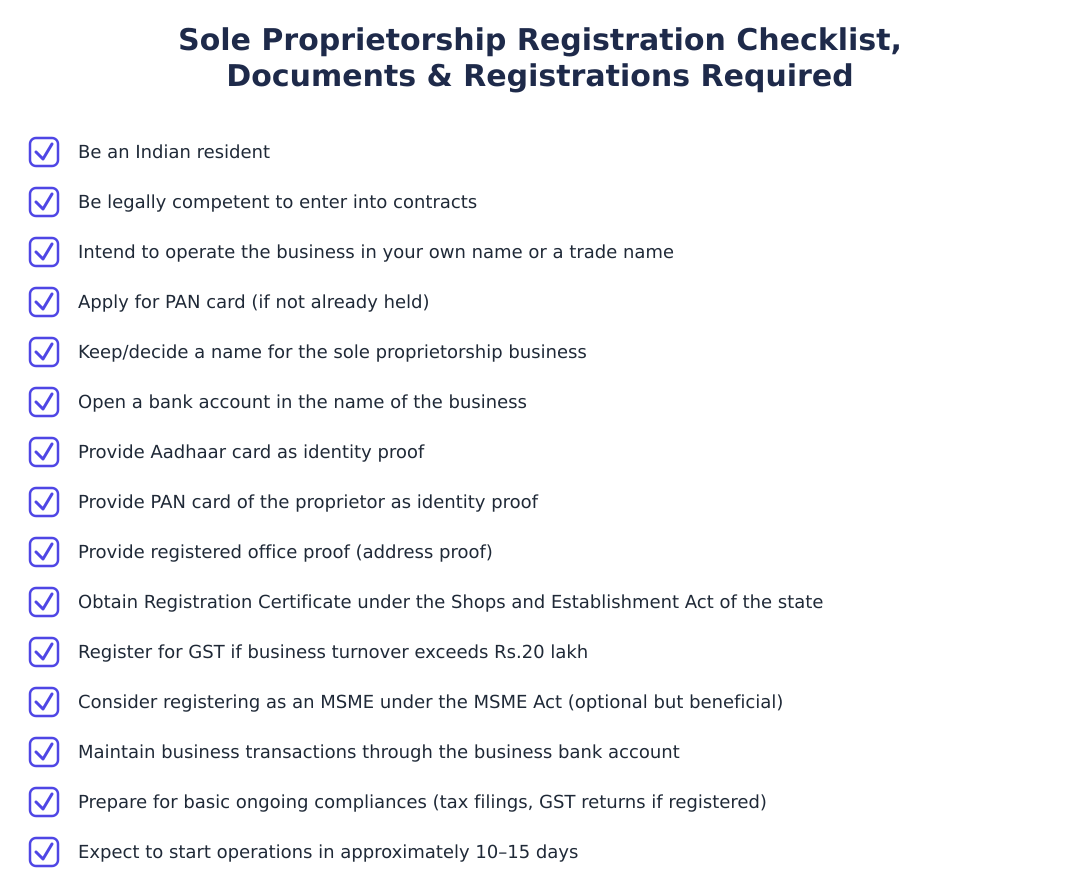
You need basic identity and address proofs, Aadhaar card and PAN card of the proprietor, plus proof of business address and a bank account in the business name. Proof of registered office can be a rental agreement or utility bill and, if renting, a No Objection Certificate from the owner. For registrations you may also need photographs, business PAN for GST application, and documents specific to state Shops & Establishment registration or MSME (Udyam) registration.
Do I have to register a sole proprietorship under the Companies Act?
No, a sole proprietorship is not registered under the Companies Act and has no mandatory incorporation requirement; registration as a proprietorship is simple and generally not required. However, to operate legally you may still need registrations like Shops & Establishment, GST (if turnover exceeds Rs.20 lakh), and PAN, and you may choose optional registrations such as MSME (Udyam). Lack of company-level registration means the proprietor and business are the same legal entity and the business does not have separate legal personality.
How long does it take to start a sole proprietorship in India?
You can start a sole proprietorship in about 10–15 days for basic setup tasks like PAN confirmation, choosing a name, and opening a bank account, while registrations may vary by authority. Shops & Establishment registration timelines depend on the state (often a few days to a couple of weeks), GST registration usually completes within a few days to a week if documents are in order, and MSME (Udyam) registration is typically instant online. Delays can occur if additional proofs or clarifications are requested by the registering authority.
What are the tax obligations for a sole proprietor?
A sole proprietor must file an Income Tax Return annually reporting business profits and may need to pay advance tax if tax liability exceeds prescribed limits; GST returns are required if registered under GST. If the proprietor's turnover exceeds GST thresholds (Rs.20 lakh nationwide, lower in some special category states), GST registration and periodic GST returns become mandatory; TDS provisions apply if you have applicable payments subject to deduction and you must file TDS returns. Additionally, if turnover or profits cross audit limits under the Income Tax Act, a tax audit and audit report may be required.
What are the main advantages of running a sole proprietorship?
The main advantages are easy and low-cost formation, complete managerial control by the owner, and entitlement to all business profits without profit-sharing. Compliance and operating costs are relatively low compared with companies or partnerships, decision-making is quick since no partners or boards are involved, and documentation requirements are minimal. It is particularly suitable for small traders, freelancers, and local service providers who want to start quickly with little capital.
What are the main disadvantages of a sole proprietorship?
The principal disadvantages are unlimited personal liability for business debts, limited access to external funding, and lack of business continuity on the proprietor’s death or incapacity. Because the business and owner are the same legal entity, personal assets can be used to meet business liabilities and lenders may be hesitant to extend large credit without personal security. Growth and succession planning can be difficult since the business depends heavily on one individual for capital and management.
Who is eligible to form a sole proprietorship in India?
Any Indian resident who is legally competent to enter into contracts can form a sole proprietorship and operate a business in their own name or a trade name. Eligibility requires residency in India and the legal capacity to run a business (i.e., not a minor or legally incapacitated person); foreigners or non-residents generally cannot form a proprietorship in India. Additionally, the proprietor should ensure the intended business activity is permitted under local laws and obtain necessary local registrations and licenses.
How is a sole proprietorship different from a partnership?
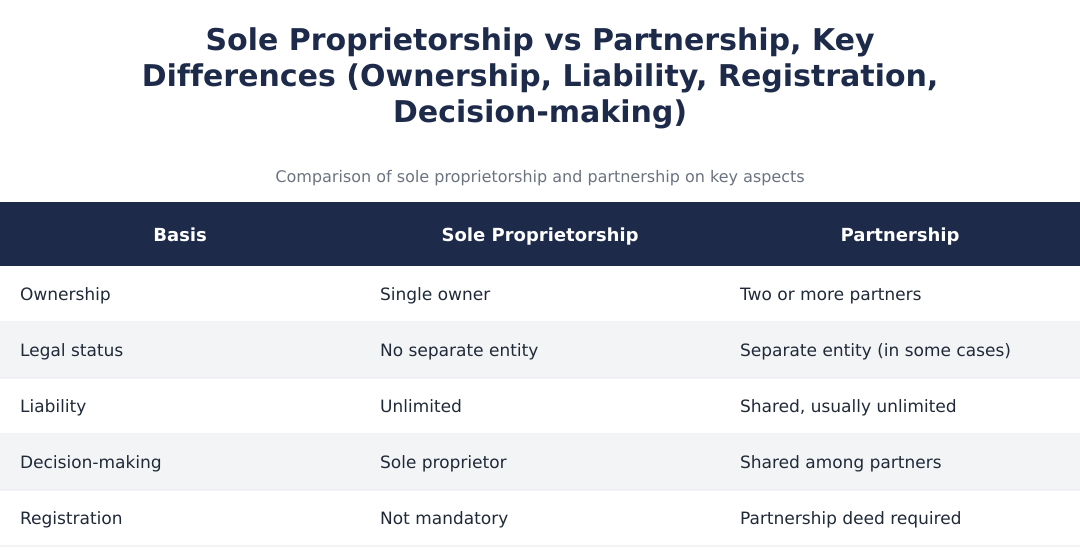
A sole proprietorship is owned and controlled by one person and has no separate legal identity, whereas a partnership involves two or more partners sharing ownership, decision-making, and profits and often operates under a partnership deed. Liability in a proprietorship is unlimited and borne solely by the owner; in a partnership liability is usually shared (and in many cases still unlimited unless it is a limited liability structure). Partnerships typically require a partnership deed (registration is voluntary but recommended) while proprietorships have no mandatory formation document, making proprietorship easier to set up but less suitable for shared management and capital.
Need help staying Company Registration compliant?
MoneyGence's AI Finance OS tracks your compliance, wallet share, and finances in one place, built for agencies and growing businesses.
Get started with MoneyGence