Solvency Certificate: Meaning, Format & How to Get One
This guide explains what a solvency certificate is, when organisations and individuals seek one, how banks or authorised issuers typically present it, and what to expect during the application process. You will learn the basic purpose of a solvency certificate, the common elements that appear on the certificate format, the general steps an issuing authority follows before granting one, and the types of supporting evidence issuers usually ask for. Understanding these aspects helps you prepare a clearer application, anticipate questions from the issuing authority, and reduce delays when you need a solvency certificate for business, legal, or travel-related purposes. Whether you are preparing for a tender, applying for a contract, or responding to a request from a third party, the guide focuses on practical expectations, how solvency certificates function as third‑party attestation of financial standing and what documentation commonly demonstrates that standing. This will allow you to organise documents, communicate effectively with bank or institutional officers, and plan timelines for obtaining the certificate. The guidance is written to be useful for individuals and entities who are unfamiliar with solvency certificates as well as for those who have obtained one previously but want to streamline the next application.
Meaning of a Solvency Certificate
A solvency certificate is a formal attestation issued by an authorised institution that indicates an individual’s or an entity’s financial capability relative to specified liabilities or commitments. It acts as an external statement intended for use by other parties who need assurance about financial standing.
The certificate is commonly requested by third parties that must evaluate creditworthiness, financial reliability, or the ability to meet contractual obligations. As an attestation, it summarises the issuer’s assessment rather than providing an exhaustive audit, and it is normally relied on alongside other documents and checks.
Solvency Certificate Format
Although formats vary between issuers, a solvency certificate typically contains a clear statement of the purpose for which it is issued, identification details of the person or entity, and a declaration about the issuer’s assessment. The wording usually defines whether the attestation relates to net worth, available credit, or suitability as collateral for a specific obligation.
Signatures, authorised officer details, and the issuing authority’s letterhead or seal are common elements that lend administrative authenticity. Depending on the issuer’s policies, the document may also reference the documents reviewed and the effective date of the assessment.
Issuance of a Solvency Certificate
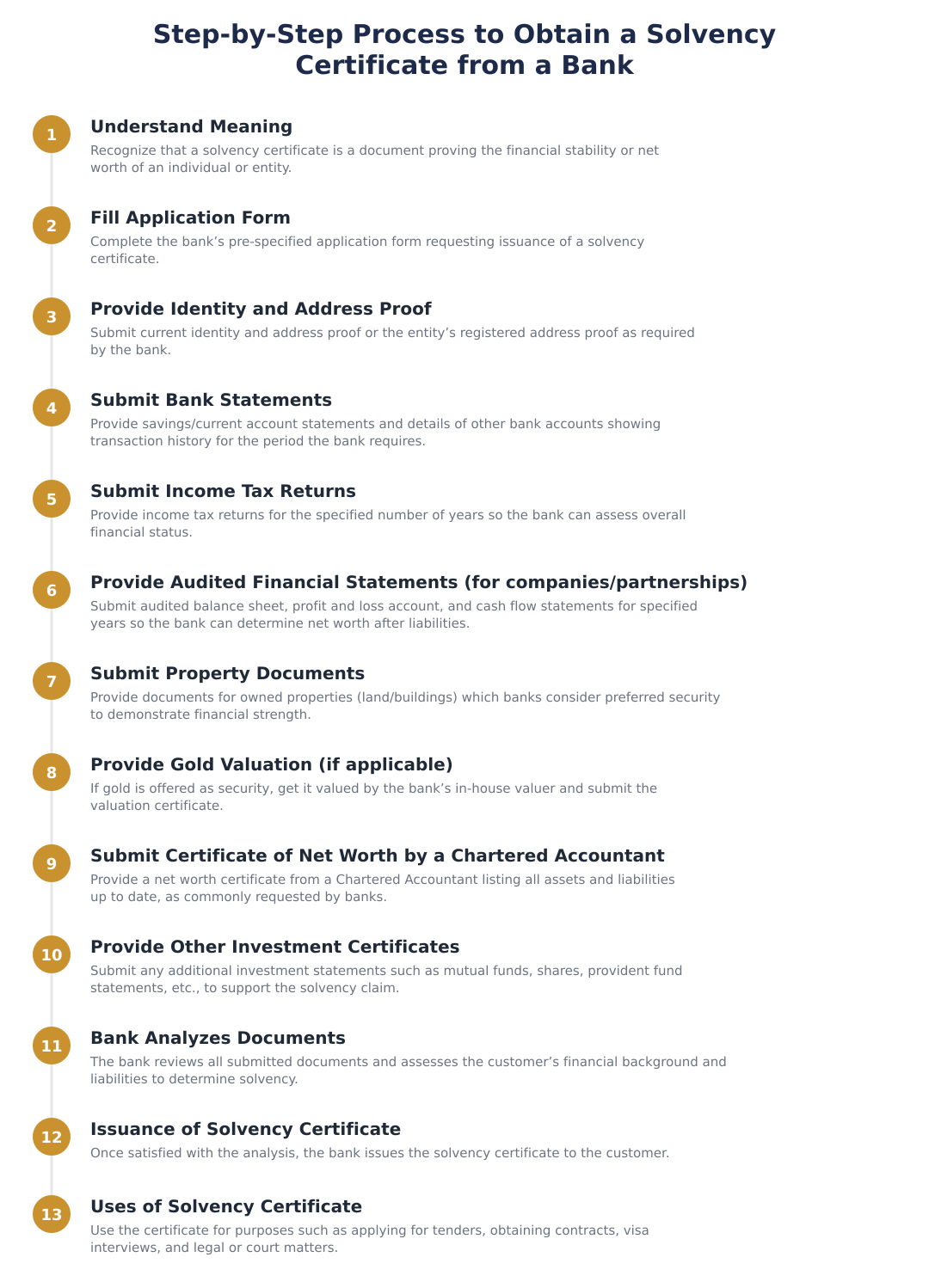
Issuing authorities generally follow a process that involves receiving a formal request, verifying the applicant’s identity, reviewing financial information, and then issuing the certificate if satisfied. Time taken, internal checks, and the scope of verification vary by issuer and the certificate’s intended use.
An issuer may limit the scope of its attestation, for example, specifying that the certificate is valid only for a particular purpose or time period. Applicants should clarify the intended use when making the request so the issuing authority can tailor the certificate’s wording appropriately.
Documents Required by a Bank to Issue a Solvency Certificate
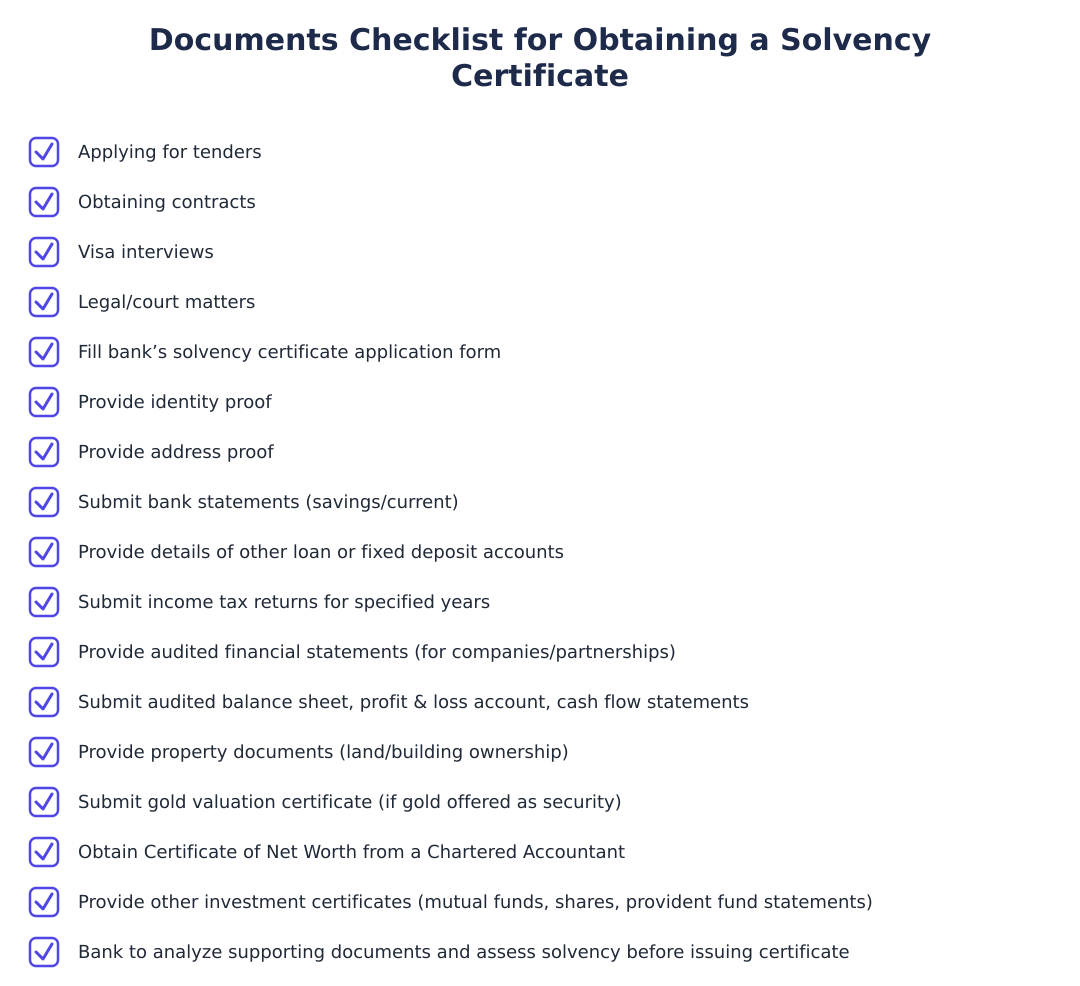
Banks and other issuers typically ask for documentation that demonstrates identity, financial history, asset ownership, and liabilities. This enables the issuing officer to form an opinion about solvency and to record the basis for the attestation.
Common categories of evidence include records showing transactional history, tax and income documentation, audited financial statements for entities, proof of assets that may be considered security, and any professional certifications of net worth. Institutions may also require a formal application form and may conduct internal checks against existing account records before issuing the certificate.
A solvency certificate is a practical tool for demonstrating financial standing to third parties. By understanding its purpose, typical format, issuance process, and the kinds of documents that support an application, you can prepare more effectively and reduce delays. Always discuss the intended use with the issuing authority so the certificate’s wording and scope match your requirements.
Frequently asked questions
What is a solvency certificate and what does it prove?
A solvency certificate is an official financial document that proves the financial stability and ability to meet liabilities of an individual or entity. It records the assessed net worth or resources available to the person or company after considering liabilities, and is typically issued by a bank or a Chartered Accountant based on supporting documents. The certificate is used as evidence of creditworthiness for purposes like tenders, contracts, visa interviews and legal matters. Issuance usually follows a bank’s or CA’s analysis of bank statements, tax returns, audited financials and other asset documents.
Who issues a solvency certificate and how is it issued?
A solvency certificate is usually issued by a bank for its customer after the bank reviews the customer’s financial records, and it can also be issued as a Certificate of Net Worth by a Chartered Accountant. Banks typically require the customer to submit a formal application and supporting documents (bank statements, income tax returns, property papers, etc.), then the bank assesses liabilities and assets before issuing the certificate. The issuing authority may also perform valuations (for example, in-house valuation of gold) or ask for audited financial statements in the case of companies or firms. The bank’s internal policy determines eligibility, the review period (customers must have transacted for a certain number of years) and final approval.
What documents do banks typically ask for to issue a solvency certificate?
Banks typically ask for an application form, identity and address proof, bank statements (savings/current) covering a specified number of years, and income tax returns to assess financial status. For companies or partnership firms, audited balance sheets, profit & loss accounts and cash flow statements for certain years are commonly required to determine net worth. Additional documents often requested include property documents, gold valuation certificate (if gold is offered as security), a net worth certificate from a Chartered Accountant, and any other investment certificates like mutual fund or share statements. The bank evaluates all these supporting documents and, if satisfied about solvency relative to liabilities, issues the certificate.
What is the typical format or content included in a solvency certificate?
A solvency certificate generally contains the name and address of the applicant, the date of issuance, a statement of the assessed net worth or solvency position, and a declaration by the issuing authority (bank or CA) about the basis of assessment. It will also list the main supporting documents reviewed, such as bank statements, income tax returns, audited financials and property details, and may mention any conditions or the period for which the assessment holds. The certificate is signed and stamped by the authorized official and often includes the issuing branch’s contact details for verification. Exact layout and wording vary by bank or CA practice, but these elements are commonly present.
For what purposes is a solvency certificate used?
A solvency certificate is used as proof of financial standing for various official and commercial purposes such as applying for tenders, obtaining contracts, visa interviews and legal or court matters. It serves as documentary evidence of the applicant’s ability to meet financial obligations and supports bids, guarantees or legal claims where creditworthiness is relevant. Banks and government agencies often accept it as part of eligibility or qualification criteria in procurement and legal proceedings. Recipients should ensure the certificate covers the period and valuation basis required by the authority requesting it.
Does a bank issue a solvency certificate to any customer or are there eligibility conditions?
Banks issue solvency certificates only to customers who meet the bank’s internal eligibility criteria, which typically include a history of transactions with the bank for a specified number of years and satisfactory financial records. The bank reviews account behaviour, outstanding loans, fixed deposits and other relevant accounts, and may require additional documents such as tax returns and property papers before approving the certificate. If the bank is not satisfied with the customer’s financial background or liabilities exceed acceptable limits, it may refuse issuance or provide a certificate with conditions. Eligibility rules and the review period vary from bank to bank, so applicants should confirm specific requirements with their branch.
Is a Chartered Accountant’s net worth certificate acceptable instead of a bank solvency certificate?
Yes, many banks and authorities accept a Certificate of Net Worth prepared and signed by a Chartered Accountant as evidence of solvency, but acceptance depends on the recipient’s requirements and the issuing authority’s rules. A CA’s net worth certificate lists assets and liabilities up to date and is often requested by banks as supporting evidence when they consider issuing their own solvency certificate. For corporate entities, audited financial statements certified by a CA are frequently required to establish net worth. Before relying solely on a CA certificate, confirm with the tendering authority, embassy or bank whether a CA-issued certificate is acceptable in lieu of a bank-issued solvency certificate.
How do banks value non-cash assets like property and gold when issuing a solvency certificate?
Banks consider property documents and may accept property ownership as preferred security, often requiring title deeds and valuation details to include property value in solvency assessment. For gold, banks typically get valuation done by their in-house valuer and use that assessed value when calculating net worth. Other investments such as mutual funds, shares or provident fund statements are accepted as additional supporting investment certificates and are included based on documentary evidence. The final solvency figure reflects the bank’s accepted valuations after adjusting for liabilities and any bank-specific haircuts or conditions.
What should I expect after submitting documents for a solvency certificate, time, verification and outcome?
After submitting the application form and required documents, the bank will verify account transactions, tax returns and asset documents and may take a few days to weeks depending on internal procedures before issuing the solvency certificate. The bank might request additional proofs, valuations (for gold/property) or a CA’s net worth certificate during verification, and approval depends on satisfactory assessment of solvency relative to liabilities. If approved, the bank issues a stamped and signed certificate mentioning the assessed net worth and basis of the assessment; if not approved, the bank may decline or ask you to rectify discrepancies. Processing time and any fees vary by bank, so check with the branch for expected timelines and charges.
Need help staying Finance Templates compliant?
MoneyGence's AI Finance OS tracks your compliance, wallet share, and finances in one place, built for agencies and growing businesses.
Get started with MoneyGence