Standard Deduction for Salaried Employees: New & Old Tax Regime
This guide explains the standard deduction and how it functions for salaried taxpayers across different tax regimes. You will learn the core idea behind the standard deduction, why governments include such deductions in income‑tax systems, how the deduction affects taxable income and take‑home pay in practical terms, and what to look for when comparing its treatment under different tax regimes. Understanding the standard deduction matters because it directly reduces the portion of your income that is subject to tax, which can simplify tax calculations and influence the choice between alternative tax regimes. By the end of this article you will have a clear conceptual grasp of what a standard deduction is, the practical implications for salaried individuals and pensioners, and sensible next steps to confirm how it applies to your own tax return under the specific rules currently in force.
What is Standard Deduction?
At its core, the standard deduction is a fixed amount that a taxpayer may subtract from gross income to arrive at taxable income. Rather than requiring individuals to itemise or substantiate a range of small employment‑related expenses, the standard deduction provides a uniform reduction that simplifies the computation of taxable income.
Because it is a fixed figure rather than an expense‑based allowance, the standard deduction removes the need for claimants to collect and present proofs for a wide range of minor costs. The deduction is applied before calculating tax liability, so a larger standard deduction directly reduces the base on which tax rates are applied.
Standard Deduction under New & Old Tax Regime
Different tax regimes may treat deductions differently. The presence, amount and eligibility of a standard deduction are set out by the prevailing tax rules for a specific tax year and regime. Whether you should use one regime or another depends on the entire set of allowances, exemptions and rates applicable under each regime, not solely on the standard deduction.
When comparing regimes, consider the overall impact on your taxable income and final tax liability. Because the standard deduction reduces taxable income by a fixed amount, its relative value changes with your total income and with what other deductions or exemptions are retained or removed under each regime. Always consult up‑to‑date official guidance or a tax professional to confirm how the standard deduction is applied under the regime you are evaluating.
Purpose of Standard Deduction
The standard deduction exists primarily to simplify tax administration and compliance. By offering a single, fixed reduction in income, tax authorities reduce the compliance burden for taxpayers who would otherwise need to document many small, employment‑related expenses.
From a policy perspective, it also provides broad‑based relief that helps lower the effective tax burden for salaried earners and pensioners who may incur routine expenses in earning their income. Because it does not require itemised claims, it reduces disputes and verification work for tax authorities.
Benefits of Standard Deduction
The most direct benefit of a standard deduction is that it lowers taxable income by a set amount, which can reduce the overall tax payable. This is especially helpful for taxpayers who do not have large itemised expenses to claim; the standard deduction provides an automatic reduction without additional paperwork.
Another practical advantage is administrative simplicity. Claiming the standard deduction typically does not require supporting bills or receipts for commonplace expenses, making the tax‑return process quicker and less error‑prone. For taxpayers choosing between tax regimes, the standard deduction is one element of the comparison and should be weighed alongside other deductions, exemptions, and the rates that apply.
Documents Required for Standard Deduction
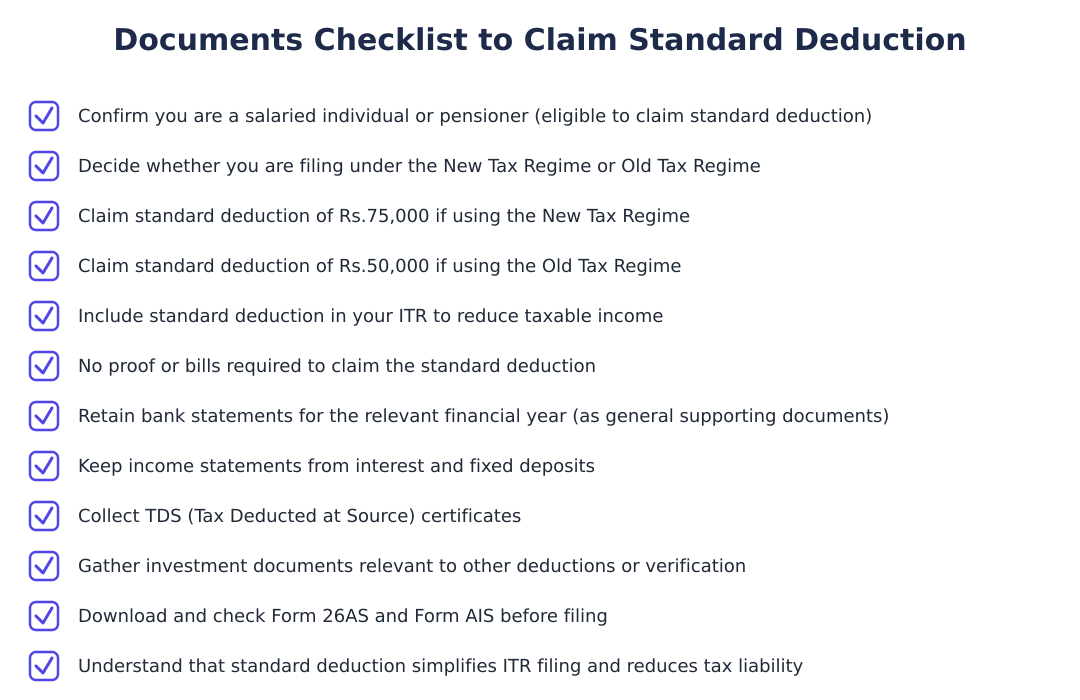
Because the standard deduction is a fixed allowance that does not depend on actual expenses, it typically does not require claimants to produce supporting documents for the small, routine costs it is intended to cover. This is one of the features that makes it administratively simple to claim.
However, you should keep routine evidence of your income and any other deductions you claim on your return (for example, salary slips, Form 26AS or other income documentation) to support your overall tax position. The exact documentation needed for other claims will depend on which deductions and exemptions you choose to use alongside or instead of the standard deduction.
Frequently Asked Questions
How does the standard deduction affect the tax I pay? The standard deduction reduces your taxable income by a fixed amount before tax is computed, so it lowers the base on which tax rates are applied and can reduce your overall tax liability.
Should I pick a tax regime because of the standard deduction alone? Choosing between tax regimes should be based on the complete set of rates, exemptions and deductions applicable in each regime. The standard deduction is one component of that calculus, but its impact depends on your whole income profile and the other benefits or restrictions under each regime.
The standard deduction is a simple, fixed reduction in taxable income that streamlines tax compliance and can lower tax payable for salaried individuals. Its actual value and availability depend on the tax rules in force for the relevant year and regime, so verify the current law or consult a tax advisor when preparing your return or comparing tax regimes.
Frequently asked questions
What is the standard deduction for salaried individuals and pensioners?
The standard deduction is a flat, fixed amount that salaried individuals and pensioners can subtract directly from their gross salary or pension to reduce taxable income. It requires no proofs or bills and is available irrespective of actual expenses incurred; for salaried taxpayers it replaced earlier exemptions like transport and medical allowances. This deduction applies in both old and new tax regimes though amounts differ, and it is claimed while computing income under 'Salaries' in your Income Tax Return. It is available to resident and non-resident employees receiving salary or pension incomes from Indian sources.
How much is the standard deduction in the old tax regime?
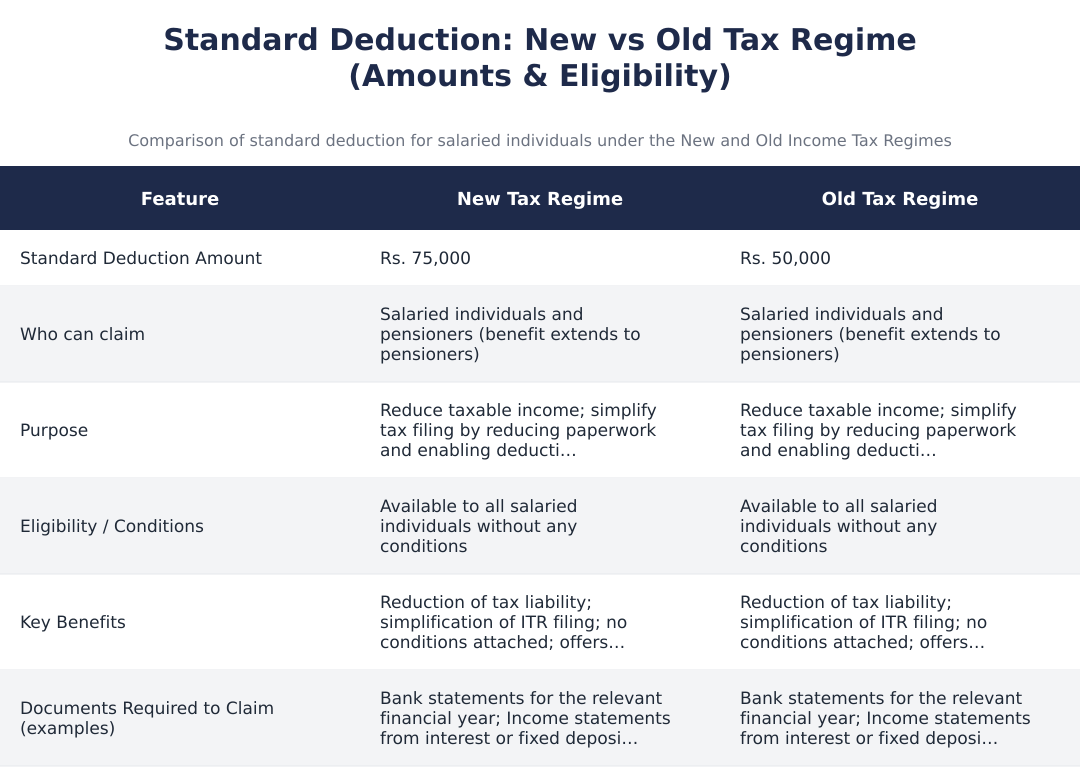
In the old tax regime the standard deduction for salaried individuals and pensioners is Rs. 50,000 per financial year. This flat amount is deducted from gross salary or pension before other income calculations and is available without any conditions or need to produce documents. Claiming this deduction reduces taxable income directly and can lower your tax liability depending on your tax slab. It coexists with other eligible deductions under the old regime such as Section 80C investments and HRA (where applicable).
How much is the standard deduction in the new tax regime?
Under the new tax regime the standard deduction available to salaried individuals and pensioners is Rs. 75,000 per financial year. This deduction is applied against salary or pension income and reduces taxable income under the new slab-based rates, even though the new regime otherwise removes most other exemptions and deductions. Claiming this Rs. 75,000 reduces your tax liability directly, but you cannot also claim other exempt allowances that are excluded under the new regime. It is important to compare total tax payable in both regimes since the new regime offers lower slabs but fewer deductions overall.
Who is eligible to claim the standard deduction?
Eligible claimants are salaried individuals and pensioners receiving salary or pension income from Indian sources; both resident and non-resident employees are covered. The deduction is automatic in computation and does not depend on actual expenses, employment status beyond being a salary earner, or any specific investments. Self-employed professionals and business owners cannot claim the standard deduction under the salaries head; they must use business expense provisions if applicable. If you receive salary through employer payroll, your employer usually considers the standard deduction when calculating taxable salary and TDS, but you can still claim it while filing the ITR if not reflected correctly.
What documents are required to claim the standard deduction?
You do not need any specific documents or proofs to claim the standard deduction because it is a flat allowance available without conditions. However, keep standard supporting documents for income verification such as salary slips, Form 16, bank statements, Form 26AS and AIS, TDS certificates, and pension statements to substantiate the income figures reported. These documents are helpful if the tax department raises queries or for general record-keeping, but none are required specifically to justify the standard deduction amount. Employers normally reflect the standard deduction while issuing Form 16, which you should retain with other tax records.
How does the standard deduction reduce my tax liability, can you give a simple example?
The standard deduction reduces taxable income directly, thereby lowering the tax computed on your income; for example, a salaried person in the old regime with gross salary of Rs. 8,00,000 would reduce that to Rs. 7,50,000 after the Rs. 50,000 deduction, lowering taxable income and tax payable. In the new regime the same person would reduce taxable salary by Rs. 75,000 to compute tax under the new slab rates. The exact tax savings depend on your marginal tax rate: e.g., if you are in the 20% bracket, a Rs. 50,000 deduction saves Rs. 10,000 of tax (excluding cess and surcharge). Always compare total tax payable under both regimes because other deductions/exemptions differ between them.
Can I claim the standard deduction along with other deductions like HRA or Section 80C?
Yes, in the old tax regime you can claim the standard deduction (Rs. 50,000) along with other eligible allowances and deductions such as HRA, Section 80C investments, medical insurance under 80D, etc., because the old regime permits various deductions and exemptions. In the new tax regime you can claim the standard deduction (Rs. 75,000) but most other exemptions and deductions are not available unless specifically allowed, so you cannot claim HRA or Section 80C in the new regime. Always verify which deductions are permitted in the chosen regime and compute tax under both regimes to decide the most tax-efficient option for your situation.
How do I claim the standard deduction while filing ITR?
To claim the standard deduction you should report your gross salary or pension in the 'Salaries' section of the Income Tax Return and then deduct the applicable standard deduction (Rs. 50,000 in old regime or Rs. 75,000 in new regime) when computing taxable salary; most ITR software and forms have a specific field for standard deduction. If your employer has already adjusted it in Form 16, ensure the same figures are used in your ITR to avoid discrepancies; if not adjusted you can still claim it while filing and reconcile with Form 26AS. No separate proof is required, but retain Form 16, salary slips, and other income documents for records and possible enquiries. After entering the deduction, continue with other computations for net taxable income and tax payable under the selected regime.
Does the standard deduction apply to taxpayers who opt for the new tax regime every year?
Yes, taxpayers who opt for the new tax regime for a financial year can claim the standard deduction of Rs. 75,000 in that year as it is available under the new regime. However, most other exemptions and deductions are not available under the new regime, so you should compute your tax under both regimes to check whether the new regime plus the Rs. 75,000 standard deduction gives a lower tax liability than the old regime with multiple deductions. Note that whether you can switch between regimes depends on your specific income sources (e.g., business income rules differ), and when switching there are procedural rules for choosing the regime while filing the ITR. Keep your supporting income documents and Form 26AS to reconcile TDS and income irrespective of the regime chosen.
Need help staying Income Tax compliant?
MoneyGence's AI Finance OS tracks your compliance, wallet share, and finances in one place, built for agencies and growing businesses.
Get started with MoneyGence