Startup Registration India: 7 Easy Steps to Register Your Startup
This guide explains, in clear and practical terms, what founders need to know about registering a startup in India and how to approach the registration journey. You will learn why formal registration matters for fundraising, hiring, contracting and credibility; what broad stages the process involves; how to prepare organisational and intellectual-property information in advance; and common pitfalls to avoid so your application proceeds smoothly. The aim is to give founders a practical roadmap they can adapt to their business model and growth stage, helping you move from idea to a formally recognised entity with confidence. Whether you are just exploring incorporation options or preparing to apply for any government‑linked startup recognition, the guidance here focuses on planning, documentation hygiene, and sensible next steps that reduce delays and make your venture investment-ready.
Why formal registration matters for startups
Formal registration transforms an informal idea into an accountable legal entity. This matters when you need to sign contracts, open bank accounts in the company’s name, hire employees under payroll, or enter into partnerships with suppliers and customers. Investors, accelerators and many service providers also expect some form of official registration before they commit resources.
Registration also creates a clear ownership and governance structure. Founders who document shareholding, director roles and decision-making procedures reduce misunderstanding later on. Good registration practices make it easier to onboard employees, grant equity, and handle compliance obligations in a predictable way.
Finally, being formally registered is often a precondition for applying to government programmes, incubators, or schemes intended to support startups. Even when the programme itself is optional, registration signals seriousness and maturity to stakeholders, which helps in fundraising and securing commercial partnerships.
The broad stages of the startup registration journey
The registration journey typically begins with choosing an appropriate legal form and incorporating or registering the entity under relevant corporate or partnership laws. This stage establishes the company’s legal identity and generates foundational documents such as incorporation certificates and constitutional documents.
After incorporation, founders often complete a separate registration or recognition process with government portals or startup hubs that offer visibility, mentorship and access to support programmes. This may involve creating an account, completing an organisational profile, and uploading supporting documents about the business model and team.
Many founders also apply for recognition from designated departments or agencies that run official startup schemes. Such recognition often requires a short application describing the innovation or scalability of the product or service, supported by documentation demonstrating the business idea and any traction or intellectual property.
Throughout these stages, founders should gather common supporting materials, entity formation documents, identity proofs for directors or partners, a clear description of the startup’s value proposition, and any evidence that supports claims around innovation or market validation.
Preparing documents and corporate housekeeping
Before you begin any registration forms, put together a tidy file of the documents you are likely to need. Typical items include proof of the entity’s existence, identity and addresses for founders and authorised signatories, and simple narrative materials that explain the product, market and team in plain language. Having these ready reduces back-and-forth with portals and speeds processing.
Maintain clear corporate records as you proceed: minute books, share or ownership ledgers, and signed agreements where relevant. If you expect to seek funding, prepare a concise pitch document and a one-page cap table. Accurate records are valuable during due diligence and help you answer queries from programme administrators quickly.
If your startup involves intellectual property or regulatory approvals, prepare summaries and status notes so these can be shared when required. Even if formal patents or trademarks are pending, a clear explanation of your IP position increases confidence among reviewers and potential partners.
Common pitfalls and how to avoid them
A frequent cause of delay is inconsistent or incomplete documentation. Ensure names, addresses and entity details are identical across all forms and supporting files. Small mismatches between incorporation records and application forms are easy to avoid with a careful review before submission.
Another common issue is vague or overly technical descriptions of the business in recognition applications. Write the business model and innovation in concise, non‑technical language that a reviewer unfamiliar with the domain can understand; include concrete examples of how customers use the product and any measurable progress.
Finally, allow time for administrators to review applications and provide clarifications. Track your submissions and retain proof of filing; if a portal provides an application number or acknowledgement, note it for follow-up communications.
Practical next steps after registration
Once registration and any recognition processes are complete, focus on operational readiness: open a business bank account in the entity’s name, set up basic accounting and payroll systems, and formalise any founder or investor agreements. These actions turn formal recognition into operational capability.
Use recognised status to approach targeted support: accelerators, incubators, mentors and investor networks. Prepare a short update pack that highlights traction, team growth and near‑term milestones so potential partners can quickly evaluate the opportunity.
Finally, revisit governance and compliance on a periodic basis. Even early‑stage startups benefit from simple, repeatable processes for bookkeeping, tax filings and statutory recordkeeping. Establishing those practices early avoids stress as the company scales.
Registering a startup is both a legal step and a strategic one: it creates credibility, enables transactions, and opens doors to institutional support. Focus on careful preparation, clear communication of your business proposition, and disciplined recordkeeping. With those elements in place, the administrative process becomes a straightforward checkpoint on the path to growth.
Frequently asked questions
Who is eligible to register as a startup under the Startup India initiative?
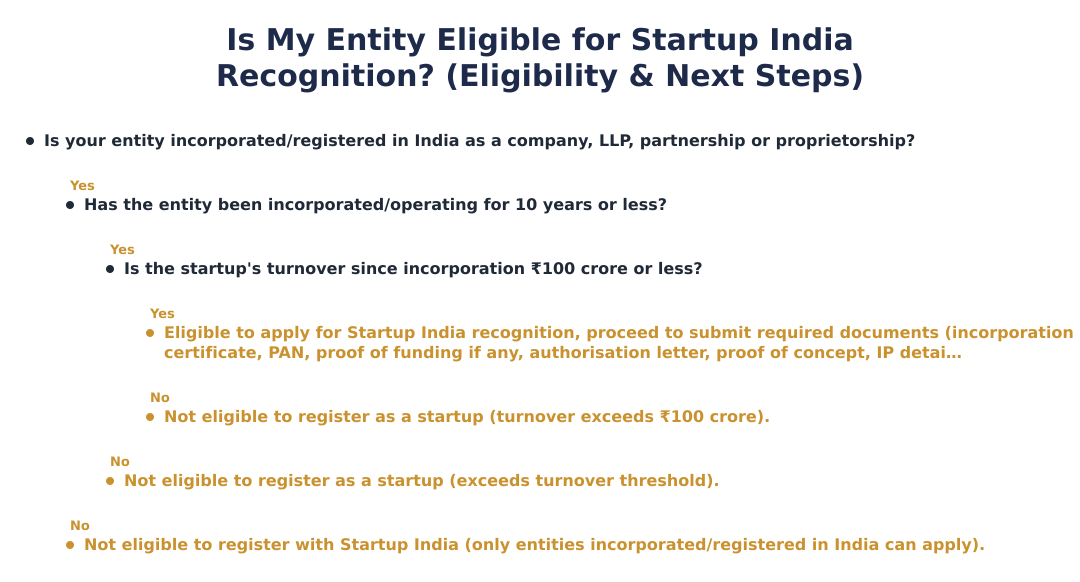
An entity incorporated as a Private Limited Company, Limited Liability Partnership (LLP) or Partnership Firm that is up to ten years old and has an annual turnover not exceeding Rs. 100 crore can register as a startup under the Startup India initiative. The entity must be working towards innovation, development, or improvement of products, services or processes and should aim to solve a problem or create scalable business models. A startup must also have at least one registered office in India to apply for benefits on the portal. Foreign entities without an Indian registered office are not eligible for portal recognition until the government extends global registrations.
What are the main benefits of registering with Startup India and getting DPIIT recognition?
Registering with Startup India and obtaining DPIIT recognition provides benefits like access to a three-year income tax exemption, fast-track IPR support and dedicated incubation and accelerator programmes. Recognised startups can self-certify compliance for six labour laws and three environmental laws for up to five years from incorporation, and get easier access to government schemes, mentorship, and investor networks. Many benefits require formal DPIIT recognition to be claimed, such as IPR facilitation and priority for government procurement and funding schemes.
What documents do I need to register my startup on the Startup India portal?
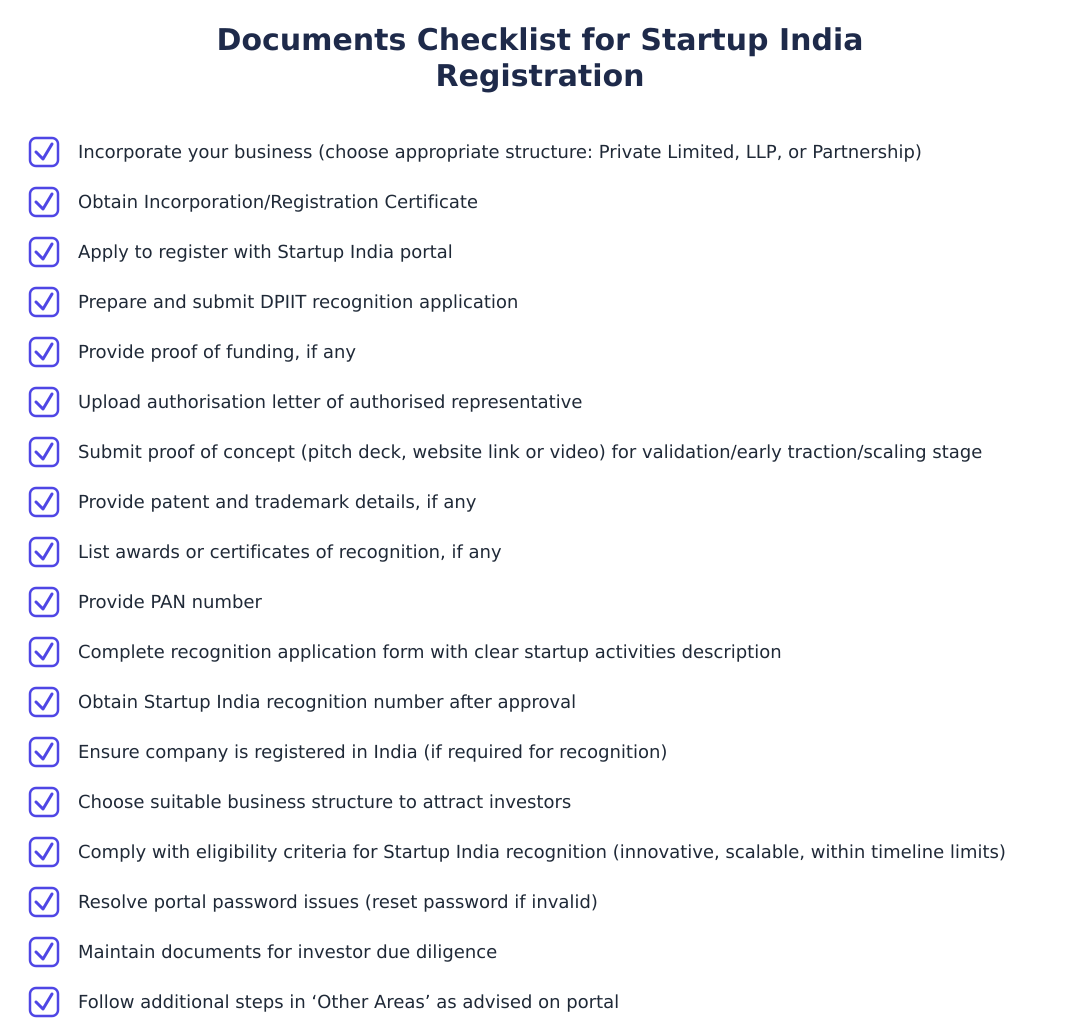
To register your startup you typically need the Incorporation/Registration Certificate, PAN number, proof of funding if any, an authorisation letter for the authorised representative, and proof of concept such as a pitch deck, website link or demo video where applicable. If relevant, include patent/trademark details and any awards or certificates of recognition to strengthen the application. Make sure the documents are in the formats accepted by the portal and that the entity has an Indian registered office address before submitting.
What are the 7 basic steps to register a startup in India under Startup India?
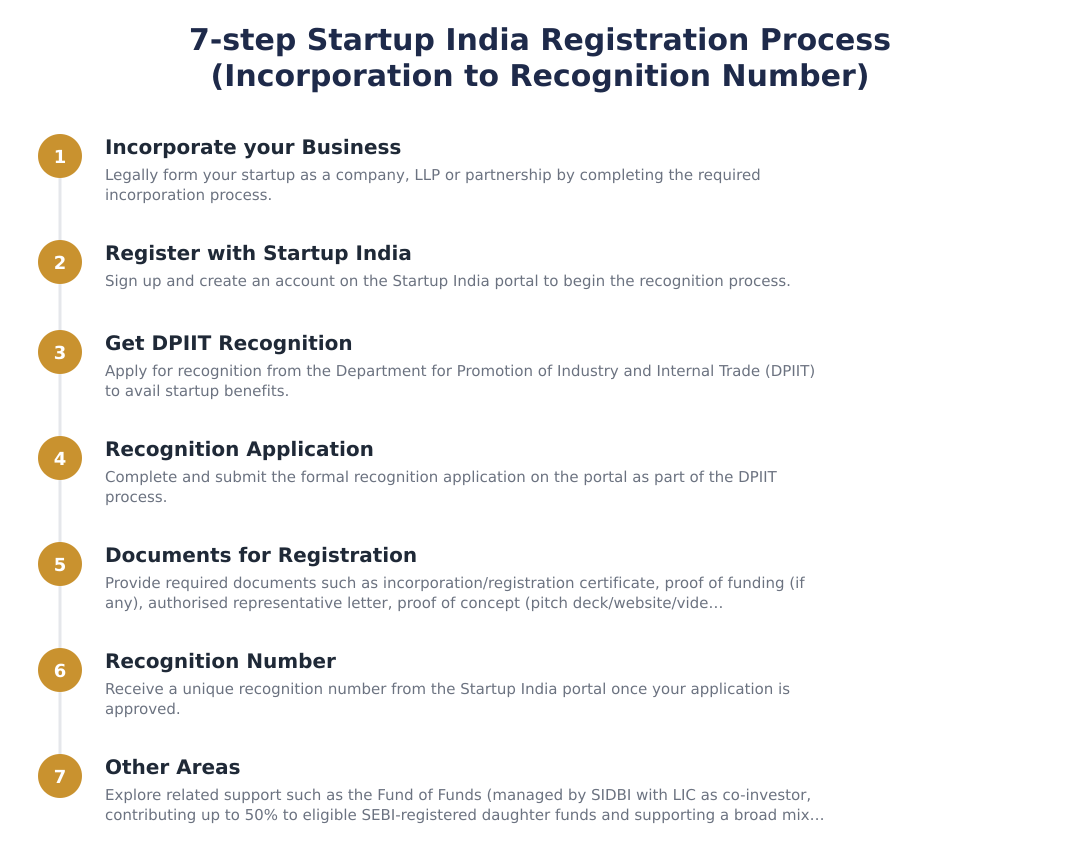
The seven basic steps are: (1) incorporate your business as a Private Limited Company, LLP or Partnership; (2) create an account and register your entity on the Startup India portal; (3) apply for DPIIT recognition by filling the recognition form and uploading required documents; (4) provide details required in the recognition application including activities and proof of concept; (5) attach supporting documents like incorporation certificate, PAN, funding proof, and IP documents; (6) receive a system-generated recognition number and downloadable certificate once approved; and (7) explore other areas such as IPR facilitation, incubation, mentorship and funding opportunities through the portal. Each step should be completed accurately, for example, the recognition form must clearly describe the problem solved, the innovative solution and the revenue model.
How long does DPIIT recognition remain valid for a startup?
DPIIT recognition remains valid until the startup completes ten years from the date of its incorporation/registration or its turnover in any previous financial year exceeds Rs. 100 crore. Once either of these thresholds is crossed, the entity ceases to be recognised as a startup under the scheme and will no longer be eligible for recognition-specific benefits. The recognition is therefore time- and turnover-bound, so startups should apply early to avail benefits within the eligible period.
Can foreign companies register or get benefits under Startup India?
A foreign company can only use the Startup India portal and avail recognition-related benefits if it has at least one registered office in India; otherwise it is not eligible for portal registration or DPIIT recognition. The government has indicated plans to expand registrations to global stakeholders, but currently the portal's location preferences and benefits are built for Indian-registered entities only. Foreign startups should therefore first establish a registered Indian presence (subsidiary or branch with a registered office) to be eligible.
What should I write in the 'Startup Activities' section to ensure recognition is accepted?
In the 'Startup Activities' section you should clearly state the problem your startup addresses, describe your innovative solution and explain how it differs from existing alternatives, and outline your revenue model and stage of validation or traction. Provide concise evidence of innovation, for example, prototype details, pilot results, patent filings, customer traction or a pitch deck link, because DPIIT assesses novelty, scalability and problem-solving focus. Avoid vague or generic statements; specificity about uniqueness and commercial potential improves chances of acceptance.
What is the Fund of Funds for startups and how does it work?
The Fund of Funds for Startups (managed by SIDBI) provides co-investment support to SEBI-registered venture (daughter) funds by contributing up to 50% of a daughter fund’s corpus, provided the daughter fund has already raised the remaining 50% from other investors. Life Insurance Corporation (LIC) is a co-investor in the Fund of Funds and SIDBI will have representation on the daughter fund’s board proportional to its contribution. The Fund aims to back a broad mix of sectors, manufacturing, agriculture, health, education and others, to increase risk capital availability to startups across stages.
Which business entity type is generally best for startups seeking investor funding?
A Private Limited Company is generally preferred by investors and is often the recommended structure for startups seeking external funding, because it provides limited liability, ease of issuing equity, and a governance structure familiar to investors. Limited Liability Partnerships (LLPs) have lower incorporation costs and simpler compliance, but they are less flexible for equity fundraising compared to Private Limited companies. Choose the structure based on factors like planned fundraising, compliance capability, tax considerations and long-term exit strategy; many startups convert from LLP to Private Limited before major funding rounds.
Need help staying Company Registration compliant?
MoneyGence's AI Finance OS tracks your compliance, wallet share, and finances in one place, built for agencies and growing businesses.
Get started with MoneyGence