Tax Deducted at Source (TDS): Meaning, Rates, Returns & Due Dates
Tax Deducted at Source, or TDS, is a fundamental mechanism introduced by the Indian Income Tax Department to collect taxes directly at the point of income generation. The core concept behind TDS is simple: the person or entity making a specified payment is responsible for deducting a certain percentage of tax before releasing the funds to the receiver. This deducted amount is then deposited with the government on behalf of the recipient, ensuring a steady and continuous flow of revenue to the treasury while keeping tax evasion in check. For businesses and individual taxpayers alike, understanding the nuances of TDS is crucial. From identifying which transactions require deduction to keeping up with quarterly filing schedules, compliance requires meticulous tracking. Failing to deduct or deposit TDS on time can lead to significant financial penalties. In this comprehensive guide, we will explore the essential aspects of TDS, including its applicability across various transaction categories, the specific Income Tax sections that govern them, the crucial quarterly return deadlines, and the penalties associated with late filing. Whether you are a business owner managing payroll and vendor payments, or an individual tracking your tax credits through your Form 26AS, this guide provides the necessary clarity to navigate the Indian TDS framework smoothly.
Applicability of TDS: Key Transactions and Sections
| Income Type/Transaction | Governing Section |
|---|---|
| Salary | Section 192 |
| Dividend | Section 194 |
| Interest | Section 194A |
| Professional and consultation fees | Section 194J |
| Contract payments | Section 194C |
| Casual income | Section 194B |
| Cash withdrawals | Section 194N |
| Commission/brokerage | Section 194H |
Understanding TDS Deposit Deadlines and Timelines
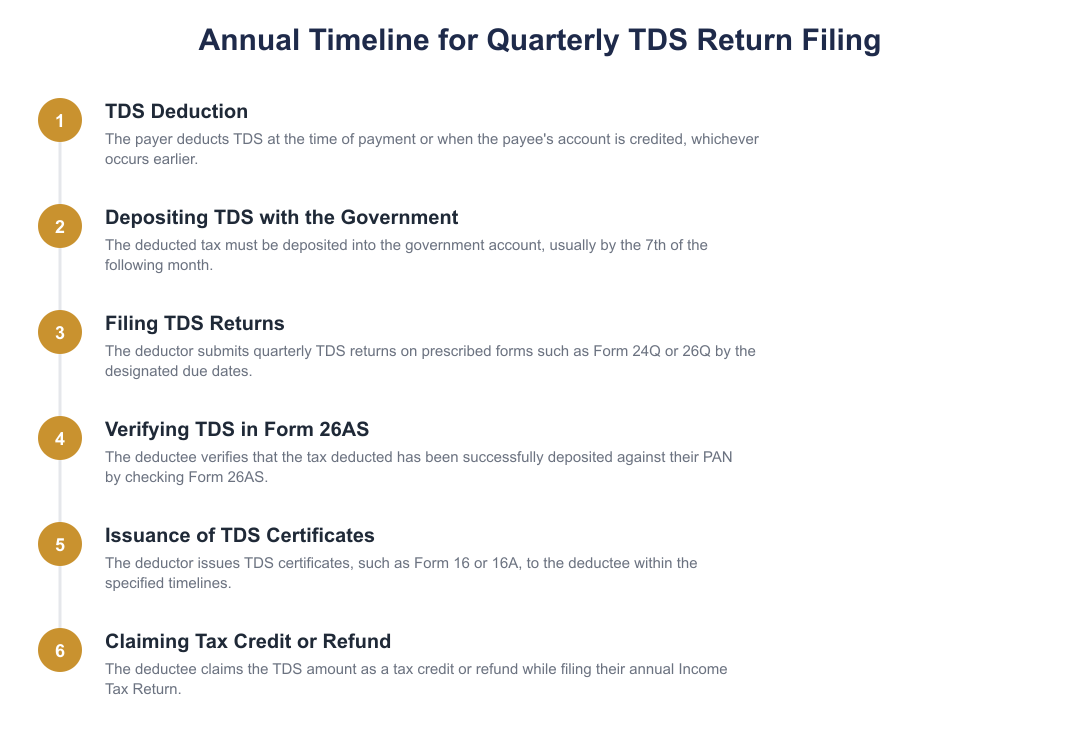
Depositing the tax deducted from payments is a time-bound responsibility for every deductor. When a business or individual deducts tax at source, they must ensure the amount reaches the government treasury within the prescribed timelines. For example, if tax is deducted in the month of June, the compliance calendar mandates that this amount must be deposited with the government on or before the 7th of July. Meticulous tracking of these monthly timelines is essential for keeping the business fully compliant.
Beyond the monthly deposits, deductors are required to submit detailed quarterly statements reporting these transactions. These quarterly returns contain consolidated records of all payments made, taxes deducted, and the corresponding PAN details of the recipients. Ensuring these returns are filed on time is critical for the tax department to match details and credit the correct amounts to the taxpayers' accounts.
Due Dates for TDS Returns and Property Forms
| Quarter or Return Form Type | Applicable Return Due Date |
|---|---|
| Q1 (April to June) | 31st July |
| Q2 (July to September) | 31st Oct |
| Q3 (October to December) | 31st Jan |
| Q4 (January to March) | 31st May |
| Form 26QB (TDS on sale of property) | 30 days from the end of the month in which TDS is deducted |
| Form 26QC (TDS on rent) | 30 days from the end of the month in which TDS is deducted |
Tracking Credits via Form 26AS
Form 26AS acts as a consolidated tax ledger for every PAN holder in India. When a deductor cuts tax from your payment and deposits it with the government, the transaction is logged against your Permanent Account Number. Regularly reviewing this document on the income tax portal allows taxpayers to verify whether the taxes deducted from their income have actually been deposited by the deductors.
Any discrepancy in Form 26AS can lead to a mismatch when filing the annual Income Tax Return. This mismatch might result in the tax department denying credit for the taxes already paid on your behalf, potentially leading to unnecessary tax demands or delayed refunds. Taxpayers should ensure that all vendors and employers quote their PAN accurately to prevent such reporting issues.
Penalties for Late Filing of TDS Returns
Timely filing of TDS returns is a non-negotiable aspect of tax compliance in India. To deter delays and ensure administrative efficiency, the Income Tax Department enforces clear financial consequences for late submissions. If a deductor fails to file their quarterly returns within the prescribed due dates, they are liable to pay a daily late fee.
The established late filing fee for TDS returns is Rs. 200 per day. This fee accumulates daily from the due date until the return is actually filed. Because these costs can quickly escalate and impact a business's cash flow, maintaining a strict compliance calendar and automating the filing process is highly recommended for all deducting entities.
Managing TDS compliance is vital for smooth business operations and trouble-free personal tax filing. By keeping track of the specific sections, adhering to monthly deposit timelines like depositing June deductions by 7th July, and meeting quarterly return deadlines, you can avoid the Rs. 200 per day late filing penalty while ensuring all tax credits are accurately reflected in Form 26AS.
Frequently asked questions
When should TDS be deducted from payments?
TDS must generally be deducted at the time of credit of the income to the payee's account or at the time of actual payment, whichever is earlier. However, for certain specific payments like salary under Section 192, the deduction must strictly happen only at the actual time of payment. Ensuring timely deduction is crucial because the deductor is responsible for depositing this tax with the government. Failing to deduct TDS on time can lead to interest penalties and non-compliance issues.
What are the due dates for filing quarterly TDS returns?
The quarterly due dates for filing TDS returns are July 31st for Q1 (April to June), October 31st for Q2 (July to September), January 31st for Q3 (October to December), and May 31st for Q4 (January to March). These deadlines apply to major quarterly returns such as Form 24Q, Form 26Q, and Form 27Q. Failing to file these returns on or before these specific dates can attract late filing fees and penalties. Timely filing ensures that the tax credit reflects correctly in the deductee's Form 26AS statement.
Which TDS form should I use to report payments other than salary?
You must use Form 26Q to report TDS on all domestic payments except salaries, such as professional fees, interest, and contract payments. This return must be filed quarterly by the deductor, with due dates falling on July 31st for Q1, October 31st for Q2, January 31st for Q3, and May 31st for Q4. For payments made to non-residents, a different form called Form 27Q must be used instead. Reporting accuracy is vital since any mismatch will prevent the payee from claiming their rightful tax credit.
How can I check if the TDS deducted from my income has been deposited with the government?
You can verify and track all TDS deposits made against your PAN by checking Form 26AS on the income tax department's e-filing portal. Form 26AS serves as a consolidated tax statement that displays details of all tax deducted at source, advance tax, and self-assessment tax paid under your PAN. It is vital to reconcile your TDS credits using Form 26AS before filing your Income Tax Return (ITR) to avoid mismatches and processing delays. If you notice any missing entries, you must contact the respective deductor to correct your PAN details.
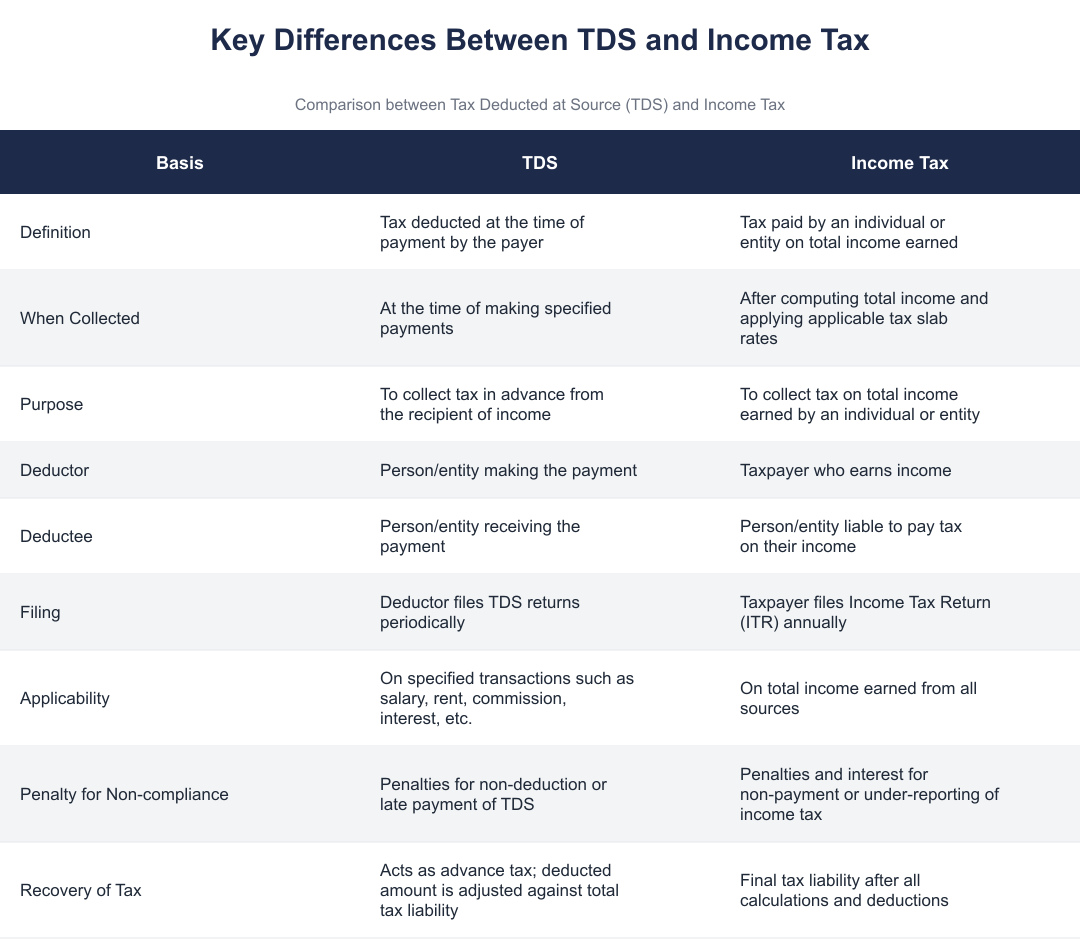
How is TDS different from regular Income Tax?
TDS is an advance tax collection mechanism where tax is deducted at the source of income by the payer, while Income Tax is the final tax computed and paid directly by the taxpayer on their total annual income. TDS is collected periodically throughout the financial year on specified transactions like salary, rent, or professional fees. In contrast, regular Income Tax is calculated annually, with the final liability adjusted against the total TDS already deducted and credited to the taxpayer. This system helps the government maintain a steady flow of revenue while reducing tax evasion.
What is the due date for depositing TDS with the government?
Generally, TDS deducted in any month must be deposited with the government by the 7th day of the following month. For example, TDS deducted during the month of June must be deposited by July 7th. However, a special exception applies to TDS deducted in the month of March, which can be deposited up to 30th April. Additionally, in the case of TDS on the purchase of property under Section 194-IA, the due date for deposit is 30 days from the end of the month in which the deduction was made.
How do I avoid TDS deduction if my total income is below the taxable limit?
You can avoid TDS deduction by submitting self-declaration forms like Form 15G or Form 15H to your bank or payer, declaring that your total estimated annual income is below the taxable threshold and your net tax liability is nil. Form 15H is meant specifically for senior citizens, while Form 15G is for individuals below 60 years of age and Hindu Undivided Families (HUFs). These declarations must be submitted at the start of each financial year to be effective.
What are the different types of TDS certificates and their issue due dates?
There are four primary TDS certificates issued to deductees: Form 16 for salary payments (issued yearly by 15th June), Form 16A for non-salary payments (issued quarterly within 15 days of the return filing due date), Form 16B for property sales, and Form 16C for rent payments (both issued for every transaction within 15 days of the return due date). These certificates act as formal proof that the tax has been deducted and successfully deposited with the government on your behalf. They contain detailed breakdowns of the payments made and the corresponding tax amounts deposited.
What TDS return forms apply to transactions like selling a property or paying high rent?
For the sale of an immovable property, the buyer must file Form 26QB, and for monthly rent payments exceeding specific limits, the tenant must file Form 26QC. Both Form 26QB and Form 26QC must be filed within 30 days from the end of the month in which the respective TDS was deducted. Unlike quarterly returns like Form 26Q or 24Q, these are transaction-specific forms. The deductor is also required to issue the corresponding certificates, Form 16B or Form 16C, within 15 days from the due date of filing these returns.
Need help staying TDS compliant?
MoneyGence's AI Finance OS tracks your compliance, wallet share, and finances in one place, built for agencies and growing businesses.
Get started with MoneyGence