Tax on FD Interest: Calculate & Pay Income Tax on Fixed Deposits
This guide explains how income from fixed deposit (FD) interest is taxed in India and what you need to do to report and minimise its impact on your annual tax liability. You will learn where to find records of the interest you have earned, how FD interest is treated when computing taxable income, which deductions may apply to the interest or principal, and how Tax Deducted at Source (TDS) interacts with your final tax payable. Understanding these points matters because FD interest must be included in your return, and correct reporting, along with claiming the right deductions and ensuring TDS is handled properly, prevents under-reporting, unexpected tax bills, or delays in refunds. The guidance covers differences that arise from age and tax-regime choices, the specific relief available to resident senior citizens, the way FD principal can qualify under the old regime, and administrative steps you can take when TDS is being deducted on your interest income. Read on for practical explanations of each area and clear next steps to ensure your FD interest is correctly treated in your income tax return.
Where can I Check my FD Interest Income?
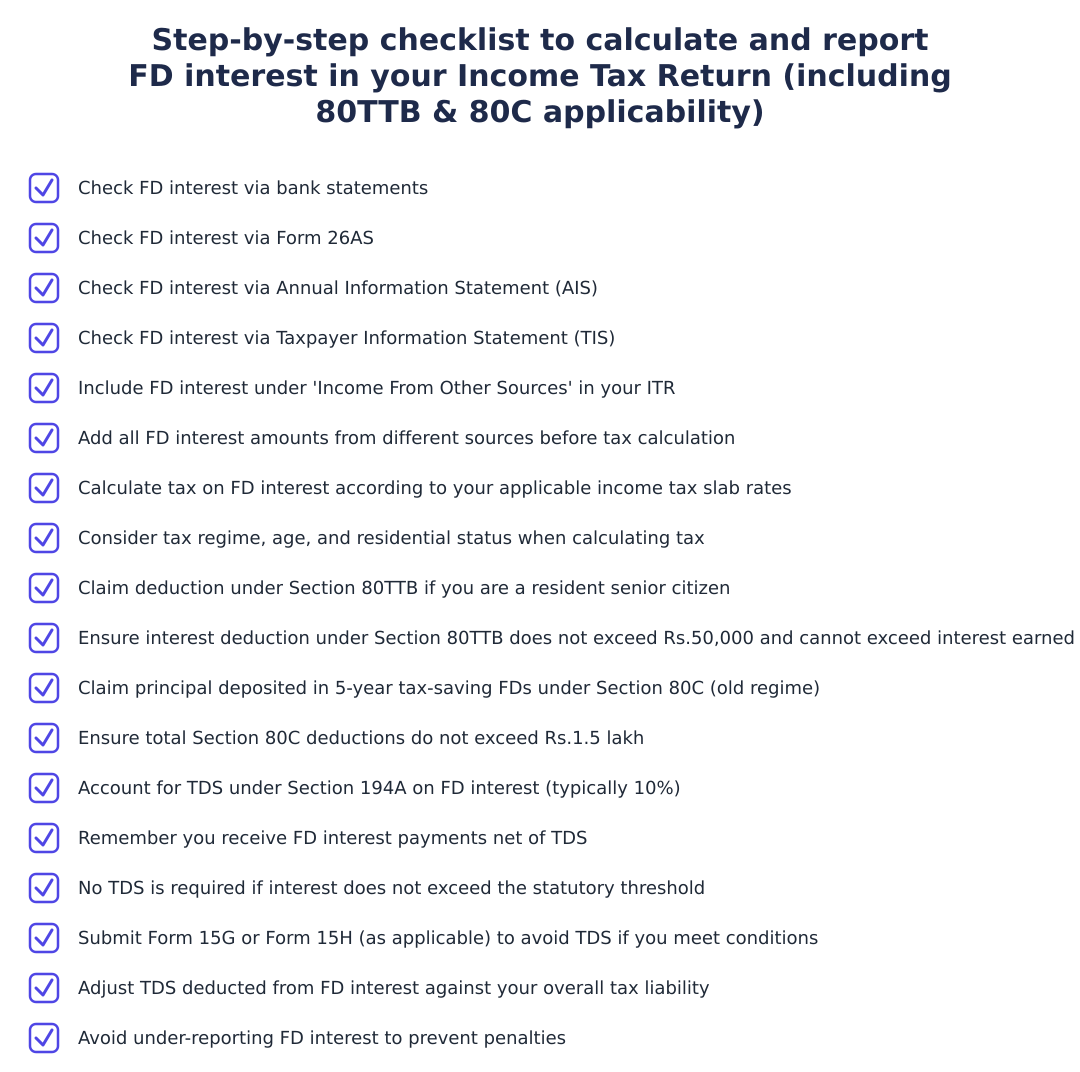
To compile accurate interest figures for tax reporting, use the official records that capture interest paid by banks and deposit-taking institutions. FD interest can be checked on your bank statements as the primary source of transaction-level details for each interest credit.
In addition to bank statements, interest reported by payers may reflect in government-maintained summaries: Form 26AS, the Annual Information Statement (AIS), and the Taxpayer Information Statement (TIS). Reviewing these sources together helps reconcile what you received with what was reported to the tax authorities, reducing the risk of mismatch when filing your return.
How to Calculate Income Tax on FD Interest?
All interest income from fixed deposits is taxable and must be included under the head 'Income From Other Sources' in your Income Tax Return. After gathering interest figures from the available sources, add the FD interest to your other income for computing total taxable income.
Tax on that total income is then calculated using the applicable slab rates. Tax implications can differ depending on the tax regime you choose (old or new), your age, and your residential status. Any TDS that has been deducted on FD interest is adjustable against the final tax liability; this adjustment can reduce what you owe or result in a refund.
FD Interest Deduction under Section 80TTB
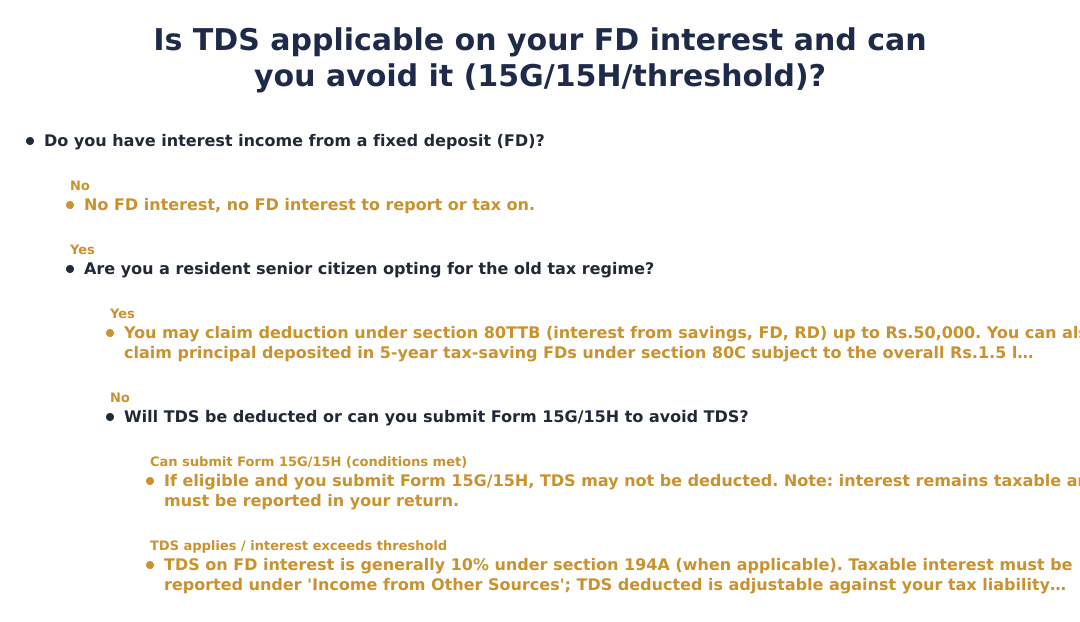
Resident senior citizens are eligible to claim a deduction under section 80TTB for interest received from savings accounts, fixed deposits, or recurring deposits. This provision is specific to resident senior citizens and applies to interest receipts rather than the principal.
The maximum limit of deduction under section 80TTB is Rs. 50,000. The deduction claimed cannot exceed the actual interest earned, so you can only claim up to the lesser of your interest income and the Rs. 50,000 limit.
FD Principal Deduction under Section 80C
Under the old tax regime, the amount deposited as an FD for a period of 5 years can be claimed as a deduction under section 80C. This relief applies to qualifying long-term fixed deposits whose principal meets the specified criteria for 80C treatment.
Deductions under section 80C are subject to an overall cap: the total amount of deduction under section 80C cannot exceed Rs. 1.5 lakhs. When planning investments and reporting deductions, ensure the principal portion claimed for such FDs is consolidated with your other 80C claims so you do not exceed the aggregate limit.
TDS on FD Interest
When a payer deducts TDS on your FD interest, you receive the interest payment net of TDS.
On submission of Form 15G or 15H as applicable and subject to conditions, interest on FD could be exempted from TDS deduction.
Any TDS deducted on FD interest is reduced from your overall tax liability; adjusting TDS with tax payable might result in a lower tax payment or a refund.
To summarise: include all FD interest under 'Income From Other Sources', verify amounts using bank statements and government statements, and compute tax based on your total income and the regime you choose. Resident senior citizens can claim section 80TTB relief up to Rs. 50,000 (limited by actual interest), while qualifying long-term FD principal can be claimed under section 80C within the Rs. 1.5 lakh cap in the old regime. If TDS has been deducted, you receive interest net of TDS and can adjust the deducted amount against your tax liability; eligible taxpayers may avoid TDS by submitting Form 15G or 15H. Accurate reporting and using available deductions will ensure correct tax outcomes and minimise surprises at assessment or refund stage.
Frequently asked questions
How do I check how much interest I earned from my fixed deposits (FDs)?
You can check your FD interest income from your bank statements, Form 26AS, the Annual Information Statement (AIS), or the Taxpayer Information Statement (TIS). Bank statements give transaction-level credit entries, while Form 26AS and AIS/TIS consolidate interest reported by banks to the tax department for easier reconciliation. Use these documents together to ensure you capture all interest credits and avoid under-reporting.
Is FD interest taxable and where do I report it in my tax return?
Yes, all interest income from fixed deposits is taxable and must be shown under the head ‘Income From Other Sources’ in your Income Tax Return. After totaling interest from all sources, include it in this head and then apply any eligible deductions such as section 80TTB for senior citizens or TDS already deducted. The tax on that interest is then calculated at your applicable slab rates under the chosen tax regime.
How do I calculate income tax on FD interest?
To calculate tax on FD interest, add all FD interest to your total income under ‘Income From Other Sources’ and compute tax at your applicable slab rates after claiming eligible deductions and credit for TDS. For resident senior citizens under the old regime, you may claim section 80TTB (up to Rs. 50,000) which reduces taxable interest; principal under section 80C (up to Rs. 1.5 lakh) applies to the invested amount in certain eligible FDs. After deductions and TDS adjustments, the remaining tax payable is computed and paid with your return or through applicable advance/self-assessment payments.
What is section 80TTB and who can claim it for FD interest?
Section 80TTB allows resident senior citizens to claim a deduction of up to Rs. 50,000 on interest income from savings accounts, fixed deposits, or recurring deposits. The deduction cannot exceed the actual interest earned and is available only to resident senior citizens under the old tax regime. Claiming this reduces the taxable interest shown under ‘Income From Other Sources’ and thus lowers your tax liability.
Can I claim the principal invested in a fixed deposit under section 80C?
Yes, under the old tax regime, the principal deposited in certain fixed deposits with a minimum 5-year lock-in can be claimed as a deduction under section 80C, subject to the overall 80C limit of Rs. 1.5 lakh. Only eligible long-term tax-saving FDs qualify for this deduction, and the total of all 80C investments (PF, ELSS, PPF, life insurance, etc.) cannot exceed Rs. 1.5 lakh in a financial year. Claiming 80C reduces your taxable income, but interest on such tax-saving FDs remains taxable unless covered by other deductions like 80TTB for seniors.
What is the TDS rate on FD interest and when is it deducted?
Under section 194A, banks and financial institutions generally deduct TDS at 10% on FD interest when it exceeds the specified threshold, and you receive the payment net of TDS. If your interest does not cross the threshold, TDS need not be deducted; additionally, submitting Form 15G or 15H (if eligible) can prevent TDS deduction subject to conditions. Any TDS deducted is reflected in Form 26AS and can be claimed as a credit against your overall tax liability when you file your return.
If TDS has been deducted on my FD interest, how do I get it adjusted or refunded?
If TDS has been deducted on your FD interest, you can claim the TDS as a tax credit in your Income Tax Return which will be set off against your total tax liability and may result in a refund if excess tax was deducted. Ensure the TDS is reflected in Form 26AS/AIS so it matches your claim; discrepancies should be reconciled with the deductor (bank). If after adjustment your tax payable is less than the TDS already deducted, the excess will be refunded after your return is processed.
Can senior citizens avoid TDS on FD interest entirely?
Senior citizens cannot universally avoid tax on FD interest, but resident senior citizens can reduce taxable interest by claiming section 80TTB up to Rs. 50,000 and may avoid TDS by submitting Form 15H if they meet the conditions for non-deduction. Form 15H prevents TDS only if the interest payer accepts it and the interest income is below the taxable threshold for the senior citizen; otherwise tax is still payable and must be declared in the return. Even if TDS is not deducted, the interest remains taxable and must be reported under ‘Income From Other Sources’.
When should I pay tax on FD interest and how does it affect my tax filing?
Tax on FD interest should be paid when you compute your total tax liability for the financial year and file your Income Tax Return; any TDS already deducted is adjusted against this liability. If you have significant interest income and your tax liability (after TDS) is large, you may need to pay advance tax or self-assessment tax before filing to avoid interest and penalties, and all interest income must be shown under ‘Income From Other Sources’. Properly reconciling bank statements with Form 26AS/AIS ensures accurate reporting and correct tax computation at filing time.
Need help staying Income Tax compliant?
MoneyGence's AI Finance OS tracks your compliance, wallet share, and finances in one place, built for agencies and growing businesses.
Get started with MoneyGence