Tax on Horse Race Winnings in India: Rates, TDS & Legal Guide
This guide explains how winnings from horse races are treated for tax purposes in India and what practical steps a bettor or participant should take to remain compliant. You will learn how such income is typically considered within a broader tax framework, why proper reporting and record-keeping matter, and when to seek professional help. The goal is to give a clear, usable overview so you can understand the tax implications of horse-race winnings, the documentation you should maintain, and how state-level rules on betting and wagering can affect your obligations. Whether you are an occasional bettor, a professional involved in racing activities, or someone who receives prize money from races, this guide will help you identify the issues to consider and the next actions to take. It also addresses common questions people have about deductions, reporting, and legality, and points you toward best-practice steps to minimise future disputes with tax authorities.
Tax Rate on Winnings from Horse Races
Income from gambling, wagering and prize winnings is treated as part of an individual’s or entity’s taxable receipts under the law. How a particular amount from horse-race winnings is taxed depends on how that income is classified for tax purposes and the taxpayer’s overall income profile. This means that the tax outcome for two different winners with the same cash prize can differ depending on their other income and the way the winnings are reported.
Because tax treatment can vary based on classification (for example, whether the activity is treated as casual winnings or as a commercial source of income), it is important to determine the nature and frequency of the activity. Regular, systematic betting may be viewed differently from an occasional win, and that difference can influence the way tax authorities assess the income. Always consider both the monetary flow and the surrounding facts when deciding how to report race winnings.
Are there any Tax Deductions Available on Horse Race Winnings?
Deductions against gambling or prize income depend on whether the winnings are treated as casual income or business income. If the activity is regarded as a business or profession (for example, frequent, organised betting by someone operating as a trader or professional), ordinary and necessary expenses related to that activity may be argued as deductions, subject to applicable limits and documentation requirements. For occasional, non-commercial wins, deductions are generally far more restricted.
Regardless of classification, claimable deductions should be supported by contemporaneous records and clear evidence that the expense relates directly to earning the prize. Without proper documentation and a defensible factual basis, deductions can be challenged by tax authorities. Consult a tax adviser before claiming expenses against winnings to ensure the approach aligns with the taxpayer’s facts and prevailing interpretations.
Is Betting on Horse Races Legal in India?
The legal status of betting and wagering can vary across jurisdictions and over time. In India, laws governing betting and wagering often involve both central and state-level considerations, and different states may regulate or prohibit betting activities in different ways. Because of this variation, whether a particular betting activity is lawful can depend on where it takes place and the specific type of betting involved.
For anyone participating in or operating betting activities, it is important to check the current legal position in the relevant jurisdiction and to ensure any required licences or permissions are in place. Engaging with recognised operators and keeping records demonstrating compliance can reduce legal and tax risk. If there is uncertainty about legality, seek legal advice before participating or accepting funds related to betting.
Frequently Asked Questions
How should I report horse-race winnings? Report such receipts in your tax return under the appropriate head of income after determining whether the amount is casual income or business income. Maintaining clear records of receipts, stakes, and any related expenses will make accurate reporting easier and reduce the likelihood of disputes.
Can I deduct my betting expenses? Whether expenses are deductible depends on how the tax authority views the activity, as casual or as a business. Legitimate, documented expenses connected to a business activity may be deductible, while casual winnings often permit fewer deductions. Always retain invoices and proof of expenditure, and consult a tax professional before claiming deductions.
Final Word
Winnings from horse races raise issues at the intersection of taxation and gambling law. The right tax outcome depends on classification, documentation and the legal context in which the activity occurs. Being proactive, keeping accurate records, understanding how your activity is characterised, and obtaining expert advice, will reduce risk and help ensure compliance.
If you routinely receive winnings or engage in organised betting, consider talking to a qualified tax adviser and, where relevant, a lawyer to confirm your reporting obligations and legal position. Proper advice tailored to your situation will give you the best protection against surprises during tax assessments or legal challenges.
If you have specific amounts, a pattern of activity, or questions about state rules and documentation requirements, consult a chartered accountant or tax lawyer who can advise based on up-to-date law and the facts of your case. Keeping detailed records and seeking early advice are the most effective ways to manage tax and legal risk related to horse-race winnings.

Frequently asked questions
What is the tax rate on horse race winnings in India?
Winnings from horse races in India are taxed at a flat rate of 30% under the Income Tax Act (section 115BB). This 30% rate is applicable on the gross amount of the winnings and is subject to applicable surcharge (if any) and 4% health and education cess on the tax amount. The tax is charged as income from other sources and is distinct from slab-based personal income tax rates, so even if your overall income falls in a lower slab you will still be taxed at this flat rate. For example, on a Rs 1,00,000 win the tax before cess would be Rs 30,000 and after 4% cess it becomes Rs 31,200 (plus any surcharge if applicable).
Will tax be deducted at source (TDS) when I win money at a horse race?
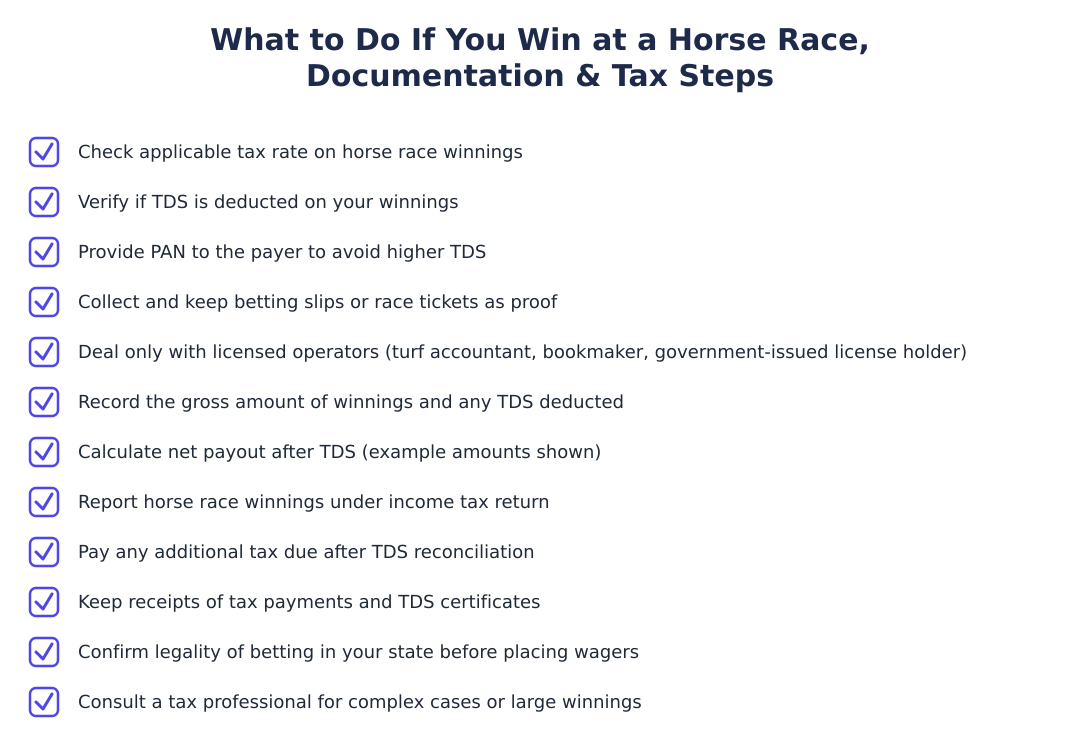
Yes, TDS is generally deducted at source on horse race winnings at 30% if the payout exceeds the threshold specified under the law (usually Rs 10,000). The payer, typically the bookmaker, turf accountant or the licensed race club, is responsible for deducting TDS under the relevant provision (section 194BB) before making the payment to the winner. If TDS is deducted, the winner will receive a TDS certificate (Form 16A) and can claim credit for the TDS while filing their income tax return; if the deducted TDS is more than the final tax liability, the excess can be claimed as a refund. Note that some payers may not deduct surcharge/cess when deducting TDS; the taxpayer should reconcile and pay any additional tax on filing ITR if required.
Can I claim any deductions against my horse race winnings to reduce tax?
No, you cannot claim deductions against income from horse race winnings; such winnings are taxable at a flat rate with no deductions allowed. The Income Tax Act disallows expenses or deductions in computing taxable income from gambling and wagering income such as horse race winnings, so deductions under sections like 80C or business expenses cannot be claimed. You must report the full gross winning as income and compute tax at the prescribed flat rate, then offset any TDS already deducted while filing your return. For example, you cannot deduct travel or tip expenses incurred while betting to reduce the taxable amount of the winnings.
Are horse races and betting on them legal in India?
Betting laws in India are complex: betting and gambling are generally prohibited under the Public Gambling Act, but wagering on horse races has been treated as a game of skill and therefore permitted in many legal rulings and state laws. State governments regulate betting and wagering activities; licensed entities such as turf accountants, bookmakers, or government-authorised operators can legally accept bets at registered race courses or through state-approved channels. However, unlicensed online or off-course betting may still be illegal in some states, so you should confirm the law in your specific state and use only licensed operators. The legal status also affects tax withholding responsibilities and the obligation to deal with licensed payers for valid TDS documentation.
How should I report horse race winnings in my income tax return?
You must report horse race winnings under 'Income from Other Sources' in your income tax return and compute tax at the flat rate prescribed for such winnings. Enter the gross amount of the winnings, show TDS deducted (if any) as tax already paid, and calculate additional tax, surcharge and cess payable if the TDS did not cover the full liability. Keep documentary evidence such as the payout slip, TDS certificate (Form 16A), and identity documents to substantiate the filing; if TDS exceeds your final liability you can claim a refund when filing the return. If you have multiple wins and losses during the year, report each gross winning and maintain records, but remember losses are not deductible against winnings for tax computation in most cases.
If TDS is not deducted by the payer, am I still liable to pay tax on horse race winnings?
Yes, you remain liable to pay tax on horse race winnings even if the payer fails to deduct TDS; taxability arises on receipt of the winnings and is not conditional on TDS deduction. You should report the full winnings in your income tax return, compute the tax at the applicable flat rate (plus surcharge and cess), and pay any self-assessed tax and interest if TDS was not deducted when it should have been. If the payer did not deduct TDS but was legally required to, you can still claim that no TDS was deducted and may pursue the payer for compliance, but your tax filing and payment obligations remain yours. Keep records of correspondence and payout evidence in case of enquiries from tax authorities.
Can I offset my horse race losses against other income for tax purposes?
No, losses from horse racing (gambling or betting) cannot be set off against other heads of income like salary or business income, as tax rules treat gambling income and losses separately with restrictive set-off rules. Losses from gambling can generally be set off only against winnings from the same type of income in the same year, and many forms of betting (like horse racing) are taxed under provisions that do not permit carrying forward those losses to future years for set-off. Practically, if you have net losses from gambling in a year, they cannot reduce your taxable salary or other income, so your other tax liabilities remain unaffected. Always maintain detailed records of both wins and losses if you plan to claim intra-gambling set-offs permitted under limited circumstances.
Who is considered a legitimate payer for horse race winnings for tax and legal purposes?
A legitimate payer for horse race winnings is typically a licensed turf accountant, registered bookmaker, or a government-authorised license holder for betting or wagering in horse races. Payments made by these recognised entities are the ones from which TDS should legally be deducted and for which you should receive proper documentation (payment receipts and Form 16A for TDS). Payouts from unlicensed operators or informal bets may not provide valid TDS documentation and can expose both payer and payee to legal and tax compliance risks, so dealing with licensed operators protects your ability to claim TDS credits and to substantiate the income in tax filings. Always verify the payer's licence and obtain official receipts when you receive winnings.
How do surcharge and cess affect the tax on horse race winnings?
Surcharge and health & education cess are additional levies applied over the base flat tax rate of 30% on horse race winnings and increase the final tax payable. After computing 30% tax on the gross winnings, applicable surcharge (depending on the total taxable income thresholds) is added, and then 4% health and education cess is applied on the resulting tax plus surcharge amount. For example, on a Rs 1,00,000 winning, base tax is Rs 30,000; after a 4% cess the tax becomes Rs 31,200; if a surcharge is applicable it will further raise the total tax payable. When filing your return, reconcile TDS already deducted against this total to determine any tax due or refund.
Need help staying TDS compliant?
MoneyGence's AI Finance OS tracks your compliance, wallet share, and finances in one place, built for agencies and growing businesses.
Get started with MoneyGence