Tax on House Property: Self-Occupied, Let-Out & Inherited
This guide explains how income from house property is taxed under the Income-tax Act, focusing on self-occupied, let-out and co-owned properties, and special situations such as arrears of rent. You will learn which sections of the Act govern house property income, how annual value is treated for self-occupied versus rented properties, what deductions are allowed, and how co-ownership changes the computation and allocation of income. Understanding these rules matters because house property frequently forms a major part of an individual's assets and cash flows, correct characterization (self-occupied or let-out), accurate computation of annual value, timely claim of deductions and correct apportionment among co-owners all directly affect taxable income and the tax payable. This article walks through the legal headings relevant to house property income (Sections 22 to 27 as referenced) and explains the practical implications you need to consider: that a self-occupied property has a nil annual value for tax purposes, that rented property is treated on the basis of its annual (deemed) rent, and that deductions such as interest on borrowed capital are available under Section 24. It also highlights special provisions that apply when rent is received in arrears or when unrealised rent is subsequently realised. Finally, the guide covers the tax treatment when a property is owned by more than one person, how income is computed and apportioned among co-owners when shares are definite. Read on for a structured, section-by-section explanation and practical steps for handling co-owned and rented properties in your tax return.
Section 22, Income from House Property
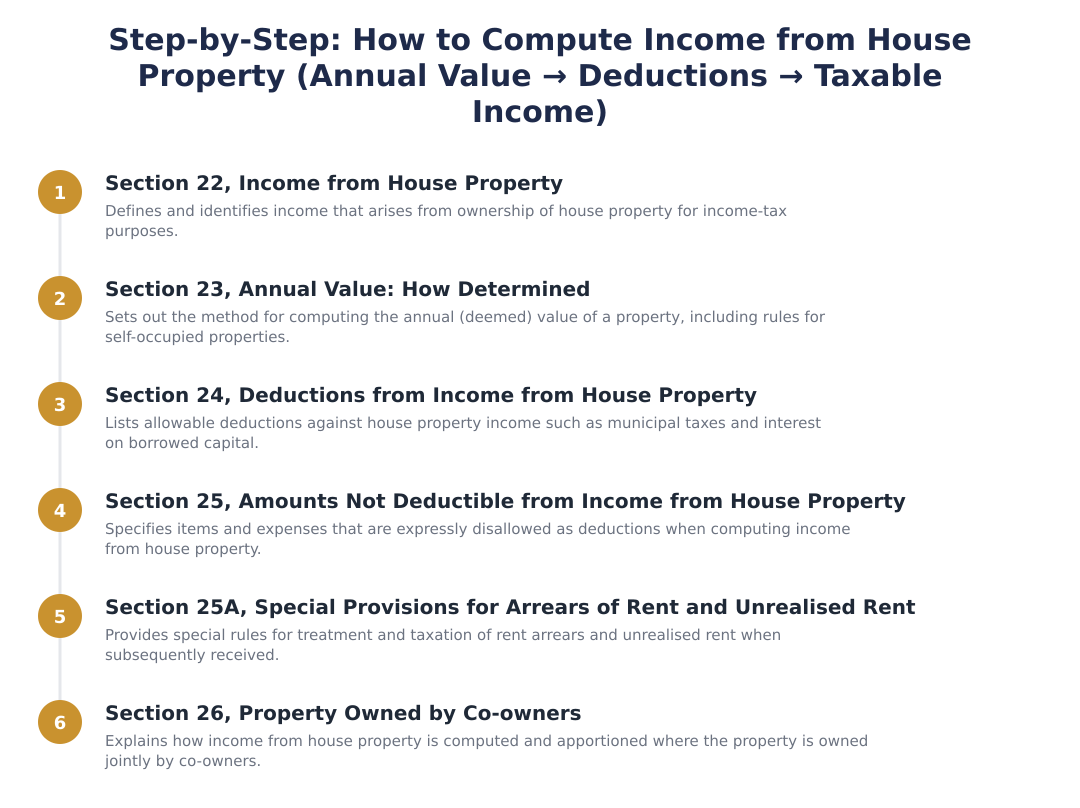
Section 22 establishes that income arising from house property is a distinct head of income under the Income-tax Act. This is the starting point for determining what part of gross receipts or deemed receipts from a property will be treated as taxable under this head.
Practically, Section 22 requires taxpayers to identify the source of receipts connected with buildings or land used for generating rental income or deemed to be let out and then proceed to compute the annual value and allowable deductions under the subsequent sections. The section separates house property income from other heads such as salary, business or capital gains, making it important to follow the specific computation rules that apply only to this head.
Section 23, How Annual Value is Determined
Section 23 deals with the determination of the annual value of a house property. The annual value is the notional or actual rent that is used as the basis for computing income from house property for tax purposes.
Two practical outcomes under the rule set are important to remember: for a self-occupied property, the annual value is nil; for a rented property, the yearly (annual) value is treated as the deemed rent and forms the starting point for the income computation. Correct classification between self-occupied and let-out property is therefore essential because it directly changes whether any annual value is brought to tax.
Section 24, Deductions from Income from House Property
Section 24 provides for deductions that reduce the taxable income from house property. One commonly used deduction under this section is for interest on borrowed capital (referenced under Section 24(b)), which allows taxpayers to account for financing costs when computing net income from a property.
In practice, claiming these deductions requires documenting the borrowing and the purpose for which funds were used. Even when a property is self-occupied (and the annual value is nil), certain deductions such as interest on borrowed capital may still be relevant depending on the law and facts of the borrowing, and should be considered when preparing the return.
Sections 25 and 25A/25AA, Non-deductible Amounts and Arrears
Section 25 identifies amounts that are not deductible from income from house property. These rules set boundaries on what expenditures can be set off against the deemed or actual rental income, ensuring only permitted items reduce the tax base.
Sections 25A and 25AA contain special provisions that apply where rent is received in arrears or where unrealised rent is subsequently realised. These provisions are intended to handle timing differences and ensure that receipts which relate to prior periods are brought to tax in a structured manner, consistent with the treatment of annual value and deductions under the other sections.
Section 26, Co-ownership: How Income is Treated
Section 26 addresses properties owned by two or more persons. Where co-owners have definite shares in a property, the income from that property is not taxed as the income of an association of persons (AOP); instead, each co-owner’s share is assessed separately.
The computation for co-owned property follows Sections 22 to 25, and the income so determined is apportioned among co-owners in accordance with their specific shares. This means each co-owner must include their proportionate share of the computed income in their own return. Special outcomes follow depending on whether the property is self-occupied or let out: if each co-owner self-occupies their share, the annual value of each share is nil; if the property is let out, the income is computed as if owned by one owner and then divided per share.
Key statutory provisions affecting house property income
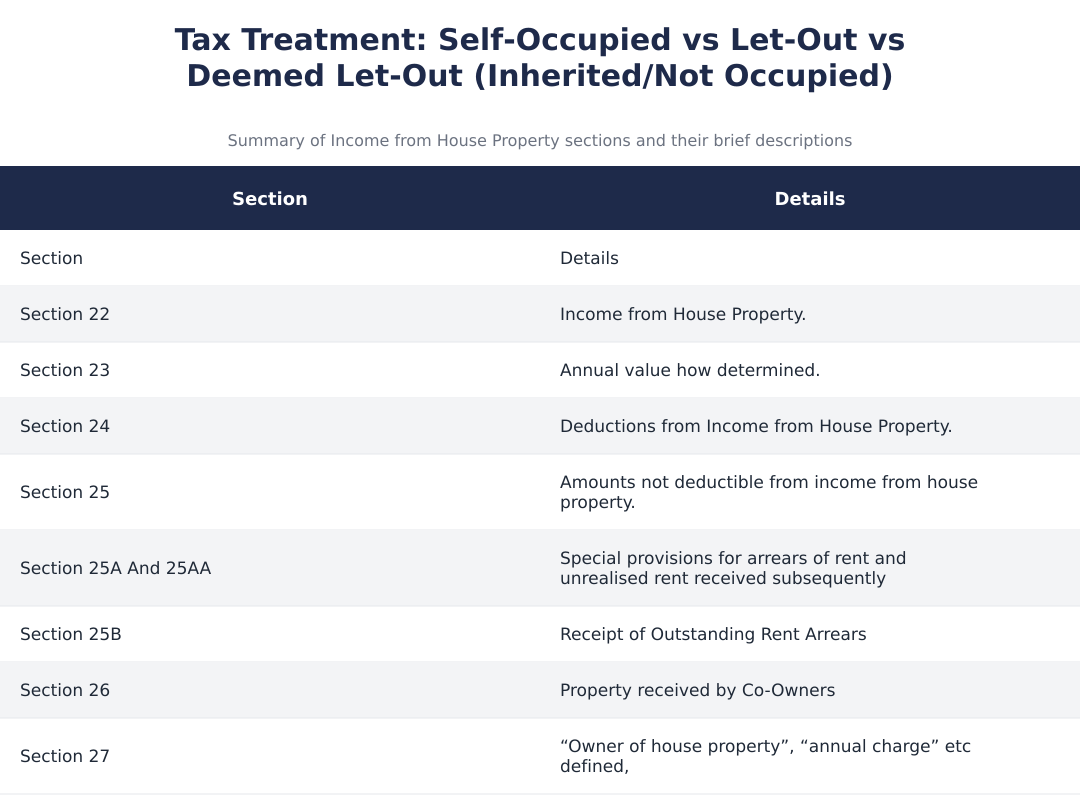
| Section | Primary focus |
|---|---|
| Section 22 | Income from House Property. |
| Section 23 | Annual value, how determined. |
| Section 24 | Deductions from Income from House Property (includes interest on borrowed capital under 24(b)). |
| Section 25 | Amounts not deductible from income from house property. |
| Section 25A / 25AA | Special provisions for arrears of rent and unrealised rent received subsequently. |
| Section 26 | Property owned by co-owners, treatment and apportionment. |
| Section 27 | Definitions: 'owner of house property', 'annual value' etc. |
Practical steps to compute and apportion income for co-owned properties
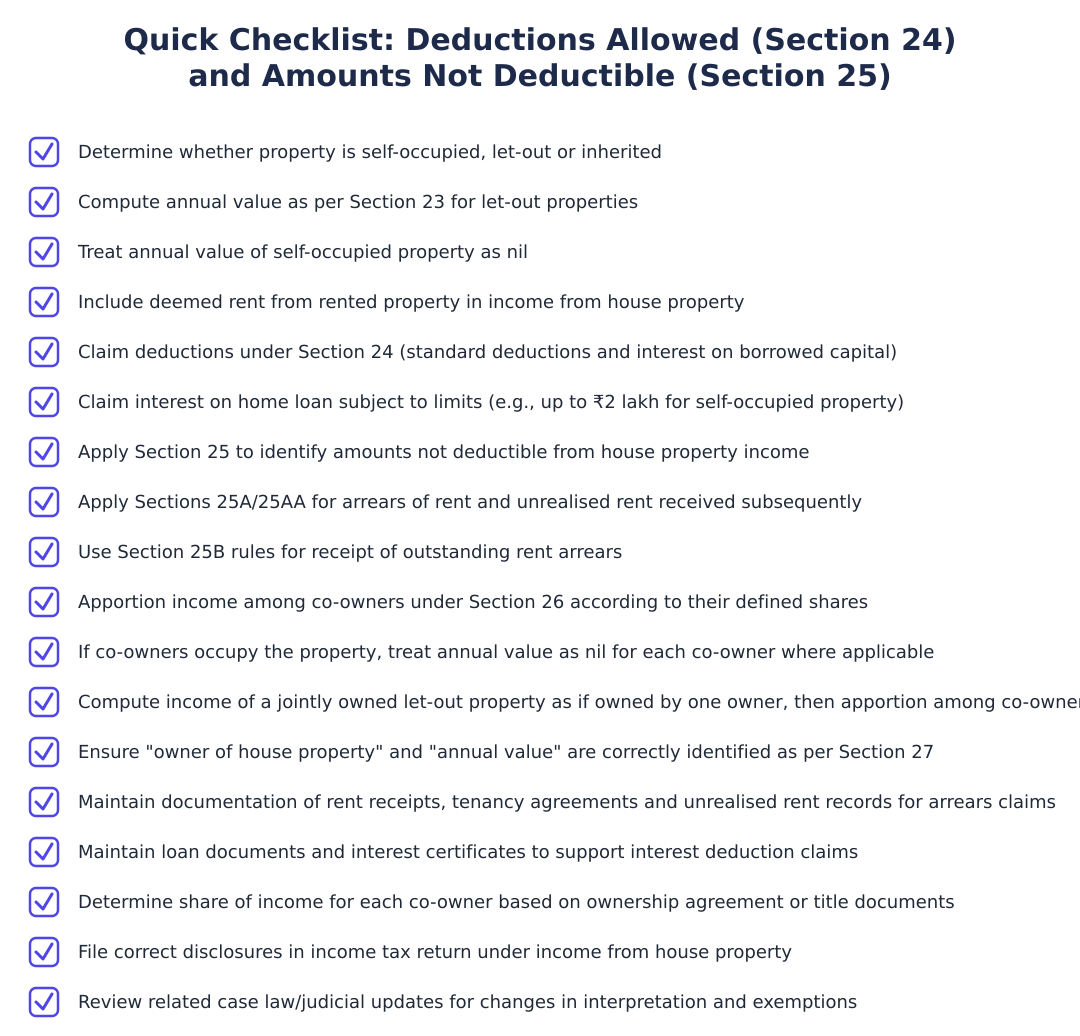
Confirm that shares among co-owners are definite; where they are, taxation is on individual shares rather than an AOP.
Apply Section 23: if each co-owner self-occupies their share, the annual value of each share is nil; if the property is let out, treat the yearly value as the deemed rent for computation.
Calculate gross annual value (actual or deemed), then apply permissible deductions under Section 24 and exclude non-deductible amounts under Section 25 to determine net income for the whole property.
Divide the computed net income according to the specific shares of each co-owner and report each share in the respective co-owner’s tax return.
Accurate treatment of house property income requires applying the specific provisions in Sections 22 to 27: classify the property correctly (self-occupied or let-out), determine the annual value, claim permissible deductions under Section 24, respect exclusions under Section 25 and follow the special rules for arrears. For co-owned properties with definite shares, compute income under the standard sections and then apportion it to each owner. Following these steps will ensure compliance with the statutory framework governing house property income.
Frequently asked questions
What is 'income from house property' under the Income Tax Act?
Income from house property under Section 22 of the Income Tax Act is the income earned by an owner from any buildings or land appurtenant to the building, typically treated as rental income or deemed rent for tax purposes. It includes actual rent received from letting out the property and the annual value of property deemed to be let out even if not actually rented; salary-like receipts or business receipts are excluded. The definition relies on terms like “owner of house property” and “annual value” defined in related sections (for example, Section 27) to determine who is taxable and how. For co-owned property, income is apportioned according to ownership share as per Section 26 rather than taxed as an association of persons (AOP).
How is the annual value of a house property determined for tax?
The annual value of a house property is determined under Section 23 and is normally the higher of actual rent received (or receivable) and the reasonable expected rent (municipal valuation or fair rent), subject to certain limits and municipal taxes. For a self-occupied property, the annual value is taken as nil, meaning there is no deemed rental income for such property unless more than one property is self-occupied in which case rules differ. Deductions such as municipal taxes paid by the owner are allowed in computing the net annual value, and the formula varies for partly let-out or vacant periods. Municipal taxes actually paid during the year are generally deducted from the gross annual value before other deductions under Section 24 are applied.
How is tax calculated on a self-occupied house property?
For a self-occupied house property the annual value is nil, so there is no gross rental income; you can still claim deductions under Section 24 such as interest on home loan and standard deductions where applicable. Specifically, interest on borrowed capital for a self-occupied property is deductible up to a prescribed limit (the page notes a range of ₹30,000–₹2,00,000 in certain co-owner scenarios, but primary law caps and exemptions depend on whether the property is a completed house, let-out, or vacant and on the financial year rules). If you have more than one self-occupied property, only one can be treated as self-occupied (annual value nil) and others are treated as deemed let-out unless specific exemptions apply. Municipal taxes actually paid are deductible before arriving at the taxable income from house property.
What deductions can I claim from income from house property under Section 24?
Under Section 24 you can claim deductions from income from house property including municipal taxes actually paid and interest on borrowed capital for repair or purchase/ construction; the interest deduction varies by situation and property status. For let-out property the entire interest paid on home loan is generally deductible with no upper limit (subject to anti-abuse rules), whereas for a self-occupied property the interest deduction may be restricted (the article references figures like ₹30,000–₹2,00,000 in specific co-ownership contexts). Additionally, standard deductions for repairs and maintenance are allowed where applicable after municipal taxes are deducted from gross annual value. Note that certain amounts are specifically disallowed under Section 25, for example capital expenditure, and must be excluded when computing taxable income.
Which expenses are not deductible from house property income under Section 25?
Section 25 lists amounts that are not deductible from income from house property, so capital expenditures, personal expenses and certain specified costs cannot be claimed against house property income. Examples include capital improvements (which may be eligible for depreciation under other heads but not as deductions here), costs of acquisition or litigation related to title, and expenses not incurred for the purpose of letting the property. These non-deductible items must be excluded when computing net income from house property, although some capital expenses may be allowed under other provisions or spread via depreciation in business/profession assessments. Always separate capital costs from revenue expenses to correctly apply Section 25 and Section 24 rules.
How are arrears of rent and unrealised rent treated for tax?
Sections 25A and 25AA provide special provisions for arrears of rent and unrealised rent received subsequently, allowing specific treatment in the year of receipt and in computing tax liability. If arrears of rent or previously unrealised rent are received in a later year, they may be taxable in the year of receipt but relief or special computation rules can apply to avoid double taxation; for example, an assessee may be allowed to compute tax on arrears with reference to the earlier year's rates under prescribed conditions. The rules also set out how to handle municipal taxes and when to include such receipts in annual value; proper documentation and timing of receipt critically affect tax treatment. Section 25B additionally deals with receipt of outstanding rent arrears and the manner of claiming relief.
How is income from a house property owned by co-owners taxed?
Income from a house property owned by co-owners is apportioned among the co-owners according to their specific shares under Section 26, and not taxed as an association of persons if shares are definite. The income (or annual value) is first computed as if the property is owned by one person and then divided among co-owners in proportion to their ownership interest; for self-occupied portions, each co-owner’s annual value may be nil if each occupies their respective share. Additionally, each co-owner can claim deductions such as interest on borrowed capital attributable to their share, examples given include entitlement to deductions in the range of ₹30,000–₹2,00,000 under Section 24(b) in co-ownership scenarios. Proper documentation of ownership share is essential to ensure correct apportionment and avoid the property being assessed as an AOP.
How are inherited properties taxed when used as self-occupied or let-out?
Inherited properties are taxed as 'income from house property' in the hands of the legal owner (the heir) under Section 22, and treatment depends on whether the heir occupies the property or lets it out: self-occupied inherited property has annual value nil while let-out inherited property is taxed on actual/annual value. Deductions such as municipal taxes actually paid and interest on any borrowed capital used by the heir for repairs, construction or acquisition are available under Section 24, subject to the same limits and conditions that apply to other owners. Transfer of ownership on inheritance does not create a taxable event for the receiver under house property rules, but future rental income or deemed rent and capital gains on subsequent sale will be taxable under relevant sections.
Where are terms like 'owner' and 'annual charge' defined for house property taxation?
Key terms such as 'owner of house property' and 'annual charge' are defined in Section 27 and related provisions, and these definitions determine who is taxable and what constitutes taxable annual value for house property income. The legal definition of 'owner' covers various situations including freehold ownership, leaseholders for long durations, and persons deemed to be owners under specific provisions, which affects liability under Section 22. Knowing these definitions is crucial because they affect treatment of municipal taxes, entitlement to deductions under Section 24, and apportionment among co-owners under Section 26. If ownership is contested or complex (for example, under trust or succession), documentary evidence and proper classification are necessary for correct tax treatment.
Need help staying Income Tax compliant?
MoneyGence's AI Finance OS tracks your compliance, wallet share, and finances in one place, built for agencies and growing businesses.
Get started with MoneyGence