Tax on Online Gaming in India: TDS, Rates & Rules
This guide explains how taxation of online gaming works in India in clear, practical terms so you can understand what to expect if you play, run, or provide online games. It covers who may be liable to tax, what kinds of receipts from gaming are typically treated as taxable income versus non-taxable, how platforms and players commonly interact with withholding obligations, and how recent policy changes can shift the responsibilities between platforms and users. You will also learn practical compliance issues, what records to keep, what documentation platforms typically collect, and how tax treatment can affect prize distributions, entry fees, and promotional incentives. Understanding taxation on online gaming matters both for casual players and for businesses operating gaming platforms. For players, clarity prevents unpleasant surprises at the time of withdrawal or during annual filing. For platforms, correct withholding, reporting, and documentation practices are central to regulatory compliance and to maintaining trust with users and payment partners. This guide avoids legalese and focuses on the practical implications of taxation rules and administrative expectations so you can identify when to seek professional advice or adjust processes for recordkeeping and reporting.
Tax on Winnings from Online Games
When you win money or receive monetary rewards from an online game, tax authorities typically treat those receipts as some form of taxable income. The exact nature of that income, whether it is classified as winnings, business income, or another category, depends on the legal provisions and administrative guidance in force. This classification determines how the amount is computed for tax purposes and whether the payer or payee bears any withholding responsibilities.
Practically, this means players should keep clear records of amounts received, the origin of those amounts (prize, refund, bonus, etc.), and any fees or charges deducted by the platform. Platforms need to maintain detailed transaction logs showing gross receipts, entry fees, payouts, and any taxes deducted at source, because those records form the basis for both user tax filings and platform reporting to authorities.
Example of Online Gaming Tax
Hypothetical examples are useful to illustrate common issues without relying on a specific numeric rule. For instance, consider a player who pays an entry fee to participate in a tournament and later receives prize money. The taxable amount could be considered as the net economic gain, prize money minus entry cost, rather than the gross payout. How exactly net gain is computed and which deductions are allowed depends on the tax rules applicable at the time.
Another common scenario involves promotional credits or bonuses. Whether such incentives are taxed at the time of receipt, at the time of conversion to withdrawable cash, or only when they generate net winnings, is determined by the tax treatment defined by law and administrative guidance. Because these treatments can differ, both platforms and players should track bonus issuance, usage, and conversion to ensure correct reporting.
Basis of Revenue Collection and their Chargeability
Tax authorities typically assess chargeability based on the nature of the receipt. Common categories relevant to online gaming include prize winnings, business income from professional gaming operations, and incidental receipts such as referral bonuses or loyalty rewards. Each category may have distinct tax implications and compliance requirements, so correct classification is essential.
From an administrative perspective, the collection mechanism can involve withholding at source by the payer (the platform) or direct assessment on the recipient during annual tax filing. Platforms often implement withholding and reporting processes to meet their compliance obligations and to facilitate user tax compliance, while players need to be aware of withheld amounts so they can claim appropriate credits when filing their returns.
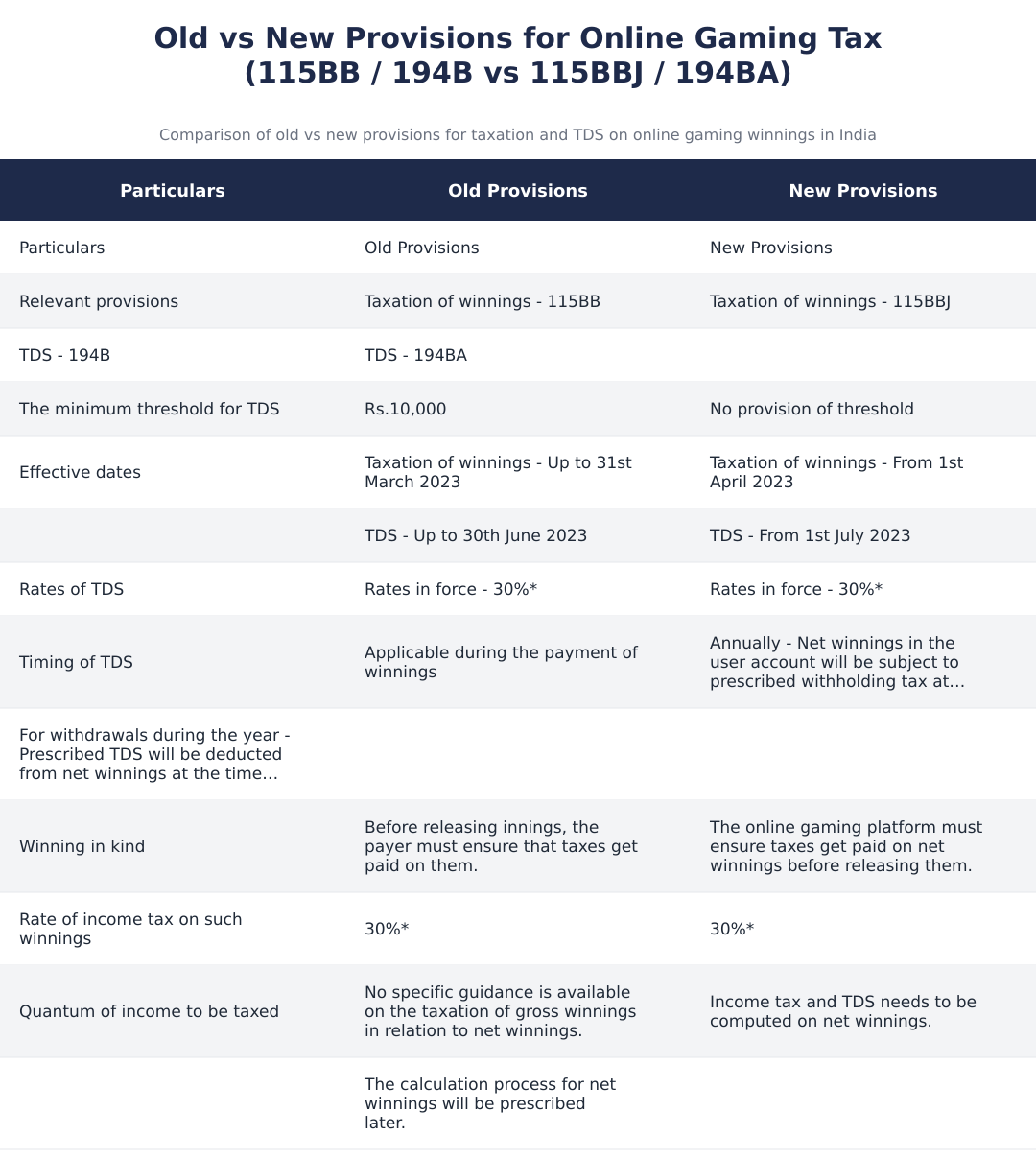
Comparison of Old and New Provisions on Online Gaming Taxation
When tax laws evolve, they may change who is liable to pay tax, how taxable income is computed, the timing of withholding, and the documentation required. Comparisons between prior and current provisions typically focus on changes such as whether tax is levied on gross receipts or net winnings, whether thresholds for withholding exist, timing of when withholding must happen, and whether platforms or users bear primary responsibility for remittance.
For stakeholders, the practical impact of such changes can include alterations to platform cashflows, modifications to user account handling (for example, when tax is deducted), and the need to update user agreements and terms of service. Businesses and regular players should monitor official announcements and seek professional advice to understand transitional rules and compliance timelines.
Frequently Asked Questions
Q: Who should keep transaction records and what should they contain? A: Both players and platforms should retain itemised records showing dates, amounts paid and received, entry fees, payouts, bonuses, and any tax withheld. These records support accurate tax returns, enable claim of credits for withheld taxes, and evidence compliance in case of queries from tax authorities.
Q: When should I consult a tax professional? A: Consult a professional when your gaming activity is frequent or sizeable, when you operate a platform, if you receive large or complex prizes (including in-kind rewards), or whenever there is uncertainty about classification of receipts or applicable withholding obligations. Tax professionals can interpret current law, advise on recordkeeping, and help with filings and claims for tax credits.
Taxation of online gaming can be complex because it touches on classification of income, withholding obligations, and recordkeeping. Stay informed about current legal provisions, keep detailed transaction records, and consult a tax advisor for situations that involve significant sums or operational responsibilities. Clear documentation and timely compliance reduce the risk of disputes and help both players and platforms manage their tax positions effectively.
Frequently asked questions
What is the tax rate on winnings from online games like Dream11 or Battlegrounds in India?
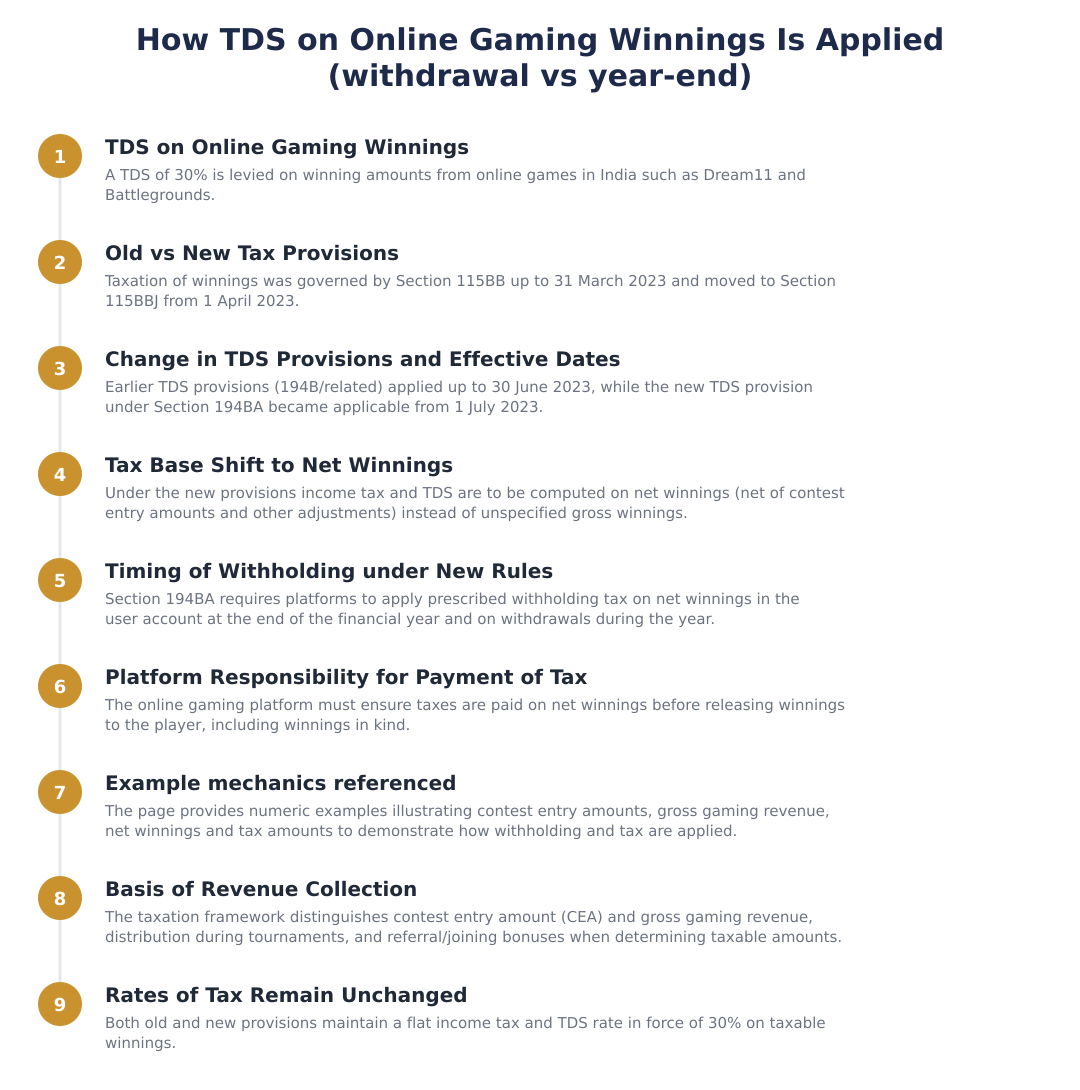
Winnings from online games in India are taxed at a flat rate of 30% under the current provisions. This 30% rate applies under Section 115BBJ for income-tax and the corresponding TDS provisions under Section 194BA, and it applies to net winnings in the user's gaming account for the fiscal year. The rate is unchanged from prior provisions, but how and when tax/TDS is applied changed from the old rules to the new rules effective from FY 2023-24. Note that this is a final/flat rate specific to specified winnings and does not use normal slab rates.
When did the new online gaming tax rules come into effect?
The new taxation of winnings (Section 115BBJ) took effect from 1 April 2023 and the new TDS provision (Section 194BA) became effective from 1 July 2023. Under the new rules, income-tax on net winnings is chargeable for the previous fiscal year starting 1 April 2023, and platforms began implementing withholding under Section 194BA from 1 July 2023 onward. Previously, the older provisions applied up to 31 March 2023 with TDS under Section 194B applicable up to 30 June 2023.
Do online gaming platforms deduct TDS on every withdrawal now?
Under the new rules platforms must ensure prescribed withholding tax on net winnings in the user account at the end of the fiscal year and also deduct TDS when users withdraw winnings during the year. The earlier regime had a Rs.10,000 threshold for TDS under Section 194B, but the new Section 194BA removes that minimum threshold and requires withholding on net winnings without a floor. In practice, this means platforms will deduct TDS at withdrawal (if applicable) and on the remaining net winnings at fiscal-year end.
Is tax charged on gross winnings or net winnings from online gaming?
Under the new provisions, income-tax and TDS are to be computed on net winnings, not gross winnings. The law specifies that Section 115BBJ taxes net winnings for the previous fiscal year at a flat 30%, and TDS under Section 194BA applies to net winnings in the user's account at year end; however, the exact calculation process for net winnings is to be prescribed later. Previously there was no clear guidance linking gross versus net winnings, but the new regime explicitly focuses on net winnings.
Who is responsible for paying and withholding tax on online gaming winnings?
The online gaming platform/payer is responsible for withholding the prescribed TDS and ensuring taxes are paid on net winnings before releasing them. The new provisions explicitly require platforms to ensure taxes are paid on net winnings prior to disbursing amounts to users, and to withhold tax on withdrawals and on the remaining balance at fiscal-year end. If winnings are paid in kind, the platform must still ensure tax compliance before release.
How did the TDS threshold change under the new rules for gaming winnings?
Under the old provision (Section 194B) there was a Rs.10,000 threshold for TDS, but the new provision (Section 194BA) removes any minimum threshold and requires TDS on net winnings regardless of amount. The effective date for TDS transition was up to 30 June 2023 under old rules and from 1 July 2023 under the new rules. This means even small net winnings held at year-end can now attract withholding tax.
How and when will TDS be applied during the financial year under the new rules?
TDS will be applied both at the time of withdrawals during the year (where prescribed) and on the remaining net winnings in the user's account at the end of the financial year. The new rule requires platforms to deduct withholding tax on withdrawals during the year as prescribed, and to compute and withhold tax on any remaining net winnings annually. Thus a user may see TDS at withdrawal and an additional adjustment at year end on remaining balances.
Are winnings paid in kind treated differently for tax on online gaming?
No, winnings paid in kind are still subject to tax and the payer/platform must ensure taxes are paid before releasing them. Under both old and new provisions the payer is required to ensure tax compliance on winnings in kind, and the new rules reiterate the platform's duty to ensure taxes on net winnings are paid before disbursal. Practically, the platform would compute the tax value and withhold or account for tax prior to handing over in-kind prizes.
What is Section 115BBJ and how does it affect my online gaming winnings?
Section 115BBJ taxes net winnings from online games at a flat rate of 30% for the previous fiscal year, and it applies from 1 April 2023 onward. This provision requires that income-tax be charged on a player's net winnings for the fiscal year rather than on individual gross receipts, and it works alongside Section 194BA which governs TDS on those net winnings. The precise method to compute 'net winnings' will be prescribed later, but the outcome is that taxable income from gaming is taxed at a separate flat rate instead of normal slab rates.
Need help staying Income Tax compliant?
MoneyGence's AI Finance OS tracks your compliance, wallet share, and finances in one place, built for agencies and growing businesses.
Get started with MoneyGence