Taxation of Income from Selling Shares: STCG & LTCG Guide
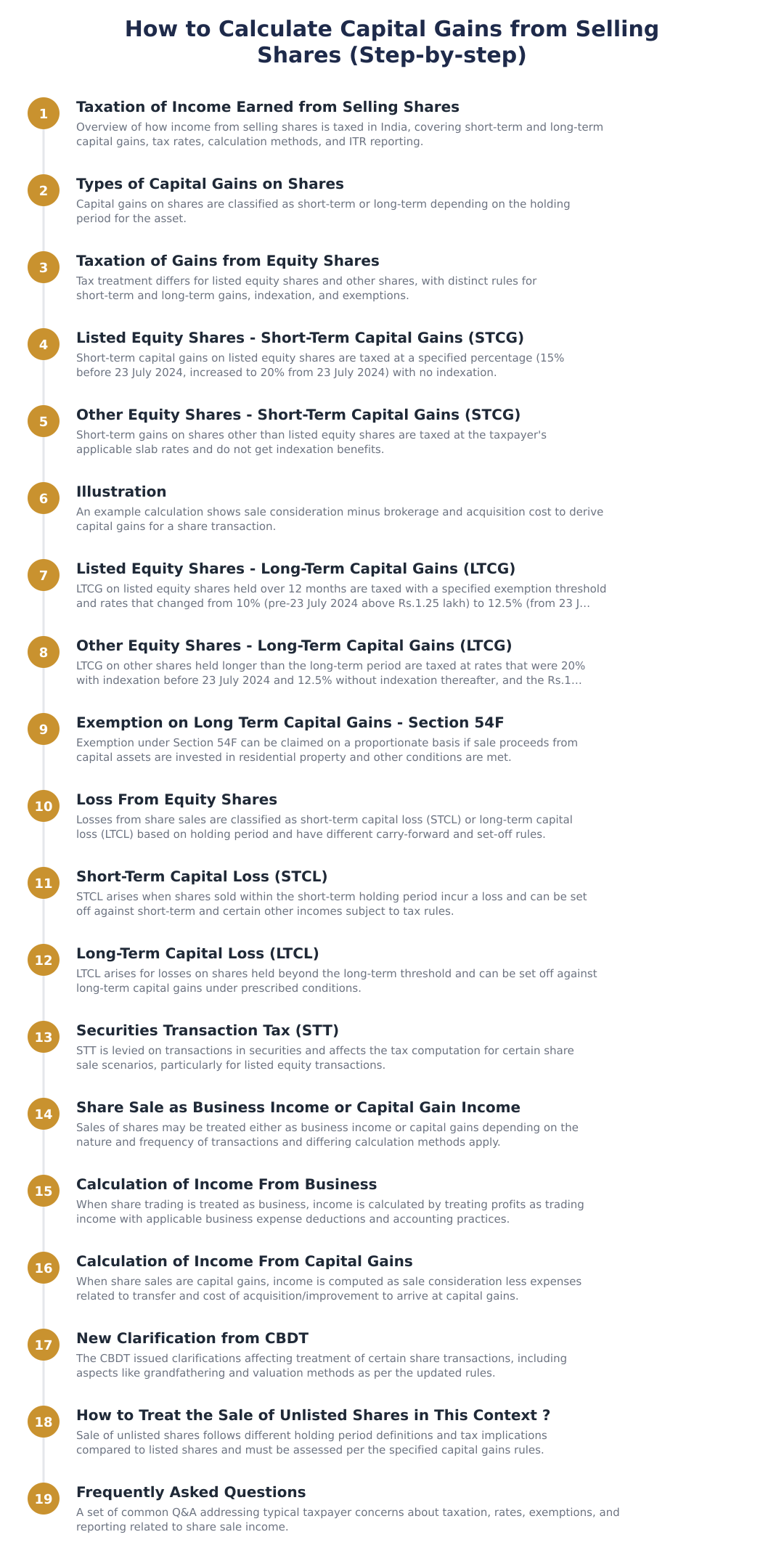
This guide explains how income from the sale of shares is taxed in India and what practical points sellers should watch for. You will learn the difference between short-term and long-term capital gains when shares are disposed of, how indexation and grandfathering rules can affect the cost of acquisition, when Securities Transaction Tax (STT) applies, and when a share sale may be treated as business income instead of capital gains. Understanding these distinctions matters because the tax treatment determines the applicable computation rules, availability of reliefs such as indexation, and the way losses can be set off or carried forward. The guide focuses on the structural rules and recent legal clarifications that commonly affect private investors, traders and businesses who deal in listed and unlisted shares. Throughout, the emphasis is on practical implications: what triggers a change in treatment, why the law treats different kinds of share sales differently, and what steps you should consider when documenting or reporting transactions. This is not a substitute for tailored tax advice, but it lays out the verified legal principles that will help you frame the right questions for your tax advisor or chartered accountant.
Types of Capital Gains on Shares
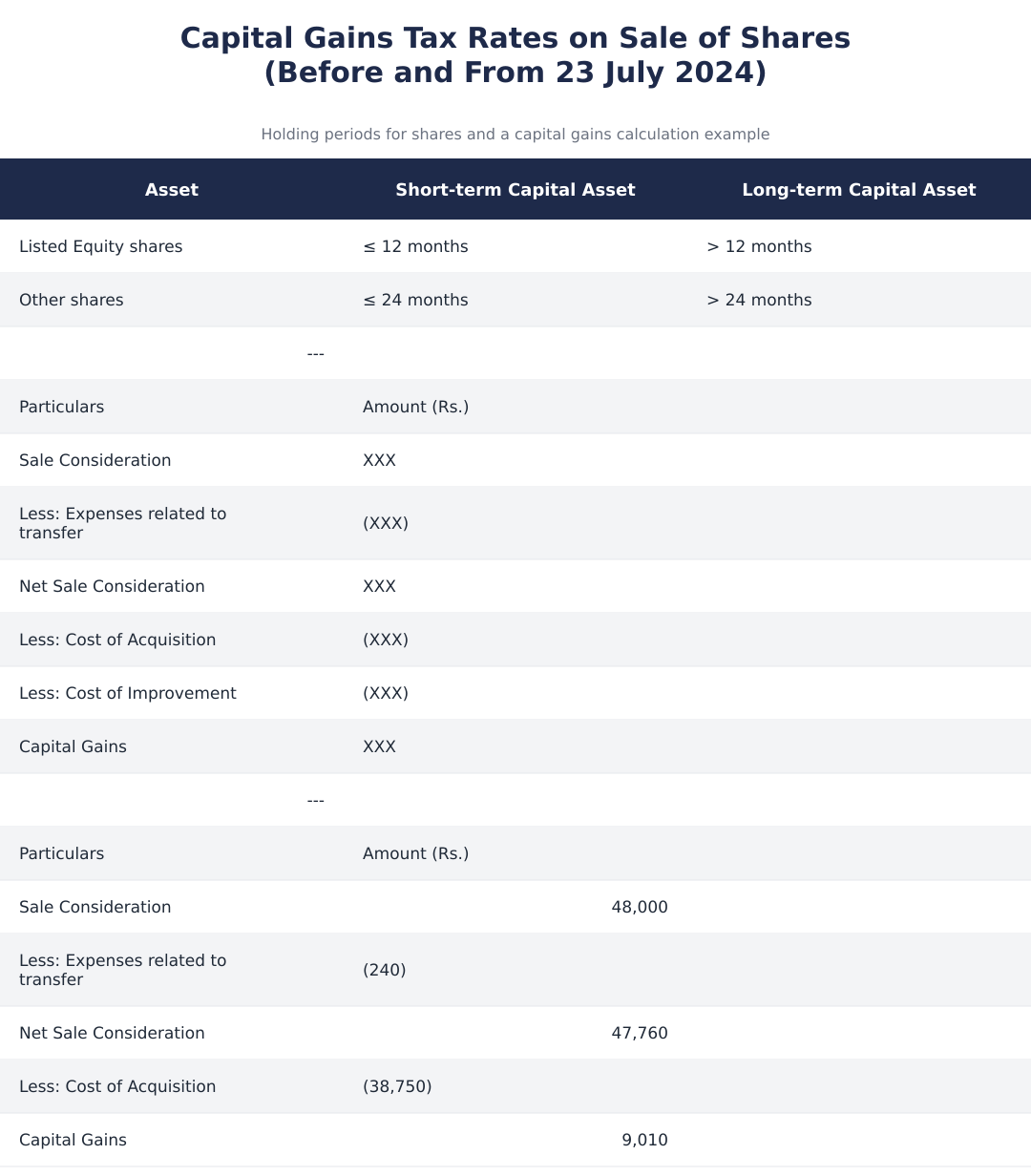
When you sell shares, the profit or loss is generally classified as either short-term capital gain (STCG) or long-term capital gain (LTCG). The classification depends on the holding period applicable to the asset class. Different holding-period thresholds apply to shares listed on a recognized stock exchange versus other types of shares, and that classification determines which set of tax rules will apply.
The distinction matters for a few reasons: availability of indexation, special reliefs such as grandfathering for certain listed equity shares, and the rate or method by which gains are taxed. Since the tax consequences influence investment decisions, investors should keep clear records of purchase and sale dates, the nature of the shares (listed or unlisted), and any transaction costs that form part of the cost of transfer.
Taxation of Gains from Equity Shares
Listed equity shares and other shares are treated differently under the income-tax rules. For listed equity shares, short-term capital gains do not qualify for indexation benefits. This means that the inflation-adjusted deduction available through indexation is not available when computing short-term gains on listed equity instruments.
For shares other than listed equity shares, short-term capital gains are taxed according to the taxpayer's applicable slab rates, and similarly there is no indexation benefit available for those short-term gains. In short, indexation is not available for short-term capital gains on either listed equity shares or other shares.
For long-term holdings of listed equity shares there is an important protective measure known as a grandfathering clause. This preserves gains accrued up to 31st January 2018; for the purpose of computing the cost of acquisition under grandfathering, the fair market value as on 31st January 2018 may be treated as the cost of acquisition if it benefits the taxpayer, subject to the constraint that the cost so considered should not exceed the sale consideration. Note that long-term capital gains tax on listed equity shares was reintroduced on 1st February 2018, which is why the grandfathering provision uses 31st January 2018 as the reference date.
Loss From Equity Shares
Sales of shares can also generate capital losses, short-term capital loss (STCL) or long-term capital loss (LTCL), depending on the holding period and nature of the asset. The existence of a capital loss changes how current and future tax liabilities can be managed, because losses may be set off against gains and carried forward under the tax code.
STCL and LTCL follow different set-off and carry-forward rules. For instance, the tax law differentiates between how short-term losses are adjusted against gains in the same or subsequent years versus long-term losses, and there are limits and conditions governing the order and categories of income against which these losses can be offset. Accurate classification of the loss at the time of sale is thus essential to ensure correct application of set-off and carry-forward provisions.
Securities Transaction Tax (STT)
In addition to income-tax consequences, certain purchases and sales of securities executed on a recognized stock exchange attract Securities Transaction Tax (STT). STT is payable on specified transactions in securities and is a separate statutory levy collected at the time of trading.
The presence of STT on a transaction can also affect the income-tax treatment of gains in some situations (for example, by determining whether a sale qualifies as a sale of 'listed equity' for the purpose of certain provisions). Therefore, it is important to note if STT was applicable and paid on a sale when reporting the transaction for income-tax purposes.
Share Sale as Business Income or Capital Gain Income
Whether a particular sale of shares is taxed as capital gains or as business income depends on the facts and circumstances of the taxpayer’s activities. Key factors include frequency of transactions, holding period, motive or intention at the time of acquisition, and the way the activity is organized (for example, whether the taxpayer maintains a trading account and treats share transactions as part of an ongoing business).
If share sales are treated as business income, the computation follows the rules applicable to business profits, allowing business-related expenses and different methods of calculating profit, whereas capital-gains treatment follows separate computation rules (including the distinct short-term/long-term distinction and indexation considerations). Because the tax treatment has consequential differences in permitted deductions and bookkeeping requirements, it is important for taxpayers to document intent and transaction patterns and to obtain professional advice where the characterisation is unclear.
In summary, the tax treatment of a share sale hinges on whether the shares are listed or unlisted, the holding period, whether STT applied, and whether the activity amounts to business. Important practical points are the unavailability of indexation for short-term gains on both listed and other shares, the grandfathering mechanism around 31st January 2018 for listed equity long-term gains, and that losses have distinct set-off and carry-forward rules. When in doubt about classification or computation, consult a tax professional who can apply these principles to your facts and help document the position for compliance.
Frequently asked questions
How are capital gains from selling shares classified as short-term or long-term?
Capital gains from selling shares are classified based on holding period: for listed equity shares, ≤ 12 months is short-term and > 12 months is long-term; for other (unlisted or not equity-traded) shares, ≤ 24 months is short-term and > 24 months is long-term. This distinction determines the tax treatment, different rates and indexation benefits apply to short-term and long-term gains. When calculating holding period use the actual purchase and sale dates; the classification matters especially for listed equity because of concessional rates and exemptions. Note that special provisions like grandfathering (based on FMV as of 31 Jan 2018) may affect cost computation for long-term listed equity bought before that date.
What is the tax rate on short-term capital gains (STCG) from listed equity shares?
Short-term capital gains on listed equity shares are taxed at a concessional flat rate, 15% for sales before 23 July 2024 and increased to 20% with effect from 23 July 2024 (plus applicable cess). No indexation benefit is available for these STCGs, and Securities Transaction Tax (STT) paid on sale is relevant for the concessional regime. These rates apply when the shares are sold within 12 months of purchase and the transaction is subject to STT on sale in the recognized stock exchange. If STT was not paid (e.g., off-market trades), STCG may be taxed under normal slab rates instead of the concessional rate, depending on facts.
How are short-term capital gains from shares other than listed equity taxed?
Short-term capital gains from shares other than listed equity are taxed at the taxpayer's applicable income-tax slab rates, irrespective of the date of sale. No indexation benefit is available for such short-term gains, and the STCG classification applies where holding period is up to 24 months for other shares. This means individual or HUF taxpayers will pay tax according to their slab, whereas companies or firms will follow their applicable tax rates. If the transaction resembles business trading in shares, the income may instead be treated as business income and taxed accordingly.
What is the tax treatment for long-term capital gains (LTCG) on listed equity shares?
Long-term capital gains on listed equity shares (held > 12 months) are taxed after an exemption of Rs. 1.25 lakh: for sales before 23 July 2024 gains above Rs. 1.25 lakh were taxed at 10% (without indexation); for sales on or after 23 July 2024 LTCG is taxed at 12.5% without indexation, also after the Rs. 1.25 lakh exemption. The grandfathering clause allows the fair market value as on 31 January 2018 to be used as the cost of acquisition (if beneficial and subject to not exceeding sale consideration) so gains accrued up to that date are effectively exempt. No indexation benefit applies to these concessional rates, and STT conditions and documentation should be maintained when using this regime.
How are long-term capital gains on 'other' (non-listed) shares taxed?
Long-term capital gains on other (non-listed) shares depend on the date of sale: if sold before 23 July 2024 LTCG were taxed at 20% with indexation benefit; if sold on or after 23 July 2024 LTCG are taxed at 12.5% without indexation. The Rs. 1.25 lakh exemption applicable to listed equity LTCG does not apply to other shares. The holding period to qualify as long-term for other shares is > 24 months, and taxpayers can choose the regime available for the relevant assessment year while computing gains. Indexation (where available) can substantially reduce taxable gains for periods before the 23 July 2024 rule change.
What is Securities Transaction Tax (STT) and why does it matter when selling shares?
Securities Transaction Tax (STT) is a tax levied at the time of sale (and sometimes purchase) of securities on a recognized stock exchange and it matters because payment of STT determines eligibility for the concessional tax treatment on listed equity gains. For STCG on listed equity to be taxed at the concessional rate (15%/20% as applicable) or for LTCG concessional regime, the transaction should have been subject to STT at the specified stage (typically on sale). If STT was not paid (for off-market transfers or unlisted), the transaction may not qualify for the concessional rates and could be taxed differently. Always retain contract notes and STT challans as proof when filing ITR and claiming concessional treatment.
How are losses from selling shares treated, short-term and long-term capital losses?
Losses from sale of shares are classified as short-term capital loss (STCL) if the holding period is within the short-term threshold and long-term capital loss (LTCL) if it exceeds the long-term threshold; these losses adjust against capital gains as per Income Tax rules. STCL arises for listed equity held ≤ 12 months (or other shares ≤ 24 months) and LTCL arises otherwise; such capital losses can be set off against capital gains in the prescribed order and can be carried forward for specified years if not fully set off in the year of loss (subject to conditions in the Income Tax Act). The specific order of set-off (short-term vs long-term) and carry-forward rules should be checked while filing ITR, and proper computation entries (sale consideration, expenses, cost of acquisition/improvement) must be maintained. Retain supporting documents like broker notes and purchase/sale proofs when claiming losses.
When is the sale of shares treated as business income instead of capital gains?
The sale of shares is treated as business income when the activity of buying and selling shares amounts to trading or a business (frequent transactions, intention to earn profits from trading operations, inventory-like treatment), rather than an investment holding, and in that case profits are taxed under 'Profits and Gains of Business or Profession'. If classified as business income, you compute income using trading P&L methods (revenue receipts less business expenses) and can claim business deductions like brokerage, interest on funds used, and other allowable expenses; losses are treated as business losses with different set-off and carry-forward rules. The tax character depends on facts and circumstances, so keep evidence (frequency, holding pattern, intent, financing) to support classification during assessment. CBDT clarifications and judicial precedents guide the assessment, and taxpayers sometimes opt for capital gains treatment only when clearly fitting investment criteria.
How should I report income from sale of shares in my Income Tax Return (ITR)?
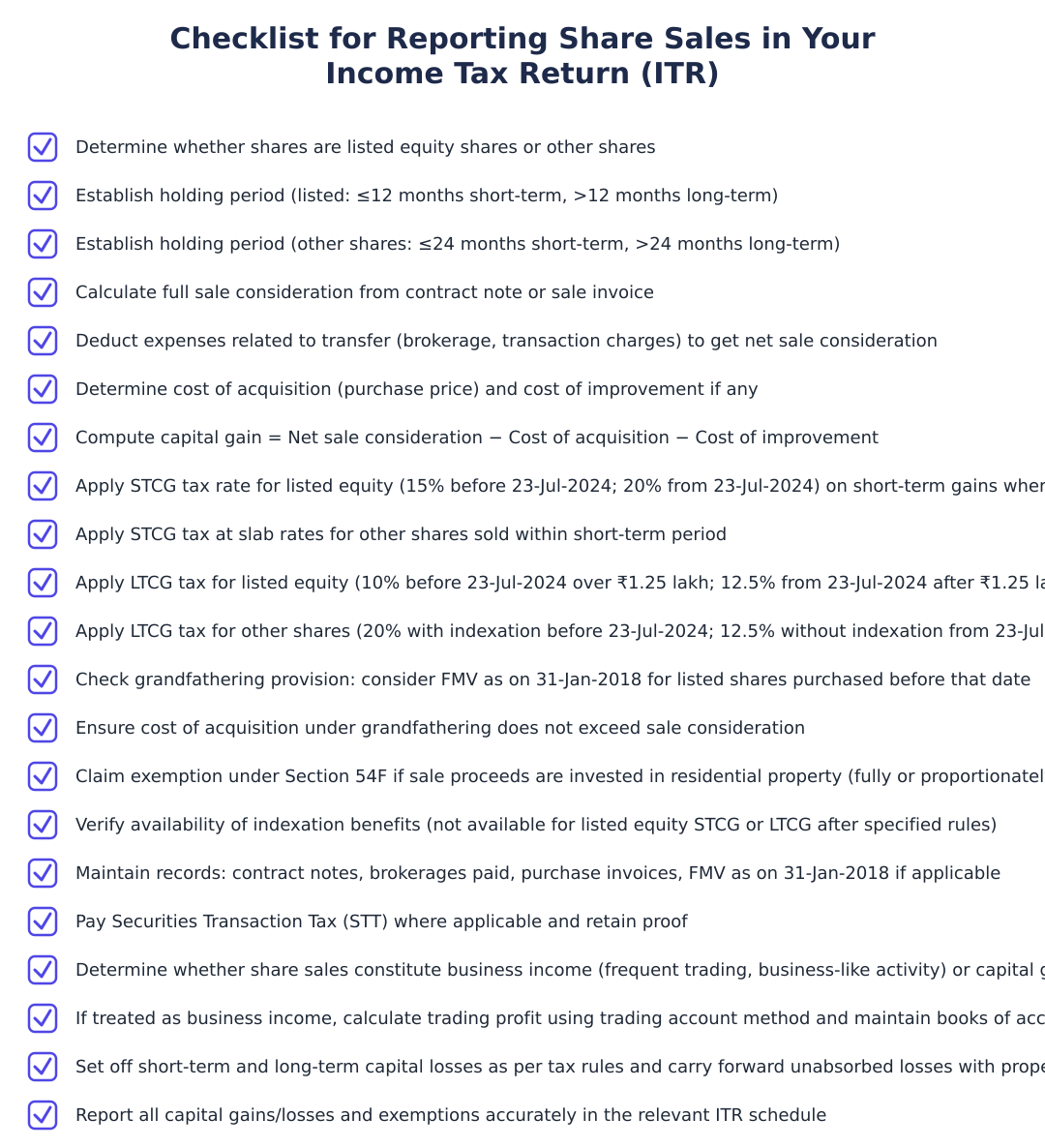
You must report income from sale of shares in the ITR under the appropriate head, 'Capital Gains' if the sale is an investment or 'Profits and Gains of Business or Profession' if trading in shares is a business, providing separate computations for short-term and long-term gains with supporting details (sale consideration, expenses, cost of acquisition/improvement). Use the Schedule for Capital Gains (Schedule CG) in the relevant ITR form to disclose each transaction or summary totals, claim exemptions like Section 54F where applicable, and carry forward losses as needed; also disclose STT paid and details for grandfathering adjustments if claiming them. Keep broker contract notes, purchase proofs, STT challans and computation worksheets ready as attachments or for assessment, and ensure you apply the correct tax rates (including the 23 July 2024 rate changes) for the AY relevant to the year of sale. If income is treated as business income, report it in the profit and loss schedules and claim business deductions with supporting vouchers.
How are unlisted (non-exchange) share sales treated for tax, capital gains or business income?
Income from transfer of unlisted shares is generally treated as capital gain and taxed under the head 'Capital Gains' irrespective of holding period, according to CBDT guidance to maintain uniformity and avoid disputes. This means gains on sale of unlisted shares will be computed as capital gains (short-term or long-term based on the specified holding period thresholds for other shares), with applicable rates and indexation where relevant, unless facts clearly indicate trading/business activity. For assessment year considerations the historic Income Tax Act provisions apply, and taxpayers should maintain full sale documentation and compute cost of acquisition carefully; if transactions display business-like frequency and intent, the assessing officer may still examine classification. Refer to CBDT circulars and keep supporting evidence if disputing the capital-gains character.
Need help staying Income Tax compliant?
MoneyGence's AI Finance OS tracks your compliance, wallet share, and finances in one place, built for agencies and growing businesses.
Get started with MoneyGence