Taxation of Interest on EPF Exceeding Rs 2.5 Lakh – Complete Guide
This guide explains how interest on Employees' Provident Fund (EPF) contributions is treated for income-tax purposes and how tax is handled when interest is credited to EPF accounts. You will learn when EPF interest is credited, who contributes and how much is the normal contribution, how voluntary higher contributions work, the legal provision that governs deduction of tax at source (TDS) on interest income, and what to do if TDS has been deducted on EPF interest. The practical aim is to help salaried individuals and payroll/accounting teams understand the flow from contribution to interest credit, the statutory basis for any TDS, and the interaction between TDS and the taxpayer's return filing. While this guide does not substitute professional tax advice for specific cases, it clarifies the central rules and the everyday implications, for example, timing of interest credit, the role of Voluntary Provident Fund (VPF), and how tax paid at source is reconciled by the taxpayer. Read on to get a clear, practical picture of EPF interest taxation and the actions employees should consider if tax is withheld on their interest income.
What is EPF?
The Employees' Provident Fund (EPF) is a retirement-oriented savings mechanism used by employees in organised establishments. Both the employee and the employer make periodic contributions to the EPF account. Over the long-term, the corpus accumulates through these contributions and by interest credited to the account.
In typical employer–employee arrangements, employers deduct the employee's share from payroll and remit both shares to the EPF account. The contribution mechanism therefore forms an important part of payroll compliance and personal retirement planning.
Latest update on timing and crediting of EPF interest
Interest on contributions to EPF accounts is generally determined and credited after the end of the financial year. The government notifies the applicable interest rate for EPF every year, and that rate is applied when the annual interest is credited to individual EPF accounts.
For taxpayers and payroll teams, this means the precise interest amount for a financial year is only finalised once the government announces the yearly EPF rate and the EPF authorities credit interest in the annual accounts. Until that process is complete, interest figures for the year are provisional.
Some important features of employee and employer EPF contributions
Employee contribution to EPF is normally fixed as a percentage of basic salary plus dearness allowance (DA). In most organisations, this percentage is applied consistently through payroll deductions so employees build up a steady retirement corpus.
Employers typically make an equal contribution to the EPF account on behalf of the employee. This matching contribution is an essential feature of the statutory EPF arrangement and affects the total funds accumulating in an individual's account over the years.
Employees who wish to contribute more than the standard percentage can do so through Voluntary Provident Fund (VPF). While VPF lets employees increase their own contribution above the usual percentage of basic plus DA, employers are not obliged to match contributions made under VPF, the employer’s matching applies to the standard contribution level only.
TDS on interest income, legal basis and practical implications
Section 194A of the Income Tax Act is the statutory provision that governs deduction of tax at source (TDS) on interest income. Any withholding of tax on interest falls under that section, and the rules and procedures for TDS follow from it.
If TDS is in fact deducted on interest credited to an EPF account, the tax withheld is a prepayment of the member’s income tax liability. Whether the member ultimately owes additional tax depends on their total taxable income for the year after allowing applicable deductions and exemptions. When filing the income‑tax return, the employee can claim credit for the TDS that has been deducted.
Practical steps an employee should take when interest is shown as taxable or TDS is deducted
First, review the EPF account statement to see the interest amount credited for the year and confirm whether any TDS has been reflected against your account. The annual credit entry and any TDS records are the starting point for tax reporting and reconciliation.
Second, when preparing your income‑tax return, include the interest income as required and claim credit for any TDS that has been deducted. Even if TDS was deducted, you may still have to pay additional tax if your total tax liability exceeds the TDS amount; conversely, you may be due a refund if your final tax liability is lower than the TDS credited.
Third, if you make voluntary contributions (VPF) or otherwise alter regular EPF contributions, keep documentation and payroll records that show contributions and employer matching. These records are important to reconcile account postings and to support the tax treatment of interest and contributions when you file returns or in case of any enquiry.
In summary, EPF interest is credited annually after the financial year at a government‑notified rate, standard employee contributions are a set percentage of basic pay plus DA with employer matching, and employees can top up contributions through VPF without employer obligation to match. TDS on interest is governed by Section 194A; if TDS is deducted the employee should reconcile it when filing their return and claim the TDS credit. For case‑specific tax treatment or to understand thresholds and rates that may apply to particular situations, consult a tax professional or the income‑tax statute and notifications.
Frequently asked questions
What exactly is taxable interest on EPF contributions exceeding Rs 2.5 lakh in a year?
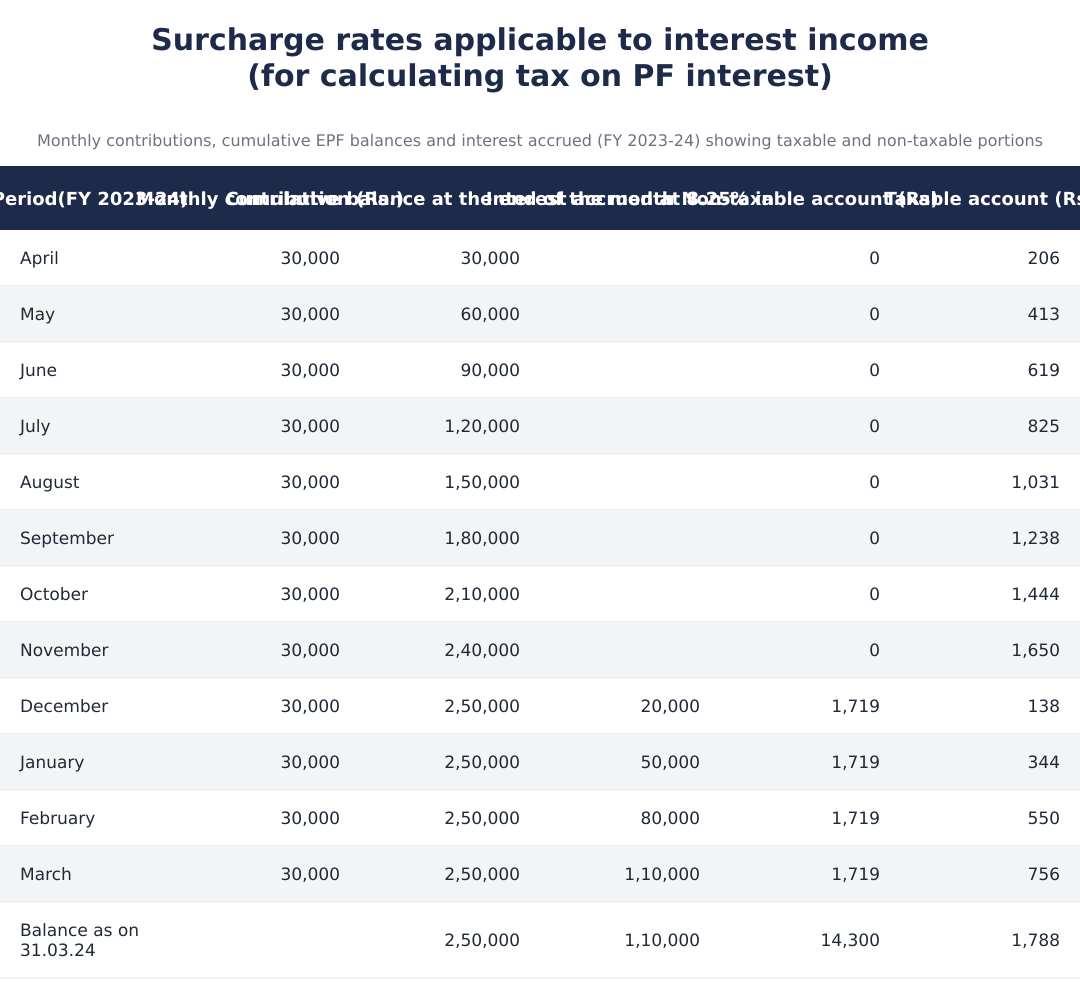
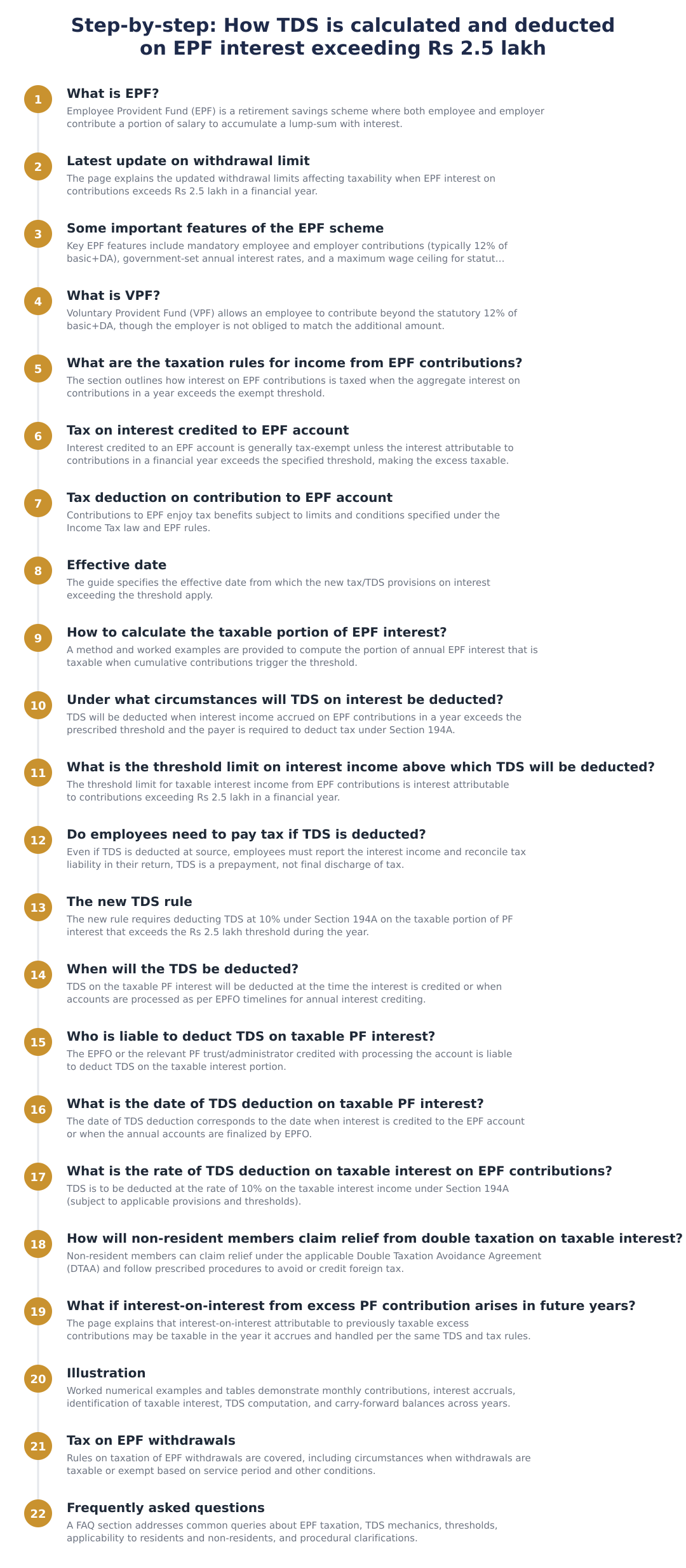
Taxable interest on EPF contributions exceeding Rs 2.5 lakh is the interest earned during a financial year on the portion of employee + employer contributions that exceed Rs 2.5 lakh, and that interest is subject to income tax. From FY 2021-22 onwards EPFO maintains two sub-accounts for each subscriber, a non-taxable account (upto Rs 2.5 lakh contribution in the year) and a taxable account (contributions above Rs 2.5 lakh), and interest credited to the taxable account is taxable. The taxable interest is included in the member’s gross income for that year and taxed at the applicable slab rates, while interest on the non-taxable account continues to be tax-exempt. For example, if total contributions in the year are Rs 3,60,000, interest on Rs 1,10,000 (the excess over Rs 2,50,000) will be taxable.
When and how will EPFO deduct TDS on taxable EPF interest?
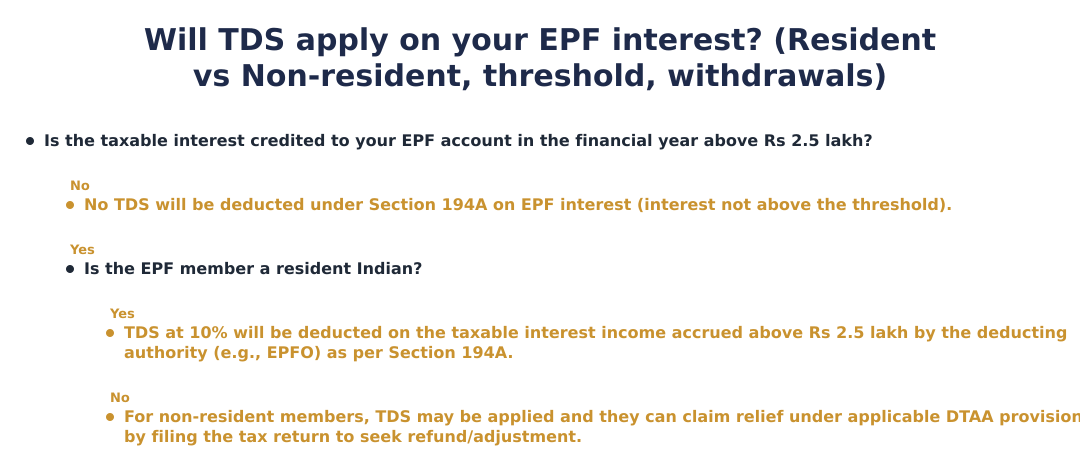
EPFO will deduct TDS at the time of crediting annual interest to the taxable sub-account, typically when annual accounts are processed after the financial year ends. The statutory TDS rate applicable under Section 194A is 10% on the taxable interest amount (subject to threshold rules for residents), and EPFO will deduct this amount and remit it to the government. The exact date of deduction is when interest is posted to the member’s taxable account during annual processing or when settlement/transfer transactions that affect balances are processed. As an illustration from the working, interest of Rs 1,788 in the taxable account resulted in TDS of Rs 179 (10%).
What is the TDS threshold for interest on PF for resident and non-resident members?
For resident Indians, TDS on interest from PF is deductible only if the interest accrued in the PF account during the financial year exceeds Rs 5,000; for non-residents there is no such threshold and TDS may be deducted regardless of the amount. This means a resident with taxable PF interest up to Rs 5,000 in a year will not have TDS deducted, whereas a non-resident member could see tax deducted even for smaller amounts. Note that the above threshold relates to TDS deduction; the underlying rule that interest on contributions above Rs 2.5 lakh is taxable still applies for residents and non-residents alike. If a resident member expects taxable interest above Rs 5,000 but wants to avoid TDS, they can submit Form 15G/15H subject to conditions and limits.
Who is liable to deduct TDS on taxable interest on EPF contributions?
The Employees’ Provident Fund Organisation (EPFO) is the deductor and is responsible for deducting TDS on taxable interest credited to the taxable sub-account under Section 194A. EPFO operates the two-account mechanism (taxable and non‑taxable) and when it credits interest to the taxable account or processes withdrawals/transfers, it will calculate and deduct TDS as applicable. Employers are not the deductor for this specific annual interest TDS; EPFO itself processes and deducts the tax centrally. Members will see the deducted TDS reflected in EPFO records and in their tax credit statements (Form 26AS) once remitted.
What rate of TDS will be applied on taxable EPF interest and are there surtaxes/surcharge considerations?
TDS on taxable EPF interest is deducted at the basic rate of 10% under Section 194A; applicable surcharge and cess will be added to the final tax liability but EPFO typically withholds at 10% as the primary TDS amount. If higher withholding is required because the member lacks PAN or is a non-resident, higher rates under the Income Tax Act may apply; for residents furnishing PAN, the standard 10% applies where TDS is triggered. Surcharge rates on interest income (not TDS) follow income slabs (for example, no surcharge up to Rs 50 lakh, 10% for Rs 50 lakh–1 crore, etc.) and will be considered while computing final tax liability at assessment or during filing of returns. Therefore 10% TDS is an advance deduction; final tax (including surcharge/cess) is determined on filing ITR.
If EPFO has deducted TDS, do employees still have to pay tax on EPF interest when filing ITR?
Yes, TDS is only an advance tax deducted at source; the employee must include the taxable EPF interest in their total income and compute final tax liability when filing the income-tax return. If the TDS deducted by EPFO is more than the final tax liability, the employee can claim a refund by filing an ITR; if it is less, additional tax must be paid before filing. Filing ITR also allows you to account for deductions, slab rates, surcharge and cess, and to claim reliefs such as foreign tax credit (for NRIs) if applicable. Always match the TDS credit shown in Form 26AS/Tax portal with the TDS certificate details issued by EPFO when preparing the return.
Can non-resident members avoid double taxation on taxable EPF interest and how do they claim relief?
Non-resident members can claim relief from double taxation by relying on the Double Taxation Avoidance Agreement (DTAA) between India and their country of residence and by furnishing a Tax Residency Certificate (TRC) and other prescribed documents to EPFO or through the ITR process. EPFO may deduct TDS at the applicable non-resident rate, but the member can claim foreign tax credit or DTAA relief while filing ITR in their country of residence or in India as per treaty provisions. To practically benefit from DTAA at source, the non-resident should submit necessary declarations and TRC in advance to EPFO; otherwise they can claim refund/credit after filing returns with evidence of tax paid in India. Keep copies of treaty articles, TRC, and proof of tax deducted (Form 16A/26AS) to substantiate relief claims.
Will interest-on-interest from the excess PF contribution (taxable account) be taxed in future years too?
Yes, interest-on-interest arising from amounts in the taxable EPF sub-account will also be treated as taxable when credited to that taxable account in the year it accrues. Because EPFO maintains a separate taxable account for contributions in excess of Rs 2.5 lakh, any compound interest (interest on earlier interest credited) that is booked into that taxable account will be part of the taxable interest for the year in which it is credited. This means taxation follows accounting/crediting: once the balance remains in the taxable sub-account, subsequent interest credited to that sub-account continues to be taxable until the taxable balance is reduced by withdrawals or transfers. For example, if Rs 1,10,000 of taxable principal gives interest in Year 1 and that interest gets credited back to the taxable sub-account, the next year’s interest includes interest-on-that-interest and is taxable.
How is the taxable portion of EPF interest calculated, can you give a simple working example?
The taxable portion is calculated by maintaining two balances: (1) non-taxable balance representing contributions up to Rs 2.5 lakh in a year and (2) taxable balance for contributions above Rs 2.5 lakh; interest is computed separately on each and only interest on the taxable balance is taxable. For example, if monthly contributions of Rs 30,000 lead to cumulative non-taxable balance of Rs 2,50,000 and additional taxable contributions of Rs 1,10,000 in FY 2023-24, interest at 8.25% on the taxable account (Rs 1,10,000) gives Rs 1,788 taxable interest; EPFO would deduct TDS @10% = Rs 179 on that amount. The working involves: split annual contributions into the two accounts, compute annual interest rate on each balance (EPF rate for that year), and sum interest credited to the taxable account which becomes the taxable income. This separate-account approach ensures precise tax treatment and TDS calculation.
Need help staying Payroll compliant?
MoneyGence's AI Finance OS tracks your compliance, wallet share, and finances in one place, built for agencies and growing businesses.
Get started with MoneyGence