TCS on Foreign Remittance 2026: Rules, Rates & Exemptions in India
This guide explains how Tax Collected at Source (TCS) applies to foreign remittances from India, and, more importantly, how you can verify, claim credit for, and, if appropriate, get a refund of TCS charged on such transfers. You will learn where TCS entries appear in official records, which documents to collect from your bank or authorised dealer, the practical steps to confirm the amount collected, and how to reflect it when you file your Income Tax Return (ITR). Knowing these procedures matters because TCS is a collection mechanism that affects cash flow at the time of remittance and can influence your tax filing position later. Proper documentation and timely reconciliation ensure you receive credit for tax already collected and avoid unnecessary tax liabilities or delays in refunds. This guide focuses on actionable verification and claim steps backed by official sources available on the Income Tax e‑filing portal and common banking practice.
What is TCS on Foreign Remittance?
TCS is a mechanism where an authorised person (commonly a bank or authorised dealer) collects tax when some categories of payments are made, including certain foreign remittances. The collected amount is deposited with the government and should be reflected against the remitter’s Permanent Account Number (PAN) so the remitter can claim credit for the tax collected.
Practically, this means that when a bank deducts TCS on a remittance, you should receive a certificate and be able to see the deduction recorded in your tax records. Retaining the TCS certificate and reconciling the deduction with the entries on the Income Tax e‑filing portal will help you ensure that you get credit for any tax already collected at source.
Latest TCS Rates on Foreign Remittance
Rate announcements and changes for TCS on foreign remittances are issued by the government and implemented by banks and authorised dealers. Because rates can change with fiscal rules and notifications, always confirm the applicable rate with your bank or the latest government circular before making a transfer.
Even when a particular rate is shown on your remittance receipt, you should still verify that the collected TCS appears in your tax records so you can claim the credit when filing your return.
How to Check and Claim TCS on Foreign Remittance
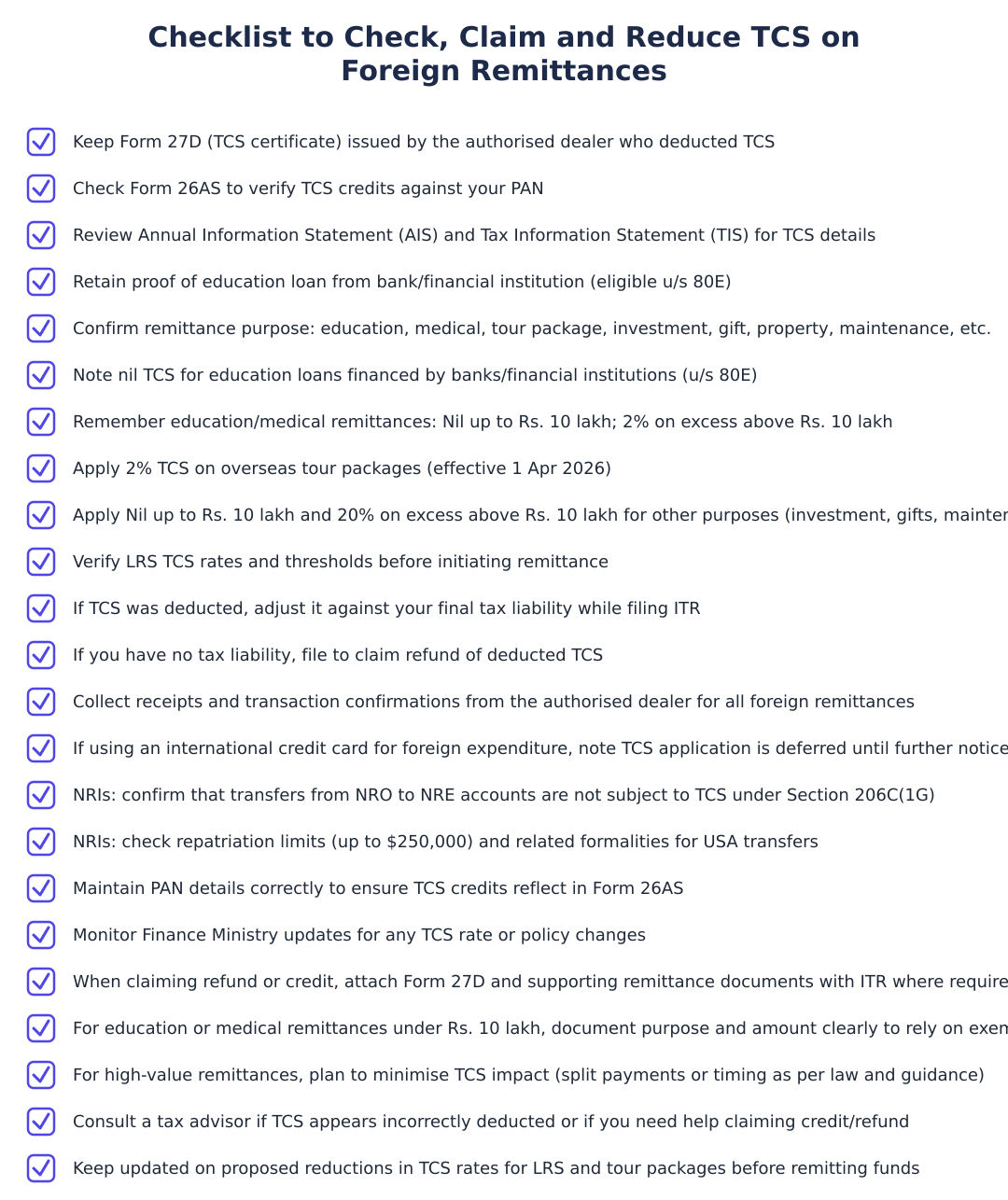
At the time of TCS deduction, the authorised dealer or the bank generally issues Form 27D, a TCS certificate that serves as proof that TCS has been collected and deposited.
Check your Form 26AS on the Income Tax e‑filing portal; it contains details of all TDS and TCS amounts deducted against your PAN and will reflect the TCS credited by the collecting agency.
Use the Annual Information Statement (AIS) and Tax Information Statement (TIS) available on the Income Tax e‑filing portal to corroborate the TCS entries and ensure there are no discrepancies between the bank’s certificate and tax portal records.
When you file your Income Tax Return, you can adjust the TCS amount against your final tax liability as shown in your return, using the credits reflected in Form 26AS and supporting certificates.
If you have no tax liability or if the tax credit exceeds your tax payable, you can claim a refund of the deducted TCS when filing your ITR.
Exemptions from Foreign Remittance Tax
Specific exemptions and reduced rates for particular kinds of remittances are determined by statute and administrative notification. To confirm whether a particular remittance is exempt or attracts a reduced TCS rate, consult the bank or authorised dealer handling your transaction and check the relevant government notifications.
Even where an exemption or special treatment applies, you should still obtain supporting documents and ensure that any claimed exemption is properly documented so that the TCS position is clear in your banking records and on the Income Tax e‑filing portal.
How to Save on Foreign Remittance Taxes?
While specific tax planning steps depend on the rules applicable to the particular remittance, the basic approach is to plan ahead and maintain complete documentation. Before initiating a transfer, discuss the transaction with your bank or authorised dealer to understand whether TCS will apply and whether any proof (for example, loan documentation or purpose-specific certificates) is needed to obtain favourable treatment.
Keep all certificates and acknowledgements issued at the time of deduction. Reconciling these with Form 26AS and the AIS/TIS during the financial year helps identify mismatches early, allowing you to get them corrected well before filing your return.
How to Transfer Money from India to the USA?
Use an authorised dealer or your bank to make outward remittances. The authorised dealer will inform you if TCS is to be collected at the time of the transfer and will provide the necessary certificate when TCS is deducted.
After remitting, verify that any TCS deducted is reflected in your Form 26AS and corroborated by the AIS/TIS on the Income Tax e‑filing portal. Retain the bank’s certificate, banks generally provide a TCS certificate at the time of deduction, so you can claim credit or a refund as applicable when you file your ITR.
TCS on foreign remittances affects cash flows at the time of transfer but can be claimed as tax credit or refunded when you file your ITR. Save the TCS certificate (Form 27D) from your bank, routinely check Form 26AS and the AIS/TIS on the Income Tax e‑filing portal to confirm credit, and use those records to adjust tax liability or claim a refund. When in doubt about rates or exemptions, consult your bank or check official notifications before remitting.
Frequently asked questions
What is TCS on foreign remittance?
TCS on foreign remittance is a tax collected at source by the authorised dealer when an Indian resident sends money abroad under the RBI’s Liberalised Remittance Scheme (LRS). The remitting bank or authorised dealer collects this percentage of the outward remittance and deposits it with the government under Section 206C(1G) of the Income Tax Act. The deducted TCS appears in your Form 26AS and can be adjusted against your final income-tax liability when you file your ITR or claimed as a refund if you have no tax due. TCS applies only to outward remittances (sending money abroad) and not to inward receipts from overseas.
What are the latest TCS rates on foreign remittance from 1 April 2026?
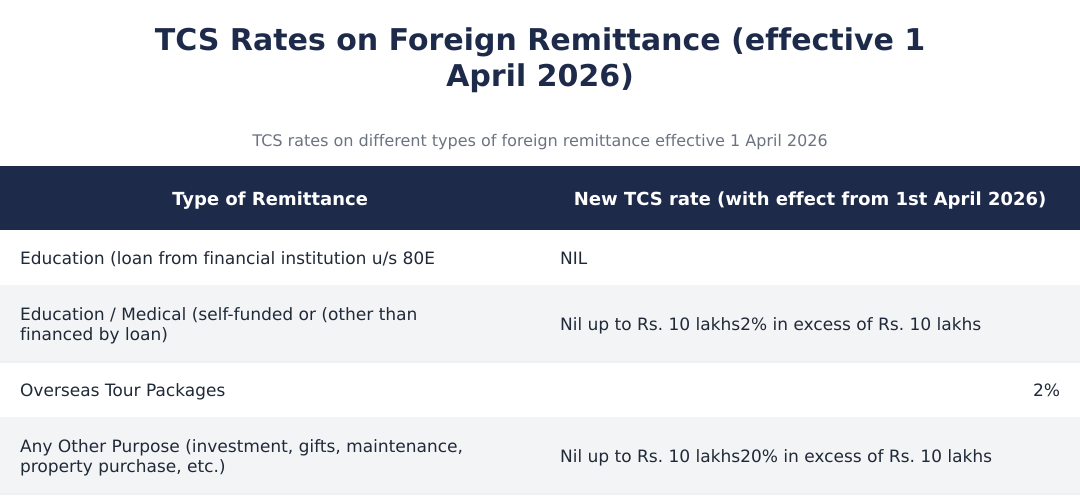
From 1 April 2026, TCS rates vary by purpose: education/medical remittances are nil up to Rs. 10 lakh and 2% on amounts exceeding Rs. 10 lakh, overseas tour packages attract 2% TCS, and all other purposes are nil up to Rs. 10 lakh and 20% on the excess above Rs. 10 lakh. Education loans financed by banks/financial institutions (eligible under section 80E) are exempt (nil TCS). These are the effective rates to expect when remitting abroad under the LRS unless further policy changes are announced.
Which remittances are exempt from foreign remittance tax (TCS)?
Certain remittances are exempt from TCS, notably education loans financed by banks or financial institutions under section 80E and specific thresholds for education and medical remittances (nil up to Rs. 10 lakh). Additionally, some categories and one-off policy changes may exempt or lower TCS, for example, international credit card foreign expenditures are treated differently until further government guidance. Always check the remitter’s documentation and Form 27D or Form 26AS to confirm whether TCS was actually collected on your transaction.
How does the TCS threshold of Rs. 10 lakh work for education, medical and other remittances?
The Rs. 10 lakh threshold means education and medical remittances are subject to nil TCS on the first Rs. 10 lakh, with 2% charged only on the amount exceeding Rs. 10 lakh, and other purposes are nil up to Rs. 10 lakh with 20% TCS on the excess. For example, if you remit Rs. 15 lakh for general investment, TCS will be nil on the first Rs. 10 lakh and 20% on the remaining Rs. 5 lakh (i.e., Rs. 1 lakh). This threshold is applied per remittance transaction type and per financial rules effective from 1 April 2026.
How can I check the TCS deducted on my foreign remittance and claim it back?
You can check TCS deducted on your remittance in Form 26AS on the Income Tax e-filing portal and by obtaining Form 27D (TCS certificate) issued by the authorised dealer who collected the tax. The deducted TCS is adjustable against your income-tax liability when you file your ITR, and if your final tax liability is lower than the TCS collected you can claim a refund by filing the return. You can also cross-check the Annual Information Statement (AIS) and Tax Information Statement (TIS) on the e-filing portal to confirm the TCS entries.
How can I reduce or avoid paying excess TCS on foreign remittance?
To reduce excess TCS you can structure remittances within the exemptions (for example, use education loan financing under section 80E or keep single remittances for education/medical under Rs. 10 lakh), ensure correct purpose codes are declared to the authorised dealer, and maintain accurate supporting documents so the bank applies the correct TCS rate. If TCS is still collected, remember it is adjustable against your final tax liability or refundable if no tax is due, so timely filing of the ITR and claiming Form 27D/Form 26AS credits will recover the amount. Also monitor policy updates, some proposed reductions (e.g., LRS for health and education to 2%) could change planning choices.
Are NRIs subject to TCS when moving money from NRO to NRE accounts or sending money to the USA?
NRIs are not subject to TCS under Section 206C(1G) when transferring money from their NRO account to their NRE account, and NRIs can repatriate up to $250,000 without stringent formalities for transfers such as to the USA. This treatment allows NRIs to remit Indian income (salary, dividends, rent, etc.) via NRO/NRE mechanisms without TCS on such transfers, although specific documentation and RBI rules for repatriation should be followed. Note that TCS rules differ for other types of foreign expenditures (for example, forex/debit card spends by resident Indians) and authorities may issue further clarifications.
Does using an international credit card abroad attract TCS on foreign expenditures?
Currently, foreign expenditures made through international credit cards while being overseas are not counted as LRS remittances and are not subject to TCS under Section 206C(1G), and the finance ministry has postponed applying TCS to such international credit-card spends until further guidance. However, foreign payments made through a debit card or forex card are treated as LRS and may attract TCS, so residents should check with their bank how a particular card transaction will be classified. Because rules and postponements can change, keep your transaction receipts and monitor official RBI and finance ministry notifications for updates.
What happens if TCS is deducted but I have no taxable income for the year?
If TCS is deducted and you have no taxable income for the year, you can claim a refund of the TCS amount by filing your Income Tax Return because TCS is a tax collected and will be credited against your final tax liability as shown in Form 26AS. You should retain the TCS certificate (Form 27D) and supporting remittance documents to substantiate the claim, and the refund will be processed after verification by the Income Tax Department. If the refund is delayed or the TCS is not reflected in Form 26AS, raise the issue with the authorised dealer and use the AIS/TIS or e-filing grievance channels to resolve it.
Need help staying Income Tax compliant?
MoneyGence's AI Finance OS tracks your compliance, wallet share, and finances in one place, built for agencies and growing businesses.
Get started with MoneyGence