TCS under GST: E‑commerce Guide to Tax Collected at Source
This guide explains Tax Collected at Source (TCS) under the Goods and Services Tax (GST) with a focus on e-commerce operators and sellers who transact through online marketplaces. You will learn who must collect TCS, when the collection obligation started, which return to file, and how TCS information flows to sellers’ purchase records. Understanding TCS is important because it affects cash flow, accounting entries, and reconciliation between marketplace reports and a seller’s GST records. For e-commerce operators, correct collection and reporting of TCS ensures compliance with GST rules; for sellers, recognizing TCS entries in their purchase-ledgers and in-form statements helps claim proper input tax credit and avoid mismatches during returns filing. This guide walks through the core legal triggers and practical implications of TCS under GST, highlights the statutory return used by e-commerce operators, and explains how the data they file appears to sellers. Where specific procedural numbers or timelines are not covered, the guide focuses on principles and the operational relationship between marketplaces and sellers so businesses can adapt their accounting and reconciliation processes accordingly.
What is TCS under GST
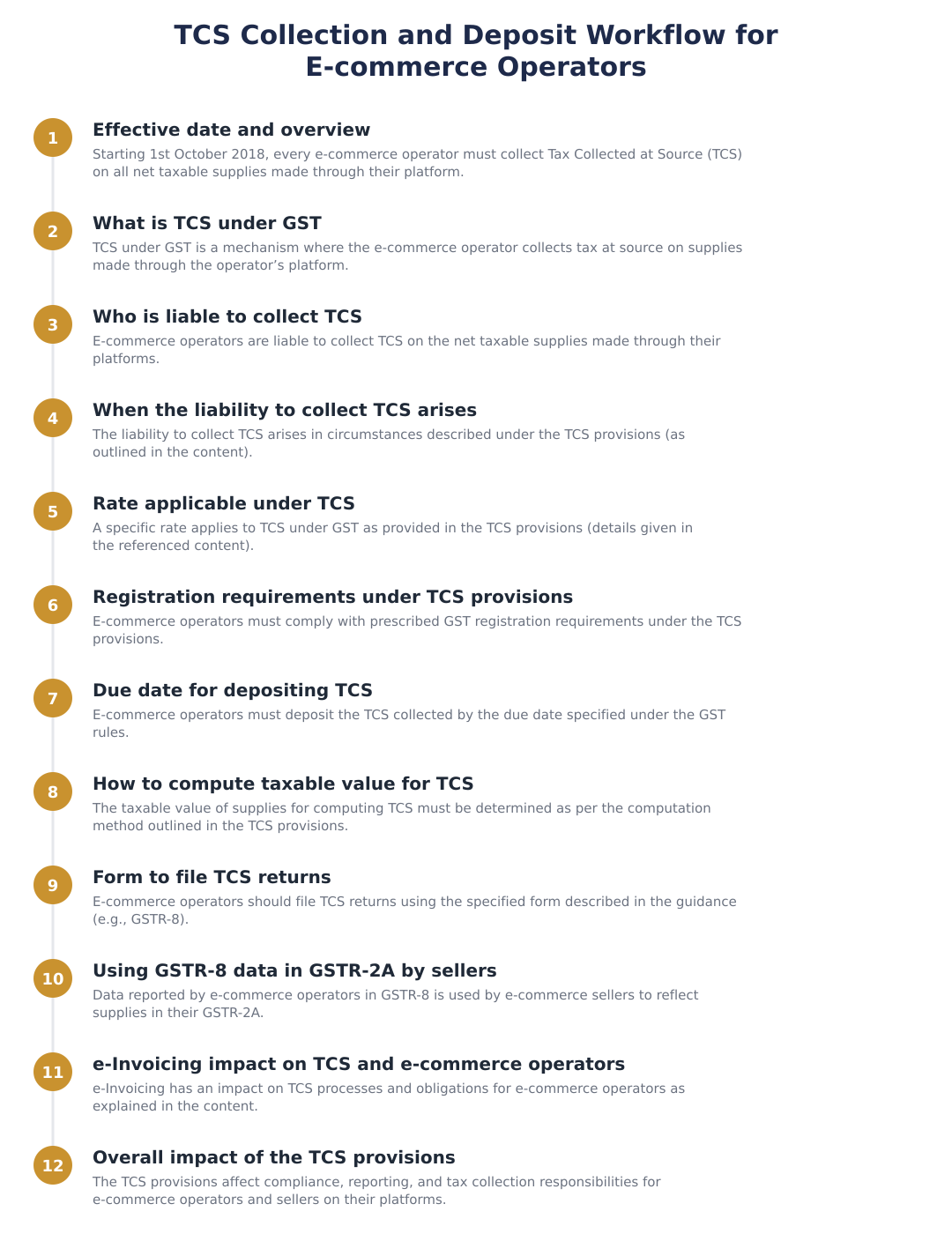
Tax Collected at Source (TCS) under GST is a mechanism where an e-commerce operator collects tax at the time of supply facilitated through its platform. The purpose of TCS is to ensure a reliable trail of taxable supplies made through e-commerce marketplaces and to capture tax at the point of collection, improving tax administration and compliance.
Under the GST framework, TCS collection by the marketplace creates a record that links the transaction, the seller and the e-commerce operator. This recorded data becomes part of the returns filed by the operator and is visible to the respective sellers for reconciliation with their own sales and input tax credit claims.
Who is liable to collect TCS under GST
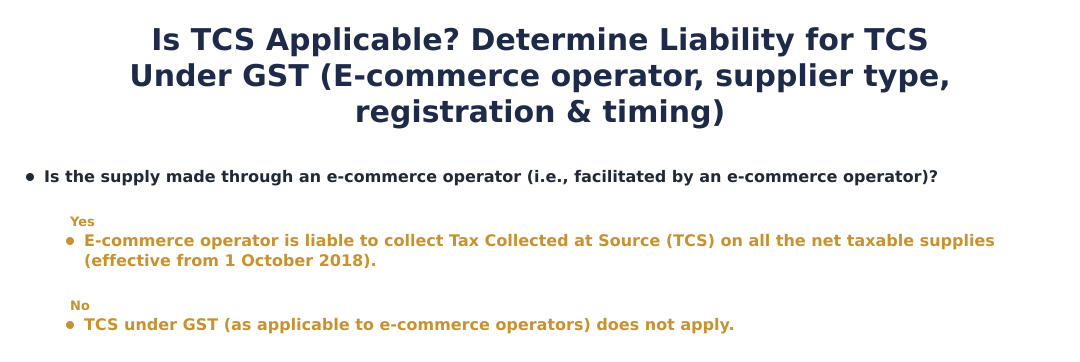
E-commerce operators are required to collect Tax Collected at Source (TCS) under GST. This obligation places the responsibility for collection on the operator that facilitates supplies made through its platform, rather than on each individual seller for transactions routed via that operator.
For marketplaces and platforms, the TCS requirement means implementing processes to identify taxable supplies made through the platform, collect the appropriate amount at source at the time of supply, and maintain records to support reporting and reconciliation.
When will the liability of collecting TCS arise
The statutory compliance date for TCS under GST for e-commerce operators began on 1st October 2018. From that date onwards, e-commerce operators have been required to collect TCS on net taxable supplies made through their platforms.
Practically, this means any supplies that fall within the scope of the e-commerce operator’s facilitation must be assessed for TCS from the compliance date. Businesses operating marketplaces needed to ensure systems and contracts reflected this new obligation from that point forward.
Which form can one use to file TCS returns
| Return form |
|---|
| GSTR-8 |
Using GSTR-8 data by e-commerce sellers in GSTR-2A
Data reported by e-commerce operators in GSTR-8 is made available to sellers so that they can reconcile supplies made through the operator with their own records. This flow of data helps sellers verify the amounts on which TCS was collected and match them against their inward supplies.
E-commerce sellers can use the GSTR-8 data that appears in their GSTR-2A to support input tax credit claims and to resolve any mismatches between marketplace-reported supplies and the seller’s books. Regular reconciliation between marketplace reports and the seller’s returns reduces the risk of discrepancies at the time of return filing or assessment.
e-Invoicing Impact on TCS and e-Commerce Operators
While specific e-invoicing rules and their interaction with TCS are governed by separate provisions, the general impact for e-commerce operators is operational: any digital invoicing process that captures transaction-level details can facilitate accurate TCS collection and reporting. Structured electronic records help marketplaces calculate amounts correctly and produce the data required for GSTR-8.
For sellers, better electronic data exchange between platforms and accounting systems simplifies reconciliation and reduces manual interventions when matching TCS entries reported by the operator with sales invoices and input credit claims.
Impact of the TCS provisions
The introduction of TCS for e-commerce operators creates clearer reporting lines for marketplace transactions and provides sellers with an authoritative source of transaction data. This improves transparency in the GST system and can lead to more efficient compliance for both operators and sellers.
Operationally, businesses need systems for collection, record-keeping, and timely reconciliation. Sellers should routinely compare marketplace-reported data with their own records to ensure input tax credit is accurately reflected and to avoid mismatches in return filings.
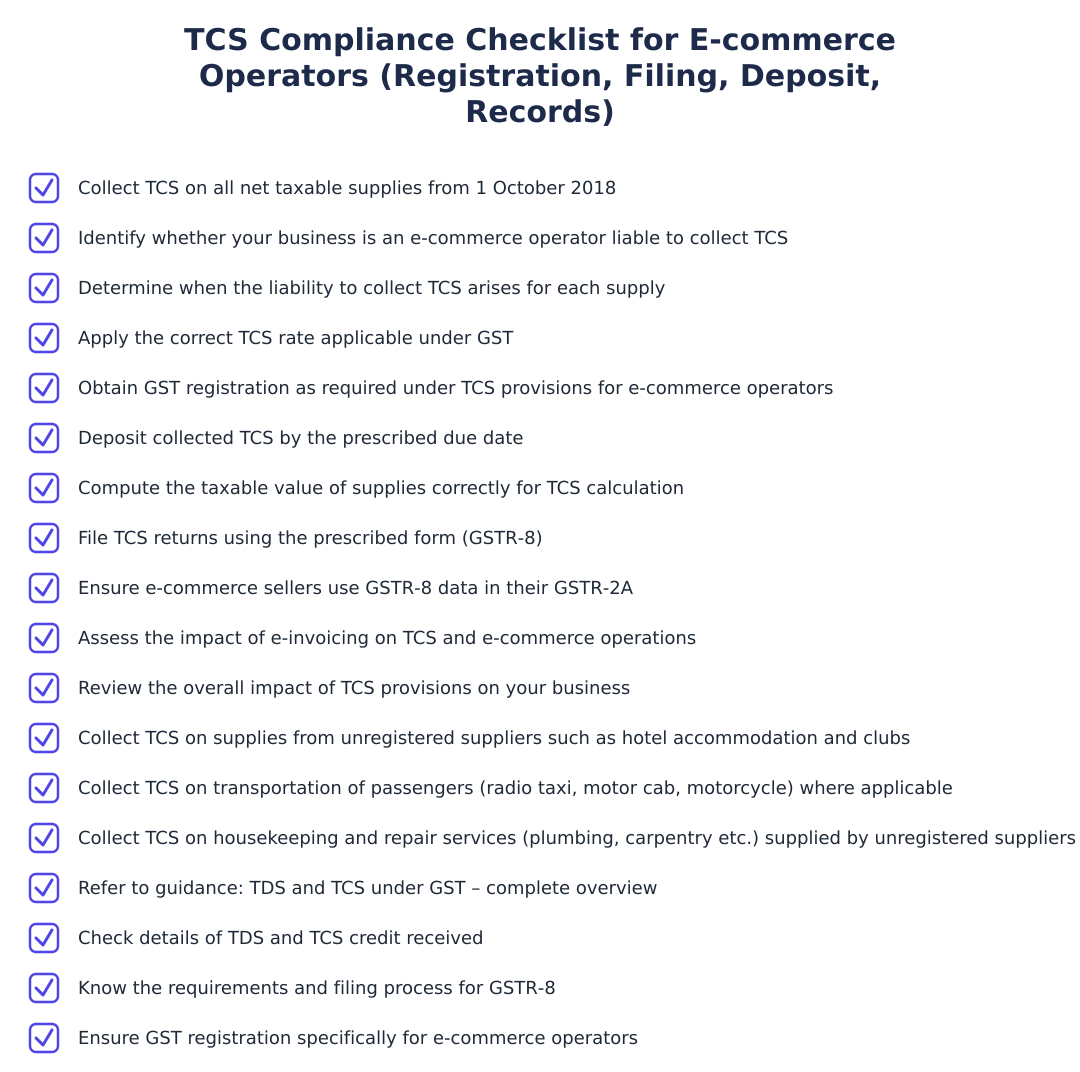
TCS under GST places the obligation of collection on e-commerce operators and has been in effect since 1st October 2018. Operators report TCS details in GSTR-8, and sellers can access those details via GSTR-2A for reconciliation and input credit purposes. Focusing on accurate data capture, timely reporting and regular reconciliation will help marketplaces and sellers manage the compliance and accounting impacts of TCS.
Frequently asked questions
What is Tax Collected at Source (TCS) under GST?
TCS under GST is the tax an e-commerce operator must collect from suppliers on the net taxable value of supplies made through its platform and deposit with the government. The provision came into effect on 1 October 2018 and requires the operator to collect specified percentage of net taxable supplies made through the platform, issue details in a return, and enable suppliers to claim input tax credit of the collected amount. TCS is separate from the supplier’s own output tax liability and is reflected in the supplier’s auto-populated purchase statement so the supplier can reconcile and claim credit. Non-compliance by the operator can attract interest and penalties under GST law.
Who is required to collect TCS under GST?
Any e-commerce operator who facilitates the supply of goods or services through its electronic platform is required to collect TCS under GST. This liability applies to operators registered as e-commerce operators under GST rules, irrespective of their aggregate turnover, and includes both marketplace operators and platforms that facilitate supplies. The operator must collect TCS on taxable supplies made through the platform by third-party sellers and deposit the amount with the government. Exemptions or special cases (for example supplies by the operator itself) should be checked against the GST law and notifications.
When does the obligation to collect TCS arise for an e-commerce operator?
The obligation to collect TCS arises at the time of receipt of the payment from the buyer or at the time of credit of proceeds to the supplier, whichever is earlier, for supplies made through the operator’s platform. Practically this means TCS must be collected when consideration for a taxable supply is received or becomes payable through the platform, ensuring collection even when payment and settlement timings differ. The operator must reflect these collections in its TCS return for the month in which collection occurred and deposit the amount by the prescribed due date. Operators should maintain clear payment and settlement records to determine the exact point when TCS is due.
What rate of TCS applies under GST?
TCS under GST is collected at the rate notified in the GST law for supplies made through e-commerce operators, commonly implemented as 1% of the net taxable value (split as 0.5% CGST and 0.5% SGST for intra-state supplies) or the applicable IGST rate for inter-state supplies. The exact rate and the tax head (CGST+SGST or IGST) depend on whether the supply is intra-state or inter-state and any specific government notifications. Operators should apply the notified percentage on the net taxable value of supplies after adjusting for taxes, discounts and returns as required, and keep updated with notifications that may amend rates. Sellers should reconcile the TCS recorded by the operator with their own tax liabilities since TCS is creditable to the supplier.
Do e-commerce operators need to register separately because of TCS provisions?
Yes, e-commerce operators must be registered under GST as e-commerce operators and typically need to obtain GST registration even if their aggregate turnover is below the normal registration threshold. The GST rules specifically require e-commerce operators to register in every state where they are required to collect TCS and facilitate supplies, and registration enables them to file the mandatory TCS return (GSTR-8). Operators should obtain GSTINs for each state as required and ensure their registration status is up to date to comply with TCS obligations. Failure to register or to collect TCS when required may attract penalties and interest.
What is the due date for depositing TCS collected under GST?
TCS collected by an e-commerce operator must be deposited with the government by the 10th day of the month following the month in which the tax was collected. The operator is also required to file the monthly TCS return (GSTR-8) by the same due date, reporting details of supplies, TCS collected and the suppliers to whom credit will be made available. Late deposit or late filing attracts interest and possible penalties, so operators should reconcile collections and deposits before the 10th of the next month. Operators must ensure timely deposit to ensure suppliers can claim credit in their returns without delay.
How do you compute the taxable value on which TCS is to be collected?
TCS is to be computed on the net taxable value of supplies made through the e-commerce operator after adjusting for discounts, returns and taxes as prescribed under GST rules. Net taxable value means the aggregate value of taxable supplies facilitated through the platform minus taxable refunds and adjustments for the relevant period; the specified TCS rate is applied on this net value. Operators must maintain detailed ledgers showing gross supplies, taxes, discounts and returns to arrive at the correct net taxable value for each supplier and for the platform as a whole. Accurate computation is essential because incorrect calculation can lead to disputes, interest and penalties and can affect the supplier’s ability to claim input tax credit.
Which form must e-commerce operators use to file TCS returns under GST?
E-commerce operators must file the monthly TCS return in GSTR-8 to report supplies made through their platform, details of sellers, and the TCS collected and deposited for the month. GSTR-8 contains line items for each supplier’s supplies and the tax collected, and these details are used to auto-populate the suppliers’ purchase statements so they can claim credit. The return is generally filed monthly and the due date aligns with the TCS deposit due date (typically the 10th of the month following the collection month); late filing attracts interest and penalties. Operators should ensure their invoicing and settlement data are reconciled before filing GSTR-8 to avoid mismatches for suppliers.
How do sellers use GSTR-8 data in their GSTR-2A and for claiming credit?
Sellers can view the TCS details reported by e-commerce operators in their auto-populated purchase statement (GSTR-2A/GSTR-2B) and claim input tax credit for the TCS amount shown, provided the transaction is reflected correctly and invoices are available. The TCS reported in GSTR-8 is credited to the corresponding supplier’s electronic ledger, which the supplier should reconcile with their own sales and invoice records before claiming credit in their return (GSTR-3B). Any mismatch between the operator’s reported data and the supplier’s books should be resolved with the operator promptly to ensure the supplier can legitimately claim the credit. Suppliers must retain supporting invoices and reconcile monthly to prevent denial of credit due to discrepancies.
Does e-invoicing affect TCS collection and reporting for e-commerce operators?
E-invoicing may streamline TCS collection and reporting but does not change the fundamental obligation of e-commerce operators to collect and deposit TCS under GST. Where e-invoicing is applicable, invoice-level data becomes electronically available and can help operators accurately compute net taxable supplies, reconcile transactions, and populate GSTR-8 with correct details, reducing mismatches for sellers. However, the requirement to collect the prescribed TCS percentage, deposit it by the due date and file GSTR-8 remains unchanged; e-invoicing only improves data quality and traceability. Operators and sellers should align their invoicing and settlement processes with e-invoicing mandates to ensure smooth credit flow and compliance.
What is the practical impact of TCS provisions on e-commerce sellers and operators?
TCS provisions increase compliance for e-commerce operators and affect cash flow and reconciliation for sellers, but they also create a transparent trail that helps suppliers claim input tax credit for tax collected on their supplies. Operators must implement systems to collect, deposit and report TCS monthly (via GSTR-8) and reconcile settlements with multiple sellers, while sellers must monitor GSTR-2A/GSTR-2B to ensure TCS credit is reflected correctly and resolve mismatches quickly. For sellers, TCS does not replace their output tax liability but provides a credit recorded by the operator; therefore accurate record-keeping, timely reconciliation and communication between sellers and operators are critical to avoid blocking of credits or disputes. Overall, TCS improves tax collection oversight but adds administrative tasks and potential short-term cash-flow timing differences for marketplace sellers.
Need help staying GST compliant?
MoneyGence's AI Finance OS tracks your compliance, wallet share, and finances in one place, built for agencies and growing businesses.
Get started with MoneyGence