TDS for Business: Guide to Tax Deducted at Source (TDS)
This guide explains how Tax Deducted at Source (TDS) works for businesses in India and what every payer should know to remain compliant. You will learn which common payments attract TDS under specific sections of the Income Tax Act, the practical compliance steps a business must follow (from obtaining TAN to issuing certificates), and which standardized forms are used for certificates. The guide focuses on actionable requirements, such as ensuring PAN details, deducting TDS at the applicable rate as per law, depositing the tax and filing TDS returns within the prescribed timelines, so you can set up processes in accounting and payroll systems to avoid mistakes. While this is not a substitute for professional tax advice, it consolidates the essential statutory touchpoints a business needs to manage TDS reliably: recognition of payments that trigger TDS, the documentation and filing framework, and the certificates to issue to payees. If you run a trading, manufacturing, services or contracting business, these TDS rules affect payments you make regularly (rent, contractor bills, professional fees, dividend payouts etc.). Understanding which section applies to which payment and following the core compliance steps reduces the risk of disputes with payees and makes year‑end reporting and audits smoother.
Tax Deducted at Source (TDS) for Business
TDS is a mechanism where the payer deducts tax at source while making specified types of payments and deposits it with the Government. For businesses this means that certain routine outflows, rent, contractor payments, professional fees, dividends, interest on securities, and specified winnings or perquisites, may require tax withholding at the time of payment or credit.
For compliance, businesses need to identify which section of the Income Tax Act governs each kind of payment and apply the TDS rate prescribed by that section. The law places the obligation to deduct, deposit and report TDS on the payer; therefore internal controls should ensure accurate identification of the payee’s PAN, correct classification of the payment, timely deposit of withheld tax, and filing of periodic TDS returns.
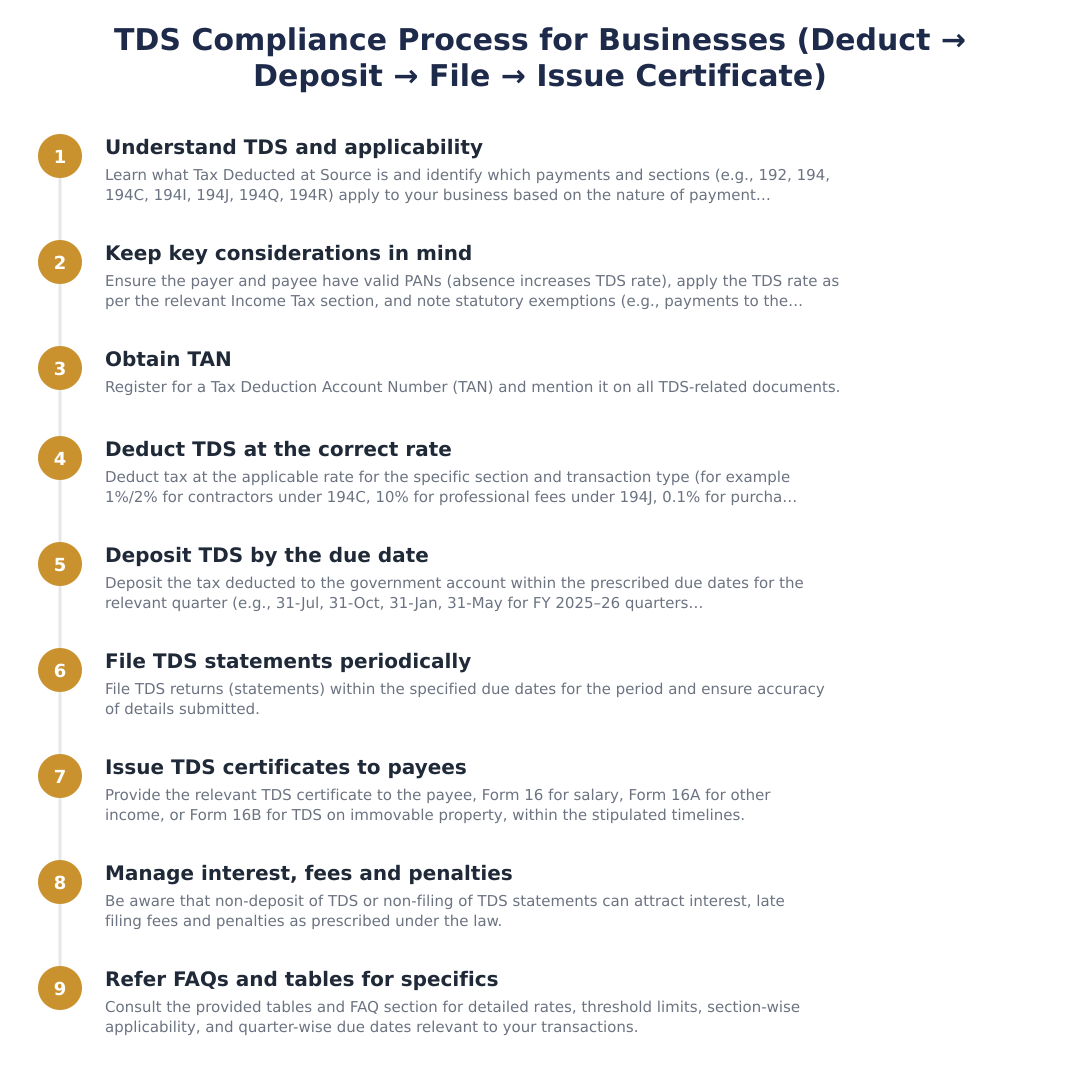
Points to Keep In Mind While Deducting TDS
The person incurring the expenditure should have a valid PAN and should also obtain the PAN of the person receiving the income; absence of PAN leads to higher TDS rates under law.
Obtain a Tax Deduction Account Number (TAN) and ensure it is quoted in all TDS-related documents and filings.
Identify the relevant TDS section applicable to the nature of payment and apply the rate prescribed by that section in the Income Tax Act, 1961.
Deduct TDS at the applicable rate and deposit the tax to the Government account within the specified due dates.
Periodically file TDS statements (TDS returns) within the prescribed due dates to report deductions made and deposits.
Issue the appropriate TDS certificate (Form 16 or Form 16A, or other applicable certificate) to the payee for the TDS deducted within the specified timelines.
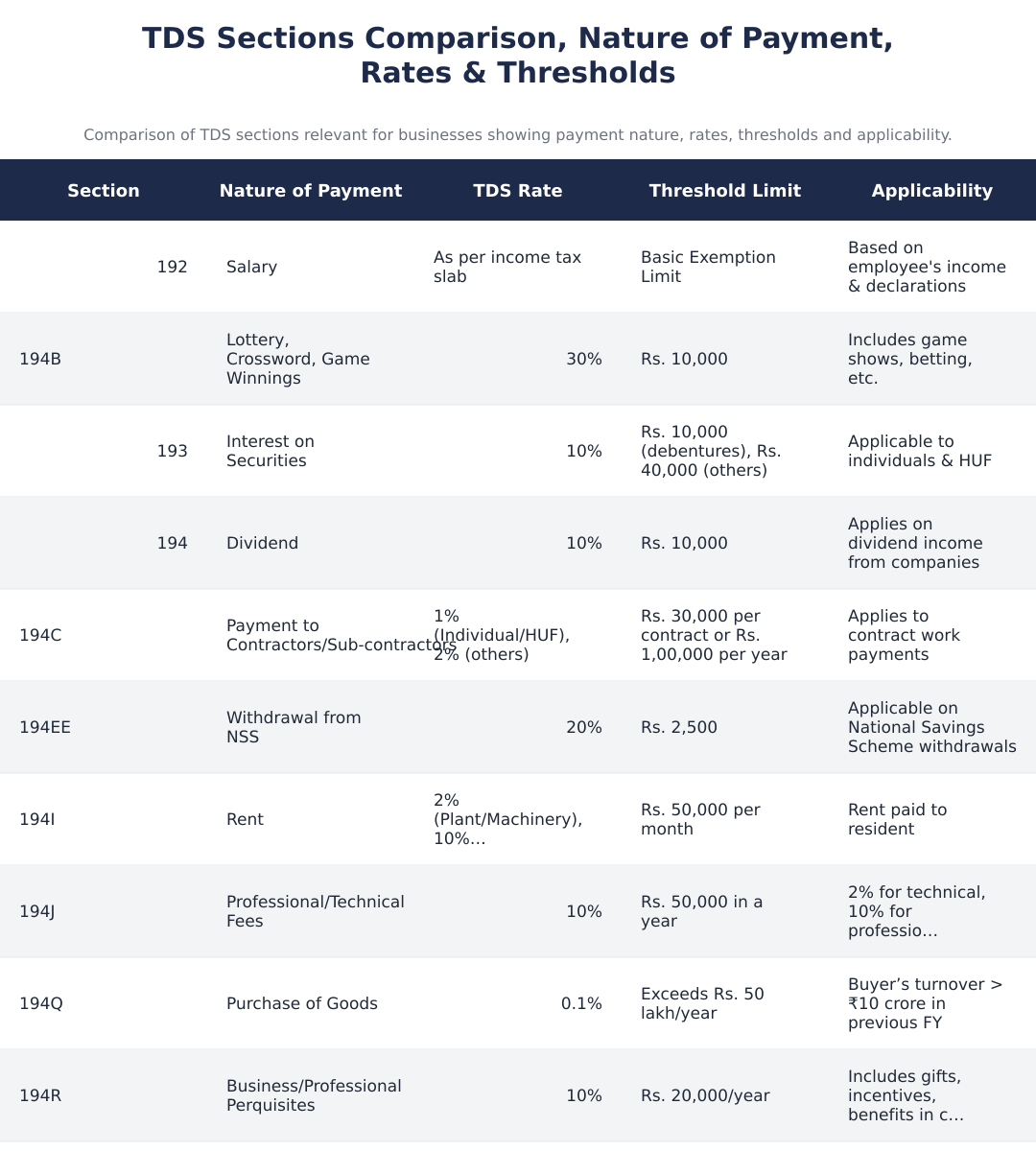
Important TDS Section for Businesses
| Section | Nature of payment |
|---|---|
| Section 192 | TDS on salary |
| Section 194B | TDS on lottery, crossword and game winnings |
| Section 193 | TDS on interest on securities |
| Section 194 | TDS on dividend |
| Section 194C | TDS on payments to contractors/sub-contractors |
| Section 194J | TDS on professional/technical fees |
| Section 194Q | TDS on purchase of goods |
| Section 194R | TDS on business/professional perquisites (gifts, incentives, benefits) |
Due Date for Paying TDS
Businesses must deposit the tax deducted to the Government within the specified due dates. The law requires timely deposit so that the deductee gets credit for the tax withheld and to maintain compliance records.
Alongside depositing TDS, periodic filing of TDS returns is mandatory within the prescribed due dates. Maintaining calendars for deposit and return filing inside accounting and payroll workflows helps prevent missed deadlines and administrative issues during assessments or reconciliations.
Interest, Late Filing Fee and Penalty on Non-Deposit of TDS and Non-Filing of TDS Statements
Non-deposit of tax deducted at source or failure to file TDS statements within prescribed timelines can lead to regulatory consequences. Businesses should treat TDS compliance as a priority financial control to avoid downstream disputes and costs.
To reduce exposure, reconcile TDS deducted in payroll and supplier ledgers with deposited amounts and TDS returns regularly. Where discrepancies arise, address them promptly through corrective filings or professional advice so that deductees receive correct tax credit and the business maintains a clean compliance record.
Frequently Asked Questions
Which certificate should I issue after deducting TDS? Issue Form 16 to people receiving salary and Form 16A for recipients of other income where TDS has been deducted; Form 16B applies for TDS on sale of immovable property.
What happens if the payee does not provide PAN? If the payee’s PAN is not available, higher TDS rates apply under the Income Tax Act. Therefore, collect and validate PAN at onboarding and insist on PAN for vendors and assessees who receive reportable payments.
How do I know which rate to apply? TDS rates must be taken as per the relevant sections provided in the Income Tax Act, 1961; classify the payment under the applicable section before applying the rate.
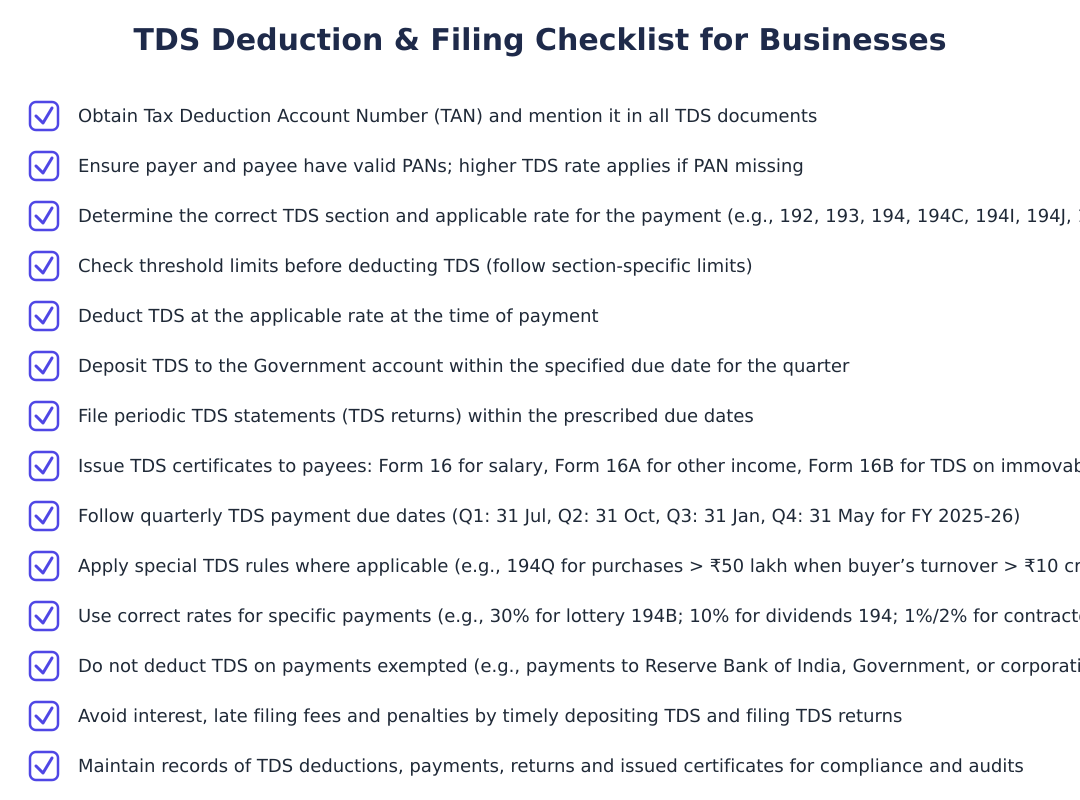
What routine checks help maintain TDS compliance? Maintain TAN on all TDS documents, reconcile deducted and deposited amounts regularly, file TDS returns within the prescribed timelines, and issue the required TDS certificates to payees.
TDS is an integral compliance area for businesses that make a range of payments. By identifying the correct section for each payment, collecting PAN details, obtaining TAN, deducting at the legally prescribed rate, depositing the tax and filing returns on time, and issuing the requisite certificates, businesses can minimise risk and ensure payees receive proper tax credit. Use this guide to build simple controls around these steps and consult a tax professional for complex situations.
Frequently asked questions
What is TDS for a business and why do I need to deduct it?
TDS (Tax Deducted at Source) for a business is tax that a payer must deduct from certain payments made to vendors, contractors, employees or others and deposit with the government. Businesses must deduct TDS to comply with the Income Tax Act, 1961, and avoid liability for the tax, interest and penalties that apply if they fail to deduct or deposit TDS; common payments subject to TDS include salaries, contractor fees, rent, professional fees, dividends and purchases above specified thresholds. Deducted TDS must be deposited within prescribed due dates and reported in periodic TDS returns, and the payee is issued a TDS certificate (e.g., Form 16 or 16A) so they can claim the credit. Failure to obtain TAN or follow rates and thresholds can increase the payer’s exposure and lead to higher withholding rates if PAN is missing.
When should a business deduct TDS on payments to contractors?
A business should deduct TDS on contractor or sub-contractor payments when the amount per contract exceeds the threshold, Rs. 30,000 per contract or Rs. 1,00,000 in aggregate in a year, and at the applicable rate of 1% for payments to individuals/HUFs and 2% for others under Section 194C. The payer must have the contractor’s PAN to apply the normal rate; absence of PAN attracts a higher rate of TDS. The deducted tax must be deposited and reported in the quarterly TDS return and a Form 16A issued to the payee.
What are the due dates for depositing TDS for each quarter?
The due dates for depositing TDS are tied to quarterly periods and for FY 2025-26 the deposit due dates are: 31st July 2025 for Apr–Jun, 31st October 2025 for Jul–Sep, 31st January 2026 for Oct–Dec, and 31st May 2026 for Jan–Mar. These are the dates by which the deducted tax must be paid to the government for the respective quarters. Missing these dates can attract interest and penalties, so businesses should calendarize deposits and file the corresponding quarterly TDS returns timely.
What are the common TDS sections and their rates that a business should know?
Common TDS sections businesses should know include Section 192 (salary: as per income tax slab), 194 (dividend: 10% above Rs. 10,000), 194C (contractor payments: 1% for individual/HUF, 2% for others), 194I (rent: 2% for plant/machinery, 10% for land/building above Rs. 50,000/month), 194J (professional/technical fees: generally 10%, with 2% for certain technical fees), 194Q (purchase of goods: 0.1% when purchases exceed Rs. 50 lakh in a year and buyer’s turnover > Rs. 10 crore), and 194R (perquisites: 10% above Rs. 20,000/year). Each section has its own threshold limits and applicability, so apply the specific rate and limit relevant to the payment type.
What happens if the payee doesn’t provide PAN to the payer?
If the payee does not provide a PAN, the payer must deduct TDS at a higher rate rather than the normal prescribed rate; this increased rate is meant to discourage non-compliance. The elevated rate applies until the payee furnishes a valid PAN, and the payer should retain evidence of PAN requests and TDS deduction to justify the withholding. Additionally, the payer should still deposit the tax and report it in the TDS return and issue the appropriate TDS certificate once PAN details are available or as required.
What forms must a business issue after deducting TDS?
After deducting TDS a business must issue the relevant TDS certificates: Form 16 for salary recipients, Form 16A for non-salary payments (e.g., contractor, professional fees), and Form 16B for TDS on sale of immovable property. These forms certify the amount of TDS deducted and allow the recipient to claim tax credit against their tax liability; they must be issued within the prescribed timelines tied to filing TDS returns. Proper issuance of these forms is also essential for the payee to reconcile and claim the deducted tax while filing their income tax return.
Do I need a TAN to deduct and deposit TDS for my business?
Yes, you must obtain a Tax Deduction Account Number (TAN) and quote it in all TDS documents because TAN is mandatory for depositing TDS and filing TDS returns. TAN should appear on challans, TDS returns and certificates; failure to obtain or quote TAN can lead to penalties and complications in compliance. Apply for TAN well before you start deducting TDS and ensure you use the same TAN consistently across filings.
What are the consequences for non-deposit or late deposit of TDS and late filing of TDS returns?
Consequences include interest on late deposit of TDS, late filing fees, and penalties under the Income Tax Act; interest is charged from the date tax was deductible to the date of actual deposit. Penalties may also be levied for failure to file TDS statements or issue certificates on time, and persistent defaults can attract prosecution in severe cases. To limit exposure, businesses should follow the deposit due dates for each quarter and file accurate TDS returns, and maintain records of deductions, deposits and communications with payees.
When does Section 194Q on TDS for purchase of goods apply to buyers?
Section 194Q applies when a buyer’s purchases from a seller exceed Rs. 50 lakh in a financial year and the buyer’s turnover in the previous financial year is more than Rs. 10 crore; the buyer must deduct TDS at 0.1% on such purchases. The obligation lies with the buyer to verify turnover and aggregate purchases, and if applicable, to deduct and deposit the TDS and report it in their TDS return. If the seller has deducted tax under other sections or the seller provides documents under section 206C(1H) as applicable, the buyer should coordinate to avoid double withholding.
Need help staying TDS compliant?
MoneyGence's AI Finance OS tracks your compliance, wallet share, and finances in one place, built for agencies and growing businesses.
Get started with MoneyGence