TDS Interest Calculator, Compute Late TDS Interest Online
A TDS (Tax Deducted at Source) interest calculator helps employers, payers and accountants estimate the interest payable when TDS is short deducted or deposited late. This guide explains what inputs the calculator needs, how it works in broad terms, and how to use an online calculator to arrive at an interest liability. Understanding and estimating TDS interest is important for budgeting cash outflows, ensuring timely compliance, and avoiding surprises during assessments or audits. In this article you will learn which inputs are essential for the calculation, the general mechanics behind interest computation, how to use an online tool to obtain an estimate, what to expect from the calculator output, and practical benefits of using such a tool. The explanations are deliberately practical so you can apply them whether you use a web-based calculator, an in-house spreadsheet, or tax software.
How Does TDS Late Payment Interest Calculator Work?
A TDS interest calculator models the financial consequence of delayed deduction or late deposit of tax deducted at source. At a high level it measures the monetary cost of the period between when tax should have been paid and when it was actually deposited or is expected to be deposited. The output is an estimate of the interest the deductor should plan to pay to regularise the shortfall.
Behind the scenes the calculator combines three basic elements: the shortfall amount (the difference between tax that ought to have been deducted/deposited and what actually was), a time dimension that captures the duration of default, and the applicable interest parameters that determine the per-period cost of the shortfall. The tool applies these inputs consistently across the default period to produce a total interest figure.
Most calculators are designed to handle simple variations such as partial payments during the default period or changes in the outstanding amount. They typically provide an itemised breakdown or a single consolidated interest figure so users can understand how the total was derived and keep that documentation for records or discussions with advisors.
How to Calculate TDS Interest Online?
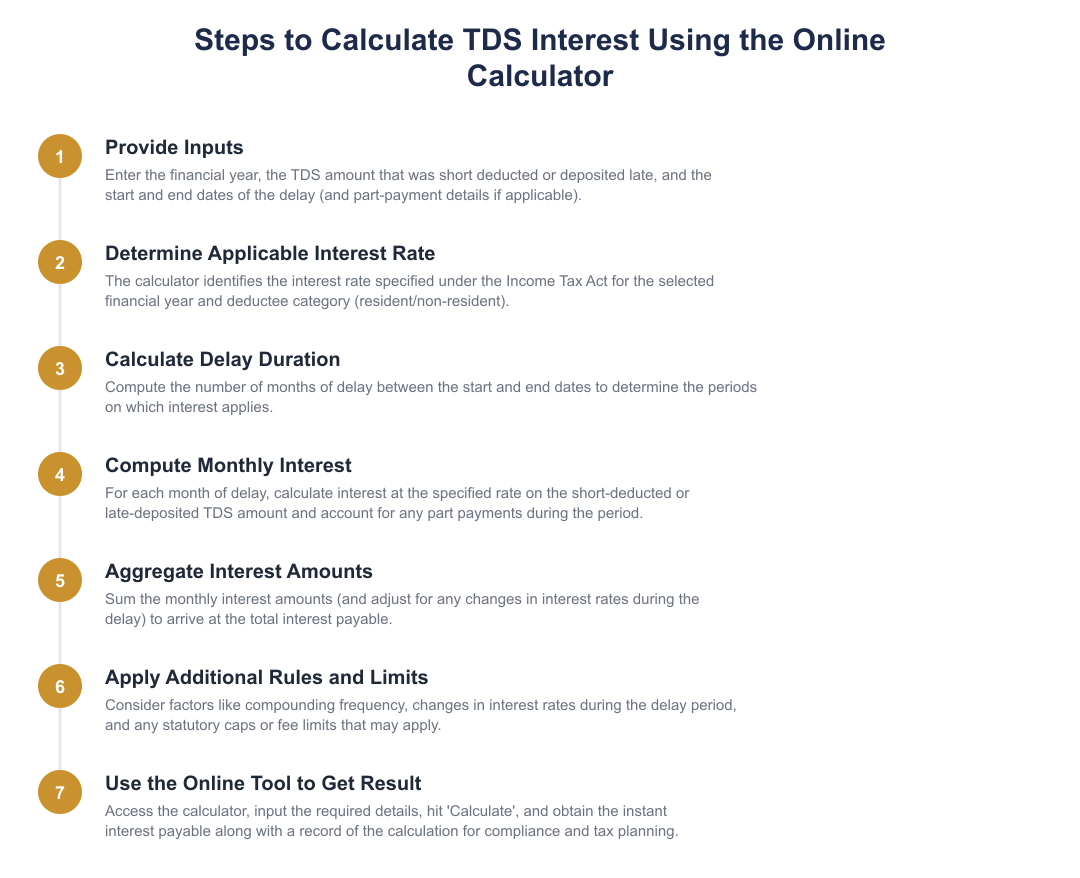
Select or enter the financial year for which the TDS was deducted or should have been deposited. This helps the tool align with the relevant period of default.
Input the monetary amount of TDS that was either short deducted or deposited late; this is the principal on which interest is calculated.
Enter the start date and end date (or the duration) representing when the delay began and when the tax was/will be deposited; the calculator uses this to measure the time dimension of interest.
Submit the inputs to obtain an estimated interest payable; some tools may allow uploading part-payment details or exporting the calculation for records.
TDS Interest Calculation Formula
Conceptually, interest on TDS defaults is computed by applying an interest rate to the outstanding shortfall for the duration of default. The simple structure involves three components: principal (the shortfall), time (measured in days, months or years depending on the tool), and the applicable interest rate. The calculator multiplies the outstanding amount by the rate and prorates it for the applicable period to arrive at the interest for each interval.
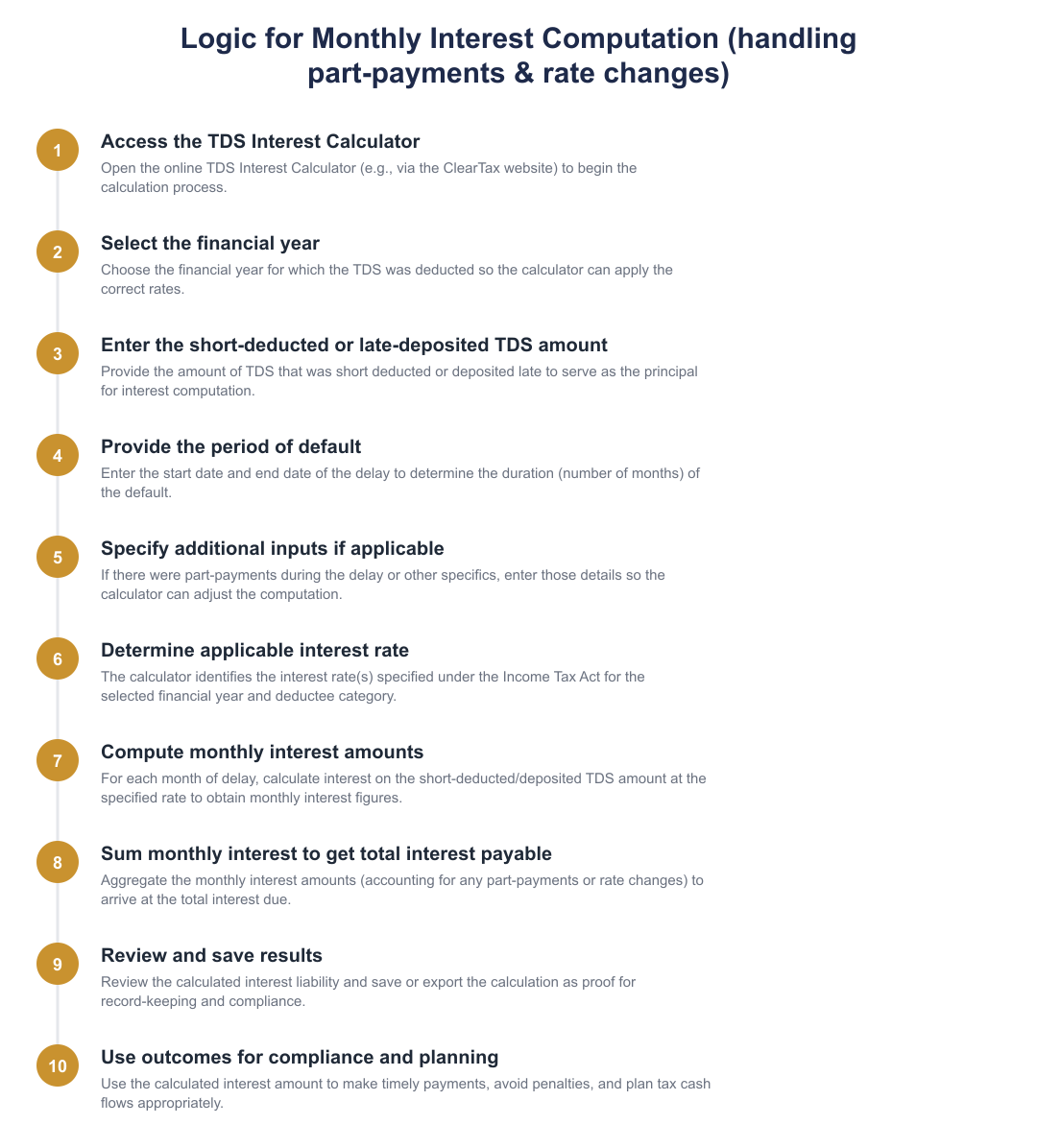
A practical calculator will iterate this computation across the entire default period: when amounts change because of partial payments or when the outstanding figure is constant, the tool recalculates the interest for each sub-period and then sums those values. Some calculators display the month‑wise or period‑wise interest breakup so users can validate each component of the result.
Keep in mind that the numerical rate and exact method of prorating (daily, monthly, or otherwise) are determined by statute or prevailing instructions; the calculator is a mechanical aid that applies the chosen rate consistently to produce an estimate.
Example for TDS Interest Calculation:
Rather than giving a numeric example, consider a hypothetical scenario to understand interpretation: you identify a shortfall for a given financial year, determine the period during which that shortfall remained unpaid, and feed those inputs into a calculator. The tool will return an interest amount that represents the cost of that delay over the specified period.
When reviewing the result, check whether the calculator shows a period-wise breakup and whether it accounts for any interim payments you may have made. If you made part-payments during the default period, confirm that the outstanding principal was reduced for the remaining duration in the tool’s workings. This helps ensure the estimate matches the real cash flow situation.
Benefits of TDS Interest Calculator
A calculator provides quick visibility into potential interest liabilities, enabling better cash-flow planning and timely corrective action. Instead of manual arithmetic across multiple periods, a tool produces a consistent estimate that can be reviewed and saved for internal records or for discussion with tax advisors.
Using an online or software-based calculator reduces the risk of arithmetic errors and saves time, particularly when dealing with multiple defaults or staggered partial payments. The output also helps those responsible for compliance to prioritise payments and understand the financial impact of delays.
Finally, having a documented calculation, showing inputs and the resulting interest amount, can be useful when reconciling books or explaining the interest paid during assessments, audits or internal reviews.
Frequently Asked Questions
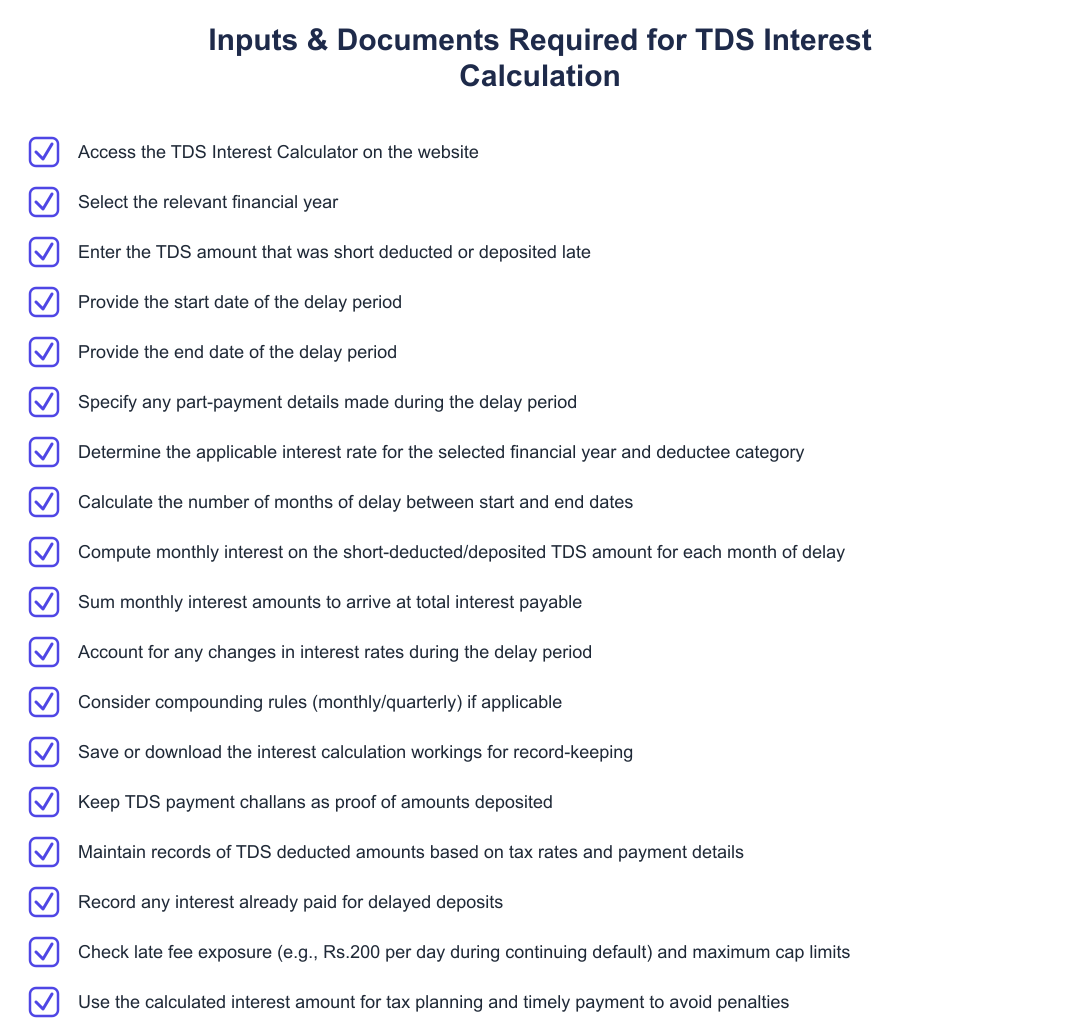
Q: What inputs does a TDS interest calculator require? A: At a minimum the calculator requires the financial year, the amount of TDS that was short deducted or deposited late, and the period of default (start and end date).
Q: Can the calculator handle part-payments or changing outstanding amounts? A: Many calculators are designed to accept interim payments and will recalculate interest for each sub-period; always verify the tool’s handling of such scenarios and review any period-wise breakdown it provides.
Q: Should I treat the calculator output as final? A: The calculator produces an estimate based on the inputs and the rate/method it uses. It is a useful planning and compliance aid, but final legal or assessment positions should rely on official rules, statutory computations and, where necessary, professional advice.
A TDS interest calculator is a practical aid to estimate the cost of late deduction or deposit of TDS. By providing the financial year, the shortfall amount and the period of default you can obtain a quick estimate that helps with compliance planning and record‑keeping. Use the calculator’s breakdowns to validate interim payments and consult a tax professional for final assessment positions.
Frequently asked questions
What is a TDS interest calculator and why should I use it?
A TDS interest calculator is an online tool that computes interest payable for late deduction or late deposit of TDS under the Income Tax Act. It quickly estimates the interest liability by taking the short-deducted or late-deposited TDS amount, the delay period and the applicable interest rate, helping deductors avoid manual errors and penalties. The tool is useful for compliance, tax planning and record-keeping because it produces clear workings you can save as proof during assessments. Many calculators also handle complexities like part-payments and changing interest rates to give a more accurate result.
How does a TDS late payment interest calculator work?
The calculator works by taking user inputs, determining the applicable interest rate for the financial year and then applying that rate to compute monthly interest on the short-deducted or late-deposited TDS amount. It first asks for the financial year, amount of short/late TDS and the start and end date of default, then computes the number of months of delay and applies the specified monthly interest to each month and sums the amounts. The tool can also account for different rates for residents versus non-residents, part-payments during the delay, and any changes in rates over the period. The final output is the total interest payable for the delay period and the TDS shortfall.
How do I calculate TDS interest online using the Cleartax tool?
To calculate TDS interest online using the Cleartax tool you select the relevant financial year, enter the TDS amount that was short deducted or deposited late, and provide the start and end date of the delay before clicking Calculate. If there were part-payments you can specify those details so the calculator prorates interest appropriately, and the tool will automatically pick the prescribed interest rate for the selected period. Within seconds it displays the total interest payable and the month-wise breakup so you can reconcile payments and plan compliance. You can then save or print the calculation for your records or tax assessment.
What is the formula used for TDS interest calculation?
The core formula is: Interest = (Short/late TDS amount × Applicable annual interest rate × Number of months of delay) / 12, applied month-wise and summed up for the entire default period. The calculator typically computes interest for each month of delay using the annual rate divided by 12 and sums monthly interest amounts; if part-payments occur, the outstanding principal for subsequent months is reduced accordingly. Different categories (resident vs non-resident) or changes in notified rates for different periods are handled by applying the relevant rate for each month. Some tools offer optional compounding methods if interest compounding is to be considered for specific scenarios.
Can you show an example of TDS interest calculation?
Yes, for example, if TDS of Rs.100,000 was deposited 3 months late and the applicable annual interest rate is 1.5% per month equivalent to 18% p.a., the monthly interest would be (100,000 × 18%)/12 = Rs.1,500, and for 3 months the total interest = Rs.4,500. A calculator will perform this month-by-month, adjusting the outstanding if any part-payment was made mid-period, and will reflect rate changes if different months have different prescribed rates. The example output usually includes a month-wise schedule and the final total interest payable for easy reconciliation. Remember to use the exact rates notified for the relevant financial year and taxpayer category when computing actual liability.
What inputs do I need to use the TDS interest calculator accurately?
You need to provide the financial year, the exact amount of TDS that was short deducted or deposited late, and the period of default with start and end dates; optionally include details of any part-payments during the delay. Accurate dates are important because the tool calculates the number of months of delay and applies the rate month-wise, and part-payments reduce the outstanding principal for subsequent months. Some calculators may also ask for deductee category (resident/non-resident) so they can pick the correct interest rate schedule. Providing correct inputs ensures the computed interest liability matches the statutory requirement.
How does the calculator handle part-payments and changing interest rates during the default period?
The calculator prorates interest by reducing the outstanding TDS principal from the month following any part-payment and applies the applicable rate for each month, and if rates change during the default period it applies the rate that corresponds to each month. For example, if you paid half the short TDS after two months, interest for months three onwards is computed on the reduced balance; if the notified annual rate changed in month three, the new rate would be used from that month. This month-wise approach ensures precise interest computation even when both payments and rates vary over the default period. If compounding is relevant, some calculators offer that option but statutory interest on TDS is typically calculated on simple interest basis unless specified otherwise.
What are the benefits of using a TDS interest calculator?
The main benefits are convenience, accurate compliance and better tax planning, you can get an instant, error-free interest estimate without lengthy manual calculations. It helps avoid penalties by showing the interest payable so deductors can correct defaults promptly, and the calculation output provides documentation you can save for record-keeping and tax assessments. The tool also handles complex situations like part-payments and rate changes, allowing more precise liability estimates and thereby improving cash-flow and compliance decisions. Many calculators are free and accessible online, saving time and effort for finance teams and taxpayers.
What supporting documents should I keep after calculating and paying TDS interest?
Keep TDS payment challans showing the amount deposited, evidence of TDS deducted based on tax rates and payment amounts, and records of any interest paid for delayed deposits as supporting documents. These documents substantiate that the TDS and the computed interest were deposited, and they are important for reconciling with Form 26Q/24Q/26QB/27Q and for responding to any notices during assessments. Also save the calculator output or a screenshot of the month-wise interest schedule as a working paper to demonstrate how the interest figure was derived. Retain these records for at least the statutory period as they may be required during audits or enquiries.
Need help staying Calculators compliant?
MoneyGence's AI Finance OS tracks your compliance, wallet share, and finances in one place, built for agencies and growing businesses.
Get started with MoneyGence