TDS on Reimbursement of Expenses: Complete Guide for Businesses
This guide explains how tax is treated when one party reimburses another for expenses, a common situation between businesses, contractors, vendors and non-resident service providers. You will learn how to distinguish a pure reimbursement from a payment that effectively contains a service element or profit, and why that distinction matters for tax withholding. The guide focuses on the practical consequences for payers: when you must withhold tax at source, what documentation helps establish the nature of the payment, and how to structure invoices and contracts to reduce ambiguity. It also walks through typical scenarios (contractor reimbursements, travel claims, payments to non-residents) and gives clear examples showing when withholding is required versus when it may not be. Although tax law can be complex and fact-sensitive, this guide highlights the single controlling principle that determines withholding in reimbursement cases and offers practical steps businesses can adopt to achieve correct withholding treatment and maintain defensible records. If you are responsible for accounts payable, vendor management, or tax compliance, this guide will help you identify risk points in reimbursements and adopt simple documentation and invoicing practices that reduce disputes and audit exposure.
What is TDS on Reimbursement of Expenses?
Withholding tax (TDS) on reimbursements is the practice of deducting tax at source when a payer makes a payment that may include compensation for services, profit, or merely repayment of expense outlays. The key concern for the payer is whether the payment is purely a pass-through of costs or whether it also contains a service component that represents income to the recipient.
For compliance teams, the distinction affects whether tax should be deducted before making payment. Properly documenting the nature of the payment and ensuring invoices distinguish between recoverable expenses and service fees reduces uncertainty and helps demonstrate the correct withholding treatment to tax authorities.
General Principle of TDS Applicability
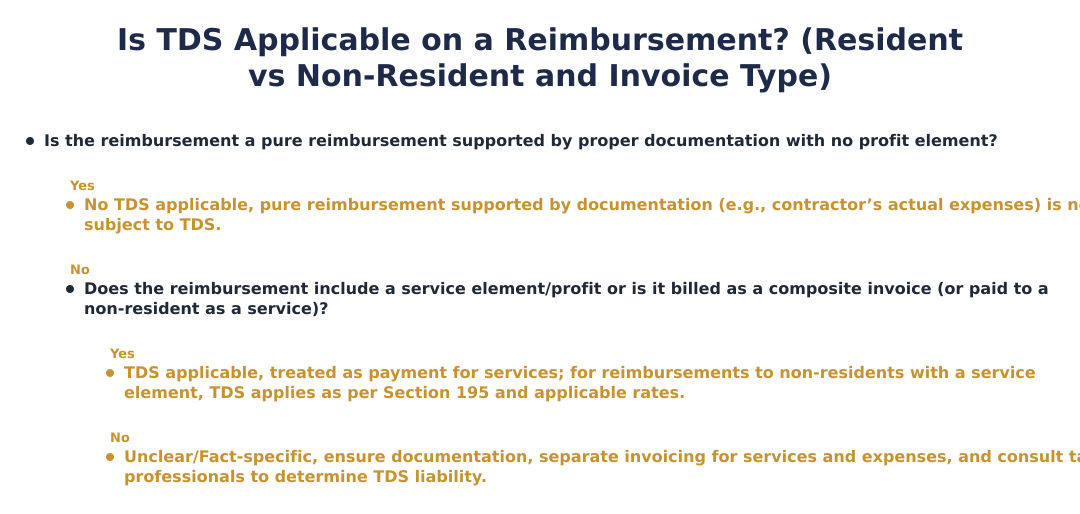
The decisive point in withholding decisions is whether the reimbursement carries a service element or profit. If a reimbursement is purely a pass-through of third-party costs, many payers treat it differently than a payment for services. However, where the payment includes a service fee or any profit element for the recipient, tax withholding becomes relevant.
Practically, this means that assessing the invoice and the underlying contract is essential: an invoice that separates expense items from service charges makes it easier to identify the taxable component. When the expense portion is clearly supported by third-party receipts and no mark-up is present, the argument for not withholding is stronger; when the supplier bundles expenses with a charge for services or marks up those expenses, withholding should be considered.
Is TDS Applicable on Reimbursement of Expenses?
The single guiding factual rule to apply is: if the reimbursement includes a service fee or profit element, TDS will be applicable as per the rates prescribed under Section 195. This means that when a payment conveys income to the recipient (through a fee or margin), withholding obligations can arise under the law referenced.
Therefore, payers must evaluate each reimbursement line: if it is income in the hands of the payee, withhold; if it is purely a reimbursement supported by documentation and without any profit, the withholding requirement is less clear and depends on whether the payment qualifies as non-taxable passthrough, for such cases, careful documentation and clear invoicing are essential to support the payer's decision.
Specific Scenarios of TDS on Reimbursement of Expenses
Contractor payments, travel reimbursements and payments to non-residents commonly raise questions about withholding. In each scenario, the same test applies: examine whether the reimbursement includes any component that effectively compensates the recipient beyond mere out-of-pocket costs. If so, withholding is required.
Businesses should treat each scenario on its facts. For example, a contractor who issues a single composite invoice that mixes service charges and disbursements creates ambiguity, this increases the likelihood that a tax authority will view part of the payment as taxable income, triggering withholding. By contrast, separate invoicing and direct evidence of third-party bills reduce this ambiguity.
Practical Steps to Reduce Withholding Risk
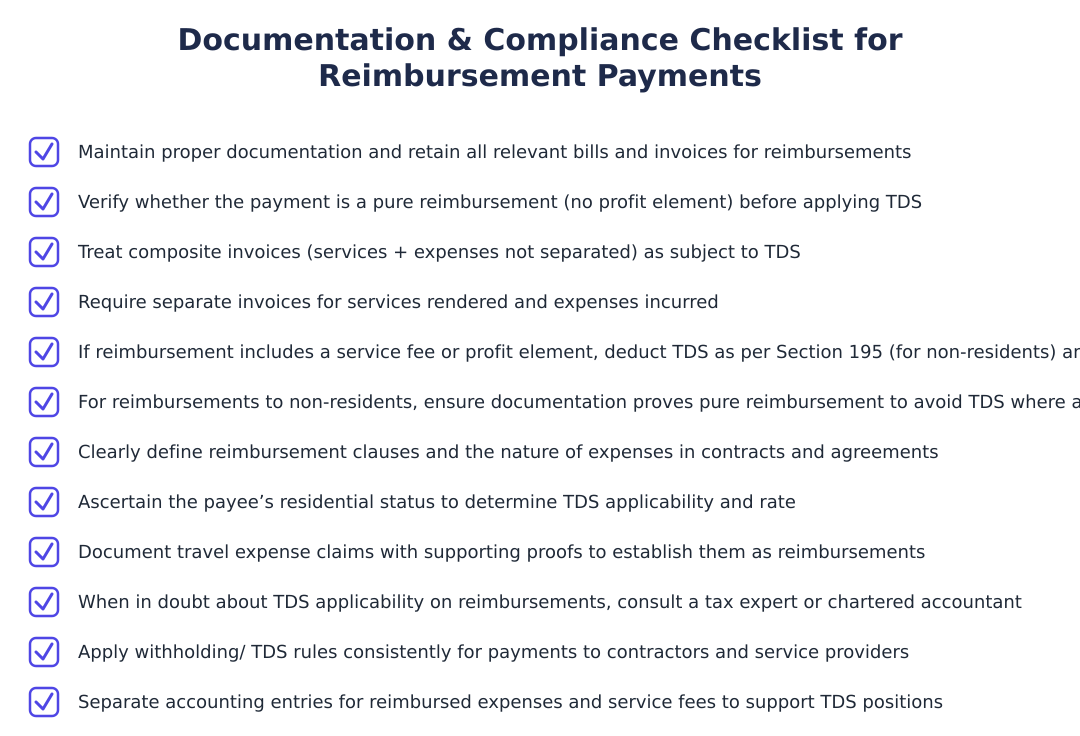
Documentation: Preserve supporting bills, receipts and vouchers for all reimbursed items so the payer can demonstrate these were out-of-pocket costs, not income. Clear documentary trails are the primary defence against assertions that reimbursements included a service element.
Invoicing and Contracts: Ask suppliers to issue separate invoices showing (a) the service/fee component and (b) reimbursable expenses with underlying receipts referenced. Contracts should explicitly state whether expenses will be reimbursed at cost and whether any mark-up is permitted. When expenses are billed separately and supported by third-party receipts, it becomes easier to justify non-withholding on the reimbursement portion.
Examples Illustrating TDS on Reimbursement of Expenses
Example, Composite invoice vs separate billing: If a supplier issues a composite invoice that intermingles a service fee and expense recoveries without separation, a payer may have to withhold tax because the payment likely contains a service element. Conversely, when the supplier presents a separate line for expenses with supporting bills and no mark-up, the payer can more confidently treat that part as a reimbursement rather than income.
Example, Payments to non-residents: The same principle applies to payments abroad, if the reimbursement to a non-resident contains a service fee or profit element, withholding will be applicable under the legal rule referenced earlier. For purely supported pass-through reimbursements without profit, careful documentation is again the key to reducing withholding risk.
Correctly treating reimbursements requires examining the substance of the payment, not merely its label. The core rule to remember is: where reimbursements include a service fee or any profit element, tax withholding applies under Section 195. To minimise disputes, maintain transparent invoicing, keep original supporting documents, and reflect reimbursement mechanics clearly in contracts. When in doubt on complex or cross-border cases, consult a tax professional who can apply the legal principles to the specific facts.
Frequently asked questions
Is TDS required on a pure reimbursement of expenses paid to a contractor?
No, TDS is not required on a pure reimbursement of expenses to a contractor if the payment is merely a repayment of actual costs supported by bills and there is no profit or service element. For instance, if a contractor pays for material or travel on behalf of the client and raises a separate bill for those costs with supporting invoices, that amount is treated as reimbursement and not chargeable to tax. However, if the contractor issues a composite invoice combining service charges and expenses without separation, the whole amount may attract TDS under the relevant provision (e.g., Section 194C/194J as applicable). Always keep clear supporting documents and, where possible, separate invoices to avoid dispute.
When will reimbursement of travelling expenses attract TDS?
Reimbursement of travelling expenses will not attract TDS when it is a pure reimbursement supported by bills and there is no mark-up or service charge included. For example, if an employee or contractor submits travel bills and is reimbursed the exact amounts with original tickets and bills, such payments are not deemed income and are not subject to TDS. But if the payer treats travel reimbursement as part of professional or contractual fees (or the provider issues a single composite invoice), then TDS may be deductible under the applicable section like 194C or 194J.
Does reimbursement to a non-resident attract TDS under Section 195?
Reimbursement to a non-resident does not attract TDS under Section 195 if it is a pure reimbursement supported by proper documentation and there is no income element; otherwise Section 195 applies. If the payment includes any service element, profit or mark-up, it becomes income for the non-resident and is chargeable to tax in India, requiring tax withholding at the rates prescribed under Section 195 or the applicable tax treaty. Always obtain invoices and, if in doubt, seek a withholding tax certificate or obtain a nil or lower deduction certificate from the Income Tax Department to avoid incorrect deduction.
What constitutes a 'composite invoice' and why does it cause TDS liability?
A composite invoice is an invoice that mixes reimbursable expenses with service or supply charges without separately identifying each element, and it causes TDS liability because the entire invoice may be treated as income. When expenses and fees are not segregated, the payer cannot reliably determine what portion is mere repayment versus taxable consideration, so tax authorities and courts often treat the whole amount as chargeable to tax, attracting TDS under the relevant section (for example 194C for contractors). To avoid this, suppliers should issue separate invoices for expenses and for the service/fee component with supporting bills attached.
What judicial precedents or circulars support non-deduction of TDS on pure reimbursements?
Several judicial decisions and CBDT circulars have held that pure reimbursements backed by bills are not taxable and thus not subject to TDS, provided there is no element of profit or service. Courts have consistently emphasized the need for clear documentation, separate invoicing, and demonstration that the payer merely passed on costs; administrative rulings and circulars reinforce that mere repayment of expenditure does not create income. However, these rulings also caution that if the arrangement shows a profit margin, composite billing, or if the recipient is carrying on a business rendering services, TDS may still be required under the relevant provisions.
What documentation should a business maintain to show reimbursements are not taxable?
A business should maintain original supporting bills, vendor invoices, purchase orders, delivery challans, payment proofs and separate reimbursement invoices to substantiate that payments are pure reimbursements. Clearly labelled vouchers showing the nature of expense, copies of third-party invoices addressed to the payer or client, and separate accounting entries help demonstrate there is no income component. Proper documentation not only prevents incorrect TDS deductions but also strengthens your position in assessments or disputes where tax authorities scrutinize the nature of the payment.
How should businesses structure contracts to avoid unnecessary TDS on reimbursements?
Businesses should draft contracts that explicitly define reimbursable expenses, require separate invoicing for expenses and fees, and mandate submission of original supporting bills to ensure reimbursements are treated as non-taxable. Clauses should state that reimbursable items are pass-through costs with no mark-up; this contractual clarity helps both parties and tax authorities distinguish between expense repayment and taxable consideration. It is also advisable to include a clause requiring vendors to issue separate invoices and to consult tax advisors when dealing with cross-border reimbursements or ambiguous cost allocations.
If a reimbursement is partly a fee and partly expenses, how should TDS be applied?
If a payment contains both a fee (taxable) and reimbursed expenses (non-taxable), TDS should be applied only on the taxable portion, provided the components are separately billed and supported by documents. The payer must ask the payee to issue distinct invoices: one for the service or fee subject to TDS and another for expense reimbursements with original bills attached; TDS is then deductible on the invoice that represents consideration. If the payee issues a single composite invoice, the payer risks having to deduct TDS on the full amount because separation cannot be reliably established.
What practical steps should firms follow to comply with TDS rules on reimbursements?
Firms should (1) obtain and file original bills for every reimbursed expense, (2) insist on separate invoices for fees and reimbursements, (3) maintain clear accounting records showing pass-through payments, and (4) consult tax experts for cross-border or ambiguous cases to determine applicability under sections like 194C/194J/195. Following these steps minimizes the risk of incorrect TDS deductions, ensures easier claiming of credits by recipients, and provides defensible documentation in case of an audit. Additionally, training procurement and accounts teams about these requirements and including reimbursement clauses in vendor contracts will prevent recurrent disputes and compliance gaps.
Need help staying TDS compliant?
MoneyGence's AI Finance OS tracks your compliance, wallet share, and finances in one place, built for agencies and growing businesses.
Get started with MoneyGence