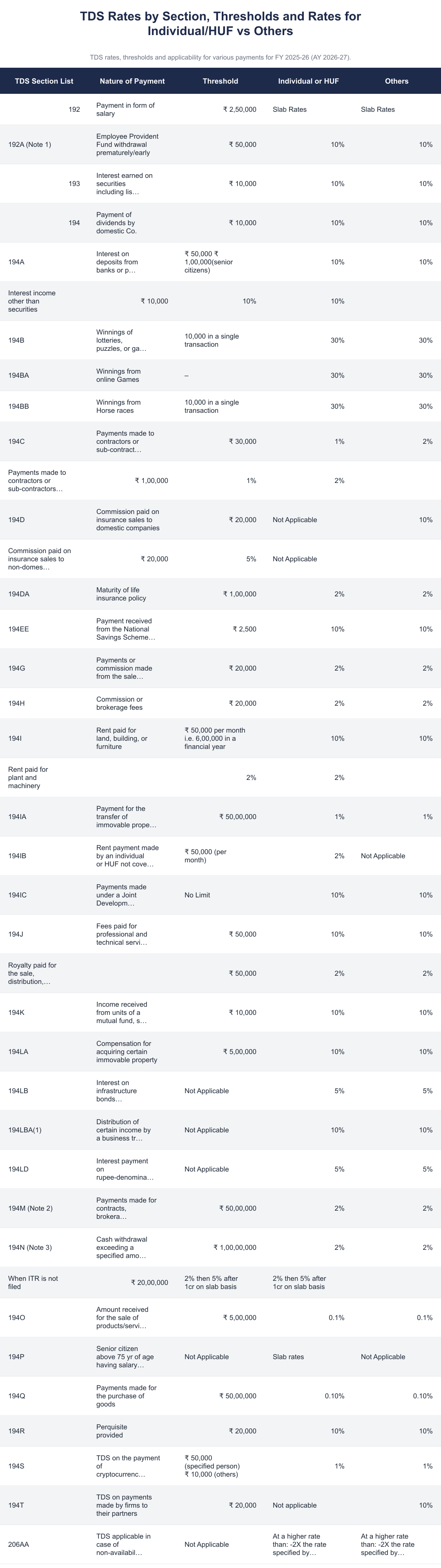
TDS Rates FY 2025-26 (AY 2026-27), Complete Rate Chart
This guide explains the key principles you need to know about Tax Deducted at Source (TDS) with a focus on the important rule that kicks in when a deductee’s PAN is not available. You will learn why TDS exists, how the law treats cases of missing PAN, and practical steps both deductors and deductees should take to avoid higher withholding. Understanding this single rule is crucial because non-availability of PAN can increase the effective withholding on payments and cause cash-flow or compliance problems for the payee. The guide also clarifies how the higher TDS rate is determined under the relevant provision, and highlights how to approach documentation and follow-up to resolve PAN-related issues. While this article does not list specific sectional rates for every type of payment, it focuses on the general mechanics and consequences that apply across TDS provisions when PAN is not furnished. By the end, you will be able to explain to clients or internal teams why furnishing PAN matters, what to expect if it is absent, and how to manage the administrative steps to minimize financial impact and avoid the higher withholding that the law prescribes.
Why TDS exists and who should care
TDS is designed as a mechanism to collect tax at the source of income, ensuring regular inflow to the exchequer and reducing tax evasion. For businesses, professionals, payers and payees, TDS directly affects cash flows: the amount withheld reduces the immediate funds available to the payee and creates a compliance obligation for the deductor to deposit tax and file returns.
Two groups should pay particular attention: deductors (those who must deduct tax before making payments) and deductees (recipients of income who depend on timely credit of TDS to claim relief). Deductors must apply the correct provisions, maintain records and furnish certificates, while deductees must ensure their details, especially PAN, are available and correct so that withholding is done at the appropriate rate.
What happens when PAN is not available: the legal approach
When a deductee does not furnish a PAN to the deductor, the law prescribes a distinct and generally less favourable treatment for withholding. The objective is to encourage filing and correct reporting of income by making non-disclosure costly through higher rates of TDS.
This higher withholding is not an arbitrary penalty; it is a statutory rule that changes the rate used for deduction. The increased rate applies to the withholding calculation and remains relevant until the deductee provides the PAN and any other required documents to the deductor and tax records are updated accordingly.
How higher TDS rate is determined under Section 206AA
| Basis for higher rate (Section 206AA) | Description |
|---|---|
| Twice the rate specified by the relevant provision | The law requires using double the rate that would otherwise apply under the relevant TDS provision. |
| 20% | A flat 20% rate is one of the benchmark rates compared for determining the withholding rate. |
| The rate otherwise applicable under the Act | The currently applicable rate under the Act (for the specific payment) is also considered; the maximum of the three is applied. |
Practical implications and what deductors should do
Deductors should proactively collect PAN and verify it before making payments. Where PAN is missing, they must be aware that the withholding rate may be higher and should communicate this consequence to the payee so it can be resolved promptly. Keeping a process checklist for PAN collection and verification reduces the likelihood of excess withholding and downstream reclaims or disputes.
From an operational perspective, systems should flag records without PAN, and finance teams should have routine follow-up procedures. If higher TDS has been deducted due to non-availability of PAN and the payee later furnishes PAN, the payee may be able to seek credit or a refund according to the tax rules and procedures, but this can involve filings and time, so prevention is preferable.
Comments, updates and staying current
Tax practice is dynamic and organizations should keep processes under periodic review. Public commentary on articles and guidance often includes practitioner questions and clarifications; the page that inspired this guide contains comments with dates that show reader engagement and query trends.
Notably, the comments on the source page include entries dated May 5, 2025, April 2, 2025 and April 12, 2025. Tracking such feedback and official circulars helps tax teams understand common pain points and ensures compliance measures are updated in line with practice and clarifications.
Section 206AA is a critical provision to understand because it makes non-availability of PAN costly through the application of a higher withholding rate, the maximum of twice the prescribed rate, 20%, or the otherwise applicable rate. Deductors should prioritise PAN collection and verification, and deductees should furnish PAN promptly to avoid higher TDS and related compliance work. Regular process checks and attention to practitioner feedback and updates will help minimise disputes and cash-flow disruption.
Frequently asked questions
What is the TDS rate on salary for FY 2025-26 (AY 2026-27)?
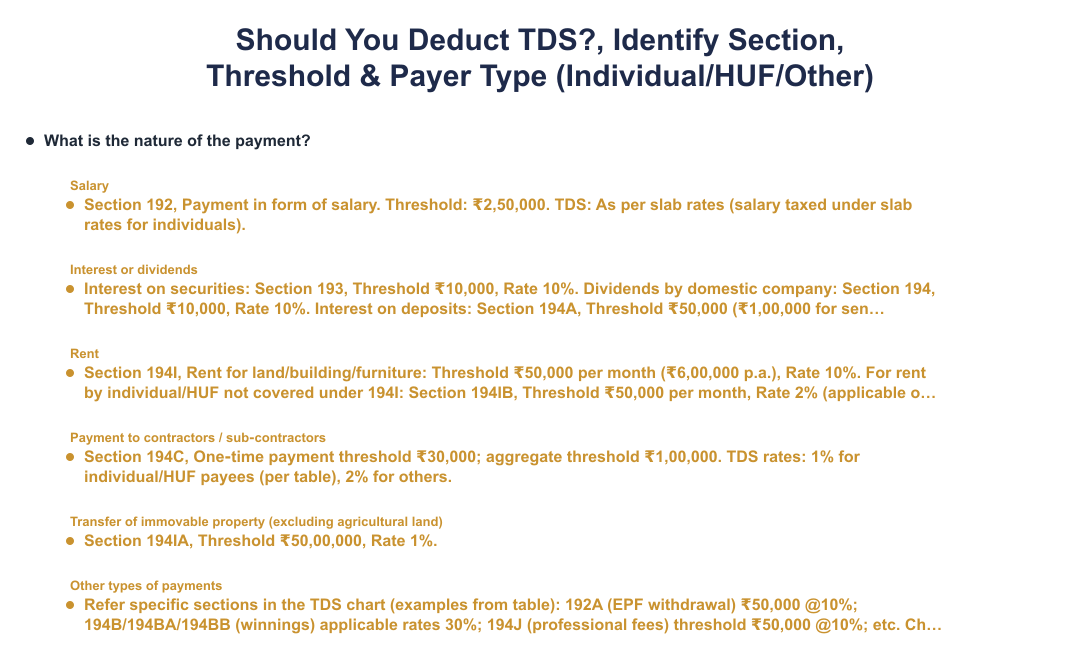
TDS on salary for FY 2025-26 is deducted as per the applicable income-tax slab rates after allowing valid deductions and exemptions. Employers must compute tax on estimated annual salary income and deduct monthly TDS according to individual slab rates (for example, basic exemption limit commonly ₹2,50,000 for general category unless changed by budgetary provisions), factoring in declarations like Form 12BB and investments under Chapter VI-A. If the employee fails to furnish investment proofs or PAN details, higher TDS provisions (such as under section 206AA) may apply. For senior citizens and special cases, available exemptions/reliefs (like higher basic exemption) should be considered while computing TDS.
What is the TDS rate on interest from bank deposits and post office accounts?
Interest on deposits from banks or post offices is subject to TDS at 10% for individuals and others when the aggregate interest in a year exceeds ₹50,000 for regular taxpayers and ₹1,00,000 for senior citizens in specified schemes. For interest other than on securities (like fixed deposits), the basic threshold in some entries is ₹10,000 with TDS at 10%, but many banks follow the ₹50,000 threshold for section 194A; if PAN is not available, higher TDS may apply. Depositors can submit Form 15G/15H (if eligible) to avoid TDS, and the actual tax liability will be determined at return filing after allowing exemptions and slab rates.
What are the TDS rules and rates for rent payments in FY 2025-26?
Rent paid for land, building or furniture is subject to TDS at 10% where monthly rent exceeds ₹50,000 (₹6,00,000 per year threshold), while rent for plant and machinery attracts TDS at 2%. If an individual or HUF (not covered under section 194I) pays rent, section 194IB requires them to deduct TDS at 2% when monthly rent exceeds ₹50,000, applicable only to individuals/HUFs not subject to tax audit. The thresholds are per month for residential/commercial rentals (₹50,000), and failure to deduct attracts interest and penalties; landlords may provide PAN to avoid higher TDS consequences.
What is the TDS rate on payments to contractors and sub-contractors?
Payments to contractors and subcontractors are subject to TDS at 1% for individual/HUF payees and 2% for others on single payments exceeding ₹30,000 or aggregate payments exceeding ₹1,00,000 in a financial year (section 194C). The lower 1% rate for individual/HUF assumes the payee is an individual/HUF and that other conditions for lower deduction are satisfied; if PAN is missing, higher TDS may apply under section 206AA. Specific provisions and exceptions (for transport contractors, etc.) may modify the rate, so payers should verify the nature of services and payee status before deducting.
What is the TDS rate when buying an immovable property (section 194IA)?
Under section 194IA, the buyer must deduct TDS at 1% on the consideration paid for transfer of immovable property (other than agricultural land) when the sale value is ₹50,00,000 or more. The buyer is responsible for depositing this TDS and issuing Form 16B to the seller; failure to deduct attracts interest and penalties for the buyer while the seller can claim credit for the TDS in their income tax return. The threshold is a one-time check on the transaction value, and the deduction applies irrespective of the seller's residential status, though exemptions may apply in limited circumstances.
What is the TDS rate on dividend income from Indian companies and mutual funds?
Dividends paid by domestic companies and mutual fund distributions are subject to TDS at 10% where the aggregate dividend exceeds ₹10,000 in a year under section 194 (dividends) and section 194K (mutual funds). If the recipient's total dividend income is below the threshold or they provide a declaration for lower/no deduction (and conditions are met), TDS may not be applicable; absence of PAN can lead to higher TDS rates. Note that dividend income remains taxable in the hands of the recipient and TDS is only a pre-payment of tax to be claimed in their ITR.
Is there TDS on cryptocurrency or virtual asset payments and what is the rate?
Yes, TDS on payments of cryptocurrencies or other virtual assets is charged at 1% when payments exceed specified thresholds (₹50,000 for specified persons and ₹10,000 for others) under section 194S. The payer is responsible for deducting and depositing the 1% TDS, and this deduction is independent of capital gains tax or other tax treatments of virtual assets; the recipient must include the gross receipts and claim TDS credit while filing return. Because crypto TDS rules are new and specific, both payers and recipients should maintain clear records and PAN to avoid higher withholding rates under section 206AA.
What are the TDS provisions for large cash withdrawals from banks (section 194N)?
Under section 194N, banks deduct TDS at 2% on cash withdrawals exceeding ₹1,00,00,000 in a financial year for taxpayers who have filed their ITR; if the account holder has not filed ITR, special slab rates apply starting at 2% and increasing to 5% beyond ₹1 crore on a slab basis. The TDS is levied on cumulative cash withdrawals from all accounts held by the person in a financial year and applies to specified classes of persons as notified. Taxpayers can avoid or reduce TDS exposure by timely filing their income-tax returns and maintaining adequate documentation for transactions.
What rate applies if PAN is not provided to the deductor (section 206AA)?
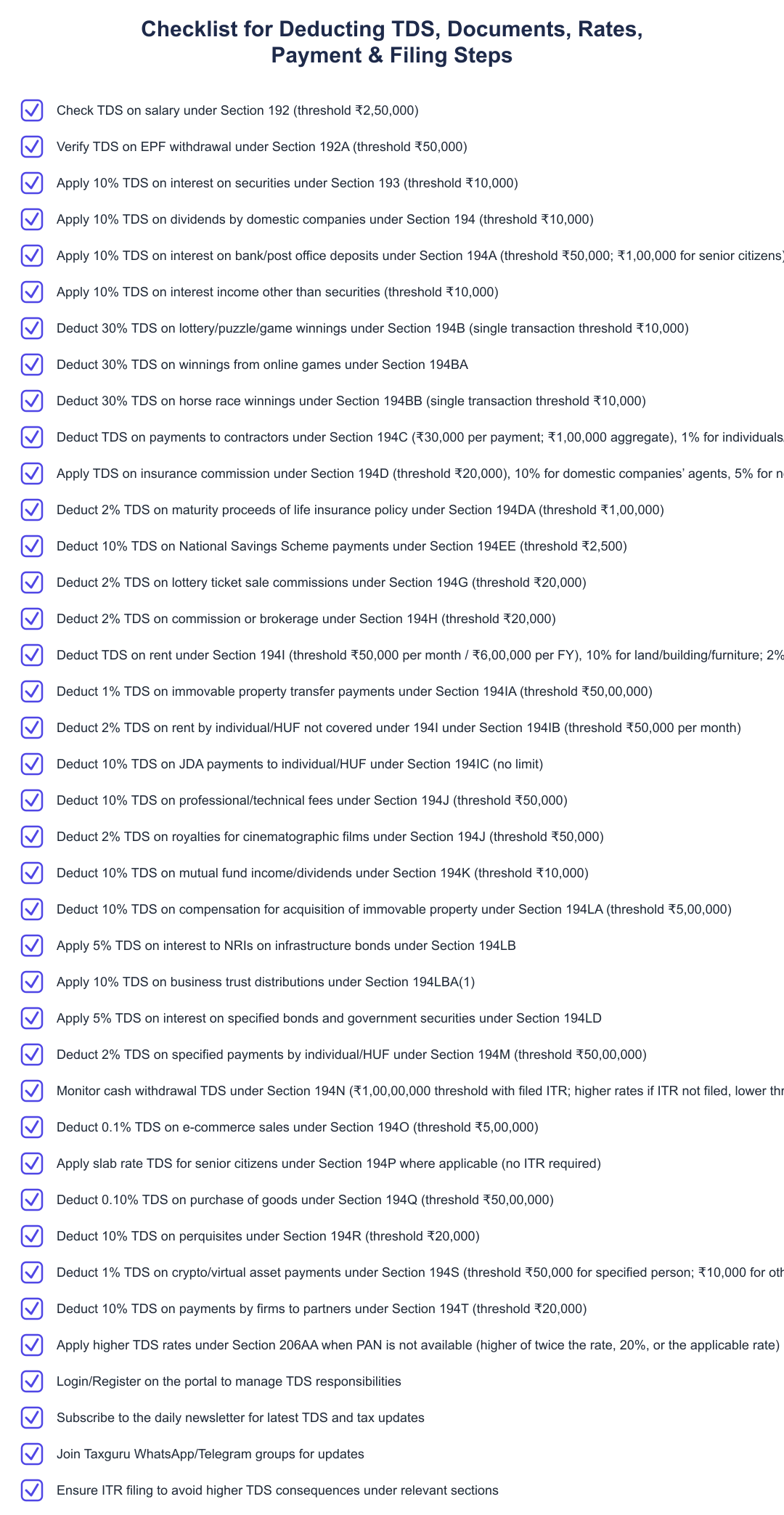
If PAN is not provided by the deductee, TDS must be deducted at a higher of (a) twice the rate specified in the relevant provision, (b) 20%, or (c) the rate specified in the Income-tax Act (whichever is higher) under section 206AA. This means in many cases TDS jumps from normal rates (like 10% or 2%) to 20% or double the statutory rate, thereby increasing tax withheld at source significantly. Deductees should furnish PAN to the payer to avoid this higher deduction and ensure proper credit of TDS in their tax account.
Need help staying TDS compliant?
MoneyGence's AI Finance OS tracks your compliance, wallet share, and finances in one place, built for agencies and growing businesses.
Get started with MoneyGence