TDS Return Filing Guide: Forms 24Q, 26Q, 27Q & 27EQ
This guide explains the basic rules and practical points you need to know about filing TDS returns using the common forms 24Q, 26Q and 27Q. You will learn which kinds of payments each form covers, the broad timelines for filing, why accuracy and timely filing matter, and what preconditions, like having an active TAN, must be met before you can file. Accurate TDS returns are important because the tax department and the payee both rely on the information in those statements: the data you submit feeds into the payee’s Form 26AS and the department uses it to generate TDS certificates (for example, Form 16 and Form 16A). This guide does not replace detailed compliance checklists or software instructions, but it will help you understand which form to use, how returns are generally scheduled, and what responsibilities rest with the deductor and the deductee. Read on for a concise, practice-oriented explanation of the forms, the filing rhythm, and the relationship between filed returns and the TDS certificates that ultimately reach payees.
What are TDS Forms?
TDS forms are statements that a person deducting tax at source must file with the government within the applicable due dates. These returns contain identifying details of the deductor and the deductee, the amount and rate of TDS deducted, the date on which the TDS was deposited with the government, and the nature of the underlying transactions.
Filing these statements is a reporting responsibility: the tax department uses the information to track tax withheld at source and to generate TDS certificates that are provided to deductors and payees. Because the department and payees rely on the returns for their tax records, accuracy and timely submission are practically important for both sides.
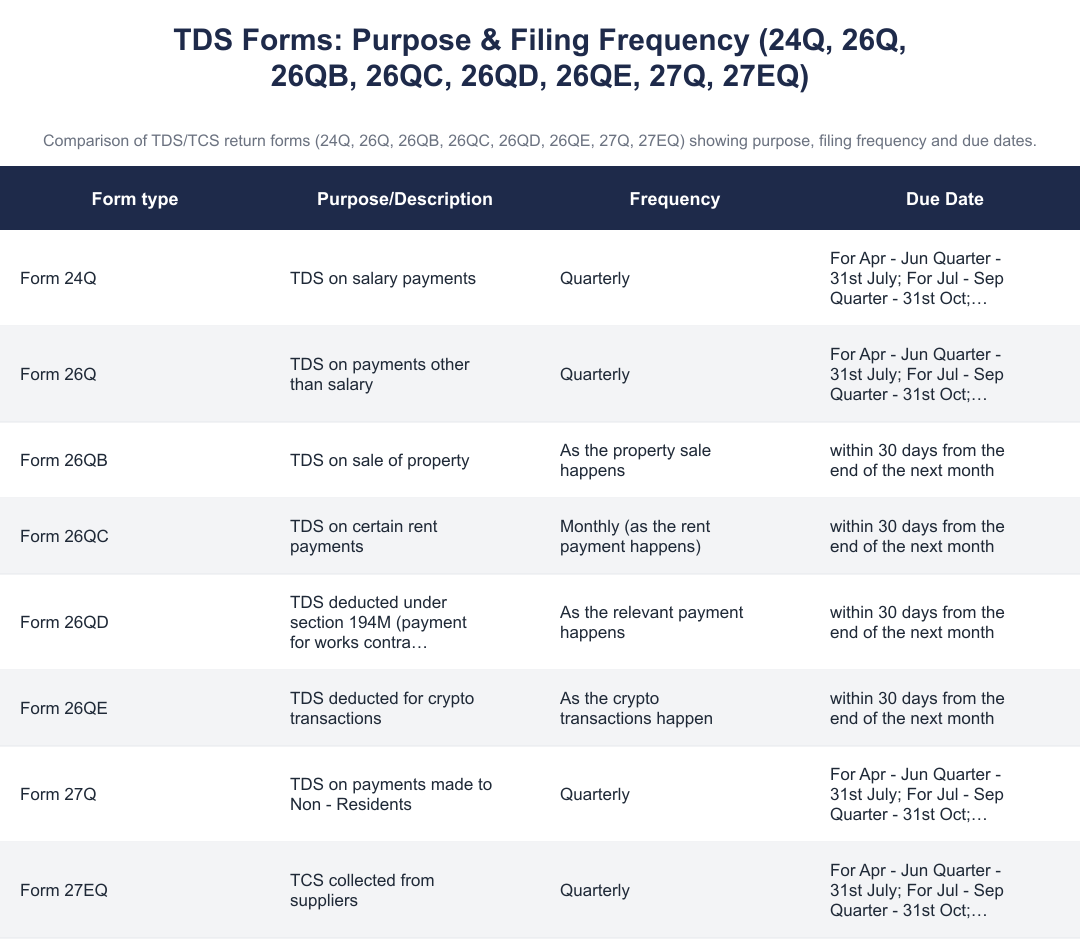
Types of TDS Return Forms
| Form type | Purpose |
|---|---|
| Form 24Q | TDS on salary payments |
| Form 26Q | TDS on payments other than salary |
| Form 27Q | TDS on payments made to non-residents |
TDS Return Due Dates & Timelines
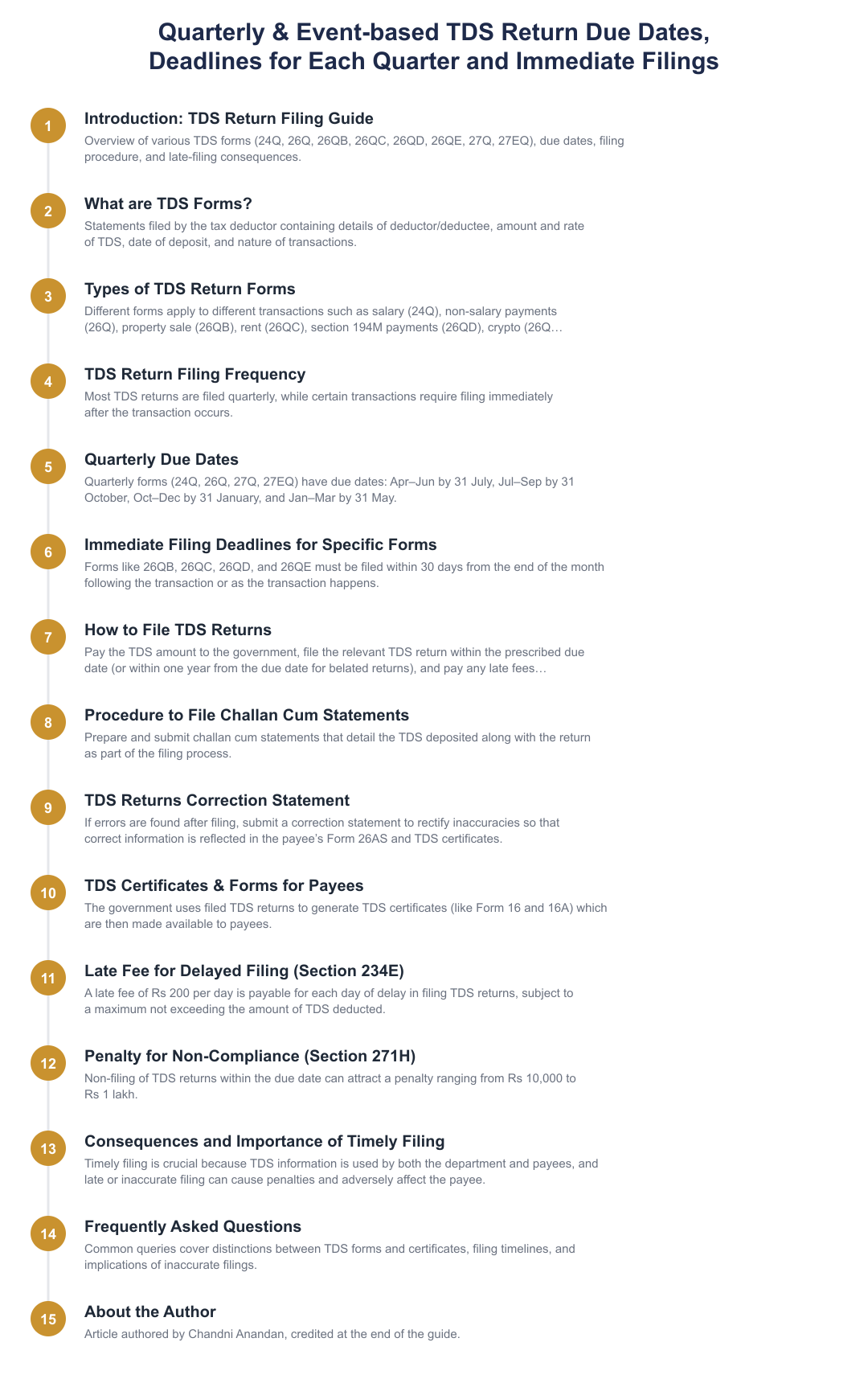
TDS returns are mostly filed on a quarterly basis. This means that for many kinds of transactions the deductor compiles transaction-level details for the quarter and files a statement covering that period with the tax department.
For certain transactions, however, the return must be filed immediately after the transaction occurs rather than waiting for the quarter-end. The filing rhythm, quarterly versus immediate, depends on the nature of the payment and the statutory rules that apply to that specific type of deduction.
Because information from TDS returns is picked up and reflected in the payee’s Form 26AS, timely and correct reporting ensures that payees can claim credit for the tax withheld when they prepare their own returns.
Preconditions and Practical Responsibilities
A deductor must hold an active TAN (Tax Deduction and Collection Account Number) to file TDS returns such as Forms 24Q, 26Q and 27Q. TAN is the identifier that links the deductor’s filings and challan payments to the correct account in the tax department’s records.
Practically, a deductor’s responsibilities include deducting the correct amount of tax at the prescribed rate, depositing the deducted tax with the government, and reporting the transactions in the appropriate return form within the required timeline. The returns you file form the basis for the TDS certificates that the department generates and provides to deductors and payees.
How TDS Returns and Certificates Connect (Process overview)
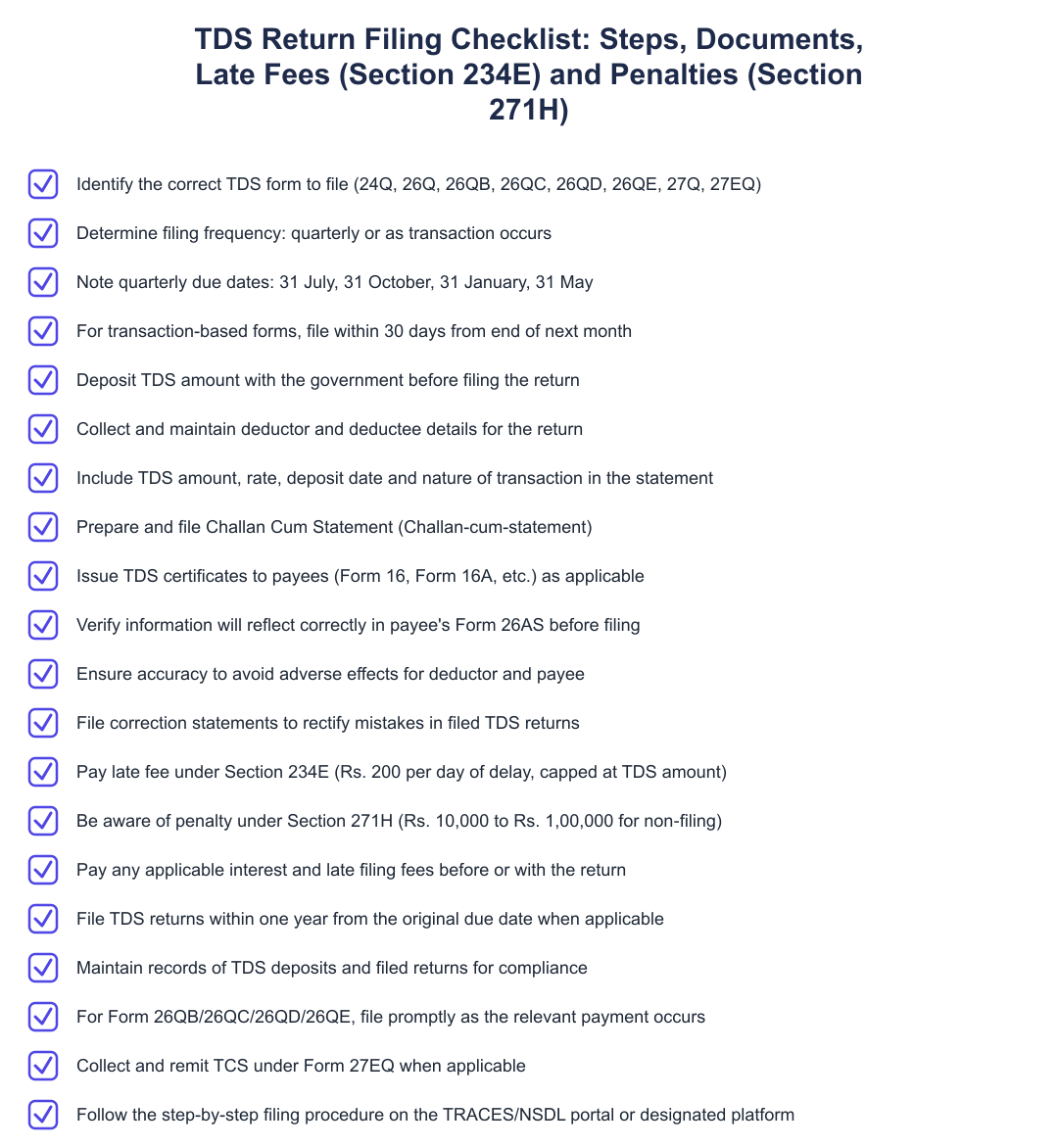
The deductor must deduct TDS at the applicable rate from payments and deposit the deducted amount with the government so that the department can record the payment against the deductor’s account.
Depending on the nature of the payment, file the correct return (for example, Form 24Q for salary or Form 26Q for non-salary). Some returns are filed quarterly while others must be filed right after the transaction, follow the schedule applicable to the transaction type.
Information from the filed returns is used by the tax department to generate TDS certificates (such as Form 16 and Form 16A) which are provided to deductors and payees.
Since the payee’s Form 26AS reflects details from TDS returns, reconcile your filings with Form 26AS to avoid mismatches that could affect the payee’s tax credit claims.
Accurate TDS return filing is foundational to correct tax crediting for payees and to clean compliance records for deductors. Use the right form for the transaction, maintain an active TAN, follow the applicable filing rhythm (quarterly or immediate), and reconcile your filings with Form 26AS. The returns you file are the source for the TDS certificates that workers and suppliers ultimately receive, so getting them right matters for everyone in the chain.
Frequently asked questions
What are TDS forms and why do I need to file them?
TDS forms are statements that a person deducting tax must file with the government to report tax deducted at source and details of deductees and payments. These statements contain deductor and deductee information, amount and rate of TDS deducted, deposit date of TDS and nature of transaction, and the information feeds into the payee's Form 26AS and TDS certificates (like Form 16/16A). Accurate filing is important because errors can adversely affect both the deductor and the payee and may attract penalties for late or non-filing. TDS returns are mostly filed quarterly, though certain transactions require filing immediately after the transaction occurs.
Which TDS form should I use for salary and non-salary payments?
Use Form 24Q for TDS on salary payments and Form 26Q for TDS on payments other than salary. Both 24Q and 26Q are quarter-wise statements filed for the financial year with due dates at the end of July, October, January and May for the Apr–Jun, Jul–Sep, Oct–Dec and Jan–Mar quarters respectively. If you are deducting tax on other specific transactions, there are dedicated forms like 26QB for property sale, 26QC for certain rent payments, 26QD for section 194M payments, 26QE for crypto, 27Q for non-residents and 27EQ for TCS. Choosing the correct form ensures the TDS appears correctly in the payee’s records and Form 26AS.
What are the due dates for filing quarterly TDS returns?
Quarterly TDS returns (Forms 24Q, 26Q, 27Q and 27EQ) are due on 31st July for Apr–Jun, 31st October for Jul–Sep, 31st January for Oct–Dec and 31st May for Jan–Mar. These deadlines must be met so the information is timely reflected in payee Form 26AS and to avoid late fees under Section 234E and penalties under Section 271H. Certain forms that arise at the time of transaction (like 26QB/26QC/26QD/26QE) must be filed within 30 days from the end of the month following the payment or transaction. Missing these timelines can lead to daily late fees of Rs 200 and other penalties as applicable.
How much late fee do I have to pay if I miss the TDS return due date?
Under Section 234E you must pay a late fee of Rs 200 per day for every day of delay in filing TDS returns, subject to a maximum equal to the amount of TDS deducted. This fee accrues from the day after the due date until the date of filing, and the total cannot exceed the total TDS amount reported in the return. In addition to the daily fee, failure to file on time may attract penalties under Section 271H and possible interest or other consequences depending on facts. Therefore prompt filing or filing a correction as soon as possible reduces exposure to escalating charges.
What penalties apply for not filing TDS returns at all?
Non-filing of TDS returns within the due date can attract a penalty under Section 271H ranging from Rs 10,000 to Rs 1,00,000. This penalty is in addition to the late fee under Section 234E (Rs 200 per day) and any interest or other liabilities for delayed deposit of tax. The assessing authority may impose the penalty after considering the reasons for non-compliance; persistent or deliberate defaults are more likely to attract higher penalties. To avoid this exposure, ensure returns are filed on time or regularize the position promptly by filing and paying applicable late fees and interest.
How do I file TDS returns online step-by-step?
To file TDS returns online you must have an active TAN, prepare the statement using the NSDL/Protean return preparation utility and generate the FYU file, then log in to the Income Tax e-filing portal to upload the FYU and submit the applicable form and e-verify. The usual flow is: download the return preparation utility, fill in deductor/deductee and payment details, generate the FYU file, log in to e-filing > Income Tax Forms, choose the relevant TDS form (24Q/26Q/27Q etc.), upload the FYU and submit for e-verification. After submission, keep the acknowledgment and ensure the TDS payment challans match the return details so the deductees see correct entries in Form 26AS. For transaction-based forms (26QB/26QC/26QD/26QE), the filing window is generally within 30 days from the end of the next month of the transaction.
How do I file a correction statement for a TDS return and what's the deadline?
You can file a TDS correction statement to rectify mistakes by preparing and uploading a correction return (correction statement) through the Income Tax e-filing portal, and corrections are allowed within one year from the due date of filing the original return. The correction procedure uses the same return preparation utility and FYU upload process, and should clearly indicate it is a correction; you must also ensure corrected challan details match the tax deposited. Filing correction statements promptly helps ensure accurate entries in Form 26AS for the payees and limits exposure to penalties or disputes arising from incorrect filings. Note that corrections beyond the permissible period may require explanations or departmental approvals depending on the nature of the error.
What is a Challan Cum Statement and how do I file it?
A Challan Cum Statement is the combined process of depositing TDS with the government and furnishing the statement of TDS details to the tax department; you file it by first paying the TDS using the TRACES/NSDL challan system and then uploading the TDS statement (FYU) on the Income Tax portal within the statutory timeline. The typical procedure is: deposit TDS with proper challan (and note BSR/Challan details), prepare the return using the NSDL utility referencing the challan, upload the FYU on the e-filing portal and e-verify the statement; for certain transactions the filing is due within 30 days from the end of the next month. You must ensure the challan details in the uploaded statement match the deposited amounts so payments reflect correctly in deductee Form 26AS. If you miss timelines, you still must pay the TDS, file the statement (often within one year from due date), and remit applicable late fees/interest to regularize the position.
How and when are TDS certificates like Form 16 and 16A issued after filing returns?
TDS certificates (such as Form 16 for salary and Form 16A for non-salary payments) are generated based on the TDS statements filed by the deductor and are provided to the deductee after the relevant returns are filed. The government or the deductor issues these certificates after the corresponding TDS return is uploaded and validated; details from the return are reflected in the payee’s Form 26AS and used to prepare Form 16/16A. It’s important the TDS return is accurate and filed on time because incorrect or delayed statements delay issuance of these certificates and can affect the payee’s tax filings. For transaction-specific TDS (like property or crypto), the appropriate certificate or acknowledgment is generated once the respective form (26QB/26QE etc.) is correctly filed and processed.
Need help staying TDS compliant?
MoneyGence's AI Finance OS tracks your compliance, wallet share, and finances in one place, built for agencies and growing businesses.
Get started with MoneyGence