TDS TCS Changes 2025: Partner’s Remuneration & New Thresholds
This guide explains upcoming changes to TDS (tax deducted at source) and TCS (tax collected at source) that affect partner payments, threshold limits and a few other commonly used provisions. You will learn what types of payments may see changed withholding or collection requirements, how higher thresholds affect routine transactions, what it means when TDS/TCS obligations are removed for certain receipts, and practical steps businesses and professionals should take to stay compliant. Understanding these changes is important because withholding and collection rules directly affect cash flow, compliance workflows, reporting and supplier relationships. Even if tax rates themselves are not changing, adjustments to thresholds or the scope of applicability change when and how often tax must be deducted or collected. This guide focuses on how to interpret such changes in practice, how to adjust payroll and accounts-payable processes, and what questions to ask your tax advisor to avoid surprises when the new rules come into effect.
Enhanced Threshold Limits For TDS
Threshold increases mean that payers will start deducting TDS only when payments cross higher amounts than before. Practically, this reduces the number of small-value transactions that attract withholding, simplifying compliance for payers and increasing immediate cash flow for recipients who no longer see small deductions at source.
For businesses this change has both operational and reporting implications. Accounts departments should update their payment workflows and TDS configurations in payroll and accounting software so that withholding is triggered only when a payment exceeds the new threshold. Reconciliation controls must be adapted to ensure correct TDS is accounted for when the higher threshold is met.
Recipients should review expected receipts and understand whether the new thresholds will mean fewer instances of tax being withheld. This can affect quarterly cash projections. Even when TDS is not withheld because of a higher threshold, recipients must still consider their ultimate tax liability and plan for any advance tax or self-assessment requirements.
Enhanced Threshold Limit For TCS
When TCS thresholds are increased, sellers and collectors will only be required to collect tax at source on larger-value receipts. The immediate effect is fewer instances where customers see an additional collection at the point of sale for lower-value purchases, and reduced administrative burden for collectors who no longer need to track many small transactions for TCS purposes.
Companies that regularly collect TCS, for example banks, e-commerce platforms, exporters or large traders depending on the provision, must update their billing and collection systems so TCS is computed only when the higher limit is exceeded. They should also update reporting templates and inform customer-facing teams about the changed behaviour at the point of collection.
Buyers and end customers will benefit from improved cash flow on day-to-day purchases, but must remain aware of their tax position: lowered frequency of TCS collections does not eliminate underlying tax liability. Proper record-keeping remains important to claim credit for any TCS actually collected when filing returns.
TDS on Partner’s Remuneration
Special rules that require deduction of tax on payments to partners for remuneration, interest and commissions change how partnerships manage partner payouts. Where such withholding applies, payers must treat partner payments differently from ordinary vendor payments, setting aside tax at the time of payment and issuing appropriate certificates to partners.
From an accounting perspective, firms should segregate partner payments in accounting systems so that remuneration, interest and commission to partners are clearly identified for TDS computation. Payroll and partner ledger processes need alignment so that tax is deducted and deposited timely, and partners receive credit for tax deducted at source.
Partners should be aware of withholding on their receipts and plan their cash flows accordingly. They should also maintain complete documentation supporting their share of profits vs. remuneration to ensure correct tax treatment at final assessment, and to claim credit for any tax withheld against their final tax liability.
Removal Of TCS On Sale Of Goods
Removing TCS on sale of goods reduces compliance for sellers and improves immediate cash flow for buyers because tax will not be collected at the point of sale for supplies that earlier attracted TCS. This change simplifies invoicing and reduces instances where sellers must reconcile TCS collected with buyers who claim credit later.
Operationally, sellers should audit their billing systems and update the logic that computes TCS so that collections stop for the specified transactions. Customer communication is important so that buyers are not surprised by the absence of TCS on invoices and understand how this affects their input tax management and cash flow.
Even when TCS is removed, businesses must ensure they continue to report sales correctly in their returns and retain supporting documents. Buyers should verify their records since the absence of TCS collection changes the evidence available when claiming tax credits or preparing returns.
Omission Of Higher Withholding Provisions For Non-Filers
Certain provisions that previously mandated higher rates of TDS or TCS for payees who had not filed returns or complied with reporting obligations may be proposed for removal. The practical effect is that the punitive higher withholding rates will no longer apply, simplifying withholding calculations and relieving some administrative pressure on payers.
Payers should nonetheless maintain robust due-diligence processes to verify counterparty compliance status, because standard withholding and reporting obligations still apply. Removing a higher-withholding rule does not change the core requirement to deduct tax where applicable and to deposit and report it timely.
Recipients who were subject to higher withholding earlier should check their tax position; while the removal of the higher withholding reduces future cash outflows at source, they must still ensure timely filing of returns and proper documentation to avoid assessment issues later.
Reduced TCS Rates For Forest Produces
A reduction in TCS rates for forest produces lowers the tax collected at source for transactions involving eligible forest produce. For sellers and buyers in this sector, this change eases immediate cash demands at the time of sale and simplifies accounting for such transactions.
Businesses involved in procurement or sale of forest produce should adjust their collection and invoicing systems to apply the reduced collection rate, and update contract templates and buyer communications to reflect the new practice. Proper record-keeping will ensure that any reduced collection is traceable for statutory reporting or audit.
Despite a lower collection rate, parties should confirm whether any other indirect taxes or sector-specific levies apply and continue to maintain transparent transaction records. Buyers who pay less tax at source will need to track their payments carefully to claim any credits when filing returns.
Changes to TDS and TCS thresholds, the treatment of partner payments, and the scope of collection rules reduce compliance burden for many routine transactions and improve cash flow for taxpayers. Organisations should review and update accounting systems, communicate changes to affected stakeholders, and consult tax advisors to ensure operational readiness. Even when withholding or collection is reduced or removed, record-keeping and timely filing remain essential to preserve tax credits and to meet statutory obligations.
Frequently asked questions
What are the new TDS threshold limits effective from 1 April 2025?
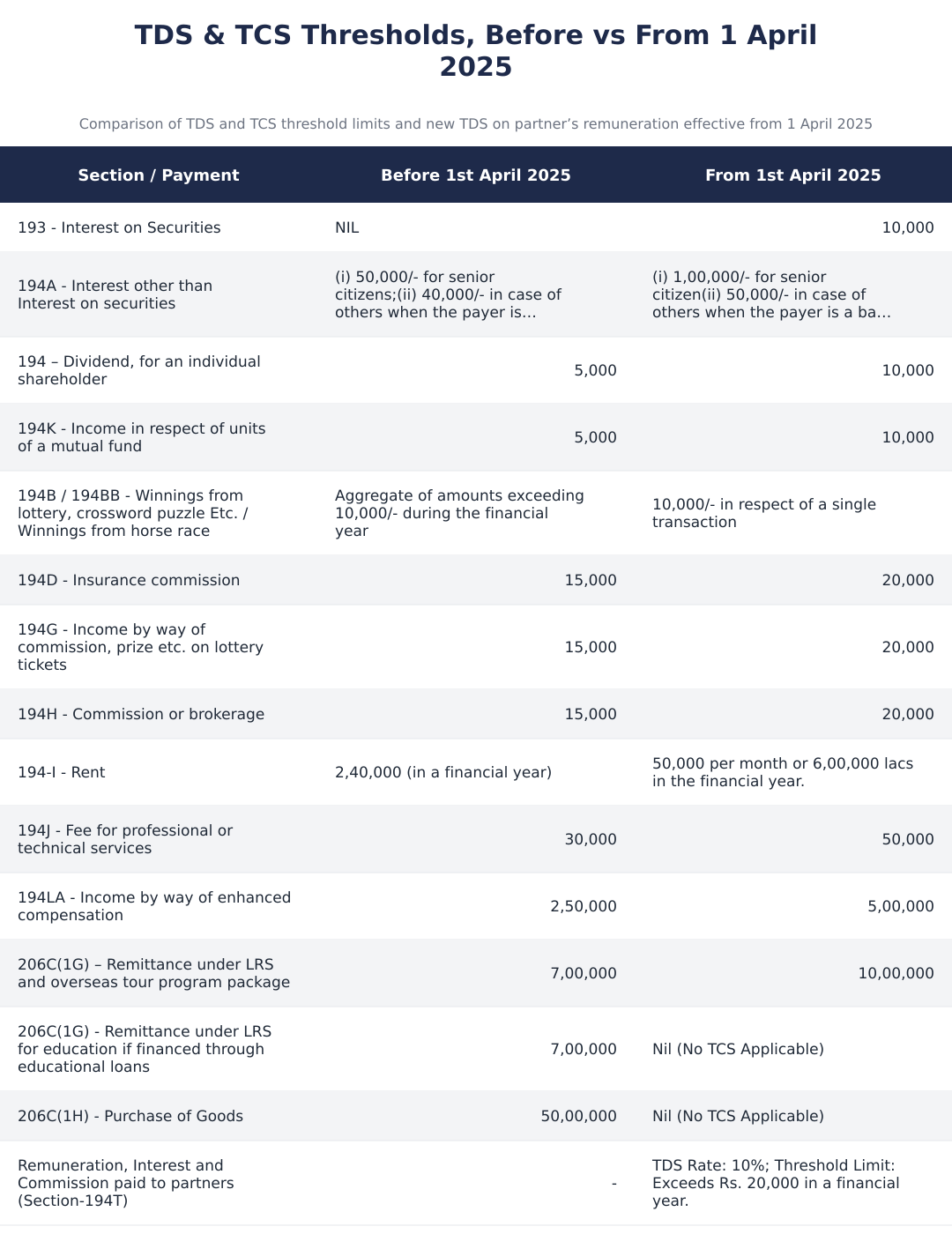
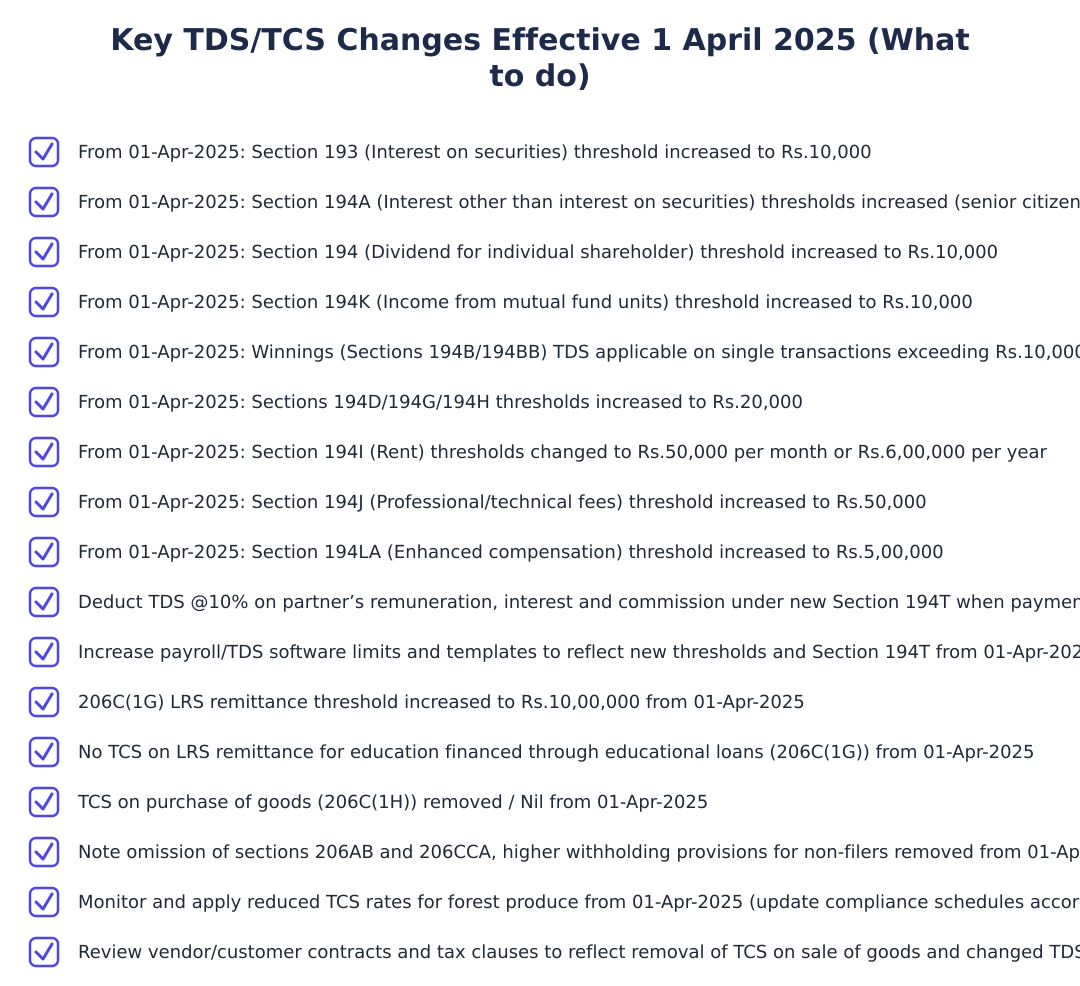
From 1 April 2025 many TDS threshold limits have been increased across various sections, for example interest on securities (section 193) is now taxable only if it exceeds Rs 10,000, interest other than securities under section 194A has been raised to Rs 1,00,000 for senior citizens and Rs 50,000 for others paid by banks/co‑op societies/post offices (Rs 10,000 in other payer cases), dividends and mutual fund unit income thresholds under sections 194 and 194K are Rs 10,000, rent under section 194I is now Rs 50,000 per month or Rs 6,00,000 per year, and professional/technical fees under section 194J are Rs 50,000. These enhanced limits apply from FY 2025‑26 (1 April 2025) and replace the lower thresholds that applied earlier, such as Rs 5,000 for dividends and Rs 30,000 for section 194J. Taxpayers and payers should review the specific section limits in the Finance Bill 2025 because some thresholds differ by payer type or nature of payment.
How has the TCS threshold for sale of goods changed from 1 April 2025?
TCS on purchase of goods under section 206C(1H) has been removed from 1 April 2025, so no TCS is applicable on purchase of goods transactions that were earlier liable once the aggregate exceeded Rs 50 lakh. Previously buyers had to collect TCS at specified rates once the yearly aggregate crossed Rs 50,00,000; now that provision is omitted, so sellers will not collect TCS under 206C(1H) for FY 2025‑26 onwards. Businesses should update their invoicing and TCS collection processes to reflect that purchases are no longer subject to 206C(1H).
What is Section 194T, TDS on partner’s remuneration, and when does it apply?
Section 194T requires a firm to deduct TDS at 10% on remuneration, interest, and commission paid to partners when such payments exceed Rs 20,000 in a financial year, effective from 1 April 2025. The provision applies to payments made by a firm to its partners (remuneration, interest, commission) and the 10% TDS must be deducted once the aggregate paid to a partner in the financial year exceeds Rs 20,000. Firms should update their payment and TDS deduction procedures to identify partner payments and deduct at source where the threshold is breached; partners can claim credit for TDS in their individual returns.
What TDS threshold applies now for rent under section 194I from April 2025?
From 1 April 2025 TDS under section 194I for rent is triggered at Rs 50,000 per month or Rs 6,00,000 in a financial year, replacing the earlier annual threshold of Rs 2,40,000. This means that if rent payable in any month exceeds Rs 50,000 or the total rent in the year exceeds Rs 6,00,000, the payer must deduct TDS at the prescribed rate; smaller monthly rents below Rs 50,000 are not subject to TDS even if they aggregate annually to a higher amount unless the annual limit is crossed. Rent payers (individuals, companies, etc.) should monitor both monthly and annual rent amounts to determine TDS applicability under the revised thresholds.
What changed for TDS on interest other than interest on securities (section 194A) from April 2025?
From 1 April 2025 the exemption limit under section 194A for interest other than interest on securities was increased: senior citizens now have a threshold of Rs 1,00,000, while other recipients have Rs 50,000 when the payer is a bank, cooperative society or post office, and Rs 10,000 in other payer cases. Previously the limits were lower (Rs 50,000 for senior citizens and Rs 40,000 for others in bank/co‑op/post office cases and Rs 5,000 in other cases), so many small interest payments will no longer attract TDS under the raised thresholds. Banks, financial institutions and other payers should update their systems to apply the correct exemption levels by recipient category from FY 2025‑26 onward.
What happened to the provisions of sections 206AB and 206CCA from 1 April 2025?
Sections 206AB and 206CCA were omitted (removed) from 1 April 2025, so the enhanced TDS/TCS withholding provisions that targeted specified persons no longer apply from that date. Those sections previously required higher rates of TDS/TCS for non‑filers or specified persons who had not filed returns, but with their omission taxpayers and collectors will revert to the standard section rates and thresholds applicable for FY 2025‑26. Taxpayers who were subject to higher withholding under those sections should update compliance workflows and rely on normal TDS/TCS provisions and rates going forward.
Are there changes to TCS on remittances under the Liberalised Remittance Scheme (LRS)?
Yes, TCS on remittances under LRS (section 206C(1G)) has been increased so the threshold is Rs 10,00,000 from 1 April 2025, and TCS on remittances for education financed through educational loans has been removed (nil TCS). Previously the threshold for TCS on LRS was Rs 7,00,000, and educational remittances financed via loans were subject to TCS; now only remittances above Rs 10 lakh attract TCS and approved education‑loan financed remittances are exempt. Individuals planning foreign remittances should check the new threshold and the educational loan exception when estimating TCS liabilities.
Have TCS rates or applicability changed for forest produce and other specific receipts?
The Finance Bill 2025 reduced TCS rates for forest produce and made some targeted rate reductions, meaning specified forest produce transactions will attract lower TCS rates from 1 April 2025 as compared to earlier rates. These reduced rates apply to categories listed in the Bill and are intended to ease the compliance burden on buyers and collectors of forest produce; affected businesses should consult the exact rate schedule in the statute or Finance Bill 2025 schedules for precise percentages. Traders and companies dealing in forest produce must update TCS calculation modules to reflect the new reduced rates and ensure correct collection and remittance.
Need help staying TDS compliant?
MoneyGence's AI Finance OS tracks your compliance, wallet share, and finances in one place, built for agencies and growing businesses.
Get started with MoneyGence