TDS under GST: Rules, Rates & TCS for E‑Commerce Operators
This guide explains TDS (Tax Deducted at Source) and TCS (Tax Collected at Source) as they operate under the Goods and Services Tax (GST) framework in India. You will learn what TDS under GST means, who is required to deduct it, how it interacts with suppliers and government-related purchasers, and what TCS means for the e-commerce sector. The guide focusses on the legal scope and practical implications for businesses and suppliers, especially those contracting with government bodies or selling through e-commerce marketplaces. Understanding TDS and TCS matters because these provisions affect cash flow, compliance obligations, and the way input tax credit is tracked and reflected on the GST portal. For suppliers, being aware of when a buyer may deduct tax at source helps with invoicing, reconciling receipts, and following up on credit on the GST portal; for buyers and e-commerce operators, knowing whether you are a deductor or collector under GST determines operational changes to payment processes and reporting. This article distils the mandatory categories of persons who must deduct TDS under GST and highlights the special compliance context for e-commerce operators required to collect TCS, so you can identify when these rules may apply to your business relationships.
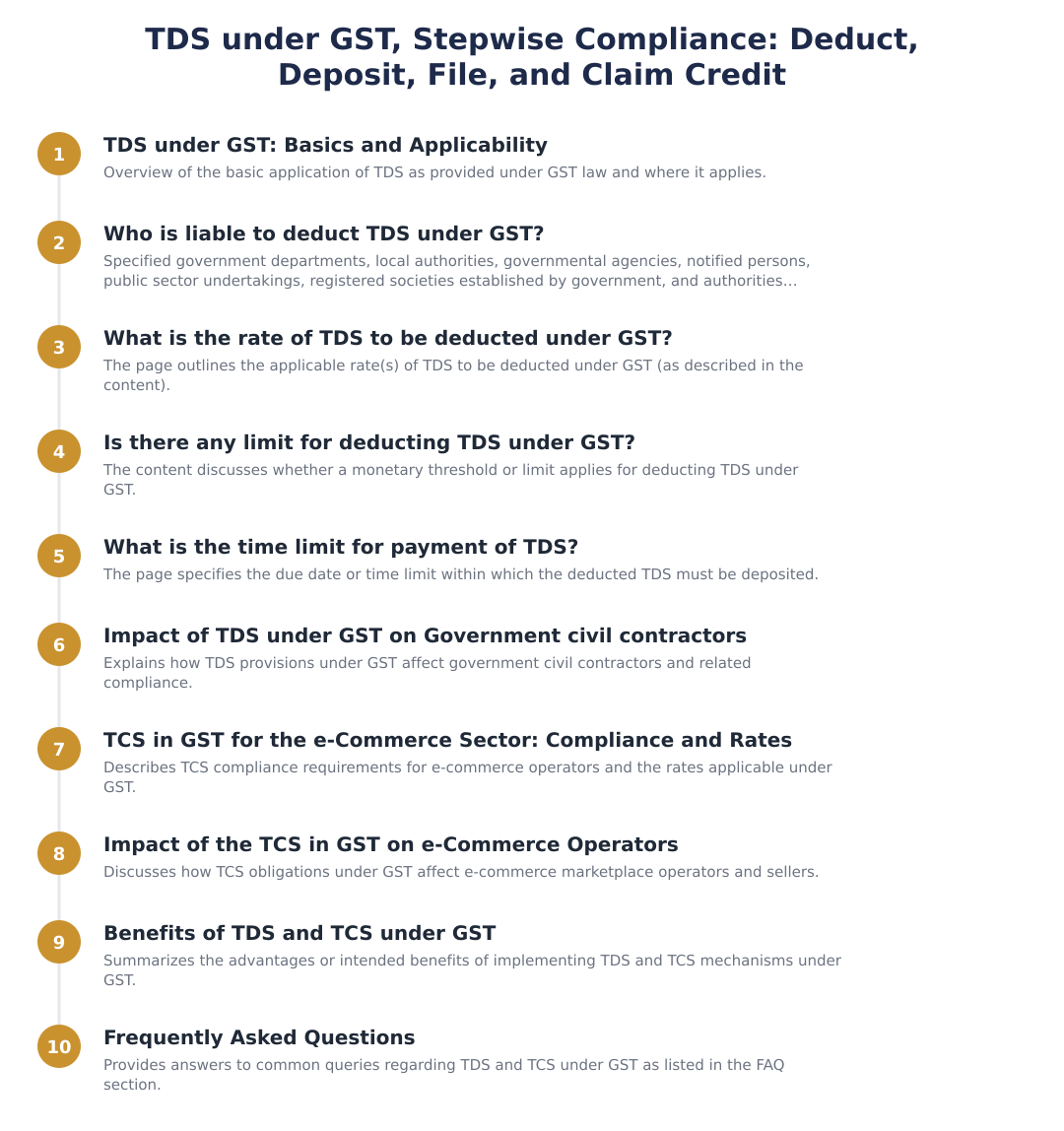
TDS under GST: Basics and Applicability
TDS under GST is a mechanism created within GST law whereby certain notified persons must deduct tax at source on specified supplies. The primary purpose of TDS is to ensure collection of GST at the point of payment to the supplier by a specified class of buyers, thereby improving transparency and traceability of taxable supplies.
Practically, when TDS is applicable the buyer (the deductor) reduces the payable amount to the supplier by the amount of tax required to be deducted and remits that tax directly to the government. For suppliers, this means the supplier’s net receipt from the buyer is lowered by the TDS amount, and they need to monitor the GST portal to ensure that the deducted amount is properly credited to their electronic ledger.
Who is liable to deduct TDS under GST?
The law specifies categories of persons who are liable to deduct TDS under GST. These include government and quasi-government entities as well as certain notified persons and organisations with public-control characteristics.
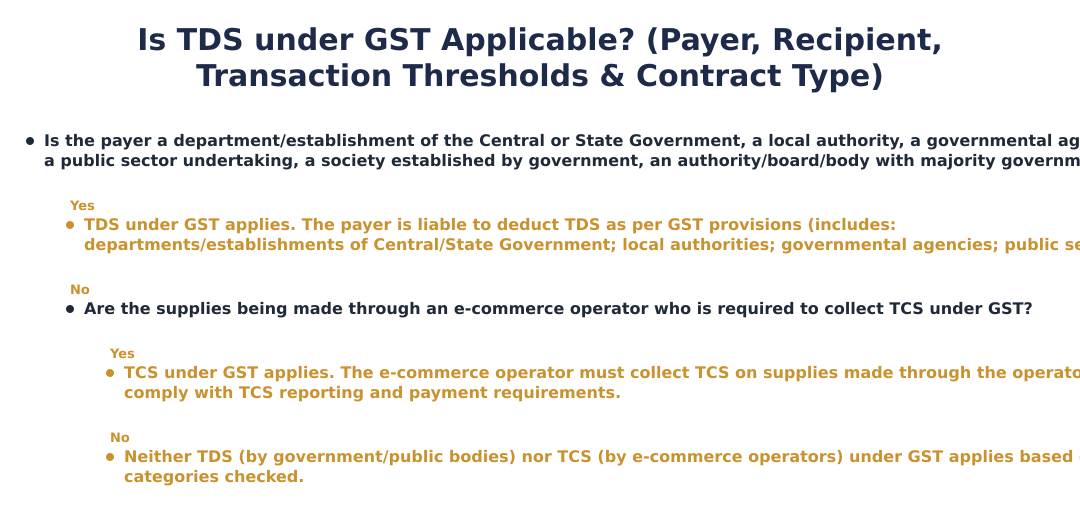
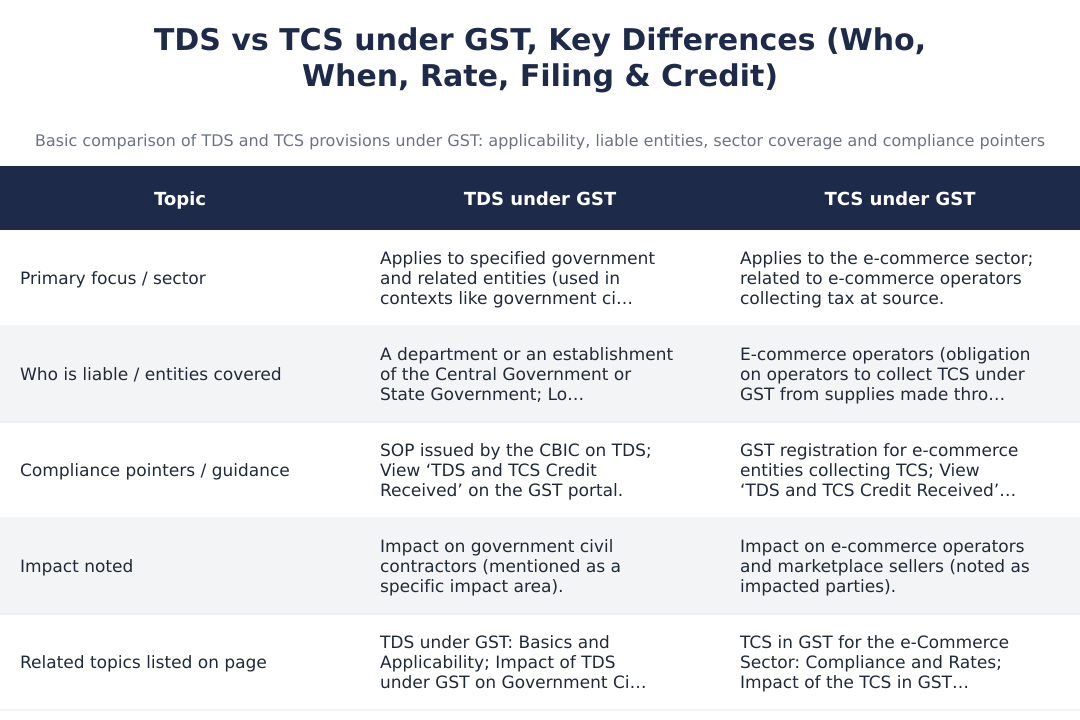
Specifically, liable deductors include: a department or an establishment of the Central Government or State Government; local authorities; governmental agencies; such persons or category of persons notified by the Government; public sector undertakings; a society established by the Central or any State Government or a Local Authority and registered under the Societies Registration Act, 1860; and an authority or a board or any other body set up by Parliament or a State Legislature or by a government with 51% equity (control) owned by the government. If your counterparty falls in one of these categories, they may be required to deduct TDS under GST on specified supplies.
Impact of TDS under GST on government civil contractors
When work involves government departments, public sector undertakings or other notified government-controlled bodies, the TDS mechanism affects cash flow for contractors and suppliers because a portion of the GST payable on a supply will be retained by the buyer and remitted as TDS. Contractors should therefore factor in lower immediate receipts and ensure their billing and cash management reflect that reality.
In addition to cash-flow considerations, contractors must track TDS entries on the GST portal to claim the credit for amounts deducted by these government-related buyers. Clear reconciliation between invoices issued and TDS credits reflected on the portal is important to avoid disputes and to ensure that input tax credit is not delayed or misplaced due to administrative mismatch.
TCS in GST for the e-Commerce Sector: Compliance and Rates
TCS under GST is a requirement that applies specifically to the e-commerce sector where operators are required to collect tax at source on supplies made through their platforms. This rule targets the large volumes and many small sellers that operate via e-commerce marketplaces, enabling the tax system to capture transactions at the point of sale aggregation.
For e-commerce operators this means an added compliance responsibility: collecting the prescribed amount of tax from sellers or buyers as per the law and ensuring that these collections are reported and remitted correctly. Sellers using marketplaces should be aware that marketplaces may collect tax on their behalf, which affects how they report supplies and reconcile receipts.
Impact of the TCS in GST on e-Commerce Operators
E-commerce operators designated as collectors of TCS must modify their invoicing, payment settlement and reporting workflows to reflect collection of tax on supplies facilitated through their platform. This can involve changes to the platform’s checkout and payout systems to ensure the correct amount is collected and clearly communicated to sellers and buyers.
From a seller perspective, receiving payments after TCS collection means reconciling marketplace statements with GST portal entries and ensuring that any tax collected by the operator is appropriately reflected in the seller’s input or output tax records. Transparent documentation and timely reporting from the operator are important to avoid disputes and to ensure sellers receive due credit.
Benefits of TDS and TCS under GST
Both TDS and TCS mechanisms under GST strengthen tax collection at source, increasing transparency in high-risk or high-volume sectors such as government procurement and e-commerce. By collecting or deducting tax at the point of payment, the system reduces leakages and improves traceability of taxable supplies.
For taxpayers and the administration alike, these provisions help ensure that tax credits and liabilities are captured on the GST portal in a timely manner. When implemented correctly, TDS and TCS promote better record-keeping, simplify verification for authorities, and can reduce the need for later assessments by improving upstream reporting.
Frequently Asked Questions
Q: Who must deduct TDS under GST? A: TDS under GST must be deducted by specified categories of persons such as Central and State government departments and establishments, local authorities, governmental agencies, notified persons, public sector undertakings, certain societies registered under the Societies Registration Act, 1860, and authorities or boards or bodies set up by Parliament or a State Legislature with majority government control. For any given transaction, whether TDS applies depends on whether the buyer falls into one of these categories and whether the supply is among those specified under the law.
Q: Does TCS apply to all e-commerce transactions? A: TCS under GST applies to e-commerce operators as a class for supplies made through their platforms. The obligations attach to operators designated by the law to collect tax at source on transactions facilitated on their marketplaces; sellers and buyers must therefore understand how the operator’s collection affects their receipts and tax reporting.
TDS and TCS under GST are targeted mechanisms designed to collect tax at source from specified classes of buyers and platform operators. If you transact with government-related buyers or sell through e-commerce platforms, review your contracts, billing procedures and reconciliation practices to ensure these provisions are handled correctly. When in doubt, consult the relevant GST provisions or a tax practitioner to confirm applicability for your specific transactions.
Frequently asked questions
Who is required to deduct TDS under GST in India?
Specified government and government-controlled entities are required to deduct TDS under GST. This includes departments or establishments of the Central and State Governments, local authorities, governmental agencies, public sector undertakings, societies established by the government and registered under the Societies Registration Act, and any authority/board with at least 51% government ownership, as well as any other persons or categories notified by the government. These deductors must withhold tax when making payments to suppliers for taxable supplies as per Section 51 of the CGST Act. If you fall in one of these categories and make taxable payments above the threshold, you are obliged to deduct TDS and comply with TDS return and deposit rules.
What is the rate at which TDS must be deducted under GST?
TDS under GST is deducted at a flat rate of 2% on the taxable value of the supply (1% CGST + 1% SGST for intra‑state supplies or 2% IGST for inter‑state supplies). This 2% is applied on the amount payable to the supplier for taxable goods or services where TDS provisions are attracted. The deductee can claim this amount as input tax credit in their electronic credit ledger once the deductor deposits the TDS and files the required return. Note that this rate is fixed under Section 51 and does not depend on the supplier’s GST rate or composition scheme status (except where supplies are exempt or outside GST scope).
Is there a minimum limit or threshold for deducting TDS under GST?
Yes, TDS under GST applies when the value of supply under a contract exceeds Rs. 2,50,000. The deductor must deduct TDS at the time of payment or credit to the supplier only if the value of the taxable supply under a single contract is more than Rs. 2.5 lakh. Transactions below this contract value are not required to have TDS deducted under Section 51. Remember that the threshold is assessed at the contract level, not aggregated across multiple smaller purchases unless they are under the same contract.
When must the GST TDS amount be deposited and reported?
The TDS amount deducted under GST must be deposited and reported promptly: the deductor must deposit the amount to the government within the prescribed time and file the monthly TDS return (GSTR‑7). Specifically, the deductor must deposit the tax deducted and furnish Form GSTR‑7 by the 10th day of the month following the month in which TDS was deducted. The supplier will see the TDS credit on the GST portal after the deductor files GSTR‑7 and deposits the tax, and the supplier can claim that credit in their electronic tax ledger. Late deposits or delayed filing attract interest and possible penalties as per GST law.
Who must collect TCS under GST and at what rate for e‑commerce supplies?
E‑commerce operators specified under Section 52 of the CGST Act are required to collect TCS on taxable supplies made through their platform at a rate of 1% of the net taxable value (0.5% CGST + 0.5% SGST for intra‑state, or 1% IGST for inter‑state). This obligation applies to e‑commerce operators who facilitate supplies of goods or services and collect consideration on behalf of suppliers, regardless of whether the supplier is registered or not. The TCS collected is credited to the supplier’s electronic cash ledger and the supplier can use that credit against their output tax liability. There is no monetary threshold exemption for TCS, the collection requirement is triggered by supplies made through the operator.
What are the compliance steps and timelines for e‑commerce operators collecting TCS under GST?
E‑commerce operators collecting TCS must deposit the collected tax and file monthly returns in Form GSTR‑8 by the 10th day of the month following the month of collection. The operator must also issue a statement of supplies and TCS details on the GST portal so suppliers can claim the tax credit. Failure to deposit TCS or file GSTR‑8 on time attracts interest, penalties, and could block the credit to the supplier. Operators should therefore reconcile transactions monthly and ensure prompt deposit to avoid downstream issues for sellers.
How does TDS under GST affect government civil contractors and their cash flow?
TDS under GST affects government civil contractors by reducing their immediate cash receipts because 2% is withheld from payments on contracts exceeding Rs. 2.5 lakh. While the deducted amount is available as input tax credit in the contractor’s electronic ledger once the deductor files GSTR‑7, the credit is only usable after the deductor deposits the tax and reports it, so there can be a timing mismatch. This withholding improves tax tracking and reduces leakages on government contracts but contractors need to plan working capital since TDS reduces the net cash inflow until credit is reflected on the portal. Contractors should regularly monitor the GST portal for receipt of TDS credit and follow up with the deductor if credits do not appear.
What are the benefits of having TDS and TCS under GST for the tax system and taxpayers?
TDS and TCS under GST strengthen compliance, improve tax collection efficiency and provide automatic credit visibility for suppliers and sellers. These mechanisms create a documented trail of taxable transactions, reduce tax evasion by capturing supplies through deductors and e‑commerce operators, and give suppliers immediate input tax credit once the deductor/operator deposits and reports the tax. For buyers and e‑commerce platforms, TDS/TCS simplify enforcement and monitoring by the tax authorities, while suppliers benefit from pre‑credited amounts in their electronic ledgers, improving transparency. However, taxpayers must manage cash flow and reconciliation since credits are available only after deposit and return filing by the deductor/operator.
How can a supplier check and claim TDS/TCS credits on the GST portal?
A supplier can check and claim TDS/TCS credits by viewing the ‘TDS and TCS Credit Received’ section on the GST portal and reconciling the details with their own records, then using the credited amount in their electronic cash ledger against output liability. The credit appears once the deductor or e‑commerce operator files the relevant return (GSTR‑7 for TDS, GSTR‑8 for TCS) and deposits the tax; discrepancies should be raised with the deductor/operator for amendment. If the credit is correctly reflected, the supplier can utilise it while filing their outward liability returns; if not, they must seek rectification from the deductor and keep documentary proof of supplies and receipts. Regular monthly reconciliation between portal credits and supplier invoices helps avoid disputes and blocked credits.
Need help staying GST compliant?
MoneyGence's AI Finance OS tracks your compliance, wallet share, and finances in one place, built for agencies and growing businesses.
Get started with MoneyGence