TDS under Income Tax Act 2025: New Sections, Same Rates
This guide explains how TDS (Tax Deducted at Source) timing works under the current Income Tax framework and what businesses and payers must do to avoid mistakes. You will learn the key principle that determines when TDS must be deducted, how that principle applies to common payment situations, practical steps to align payroll and accounting processes, and recordkeeping best practices that reduce compliance risk. Getting TDS timing right matters because incorrect timing can lead to interest, notices, reconciliation mismatches and operational headaches, even when rates and thresholds are unchanged. This article focuses on the core rule that governs TDS timing and then expands into actionable guidance for implementation and audit readiness. Whether you are a payroll manager, accounts payable professional, in-house tax counsel, or an external advisor, the explanations and steps below will help you translate the legal timing rule into day-to-day controls and checks that reduce errors and simplify year-end procedures.
The single rule that decides TDS timing
At the heart of TDS timing is one clear operational principle: the obligation to deduct TDS depends on which event occurs earlier, the income being credited to the payee’s account or the income being actually paid. This "earlier of credit or payment" rule determines the moment when the payer must assess whether tax should be withheld.
Practically, that means two streams of activity need to be monitored continuously: entries made in the accounting or payroll system that recognize a liability or an expense credit for the recipient, and the actual cash/bank transfers or disbursements that realize the payment. The earlier of those two triggers is the point at which the payer’s TDS duty crystallises.
Understanding this single rule simplifies many compliance decisions. Instead of asking only when money moved, organisations should set up controls to capture when amounts are recorded as payable or credited to the recipient, because an accounting entry alone can be the event that starts the TDS obligation.
How the rule plays out in common scenarios
Invoices recorded in the books before payment: When an invoice is entered and the supplier’s account is credited, that accounting action can be the earlier event and therefore may require immediate TDS deduction even if the cash payment happens later. This is why attention to the timing of supplier-ledger credits is essential.
Salary and payroll credits: For payroll teams, salary accruals, payroll journal entries, or credit entries in an employee’s account can trigger the TDS timing. Ensuring payroll systems flag the accrual/credit moment helps avoid under- or late-deduction.
Reimbursements and advances: For reimbursements or advance payments, determine whether a credit is recorded when the obligation is recognised or only when the amount is paid out. The earlier recognition, if it occurs before disbursement, may be the operative event for TDS.
Practical steps to align systems and processes
Identify which accounting entries in your ledgers constitute a credit to the payee and ensure your tax team is alerted at that point so the earlier-of-credit-or-payment rule is applied consistently.
Update payroll and accounts-payable workflows so that accruals, credits and actual payments are all visible to compliance teams; add a review step for any credit that precedes payment.
Before processing a payment, run a quick reconciliation between payee credits recorded and pending disbursements to confirm whether TDS should already have been deducted.
Maintain a short written policy describing when your organisation treats a credit as effective for TDS purposes; consistent documentation helps on audit and reconciliation.
Recordkeeping and audit readiness
Given the earlier-of-credit-or-payment rule, your records must show both when an amount was credited and when it was paid. Clear, timestamped evidence in the general ledger, supplier/employee ledgers, bank statements and remittance advices makes it straightforward to demonstrate compliance with timing obligations.
Reconciliations that tie TDS deducted to the corresponding credits and payments should be carried out periodically and retained. These reconciliations act as the first line of defence in case of notices or queries and reduce the time spent responding to tax authority questions.
Common pitfalls and how to avoid them
Treating payment date as the only trigger: Many organisations default to focusing solely on cash outflows. Because the legal trigger can be the earlier credit event, relying only on actual payment dates creates a risk of late deduction.
Fragmented system visibility: When accounting, payroll and treasury systems are not integrated, one team may see a credit while another only sees payment. Bridging those visibility gaps through alerts and shared reports prevents missed TDS obligations.
Ad hoc manual overrides: Manual adjustments without documented rationale can create discrepancies. If manual decisions are necessary, record the reason and authorisation so that timing choices can be justified later.
The timing of TDS hinges on a single, practical rule: the earlier of credit or payment. By mapping accounting events to tax triggers, updating payroll and AP workflows, maintaining clear records, and conducting regular reconciliations, businesses can minimise the risk of timing errors. Implement these controls to convert a potentially complex timing test into routine, auditable practice.
Frequently asked questions
What is the main change to TDS provisions under the Income Tax Act 2025?
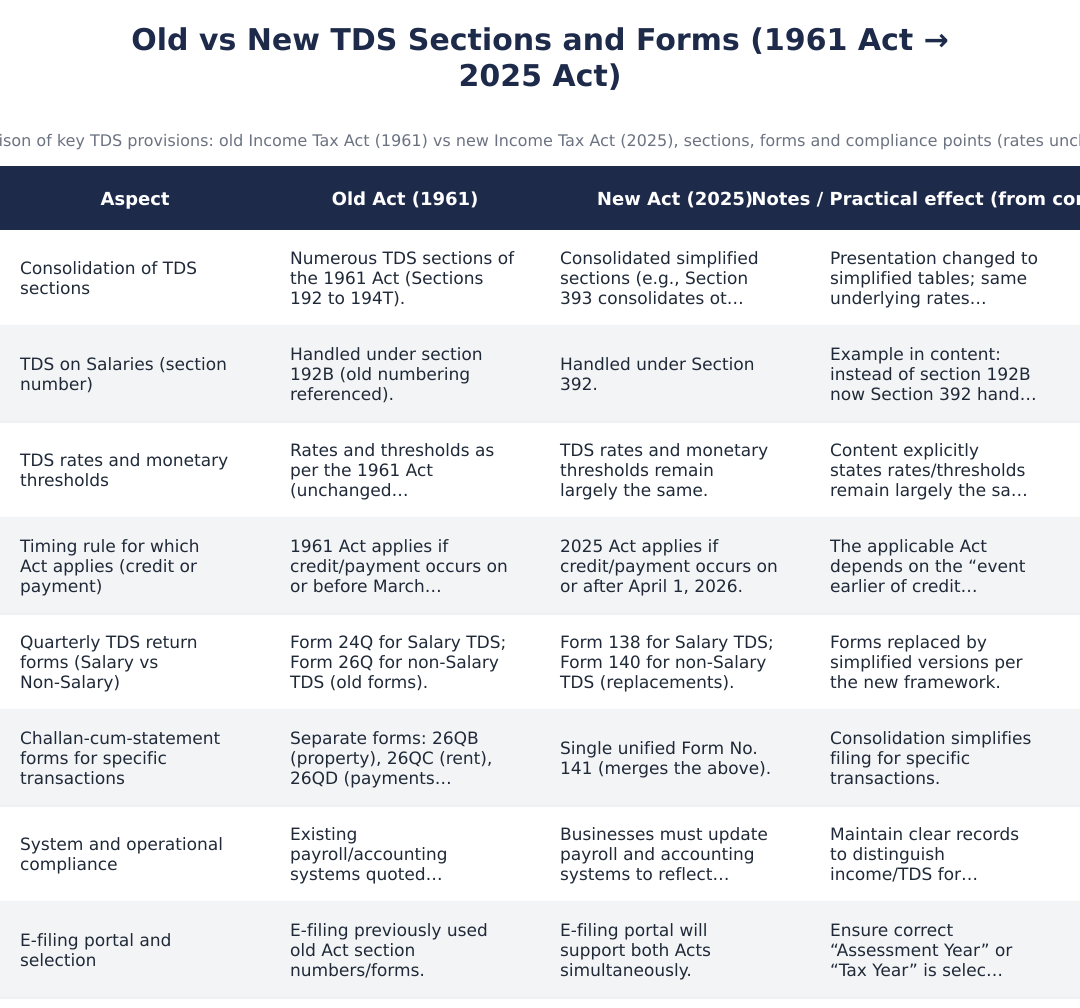
The main change is that TDS provisions have been reorganized into simplified, consolidated sections and forms while keeping rates and thresholds largely unchanged. The numerous old sections (like 192 to 194T) are consolidated (for example, many payments are now under Section 393 and salary TDS under Section 392) to improve readability and reduce fragmentation. Practically, this is a re‑presentation, existing rates and limits generally remain the same, but taxpayers and withholding agents must update systems and references to the new section numbers from April 1, 2026. Failure to quote the correct new section in systems or returns may cause reconciliation and processing errors even though substantive tax liability is unchanged.
Do TDS rates and monetary thresholds change under the new Act?
No, TDS rates and monetary thresholds remain largely the same under the Income Tax Act 2025; only the presentation and section numbering have changed. The law consolidates provisions for readability but preserves the existing rate schedules and exemption/threshold amounts, so withholding percentages applicable prior to April 1, 2026 continue to apply. Taxpayers should still check specific entries because the reorganization groups items differently (for example, multiple old sections like 194C are subsumed under Section 393) even though the numeric rates tied to types of payments are retained. Compliance impact therefore relates to administrative updates rather than rate changes.
When do I apply the old 1961 Act rules versus the new 2025 Act rules for TDS?
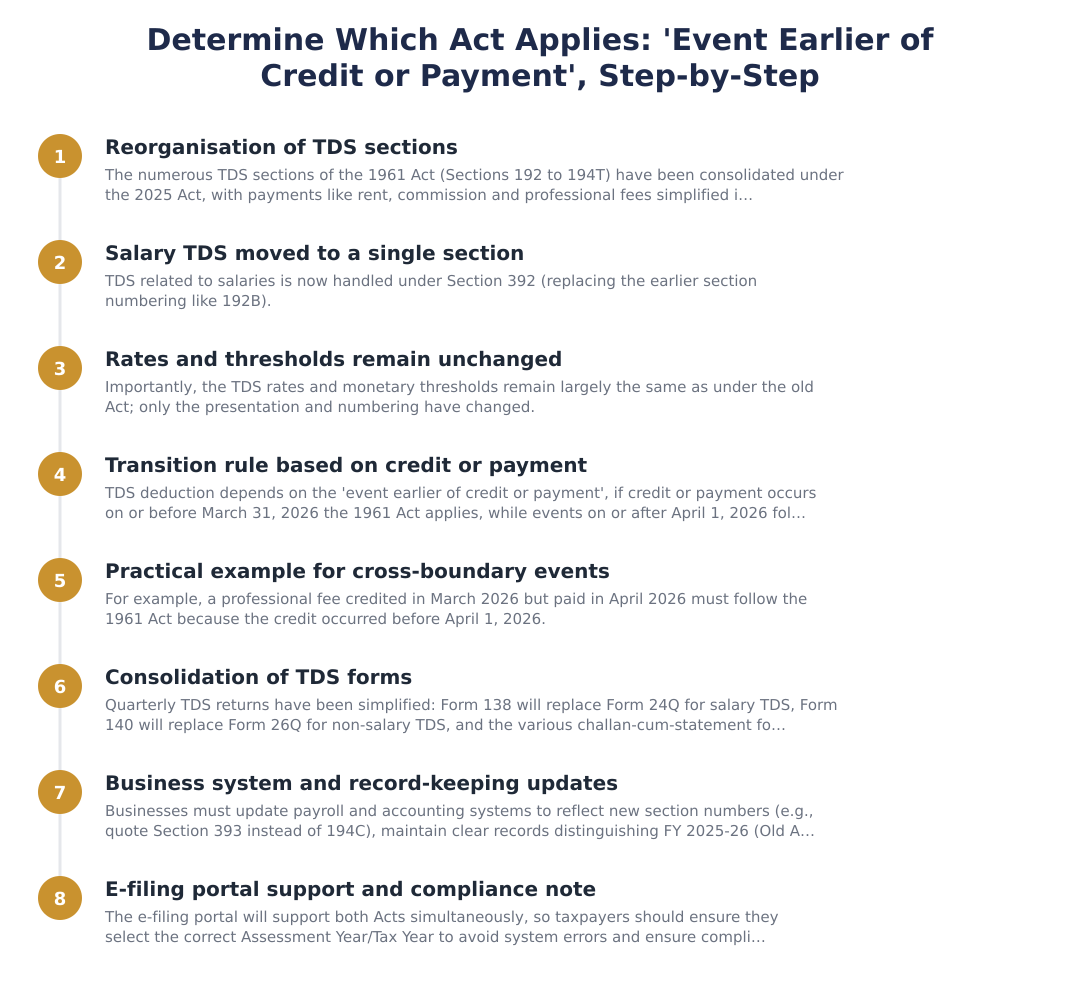
Apply the old 1961 Act rules if the credit or payment event occurs on or before March 31, 2026, and apply the new 2025 Act rules if the credit or payment occurs on or after April 1, 2026. The statute uses the ‘earlier of credit or payment’ rule to determine which Act governs TDS: if an amount was credited to the payee's account in March 2026 but paid in April 2026, the 1961 Act (old sections) applies. Conversely, amounts credited on or after April 1, 2026 must quote the new section numbers (for example, Section 392 for salaries, Section 393 for many other payments) and follow the new forms. Be careful to document dates in your payroll and accounting systems to ensure correct Act selection at the time of deduction and reporting.
Which new forms replace the old TDS return and challan forms?
The quarterly TDS return forms have been simplified: Form 138 replaces the old Form 24Q for salary TDS, and Form 140 replaces the old Form 26Q for non‑salary TDS; multiple transaction-specific challan‑cum‑statement forms (26QB/26QC/26QD/26QE) are consolidated into a single Form No. 141. These consolidated forms are intended to streamline reporting for withholding agents and cover property, rent, payments by individuals/HUFs and virtual digital asset transactions in one unified submission. Withholding agents must start using the appropriate new form corresponding to the date of credit/payment (i.e., for transactions on or after April 1, 2026) and ensure their systems generate the correct form numbers. Maintain clear backups mapping old form data to the new single forms for audit and reconciliation.
How should businesses update payroll and accounting systems for the TDS reorganization?
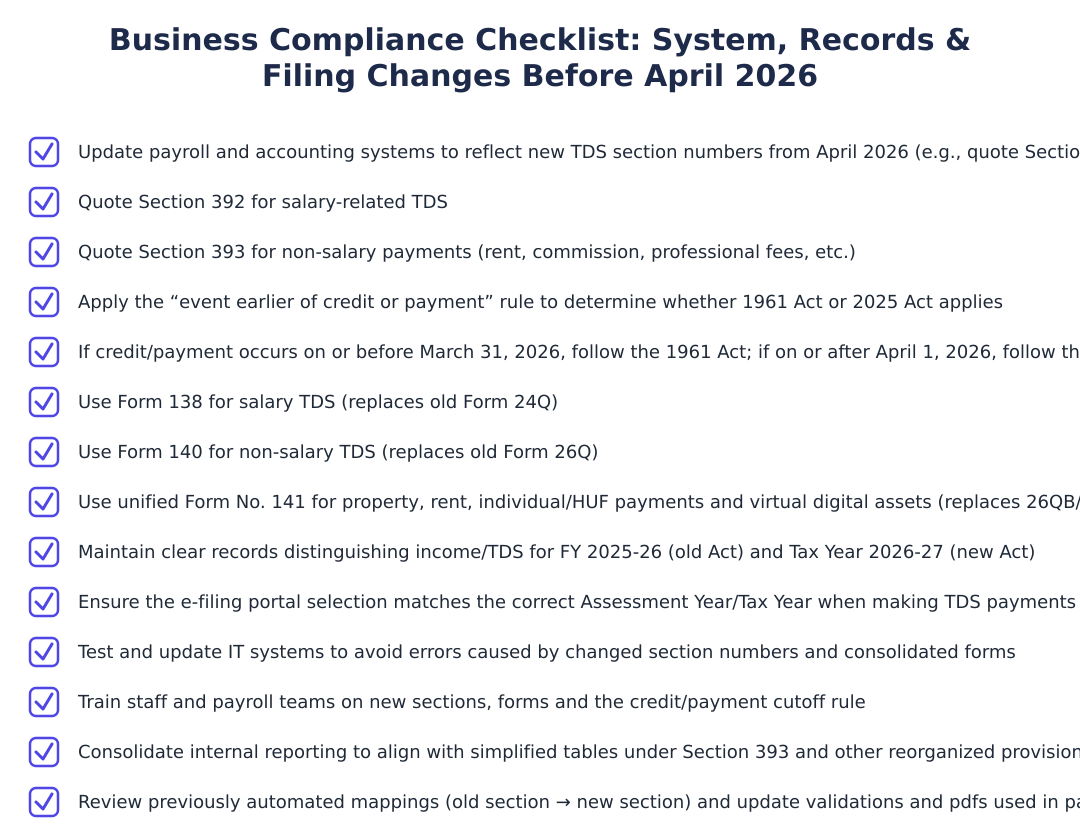
Businesses should update payroll and accounting systems to reflect new section numbers (for example, quote Section 392 for salaries and Section 393 for various other payments) and to generate the new return/challan form numbers from April 1, 2026 to avoid system errors. Reconcile mappings from old section codes (like 194C) to new consolidated sections, update templates for Form 138/140/141, and ensure the system records the ‘date of credit or payment’ correctly to determine which Act applies. It is also important to train staff and update vendor/supplier communications so withholding certificates and TDS entries cite the correct new section and form references. Failing to update these items may not change tax due but can cause e‑filing rejections and downstream processing issues.
Will the e‑filing portal accept TDS payments and returns under both Acts at the same time?
Yes, the e‑filing portal will support filings under both the 1961 Act and the 2025 Act simultaneously, so taxpayers must select the correct Assessment/Tax Year and Act when making payments or filing returns. The portal will require the correct section number and form corresponding to the date of credit or payment (old section for events on or before March 31, 2026; new section for events on or after April 1, 2026). Withholding agents should double‑check selections during e‑filing to avoid misclassification, and retain documentation showing the event date used to determine which Act applied. If an incorrect Act or section is selected, amend or rectify timely according to portal instructions to prevent processing delays.
Does consolidation of TDS sections affect the underlying tax liability of payees?
No, consolidation of TDS sections into new numbers under the 2025 Act does not change the underlying tax liability of payees; only the administrative references and reporting formats change. The withholding percentage and thresholds applicable to types of payments remain largely the same, so the actual amount of TDS deducted from a payee's income is unaffected by renumbering. Payees should, however, ensure their Form 26AS/TDS certificates and records quote the correct section and form for reconciliation and to avoid confusion during assessment or claims for credit. If TDS has been deducted under the wrong Act or section due to timing confusion, maintain supporting evidence (dates of credit/payment) to resolve any discrepancies with tax authorities.
Are there any special rules for transitional transactions that straddle March-April 2026?
Yes, transitional transactions are governed by the ‘earlier of credit or payment’ rule: if the credit occurs on or before March 31, 2026 the old 1961 Act applies, even if payment follows in April 2026, and if credit occurs on or after April 1, 2026 the new 2025 Act applies. For example, a professional fee credited to the payee's account on March 28, 2026 but paid on April 5, 2026 falls under the 1961 Act and old section numbering; conversely, credit on April 2, 2026 would trigger the 2025 Act. Withholding agents must document the exact credit/payment dates and ensure systems can apply the correct Act and new form/section for filings. Keep clear audit trails for such straddling payments to prevent disputes with tax authorities.
What practical steps should smaller businesses and individuals take now to prepare for TDS reorganization?
Smaller businesses and individuals should (1) update payroll/accounting templates to reflect new section numbers and forms (Section 392/393, Forms 138/140/141), (2) train staff on the ‘earlier of credit or payment’ rule for choosing the correct Act, and (3) maintain dual records for FY 2025‑26 and Tax Year 2026‑27 so filings and reconciliations are accurate. Also confirm with software providers that updates are available, map old section/form references to the new consolidated ones, and test e‑filing using correct Assessment/Tax Year selections to avoid rejections. These steps minimize administrative disruption since the substantive tax rates do not change, but correct citation of new sections and forms is necessary for smooth compliance from April 1, 2026.
Need help staying TDS compliant?
MoneyGence's AI Finance OS tracks your compliance, wallet share, and finances in one place, built for agencies and growing businesses.
Get started with MoneyGence